H30
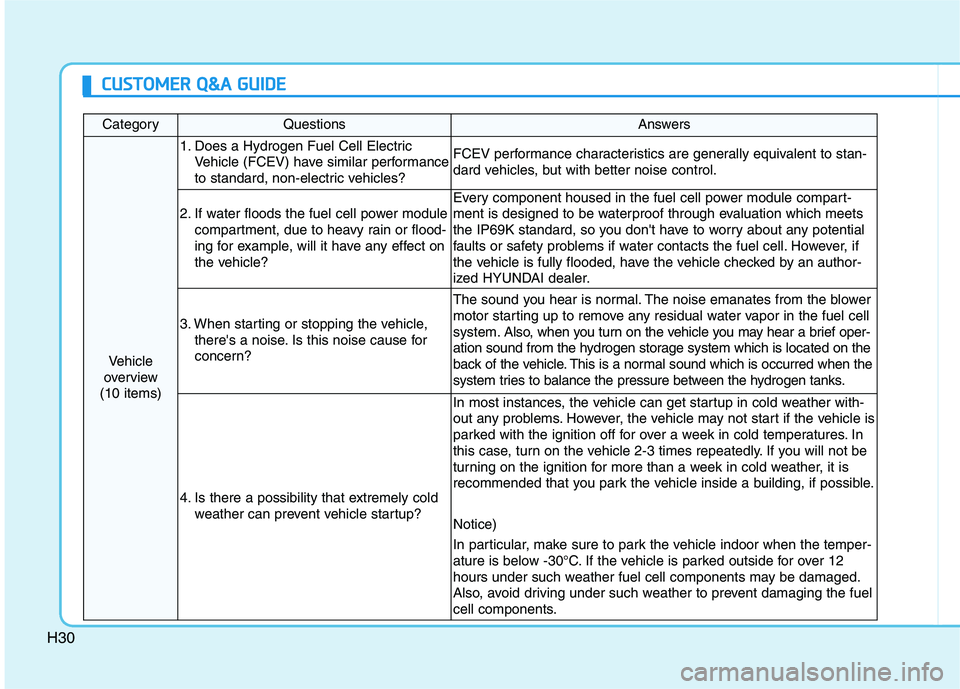
CCUU SSTT OO MM EERR QQ && AA GG UU IIDD EE
CategoryQuestionsAnswers
Vehicle
overview
(10 items)
1. Does a Hydrogen Fuel Cell Electric Vehicle (FCEV) have similar performance
to standard, non-electric vehicles?FCEV performance characteristics are generally equivalent to stan-
dard vehicles, but with better noise control.
2. If water floods the fuel cell power modulecompartment, due to heavy rain or flood-
ing for example, will it have any effect on
the vehicle?
Every component housed in the fuel cell power module compart-
ment is designed to be waterproof through evaluation which meets
the IP69K standard, so you don't have to worry about any potential
faults or safety problems if water contacts the fuel cell. However, if
the vehicle is fully flooded, have the vehicle checked by an author-
ized HYUNDAI dealer.
3. When starting or stopping the vehicle,there's a noise. Is this noise cause for
concern?
The sound you hear is normal. The noise emanates from the blower
motor starting up to remove any residual water vapor in the fuel cellsystem. Also, when you turn on the vehicle you may hear a brief oper-
ation sound from the hydrogen storage system which is located on the
back of the vehicle. This is a normal sound which is occurred when the
system tries to balance the pressure between the hydrogen tanks.
4. Is there a possibility that extremely cold weather can prevent vehicle startup?
In most instances, the vehicle can get startup in cold weather with-
out any problems. However, the vehicle may not start if the vehicle is
parked with the ignition off for over a week in cold temperatures. In
this case, turn on the vehicle 2-3 times repeatedly. If you will not be
turning on the ignition for more than a week in cold weather, it is
recommended that you park the vehicle inside a building, if possible. Notice)
In particular, make sure to park the vehicle indoor when the temper-
ature is below -30°C. If the vehicle is parked outside for over 12
hours under such weather fuel cell components may be damaged.
Also, avoid driving under such weather to prevent damaging the fuel
cell components.
H45
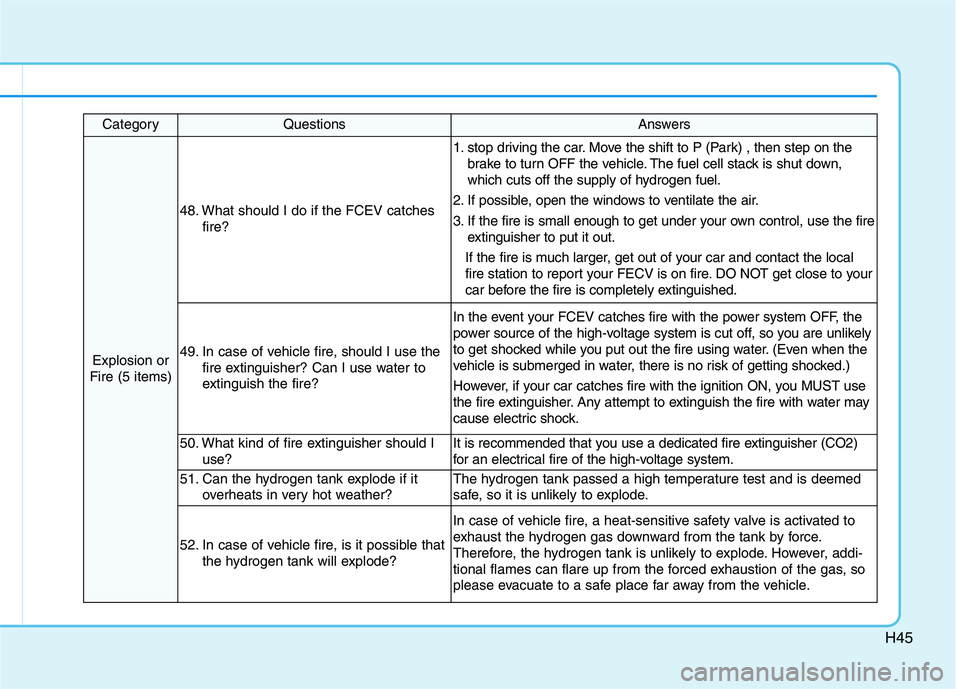
CategoryQuestionsAnswers
Explosion or
Fire (5 items)
48. What should I do if the FCEV catches fire?
1. stop driving the car. Move the shift to P (Park) , then step on thebrake to turn OFF the vehicle. The fuel cell stack is shut down,
which cuts off the supply of hydrogen fuel.
2. If possible, open the windows to ventilate the air.
3. If the fire is small enough to get under your own control, use the fire extinguisher to put it out.
If the fire is much larger, get out of your car and contact the local
fire station to report your FECV is on fire. DO NOT get close to your
car before the fire is completely extinguished.
49. In case of vehicle fire, should I use the fire extinguisher? Can I use water to
extinguish the fire?
In the event your FCEV catches fire with the power system OFF, the
power source of the high-voltage system is cut off, so you are unlikely
to get shocked while you put out the fire using water. (Even when the
vehicle is submerged in water, there is no risk of getting shocked.)
However, if your car catches fire with the ignition ON, you MUST use
the fire extinguisher. Any attempt to extinguish the fire with water may
cause electric shock.
50. What kind of fire extinguisher should Iuse?It is recommended that you use a dedicated fire extinguisher (CO2)
for an electrical fire of the high-voltage system.
51. Can the hydrogen tank explode if itoverheats in very hot weather?The hydrogen tank passed a high temperature test and is deemed
safe, so it is unlikely to explode.
52. In case of vehicle fire, is it possible that
the hydrogen tank will explode?
In case of vehicle fire, a heat-sensitive safety valve is activated to
exhaust the hydrogen gas downward from the tank by force.
Therefore, the hydrogen tank is unlikely to explode. However, addi-
tional flames can flare up from the forced exhaustion of the gas, so
please evacuate to a safe place far away from the vehicle.