Page 502 of 533
7-71
7
Maintenance
Rear combination lamp bulb
replacement
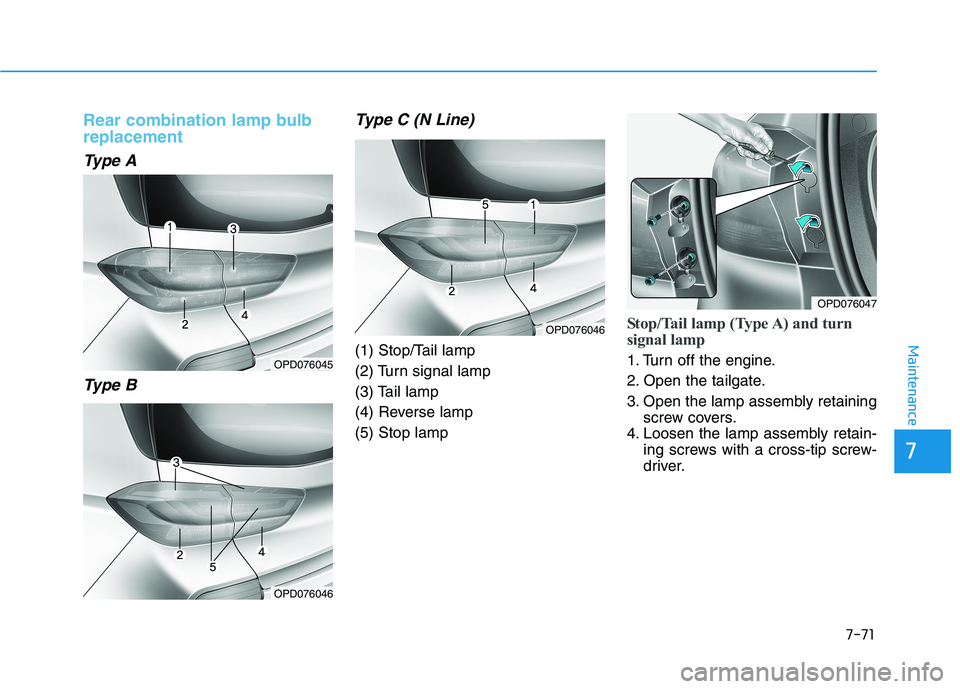
Type A
Type B Type C (N Line)
(1) Stop/Tail lamp
(2) Turn signal lamp
(3) Tail lamp
(4) Reverse lamp
(5) Stop lamp
Stop/Tail lamp (Type A) and turn
signal lamp
1. Turn off the engine.
2. Open the tailgate.
3. Open the lamp assembly retaining
screw covers.
4. Loosen the lamp assembly retain-
ing screws with a cross-tip screw-
driver.OPD076045
OPD076047
OPD076046
OPD076046
Page 504 of 533
7-73
7
Maintenance
Stop/Tail lamp (Type B, Type C)
If the LED lamp does not operate, we
recommend that you have the vehi-
cle checked by an authorized
HYUNDAI dealer.
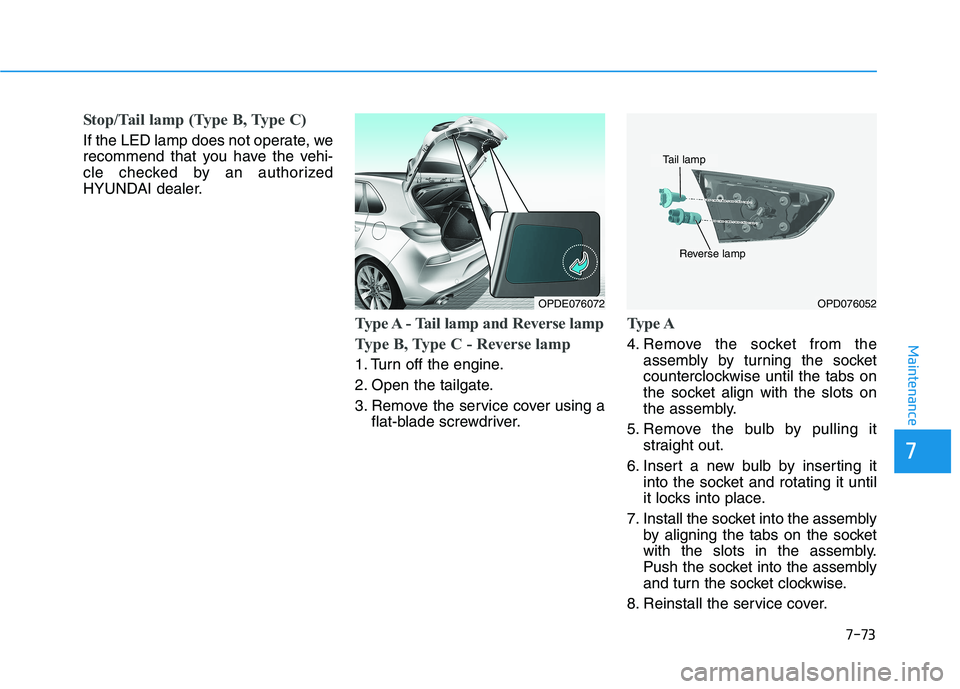
Type A - Tail lamp and Reverse lamp
Type B, Type C - Reverse lamp
1. Turn off the engine.
2. Open the tailgate.
3. Remove the service cover using a
flat-blade screwdriver.
Type A
4. Remove the socket from the
assembly by turning the socket
counterclockwise until the tabs on
the socket align with the slots on
the assembly.
5. Remove the bulb by pulling it
straight out.
6. Insert a new bulb by inserting it
into the socket and rotating it until
it locks into place.
7. Install the socket into the assembly
by aligning the tabs on the socket
with the slots in the assembly.
Push the socket into the assembly
and turn the socket clockwise.
8. Reinstall the service cover.
OPDE076072OPD076052
Reverse lamp
Tail lamp
Page 509 of 533

7-78
Maintenance
High-pressure washing
When using high-pressure washers,
make sure to maintain sufficient dis-
tance from the vehicle.
Insufficient clearance or excessive
pressure can lead to component
damage or water penetration.
Do not spray the camera, sensors or
its surrounding area directly with a
high pressure washer. Shock
applied from high pressure water
may cause the device to not operate
normally.
Do not bring the nozzle tip close to
boots (rubber or plastic covers) or
connectors as they may be dam-
aged if they come into contact with
high pressure water. Water washing in the engine com-
partment including high pressure
water washing may cause the fail-
ure of electrical circuits located in
the engine compartment.
Never allow water or other liquids
to come in contact with electri-
cal/electronic components inside
the vehicle as this may damage
them.Matte paint finish vehicle
Automatic car wash which uses
rotating brushes should not be
used as this can damage the sur-
face of your vehicle. A steam
cleaner which washes the vehicle
surface at high temperature may
result the oil to adhere and leave
stains that is difficult to remove.
Use a soft cloth (e.g. microfiber
towel or sponge) when washing
your vehicle and dry with a
microfiber towel. When you hand
wash your vehicle, you should not
use a cleaner that finishes with
wax. If the vehicle surface is too
dirty (sand, dirt, dust, contami-
nant, etc.), clean the surface with
water before washing the vehicle.
NOTICE
NOTICE
OLMB073082
Page 518 of 533

7-87
7
Maintenance
Canister
Fuel vapours generated inside the
fuel tank are absorbed and stored in
the onboard canister. When the
engine is running, the fuel vapours
absorbed in the canister are drawn
into the surge tank through the purge
control solenoid valve.
Purge Control Solenoid Valve
(PCSV)
The purge control solenoid valve is
controlled by the Engine Control
Module (ECM); when the engine
coolant temperature is low during
idling, the PCSV closes so that evap-
orated fuel is not taken into the
engine. After the engine warms-up
during ordinary driving, the PCSV
opens to introduce evaporated fuel to
the engine.
3. Exhaust emission control
system
The Exhaust Emission Control System
is a highly effective system which con-
trols exhaust emissions whilst main-
taining good vehicle performance.
Engine exhaust gas precautions
(carbon monoxide)
Carbon monoxide can be present
with other exhaust fumes. Therefore,
if you smell exhaust fumes of any
kind inside your vehicle, have it
inspected and repaired immediately.
If you ever suspect exhaust fumes
are coming into your vehicle, drive it
only with all the windows fully open.
Have your vehicle checked and
repaired immediately. Do not operate the engine in con-
fined or closed areas (such as
garages) any more than what is
necessary to move the vehicle in or
out of the area.
When the vehicle is stopped in an
open area for more than a short
time with the engine running,
adjust the ventilation system (as
needed) to draw outside air into the
vehicle.
Never sit in a parked or stopped
vehicle for any extended time with
the engine running.
When the engine stalls or fails to
start, excessive attempts to restart
the engine may cause damage to
the emission control system.
Engine exhaust gases contain
carbon monoxide (CO). Though
colourless and odourless, it is
dangerous and could be lethal if
inhaled. Follow the instructions
following to avoid CO poisoning.
WARNING
Page 519 of 533
7-88
Maintenance
Operating precautions for cat-
alytic converters (if equipped)Your vehicle is equipped with a cat-
alytic converter emission control
device.
Therefore, the following precautions
must be observed:
Use only UNLEADED FUEL for
petrol engines.
Do not operate the vehicle when
there are signs of engine malfunc-
tion, such as misfire or a noticeable
loss of performance.
Do not misuse or abuse the
engine. Examples of misuse are
coasting with the engine off and
descending steep grades in gear
with the engine off.
Do not operate the engine at high
idle speed for extended periods (5
minutes or more). Do not modify or tamper with any
part of the engine or emission con-
trol system. All inspections and
adjustments must be made by an
authorised HYUNDAI dealer.
Avoid driving with a very low fuel
level. If you run out of petrol, it
could cause the engine to misfire
and result in excessive loading of
the catalytic converter.
Failure to observe these precautions
could result in damage to the catalytic
converter and to your vehicle.
Additionally, such actions could void
your warranties.
A hot exhaust system can
ignite flammable items under
your vehicle. Do not park, idle,
or drive the vehicle over or
near flammable objects, such
as dry grass, paper, leaves, etc.
The exhaust system and cat-
alytic system are very hot
whilst the engine is running or
immediately after the engine is
turned off. Keep away from the
exhaust system and catalytic
converter as you may get
burned.
Also, do not remove the heat
sink around the exhaust sys-
tem, do not seal the bottom of
the vehicle and do not coat the
vehicle for corrosion control. It
may present a fire risk under
certain conditions.
WARNING
Page 520 of 533
7-89
7
Maintenance
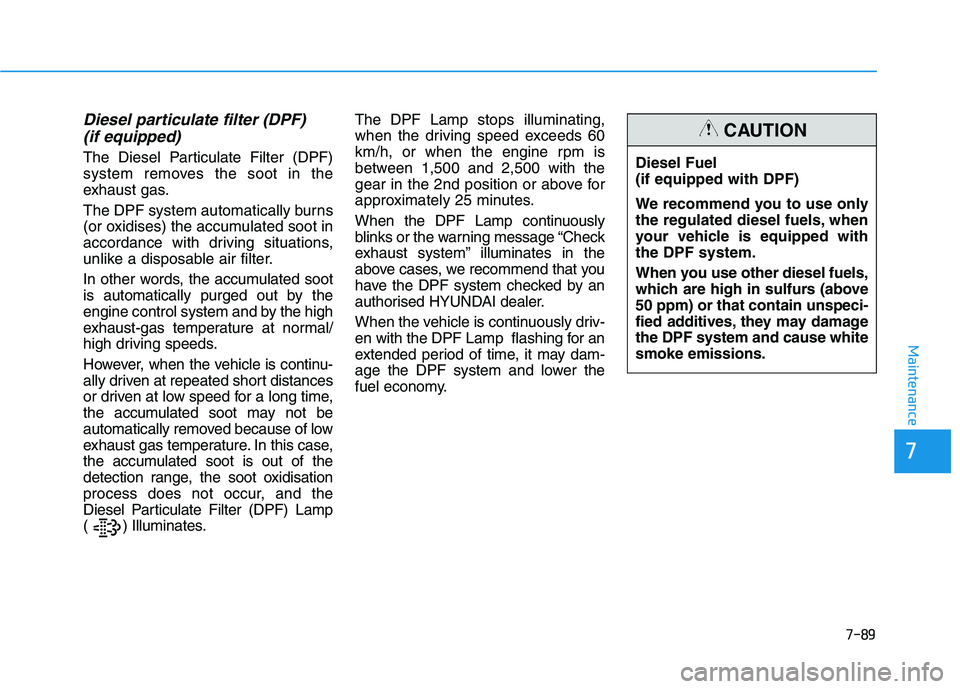
Diesel particulate filter (DPF)
(if equipped)
The Diesel Particulate Filter (DPF)
system removes the soot in the
exhaust gas.
The DPF system automatically burns
(or oxidises) the accumulated soot in
accordance with driving situations,
unlike a disposable air filter.
In other words, the accumulated soot
is automatically purged out by the
engine control system and by the high
exhaust-gas temperature at normal/
high driving speeds.
However, when the vehicle is continu-
ally driven at repeated short distances
or driven at low speed for a long time,
the accumulated soot may not be
automatically removed because of low
exhaust gas temperature. In this case,
the accumulated soot is out of the
detection range, the soot oxidisation
process does not occur, and the
Diesel Particulate Filter (DPF) Lamp
( ) Illuminates.The DPF Lamp stops illuminating,
when the driving speed exceeds 60
km/h, or when the engine rpm is
between 1,500 and 2,500 with the
gear in the 2nd position or above for
approximately 25 minutes.
When the DPF Lamp continuously
blinks or the warning message “Check
exhaust system” illuminates in the
above cases, we recommend that you
have the DPF system checked by an
authorised HYUNDAI dealer.
When the vehicle is continuously driv-
en with the DPF Lamp flashing for an
extended period of time, it may dam-
age the DPF system and lower the
fuel economy.Diesel Fuel
(if equipped with DPF)
We recommend you to use only
the regulated diesel fuels, when
your vehicle is equipped with
the DPF system.
When you use other diesel fuels,
which are high in sulfurs (above
50 ppm) or that contain unspeci-
fied additives, they may damage
the DPF system and cause white
smoke emissions.
CAUTION
Page 522 of 533
8
Specifications & Consumer information
8
Specifications & Consumer information
8
Dimensions ..............................................................8-2
Engine ......................................................................8-2
Bulb wattage ...........................................................8-3
Tyres and wheels ...................................................8-4
Air conditioning system ........................................8-6
Vehicle weight and luggage volume ....................8-6
Recommended lubricants and capacities ...........8-7
Recommended SAE viscosity number ..........................8-8
Vehicle identification number (VIN) ..................8-10
Vehicle certification label ...................................8-10
Tyre specification and pressure label ..............8-11
Engine number .....................................................8-11
Air conditioner compressor label ......................8-11
Fuel label ...............................................................8-12
Petrol engine ....................................................................8-12
Diesel engine ....................................................................8-12
Page 523 of 533
8-2
Specifications & Consumer information
D DI
IM
ME
EN
NS
SI
IO
ON
NS
S
E EN
NG
GI
IN
NE
E
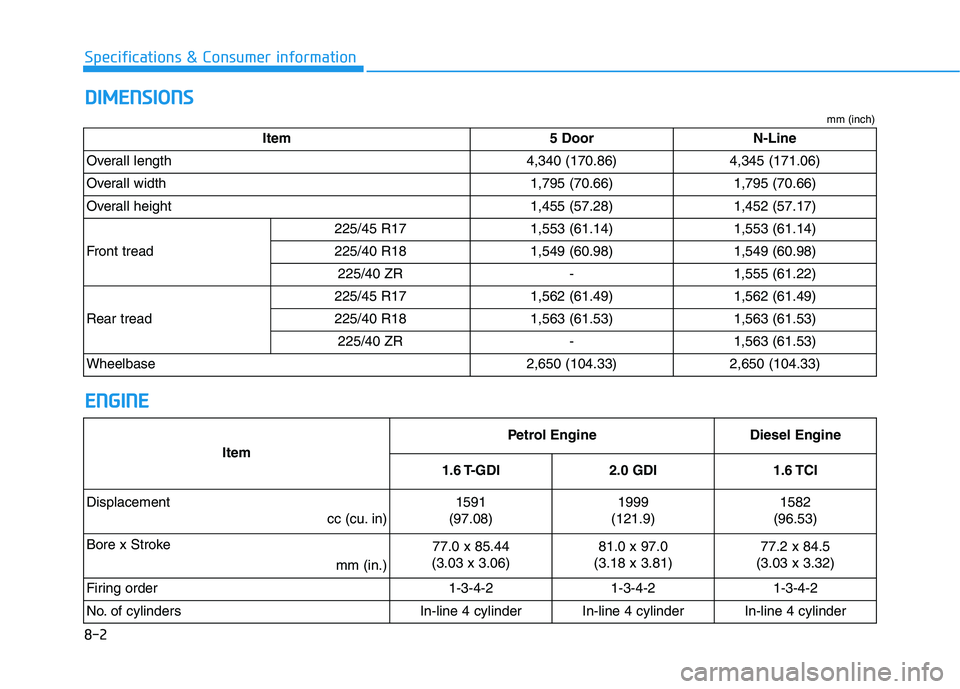
Item 5 Door N-Line
Overall length 4,340 (170.86) 4,345 (171.06)
Overall width 1,795 (70.66) 1,795 (70.66)
Overall height 1,455 (57.28) 1,452 (57.17)
Front tread225/45 R17 1,553 (61.14) 1,553 (61.14)
225/40 R18 1,549 (60.98) 1,549 (60.98)
225/40 ZR - 1,555 (61.22)
Rear tread225/45 R17 1,562 (61.49) 1,562 (61.49)
225/40 R18 1,563 (61.53) 1,563 (61.53)
225/40 ZR - 1,563 (61.53)
Wheelbase 2,650 (104.33) 2,650 (104.33)
Item
Petrol EngineDiesel Engine
1.6 T-GDI2.0 GDI1.6 TCI
Displacement
cc (cu. in)
1591
(97.08)1999
(121.9)1582
(96.53)
Bore x Stroke
mm (in.)
77.0 x 85.44
(3.03 x 3.06)81.0 x 97.0
(3.18 x 3.81)77.2 x 84.5
(3.03 x 3.32)
Firing order
1-3-4-21-3-4-21-3-4-2
No. of cylinders
In-line 4 cylinderIn-line 4 cylinderIn-line 4 cylinder
mm (inch)