2023 HYUNDAI I30 fuel additives
[x] Cancel search: fuel additivesPage 8 of 533
![HYUNDAI I30 2023 Owners Manual F8
Introduction
Petrol containing ethanol
Ethanol [E-10], a mixture of petrol
and ethanol (also known as grain
alcohol), is marketed along with or
instead of leaded or unleaded petrol.
Do not use petr](/manual-img/35/56144/w960_56144-7.png "HYUNDAI I30 2023 Owners Manual F8
Introduction
Petrol containing ethanol
Ethanol [E-10], a mixture of petrol
and ethanol (also known as grain
alcohol), is marketed along with or
instead of leaded or unleaded petrol.
Do not use petr")
F8
Introduction
Petrol containing ethanol
Ethanol [E-10], a mixture of petrol
and ethanol (also known as grain
alcohol), is marketed along with or
instead of leaded or unleaded petrol.
Do not use petrol containing more
than 10% ethanol, and do not use
petrol or ethanol containing any
methanol. Either of these fuels may
cause drivability problems and dam-
age to the fuel system, engine con-
trol system and emission control sys-
tem.
Discontinue using ethanol of any
kind if driveability problems occur.
Vehicle damage or driveability prob-
lems may not be covered by the
manufacturer’s warranty if they result
from the use of:
1. Petrol containing more than 10%
ethanol.
2. Petrol or ethanol containing
methanol.
3. Leaded fuel or leaded ethanol.Never use fuel which contains
methanol. Discontinue use of any
petrol product which impairs dri-
vability.
Other fuels
Using fuel additives such as:
- Silicone fuel additive
- MMT (Magnanese, Mn) fuel additive
- Ferrocene (iron-based) fuel additive
- Other metallic-based fuel additives
may result in cylinder misfire, poor
acceleration, engine stalling, dam-
age to the catalytic converter, or
abnormal corrosion, and may cause
damage to the engine resulting in a
reduction in the overall life of the
powertrain.
Damage to the fuel system or per-
formance problems caused by the
use of these fuels may not be cov-
ered by your New Vehicle Limited
Warranty.
NOTICE
NOTICE
Page 9 of 533
F9
Introduction
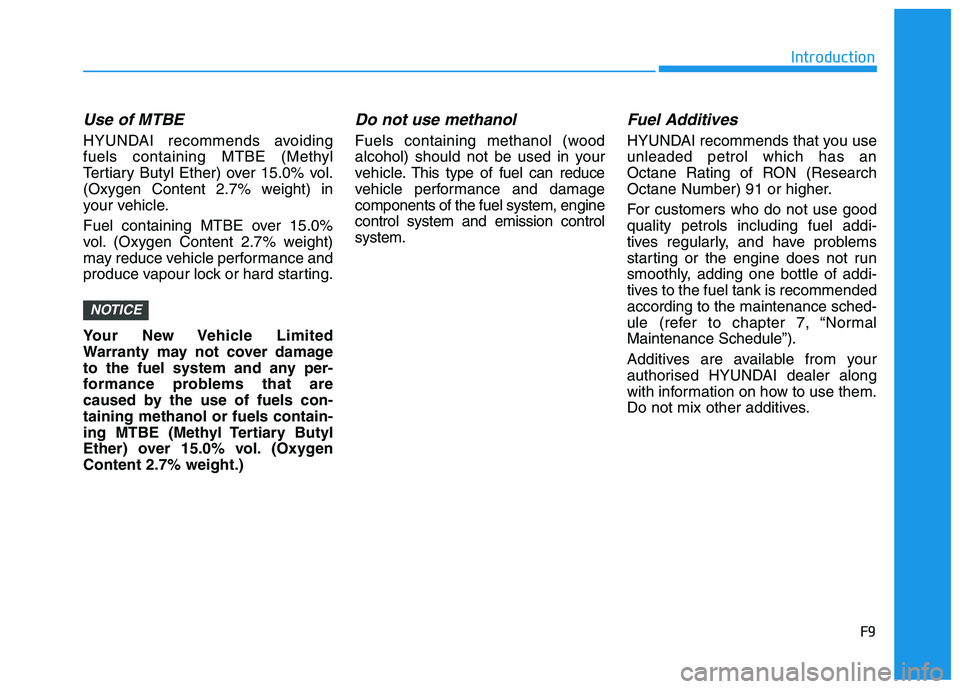
Use of MTBE
HYUNDAI recommends avoiding
fuels containing MTBE (Methyl
Tertiary Butyl Ether) over 15.0% vol.
(Oxygen Content 2.7% weight) in
your vehicle.
Fuel containing MTBE over 15.0%
vol. (Oxygen Content 2.7% weight)
may reduce vehicle performance and
produce vapour lock or hard starting.
Your New Vehicle Limited
Warranty may not cover damage
to the fuel system and any per-
formance problems that are
caused by the use of fuels con-
taining methanol or fuels contain-
ing MTBE (Methyl Tertiary Butyl
Ether) over 15.0% vol. (Oxygen
Content 2.7% weight.)
Do not use methanol
Fuels containing methanol (wood
alcohol) should not be used in your
vehicle.This type of fuel can reduce
vehicle performance and damage
components of the fuel system, engine
control system and emission control
system.
Fuel Additives
HYUNDAI recommends that you use
unleaded petrol which has an
Octane Rating of RON (Research
Octane Number) 91 or higher.
For customers who do not use good
quality petrols including fuel addi-
tives regularly, and have problems
starting or the engine does not run
smoothly, adding one bottle of addi-
tives to the fuel tank is recommended
according to the maintenance sched-
ule (refer to chapter 7, “Normal
Maintenance Schedule”).
Additives are available from your
authorised HYUNDAI dealer along
with information on how to use them.
Do not mix other additives.
NOTICE
Page 10 of 533

F10
Introduction
Diesel engine
Diesel fuel
Diesel engines must be operated
only on commercially available diesel
fuel that complies with EN 590 or
comparable standard. (EN stands for
"European Norm"). Do not use
marine diesel fuel, heating oils, or
non-approved fuel additives, as this
will increase wear and cause dam-
age to the engine and fuel system.
The new vehicle warranty may be
invalidated if non-approved fuels
and/or fuel additives are used.
Diesel fuel of above cetane 51
should be used in your vehicle. If two
types of diesel fuel are available, use
summer or winter fuel properly
according to the following tempera-
ture conditions.
Above -5°C (23°F) ... Summer type
diesel fuel.
Below -5°C (23°F) ... Winter type
diesel fuel.
Watch the fuel level in the tank very
carefully : If the engine stops through
fuel failure, the circuits must be com-
pletely purged to permit restarting.Do not let any petrol or water enter
the tank. This would make it nec-
essary to drain it out and to bleed
the lines to avoid jamming the
injection pump and damaging the
engine.
It is recommended to use the reg-
ulated automotive diesel fuel for
diesel vehicle equipped with the
DPF system.
If you use diesel fuel including
high sulfur (more than 50 ppm sul-
fur) and unspecified additives, it
can cause the DPF system to be
damaged and white smoke can be
emitted.
Biodiesel
Commercially supplied Diesel blends
of no more than 7% biodiesel, com-
monly known as "B7 Diesel" may be
used in your vehicle if Biodiesel meets
EN 14214 or equivalent specifications.
(EN stands for "European Norm"). The
use of biofuels exceeding 7% made
from rapeseed methyl ester (RME),
fatty acid methyl ester (FAME), veg-
etable oil methyl ester (VME) etc. or
mixing diesel exceeding 7% with
biodiesel will cause increased wear or
damage to the engine and fuel sys-
tem. Repair or replacement of worn or
damaged components due to the use
of non approved fuels will not be cov-
ered by the manufacturer's warranty.
Never use any fuel, whether
diesel, B7 biodiesel or other-
wise, that fails to meet the latest
petroleum industry specifica-
tion.
Never use any fuel additives or
treatments that are not recom-
mended or approved by the
vehicle manufacturer.
NOTICE
NOTICE
NOTICE
Page 11 of 533
Biodiesel (for New Zealand)
Commercially supplied Diesel blends
of no more than 7% biodiesel, com-
monly known as "B7 Diesel" may be
used in your vehicle if the Biodiesel
meets EN 14214 or equivalent spec-
ifications. (EN stands for "European
Norm"). The use of biofuels exceed-
ing 7%, made from rapeseed methyl
ester (RME), vegetable oil methyl
ester (VME) etc. or mixing diesel
exceeding 7% with biodiesel will
cause increased wear or damage to
the engine and fuel system. Repair
or replacement of worn or damaged
components due to the use of non
approved fuels will not be covered by
the manufacturer's warranty. Never use any fuel, whether
diesel, B7 biodiesel or other-
wise, that fails to meet the latest
petroleum industry specifica-
tion.
Never use any fuel additives or
treatments that are not recom-
mended or approved by the
vehicle manufacturer. This vehicle should not be modi-
fied. Modification of your vehicle
could affect its performance, safety
or durability and may even violate
governmental safety and emis-
sions regulations.
In addition, damage or perform-
ance problems resulting from any
modification may not be covered
under warranty.
If you use unauthorised electronic
devices, it may cause the vehicle to
operate abnormally, wire damage,
battery discharge and fire. For your
safety, do not use unauthorised
electronic devices.
NOTICE
F11
Introduction
V VE
EH
HI
IC
CL
LE
E
M
MO
OD
DI
IF
FI
IC
CA
AT
TI
IO
ON
NS
S
Page 441 of 533
![HYUNDAI I30 2023 Owners Manual Maintenance
7-10
Normal Maintenance Schedule (Petrol Engine [1.6 T-GDI])
Months1224364860728496
Km x 1,0001020304050607080
Drive belts *1IIII
Engine oil and engine oil filter *2 *3RRRRRRRR
Intercoole](/manual-img/35/56144/w960_56144-440.png "HYUNDAI I30 2023 Owners Manual Maintenance
7-10
Normal Maintenance Schedule (Petrol Engine [1.6 T-GDI])
Months1224364860728496
Km x 1,0001020304050607080
Drive belts *1IIII
Engine oil and engine oil filter *2 *3RRRRRRRR
Intercoole")
Maintenance
7-10
Normal Maintenance Schedule (Petrol Engine [1.6 T-GDI])
Months1224364860728496
Km x 1,0001020304050607080
Drive belts *1IIII
Engine oil and engine oil filter *2 *3RRRRRRRR
Intercooler, in/out hose, air intake hoseIIIIIIII
Fuel additives *4Add every 10,000 km or 12 months
Air cleaner filterIIIRIIIR
Spark plugs *5Replace every 70,000 km or 84 months
Vapour hose and fuel filler capI
Fuel tank air filterI
I : Inspect and if necessary, adjust, correct, clean or replace.
R : Replace or change.
*
1: Inspect drive belt tensioner, idler and alternator pulley and if necessary correct or replace.
*2: Check the engine oil level for leaks every 500 km or before starting a long trip.
*3: The engine oil level should be checked regularly and maintained properly. Operating with an insufficient amount of oil can dam-
age the engine, and such damage is not covered by warranty.
*
4: If good quality petrols meet Europe Fuel standards (EN228) or equivalents including fuel additives is not available, one bottle
of additive is recommended. Additives are available from your authorised HYUNDAI dealer along with information on how to
use them. Do not mix other additives.
*
5: For your convenience, it can be replaced prior to it's interval when you do maintenance of other items.
MAINTENANCE
INTERVALS
MAINTENANCE
ITEM
Page 446 of 533
![HYUNDAI I30 2023 Owners Manual 7-15
7
Maintenance
Normal Maintenance Schedule (Petrol Engine [2.0 GDI])
Months1224364860728496
Km x 1,000153045607590105120
Drive belts *1IIII
Engine oil and engine oil filter *2 *3RRRRRRRR
Fuel add](/manual-img/35/56144/w960_56144-445.png "HYUNDAI I30 2023 Owners Manual 7-15
7
Maintenance
Normal Maintenance Schedule (Petrol Engine [2.0 GDI])
Months1224364860728496
Km x 1,000153045607590105120
Drive belts *1IIII
Engine oil and engine oil filter *2 *3RRRRRRRR
Fuel add")
7-15
7
Maintenance
Normal Maintenance Schedule (Petrol Engine [2.0 GDI])
Months1224364860728496
Km x 1,000153045607590105120
Drive belts *1IIII
Engine oil and engine oil filter *2 *3RRRRRRRR
Fuel additives *4Add every 15,000 km or 12 months
Air cleaner filterIIRIIRII
Spark plugs *5Replace every 150,000 km or 120 months
Vapour hose and fuel filler capII
Fuel tank air filterII
I : Inspect and if necessary, adjust, correct, clean or replace.
R : Replace or change.
*
1: Inspect drive belt tensioner, idler and alternator pulley and if necessary correct or replace.
*2: Check the engine oil level for leaks every 500 km or before starting a long trip.
*3: The engine oil level should be checked regularly and maintained properly. Operating with an insufficient amount of oil can dam-
age the engine, and such damage is not covered by warranty.
*
4: If good quality petrols meet Europe Fuel standards (EN228) or equivalents including fuel additives is not available, one bottle
of additive is recommended. Additives are available from your authorised HYUNDAI dealer along with information on how to
use them. Do not mix other additives.
*
5: For your convenience, it can be replaced prior to it's interval when you do maintenance of other items.
MAINTENANCE
INTERVALS
MAINTENANCE
ITEM
Page 520 of 533
7-89
7
Maintenance
Diesel particulate filter (DPF)
(if equipped)
The Diesel Particulate Filter (DPF)
system removes the soot in the
exhaust gas.
The DPF system automatically burns
(or oxidises) the accumulated soot in
accordance with driving situations,
unlike a disposable air filter.
In other words, the accumulated soot
is automatically purged out by the
engine control system and by the high
exhaust-gas temperature at normal/
high driving speeds.
However, when the vehicle is continu-
ally driven at repeated short distances
or driven at low speed for a long time,
the accumulated soot may not be
automatically removed because of low
exhaust gas temperature. In this case,
the accumulated soot is out of the
detection range, the soot oxidisation
process does not occur, and the
Diesel Particulate Filter (DPF) Lamp
( ) Illuminates.The DPF Lamp stops illuminating,
when the driving speed exceeds 60
km/h, or when the engine rpm is
between 1,500 and 2,500 with the
gear in the 2nd position or above for
approximately 25 minutes.
When the DPF Lamp continuously
blinks or the warning message “Check
exhaust system” illuminates in the
above cases, we recommend that you
have the DPF system checked by an
authorised HYUNDAI dealer.
When the vehicle is continuously driv-
en with the DPF Lamp flashing for an
extended period of time, it may dam-
age the DPF system and lower the
fuel economy.Diesel Fuel
(if equipped with DPF)
We recommend you to use only
the regulated diesel fuels, when
your vehicle is equipped with
the DPF system.
When you use other diesel fuels,
which are high in sulfurs (above
50 ppm) or that contain unspeci-
fied additives, they may damage
the DPF system and cause white
smoke emissions.
CAUTION