2023 HYUNDAI I30 floor
[x] Cancel search: floorPage 28 of 533
2-7
Safety system of your vehicle
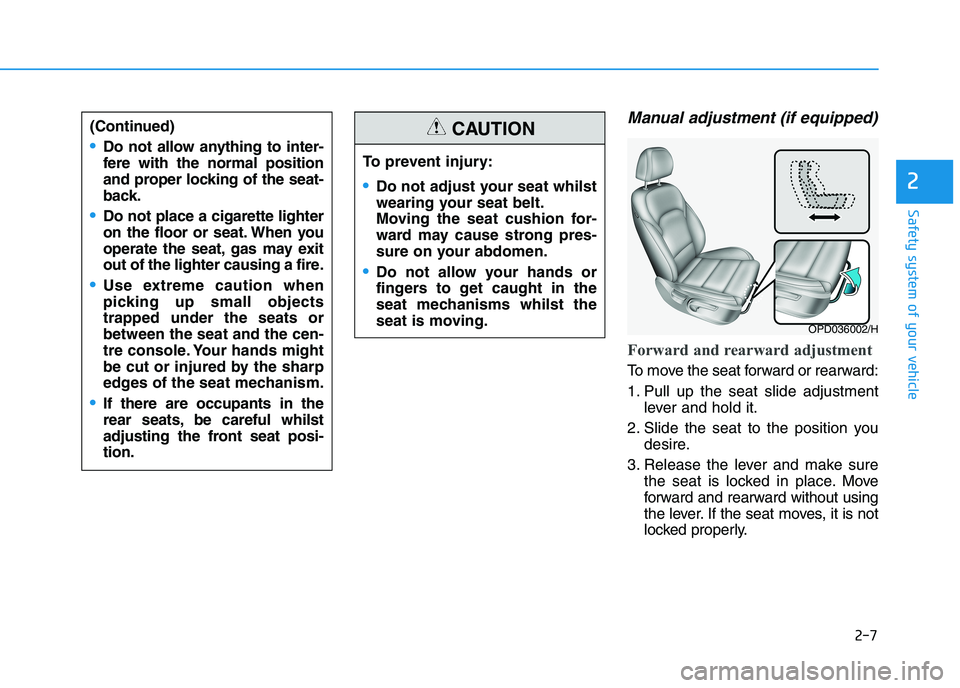
Manual adjustment (if equipped)
Forward and rearward adjustment
To move the seat forward or rearward:
1. Pull up the seat slide adjustment
lever and hold it.
2. Slide the seat to the position you
desire.
3. Release the lever and make sure
the seat is locked in place. Move
forward and rearward without using
the lever. If the seat moves, it is not
locked properly.
2
To prevent injury:
Do not adjust your seat whilst
wearing your seat belt.
Moving the seat cushion for-
ward may cause strong pres-
sure on your abdomen.
Do not allow your hands or
fingers to get caught in the
seat mechanisms whilst the
seat is moving.
CAUTION(Continued)
Do not allow anything to inter-
fere with the normal position
and proper locking of the seat-
back.
Do not place a cigarette lighter
on the floor or seat. When you
operate the seat, gas may exit
out of the lighter causing a fire.
Use extreme caution when
picking up small objects
trapped under the seats or
between the seat and the cen-
tre console. Your hands might
be cut or injured by the sharp
edges of the seat mechanism.
If there are occupants in the
rear seats, be careful whilst
adjusting the front seat posi-
tion.
OPD036002/H
Page 67 of 533
2-46
Safety system of your vehicle
The vehicles are equipped with a
Supplemental Air Bag System for the
driver’s seat and front passenger’s
seats.
The front air bags are designed to
supplement the three-point seat
belts. For these air bags to provide
protection, the seat belts must be
worn at all times when driving.
You can be severely injured or killed
in an accident if you are not wearing
a seat belt. Air bags are designed to
supplement seat belts, but do not
replace them. Also, air bags are not
designed to deploy in every collision.
In some accidents, the seat belts are
the only restraint protecting you.AIR BAG SAFETY PRECAUTIONS
ALWAYS use seat belts Child Restraint Systems - every trip, every
time, everyone! Even with air bags, you can be seriously injured or
killed in a collision if you are improperly restrained or not wearing
your seat.
NEVER place a child in any Child Restraint System or booster seat in
the front passenger seat.
An inflating air bag could forcefully strike the infant or child causing
serious or fatal injuries.
ABC - Always Buckle Children under age 13 in the back seat. It is the
safest place for children of any age to ride. If a child age 13 or older
must be seated in the front seat, he or she must be properly belted
and the seat should be moved as far back as possible.
All occupants should sit upright with the seatback in an upright posi-
tion, centred on the seat cushion with their seat belt on, legs com-
fortably extended and their feet on the floor until the vehicle is parked
and the engine is turned off. If an occupant is out of position during
an accident, the rapidly deploying air bag may forcefully contact the
occupant causing serious or fatal injuries.
You and your passengers should never sit or lean unnecessarily
close to the air bags or lean against the door or centre console.
Move your seat as far back as possible from front air bags, whilst still
maintaining control of the vehicle.
WARNING
Page 85 of 533
Wipers and washers ............................................3-92
Windscreen wipers..........................................................3-92
Windscreen washers ......................................................3-94
Rear window wiper and washer switch.....................3-95
Driver Assist System ...........................................3-96
Rear view monitor...........................................................3-96
Parking distance warning (reverse) system .............3-97
Parking distance warning (forward/reverse)
system..............................................................................3-100
Defroster .............................................................3-104
Rear window defroster ...............................................3-104
Manual climate control system........................3-105
Heating and air conditioning......................................3-106
System operation ..........................................................3-110
System maintenance ....................................................3-112
Automatic climate control system ...................3-114
Automatic heating and air conditioning ..................3-115
Manual heating and air conditioning .......................3-116
System operation ..........................................................3-122
System maintenance ....................................................3-124
Windscreen defrosting and defogging ...........3-126
Manual climate control system .................................3-126
Automatic climate control system ............................3-127
Defogging logic..............................................................3-128
Auto defogging system
(only for automatic climate control system) .........3-129
Climate control additional features.................3-130
Cluster ionizer ................................................................3-130
Automatic ventilation ...................................................3-130
Sunroof inside air recirculation.................................3-130
Storage compartment ........................................3-131
Centre console storage ...............................................3-131
Glove box ........................................................................3-131
Sunglasses holder .........................................................3-132
Multi box .........................................................................3-132
Interior features.................................................3-133
Ashtray ............................................................................3-133
Cup holder.......................................................................3-133
Sliding armrest ...............................................................3-134
Sunvisor ...........................................................................3-135
Power outlet ...................................................................3-135
Cigarette lighter ............................................................3-137
Wireless mobile phone charging system ................3-137
Clock .................................................................................3-139
Clothes hanger ..............................................................3-139
Floor mat anchor(s)......................................................3-140
Luggage net....................................................................3-141
Luggage compartment cover .....................................3-142
3
Page 189 of 533
3-106
Convenient features of your vehicle
Heating and air conditioning
1. Start the engine.
2. Set the mode to the desired posi-
tion.
To improve the effectiveness of
heating and cooling, select:
- Heating:
- Cooling:
3. Set the temperature control to the
desired position.
4. Set the air intake control to the
outside (fresh) air position.
5. Set the blower speed control to the
desired speed.
6. If air conditioning is desired, turn
the air conditioning system on.
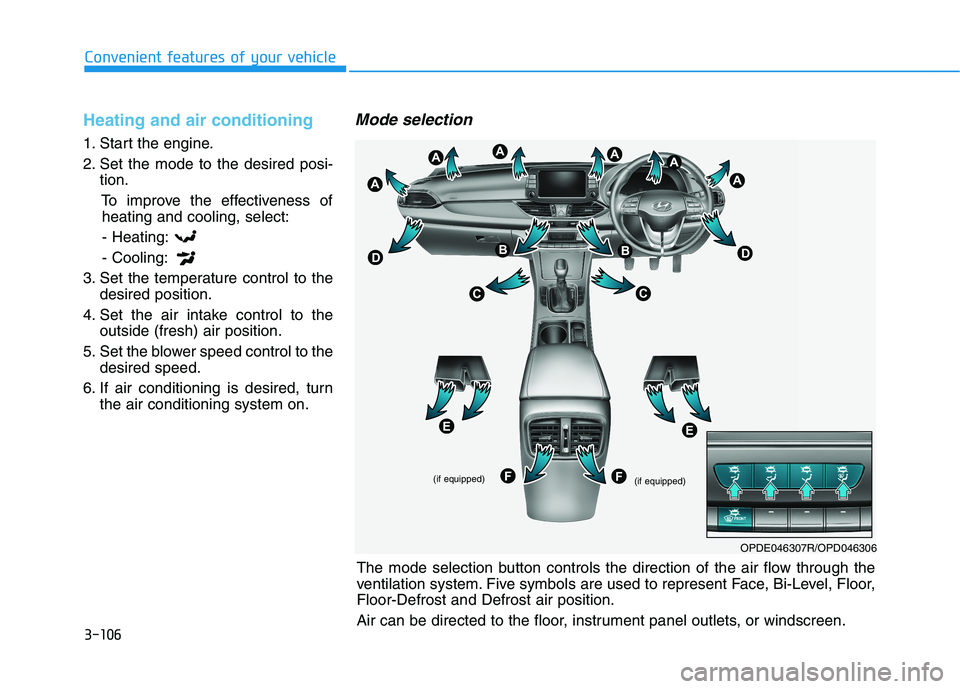
Mode selection
(if equipped) (if equipped)
OPDE046307R/OPD046306
The mode selection button controls the direction of the air flow through the
ventilation system. Five symbols are used to represent Face, Bi-Level, Floor,
Floor-Defrost and Defrost air position.
Air can be directed to the floor, instrument panel outlets, or windscreen.
Page 190 of 533
3-107
Convenient features of your vehicle
3
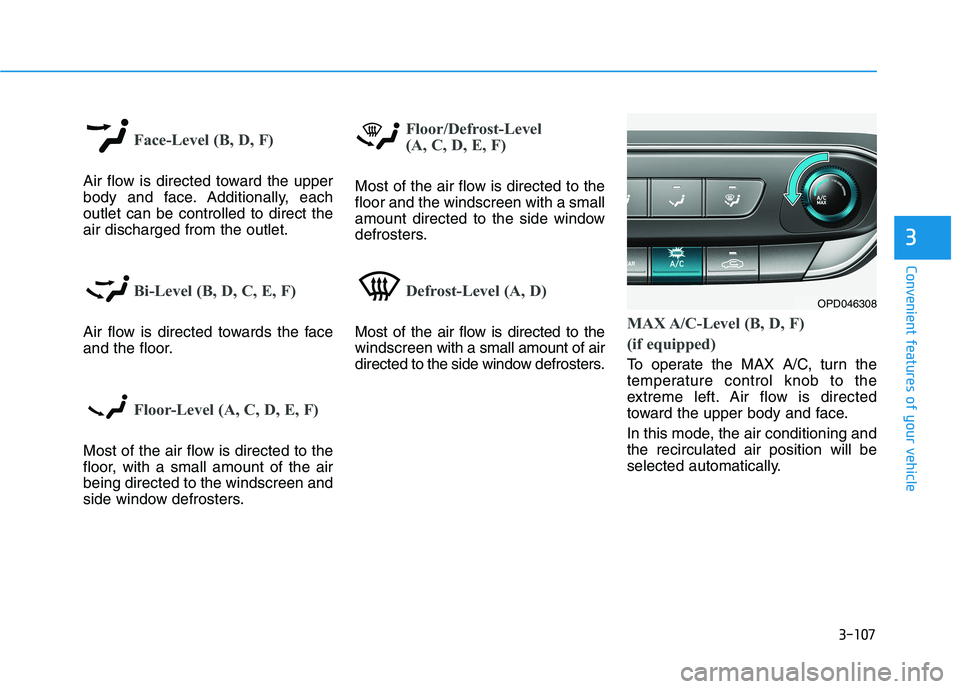
Face-Level (B, D, F)
Air flow is directed toward the upper
body and face. Additionally, each
outlet can be controlled to direct the
air discharged from the outlet.
Bi-Level (B, D, C, E, F)
Air flow is directed towards the face
and the floor.
Floor-Level (A, C, D, E, F)
Most of the air flow is directed to the
floor, with a small amount of the air
being directed to the windscreen and
side window defrosters.
Floor/Defrost-Level
(A, C, D, E, F)
Most of the air flow is directed to the
floor and the windscreen with a small
amount directed to the side window
defrosters.
Defrost-Level (A, D)
Most of the air flow is directed to the
windscreenwith a small amount of air
directed to the side window defrosters.MAX A/C-Level (B, D, F)
(if equipped)
To operate the MAX A/C, turn the
temperature control knob to the
extreme left. Air flow is directed
toward the upper body and face.
In this mode, the air conditioning and
the recirculated air position will be
selected automatically.
OPD046308
Page 200 of 533
3-117
Convenient features of your vehicle
3
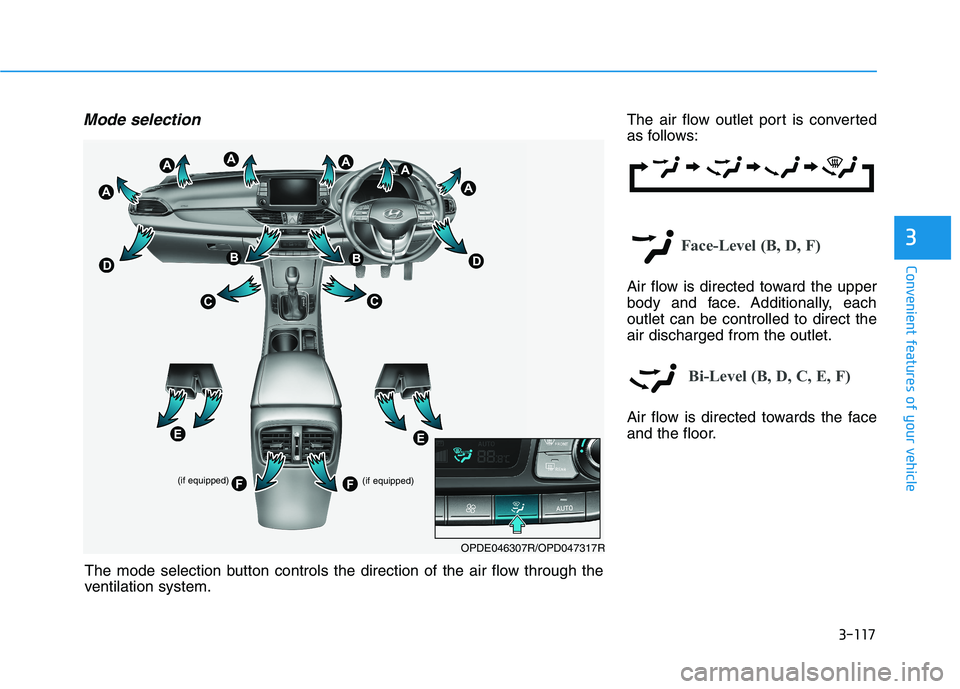
Mode selectionThe air flow outlet port is converted
as follows:
Face-Level (B, D, F)
Air flow is directed toward the upper
body and face. Additionally, each
outlet can be controlled to direct the
air discharged from the outlet.
Bi-Level (B, D, C, E, F)
Air flow is directed towards the face
and the floor.
(if equipped) (if equipped)
OPDE046307R/OPD047317R
The mode selection button controls the direction of the air flow through the
ventilation system.
Page 201 of 533
3-118
Convenient features of your vehicle
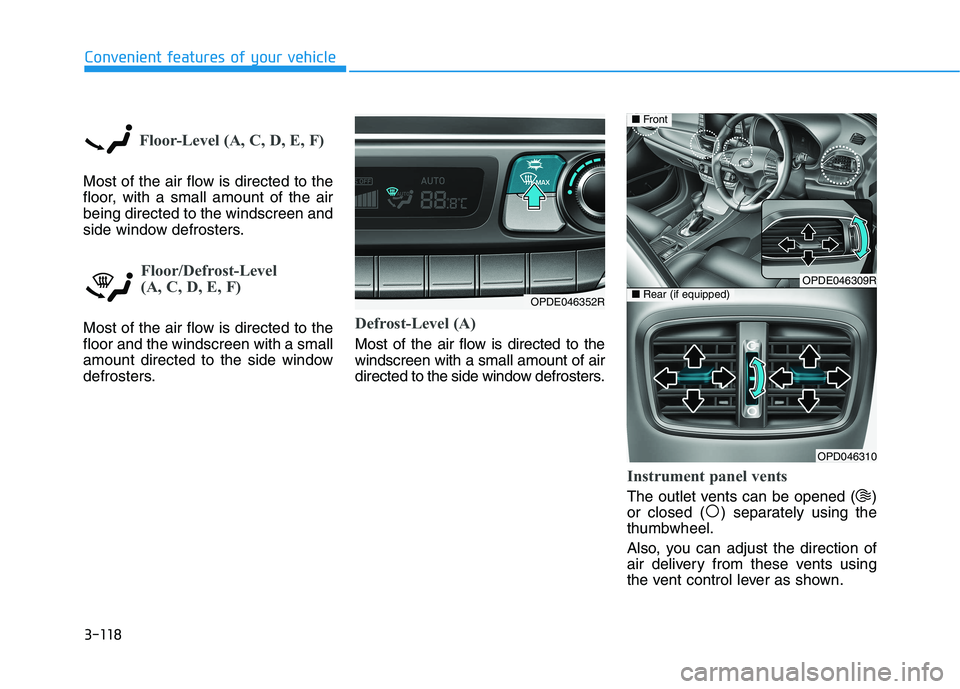
Floor-Level (A, C, D, E, F)
Most of the air flow is directed to the
floor, with a small amount of the air
being directed to the windscreen and
side window defrosters.
Floor/Defrost-Level
(A, C, D, E, F)
Most of the air flow is directed to the
floor and the windscreen with a small
amount directed to the side window
defrosters.Defrost-Level (A)
Most of the air flow is directed to the
windscreen with a small amount of air
directed to the side window defrosters.
Instrument panel vents
The outlet vents can be opened ( )
or closed ( ) separately using the
thumbwheel.
Also, you can adjust the direction of
air delivery from these vents using
the vent control lever as shown.
OPDE046352R
OPDE046309R
OPD046310
■Front
■Rear (if equipped)
Page 209 of 533
3-126
Convenient features of your vehicle
For maximum windscreen defrost-
ing, set the temperature control
knob to the highest temperature
setting and the blower speed con-
trol knob to the highest blower
speed. Select the front defrost but-
ton on the climate control display.
After the engine warm-up period,
warm air will be directed to the
front windscreen.
If warm air to the floor is desired
whilst defrosting or defogging, set the
mode to the floor-defrost position.
Before driving, clear all snow and
ice from the windscreen, rear win-
dow, outside rear view mirrors, and
all side windows.
Clear all snow and ice from the bon-
net and air inlet in the cowl grill to
improve heater and defroster effi-
ciency and to reduce the probability
of fogging up inside of the wind-
screen.
Information
If the engine temperature is still cold
after starting, then a brief engine
warm up period may be required for
the vented air flow to become warm or
hot.
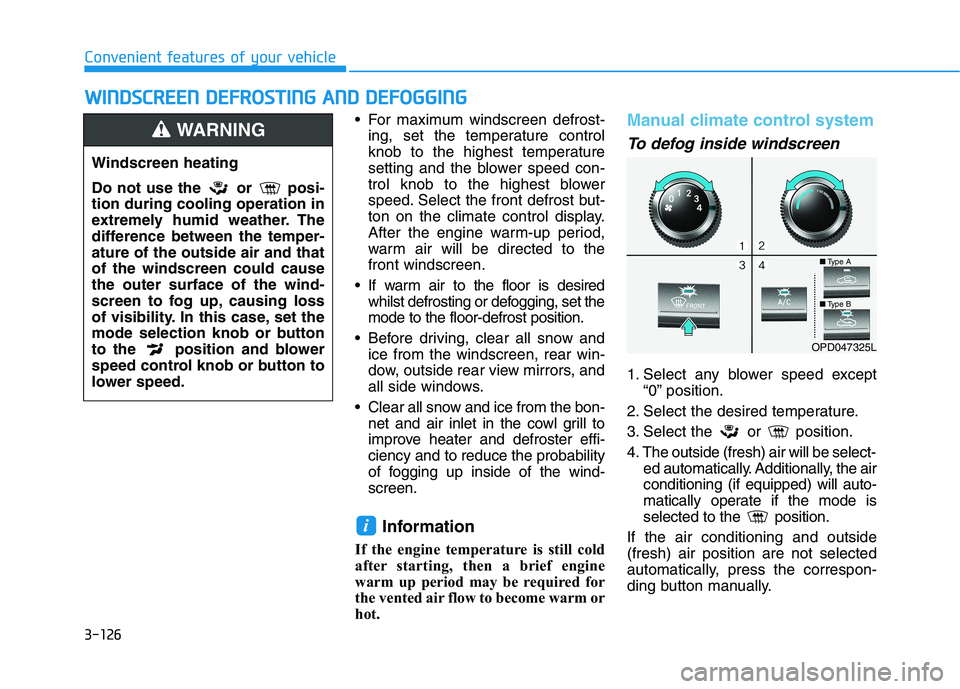
Manual climate control system
To defog inside windscreen
1. Select any blower speed except
“0” position.
2. Select the desired temperature.
3. Select the or position.
4. The outside (fresh) air will be select-
ed automatically. Additionally, the air
conditioning (if equipped) will auto-
matically operate if the mode is
selected to the position.
If the air conditioning and outside
(fresh) air position are not selected
automatically, press the correspon-
ding button manually.
i
W WI
IN
ND
DS
SC
CR
RE
EE
EN
N
D
DE
EF
FR
RO
OS
ST
TI
IN
NG
G
A
AN
ND
D
D
DE
EF
FO
OG
GG
GI
IN
NG
G
Windscreen heating
Do not use the or posi-
tion during cooling operation in
extremely humid weather. The
difference between the temper-
ature of the outside air and that
of the windscreen could cause
the outer surface of the wind-
screen to fog up, causing loss
of visibility. In this case, set the
mode selection knob or button
to the position and blower
speed control knob or button to
lower speed.
WARNING
OPD047325L
■Type A
■Type B