2023 FORD SUPER DUTY warning
[x] Cancel search: warningPage 213 of 738
ACCESSING THE PASSIVE KEY
BACKUP POSITION
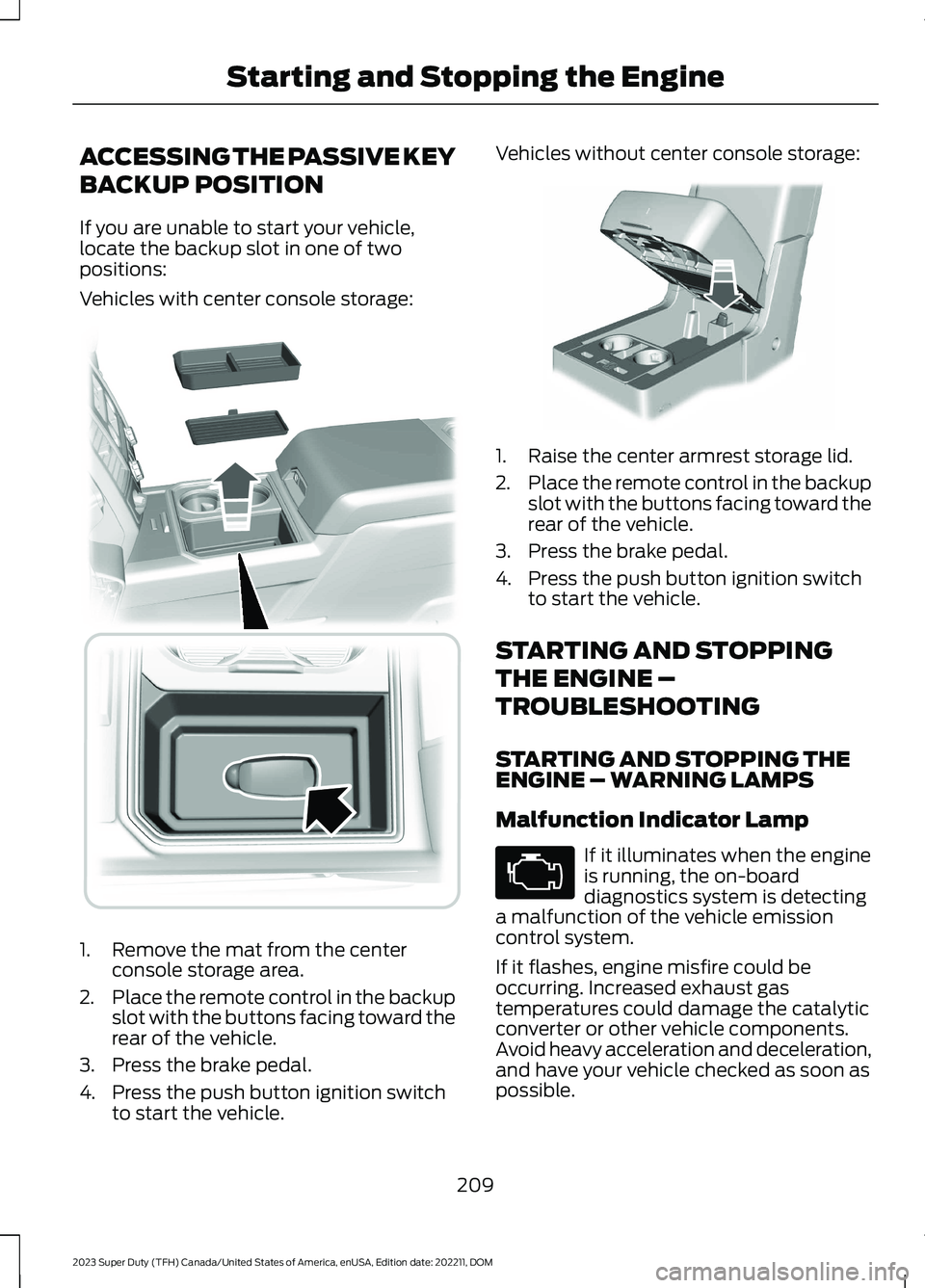
If you are unable to start your vehicle,locate the backup slot in one of twopositions:
Vehicles with center console storage:
1.Remove the mat from the centerconsole storage area.
2.Place the remote control in the backupslot with the buttons facing toward therear of the vehicle.
3.Press the brake pedal.
4.Press the push button ignition switchto start the vehicle.
Vehicles without center console storage:
1.Raise the center armrest storage lid.
2.Place the remote control in the backupslot with the buttons facing toward therear of the vehicle.
3.Press the brake pedal.
4.Press the push button ignition switchto start the vehicle.
STARTING AND STOPPING
THE ENGINE –
TROUBLESHOOTING
STARTING AND STOPPING THEENGINE – WARNING LAMPS
Malfunction Indicator Lamp
If it illuminates when the engineis running, the on-boarddiagnostics system is detectinga malfunction of the vehicle emissioncontrol system.
If it flashes, engine misfire could beoccurring. Increased exhaust gastemperatures could damage the catalyticconverter or other vehicle components.Avoid heavy acceleration and deceleration,and have your vehicle checked as soon aspossible.
209
2023 Super Duty (TFH) Canada/United States of America, enUSA, Edition date: 202211, DOMStarting and Stopping the Engine E226701 E269950 E67028
Page 214 of 738
Powertrain Warning Lamp
If it illuminates when the engineis running, this indicates apowertrain or four-wheel drivefault. If it flashes when you are driving,immediately reduce the vehicle speed.Avoid heavy acceleration and deceleration,and have your vehicle checked as soon as
possible.
If both lamps illuminate when the engineis running, stop your vehicle as soon as itis safe to do so. Continuing to drive yourvehicle could cause reduced power or theengine to stop. Switch the ignition off andattempt to restart the engine. Have yourvehicle checked as soon as possible.
STARTING AND STOPPING THE ENGINE – INFORMATION MESSAGES
ActionMessage
Displays if you exceed the starting time limit. You cannotattempt to start the engine for 15 minutes. If you cannot startthe engine after 15 minutes passes, have your vehicle imme-diately checked.
Cranking Time Exceeded
Displays if you are unable to start your vehicle with a correctlycoded key. The system has detected a fault that requiresservice. Have your vehicle checked as soon as possible.
Starting System Fault
Displays if the system does not detect a valid passive key.No Key Detected
210
2023 Super Duty (TFH) Canada/United States of America, enUSA, Edition date: 202211, DOMStarting and Stopping the Engine
Page 218 of 738
FUEL AND REFUELING
PRECAUTIONS
WARNING: Fuels can cause seriousinjury or death if misused or mishandled.
WARNING: Fuel may containbenzene, which is a cancer-causingagent.
Follow these guidelines when refueling:
•Extinguish all smoking materials andany open flames before refueling yourvehicle.
•Switch the engine off before refueling.
•Automotive fuels can be harmful orfatal if swallowed. Fuel is highly toxicand if swallowed can cause death orpermanent injury. If fuel is swallowedimmediately call a physician, even if nosymptoms are immediately apparent.The toxic effects of fuel may not beapparent for hours.
•Avoid inhaling fuel vapors. Inhaling fuelvapor can lead to eye and respiratorytract irritation. In severe cases,excessive or prolonged breathing offuel vapor can cause serious illness andpermanent injury.
•Avoid getting fuel in your eyes. If yousplash fuel in your eyes, immediatelyremove contact lenses, if worn, flushwith water for 15 minutes and seekmedical attention. Failure to seekproper medical attention could lead topermanent injury.
•Fuels can be harmful if absorbedthrough the skin. If you splash fuel onyour skin, clothing or both, promptlyremove contaminated clothing andthoroughly wash your skin with soapand water. Repeated or prolonged skincontact causes skin irritation.
•Be particularly careful if you are takingAntabuse or other forms of Disulfiramfor the treatment of alcoholism.Breathing fuel vapors could cause anadverse reaction, serious personalinjury or sickness. Immediately call aphysician if you experience any adversereactions.
FUEL QUALITY
SELECTING THE CORRECT FUEL -GASOLINE
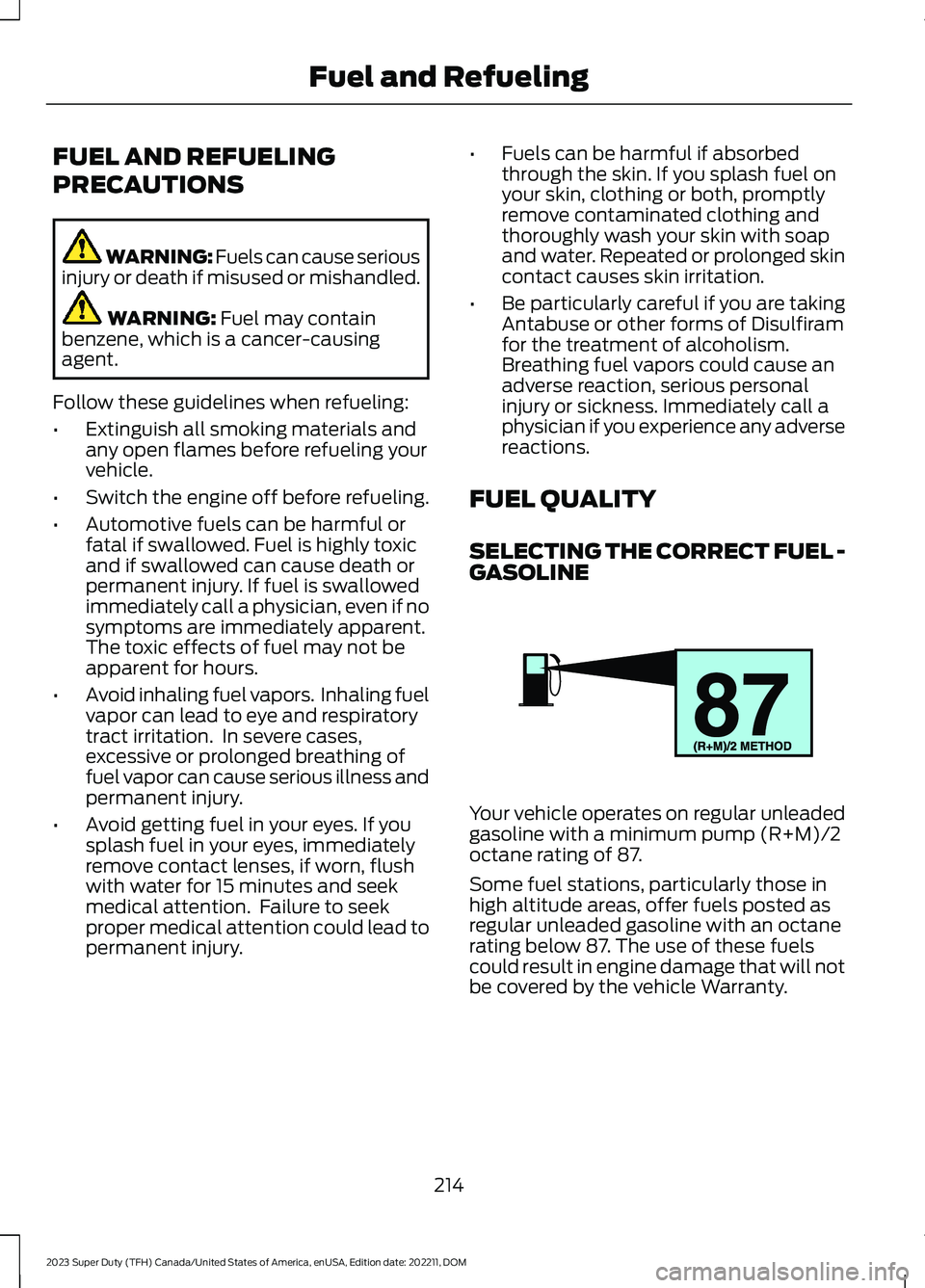
Your vehicle operates on regular unleadedgasoline with a minimum pump (R+M)/2octane rating of 87.
Some fuel stations, particularly those inhigh altitude areas, offer fuels posted asregular unleaded gasoline with an octanerating below 87. The use of these fuelscould result in engine damage that will notbe covered by the vehicle Warranty.
214
2023 Super Duty (TFH) Canada/United States of America, enUSA, Edition date: 202211, DOMFuel and RefuelingE161513
Page 220 of 738
Using low-sulfur diesel fuel(16-500 ppm) or high-sulfurdiesel fuel (greater than 500ppm) in your diesel engine will causecertain emission components tomalfunction which could also cause theservice engine soon light to illuminateindicating an emissions-related concern.
Diesel fuel is adjusted seasonally for coldtemperature. For best results attemperatures below 19°F (-7°C), werecommend using a diesel fuel which hasbeen seasonally adjusted for the ambientconditions.
Choosing the Right Fuel: VehiclesOperated Where Ultra Low SulfurDiesel Fuel Is Not Required
For the engine to operate reliably onlow-sulfur or high-sulfur diesel fuel, theengine must be a factory-built high-sulfurengine (available as a dealer order optionfor select markets) or an ultra-low sulfurdiesel fuel configured engine that has beenretrofitted for high-sulfur diesel fuel usingauthorized dealer service parts. Failure touse retrofit components other than thoseavailable through your authorized dealerresults in coolant system damage, engineoverheating, selective catalyst reductionsystem or diesel particulate filter damageand possible base engine damage.
Use only a diesel engine configured for usewith high-sulfur diesel fuel in markets withdiesel fuel that has sulfur content greaterthan 15 ppm. Using low-sulfur diesel fuel(16–500 ppm) or high-sulfur diesel fuel(greater than 500 ppm) in a diesel enginedesigned to use only ultra-low sulfur dieselfuel could result in damage to engineemission control devices and the aftertreatment system, potentially renderingthe vehicle inoperable.
Vehicles with engines configured for usewith high-sulfur diesel fuel are onlyavailable for sale in countries whereultra-low sulfur diesel fuel is generally notavailable or mandated by the government.Vehicles originally sold in an ultra-lowsulfur diesel fuel market that aresubsequently exported to non-ultra lowsulfur diesel fuel markets will need to beretrofitted at the customer’s expense usingFord authorized dealer service parts inorder to be reliably operated on non-ultralow sulfur diesel fuel.
Biodiesel
WARNING: Do not mix diesel withgasoline, gasohol or alcohol. This couldcause an explosion.
Note:Do not use home heating oil,agricultural fuel, raw fats and oils, wastecooking greases, biodiesel greater than 20%or any diesel not intended for highway use.Damage to the fuel injection system, engineand exhaust catalyst, and diesel particulatefilter can occur if you use an improper fuel.Red dye is used to identify fuels intendedfor agricultural and non-highway use.
You can operate your vehicle on dieselfuels containing up to 20% biodiesel, alsoknown as B20.
Biodiesel fuel is a chemically convertedproduct from renewable fuel sources, suchas vegetable oils, animal fats and wastecooking greases.
To help achieve acceptable engineperformance and durability when usingbiodiesel in your vehicle:
•Confirm the biodiesel content of thefuel to be B20 (20% biodiesel) or less.
•Only use biodiesel fuel of good qualitythat complies with industry standards.
216
2023 Super Duty (TFH) Canada/United States of America, enUSA, Edition date: 202211, DOMFuel and RefuelingE67028
Page 221 of 738
•Follow the recommended servicemaintenance intervals. See GeneralMaintenance Information (page 594).
•Do not store biodiesel fuel in the fueltank for more than 1 month.
•Consider changing brands or reducingbiodiesel content if you have coldtemperature fuel gelling issues or afrequently appearing LOW FUELPRESSURE message.
Use of biodiesel in concentrations greaterthan 20% can cause damage to yourvehicle, including engine and/or exhaustafter-treatment hardware (exhaustcatalyst and particulate filter) failures.Concentrations greater than 20% can alsocause fuel filter restrictions that couldresult in a lack of power or damage to fuelsystem components, including fuel pumpand fuel injector failures.
We recommend SAE 5W-40 oil for fuelswith greater than 5% biodiesel (B5). Formore information about oil changeintervals and other maintenance whenoperating on biodiesel. See SpecialOperating Conditions ScheduledMaintenance (page 603).
Look for a label on the fuel pump toconfirm the amount of biodiesel containedin diesel fuel. Ask the service stationattendant to confirm the biodiesel contentof diesel fuel, if you do not see a label onthe fuel pump.
If you plan to park or store your vehicle formore than 1 month, then you should emptyyour vehicle fuel tank of biodiesel fuel. Youshould fill the tank with a purepetroleum-based diesel fuel and run yourvehicle for a minimum of 30 minutes.
Note:Degraded or oxidized biodiesel candamage fuel system seals and plastics andcorrode steel parts.
During cold weather, if you have problemsoperating on biodiesel, you may need touse diesel fuel with lower biodieselcontent, try another brand or discontinuethe use of biodiesel.
Diesel Fuel Additives
It should not be necessary to add anyaftermarket additives to your fuel if youuse a high-quality diesel fuel that conformsto ASTM industry specifications.Aftermarket additives can damage the fuelinjector system or engine.
Use Motorcraft® cetane booster or anequivalent cetane booster additive if yoususpect fuel has low cetane. UseMotorcraft® anti-gel and performanceimprover or an equivalent additive if thereis fuel gelling.
Do not use alcohol-based additives toimprove cetane quality, to prevent fuelgelling or any other use. The use of alcoholadditives could result in damage to the fuelinjectors and system.
Your Warranty may not cover repairsneeded to correct the effects of using anaftermarket product that does not meetour specifications in your fuel.
RUNNING OUT OF FUEL
FILLING A PORTABLE FUELCONTAINER
WARNING: Flow of fuel through afuel pump nozzle can produce staticelectricity. This can cause a fire if you arefilling an ungrounded fuel container.
217
2023 Super Duty (TFH) Canada/United States of America, enUSA, Edition date: 202211, DOMFuel and Refueling
Page 222 of 738
Use the following guidelines to avoidelectrostatic charge build-up, which canproduce a spark, when filling anungrounded fuel container:
•Only use an approved fuel container totransfer fuel to your vehicle. Place thecontainer on the ground when filling it.
•Do not fill a fuel container when it isinside your vehicle (including the cargoarea).
•Keep the fuel pump nozzle in contactwith the fuel container when filling it.
•Do not use a device that holds the fuelpump nozzle lever in the fill position.
ADDING FUEL FROM A PORTABLEFUEL CONTAINER
WARNING: Do not pry open thefuel tank filler valve. This could damagethe fuel system. Failure to follow thisinstruction could result in fire, personalinjury or death.
WARNING: Do not dispose of fuelin the household refuse or the publicsewage system. Use an authorized wastedisposal facility.
When refueling the vehicle fuel tank froma fuel container, do the following:
1.Fully open the fuel filler door.
2.Turn the fuel filler capcounterclockwise and remove it.
3.Add fuel to your vehicle from the fuelcontainer.
4.To replace the fuel filler cap, turn itclockwise until you feel a strongresistance and it clicks.
5.Fully close the fuel filler door.
Note:If your vehicle runs out of fuel add aminimum of 1.3 gal (5 L) of fuel to restartthe engine.
Note:You may need to switch the ignitionfrom off to on several times after refuelingto allow the fuel system to pump the fuelfrom the tank to the engine. Whenrestarting, cranking time takes a fewseconds longer than normal.
REFUELING
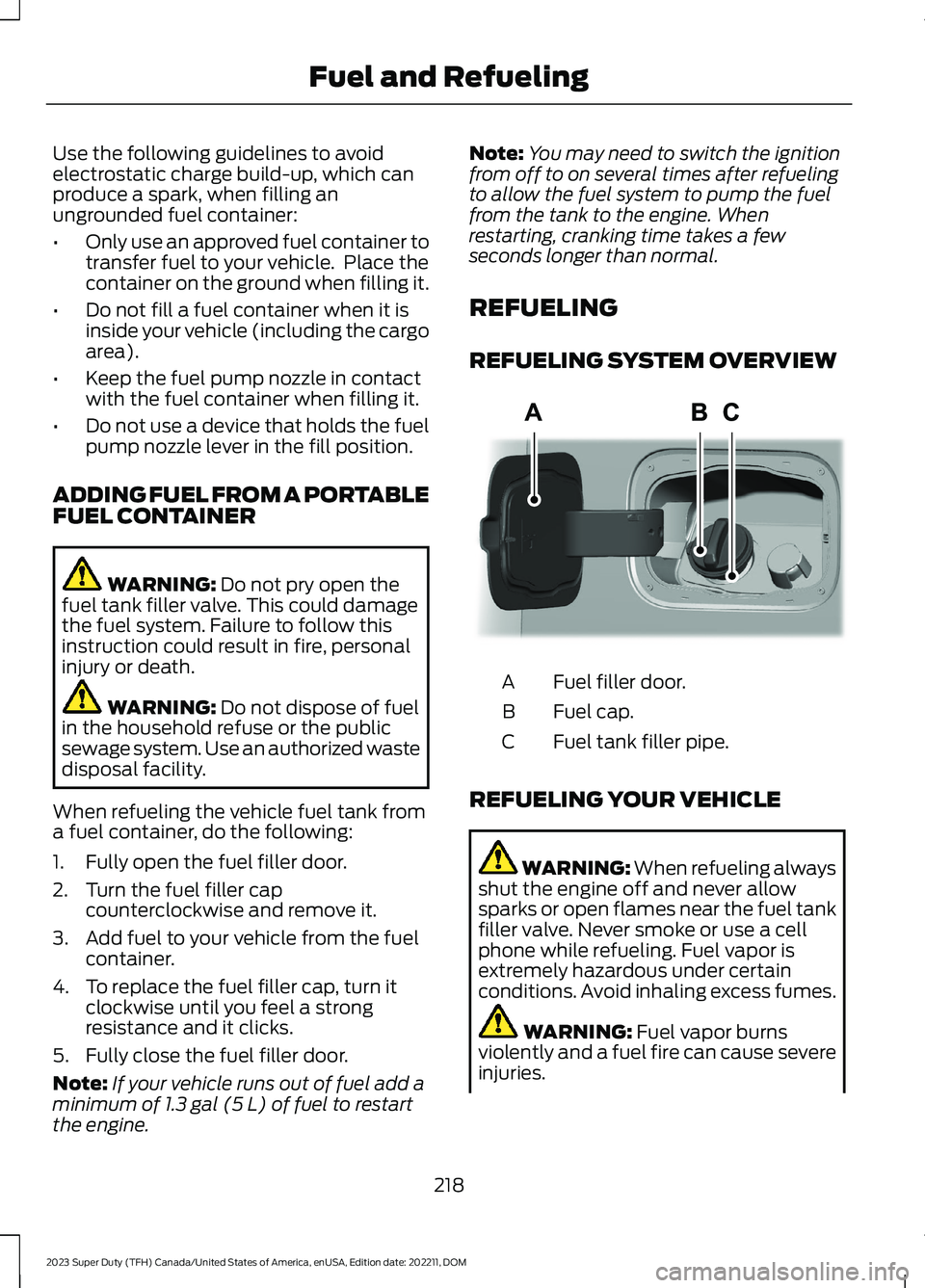
REFUELING SYSTEM OVERVIEW
Fuel filler door.A
Fuel cap.B
Fuel tank filler pipe.C
REFUELING YOUR VEHICLE
WARNING: When refueling alwaysshut the engine off and never allowsparks or open flames near the fuel tankfiller valve. Never smoke or use a cellphone while refueling. Fuel vapor isextremely hazardous under certainconditions. Avoid inhaling excess fumes.
WARNING: Fuel vapor burnsviolently and a fuel fire can cause severeinjuries.
218
2023 Super Duty (TFH) Canada/United States of America, enUSA, Edition date: 202211, DOMFuel and RefuelingAAE346555
Page 223 of 738
WARNING: The fuel system maybe under pressure. If you hear a hissingsound near the fuel filler inlet, do notrefuel until the sound stops. Otherwise,fuel may spray out, which could causeserious personal injury.
WARNING: Keep children awayfrom the fuel pump. Never let childrenpump fuel.
WARNING: Do not pry open thefuel tank filler valve. This could damagethe fuel system. Failure to follow thisinstruction could result in fire, personalinjury or death.
WARNING: Stay outside yourvehicle and do not leave the fuel pumpunattended when refueling your vehicle.
WARNING: Do not remove the fuelpump nozzle from its fully insertedposition when refueling.
WARNING: Stop refueling whenthe fuel pump nozzle automaticallyshuts off for the first time. Failure tofollow this will fill the expansion spacein the fuel tank and could lead to fueloverflowing.
WARNING: Do not overfill the fueltank. The pressure in an overfilled tankmay cause leakage and lead to fuel sprayand fire.
WARNING: Wait at least fiveseconds before removing the fuel pumpnozzle to allow any residual fuel to draininto the fuel tank.
1.Fully open the fuel filler door.
2.Remove the fuel filler cap by turning itcounterclockwise.
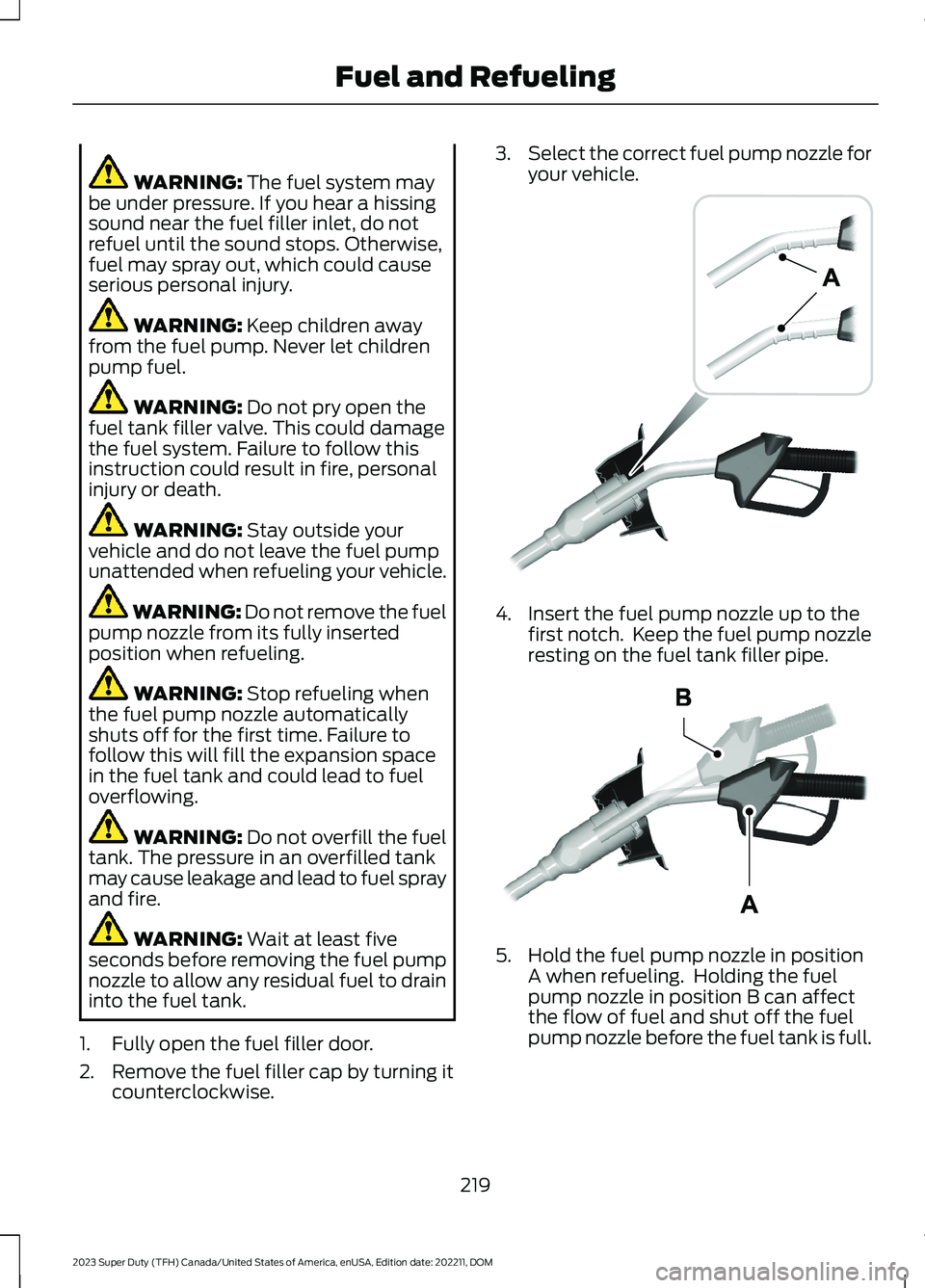
3.Select the correct fuel pump nozzle foryour vehicle.
4.Insert the fuel pump nozzle up to thefirst notch. Keep the fuel pump nozzleresting on the fuel tank filler pipe.
5.Hold the fuel pump nozzle in positionA when refueling. Holding the fuelpump nozzle in position B can affectthe flow of fuel and shut off the fuelpump nozzle before the fuel tank is full.
219
2023 Super Duty (TFH) Canada/United States of America, enUSA, Edition date: 202211, DOMFuel and RefuelingE139202 E327438
Page 224 of 738
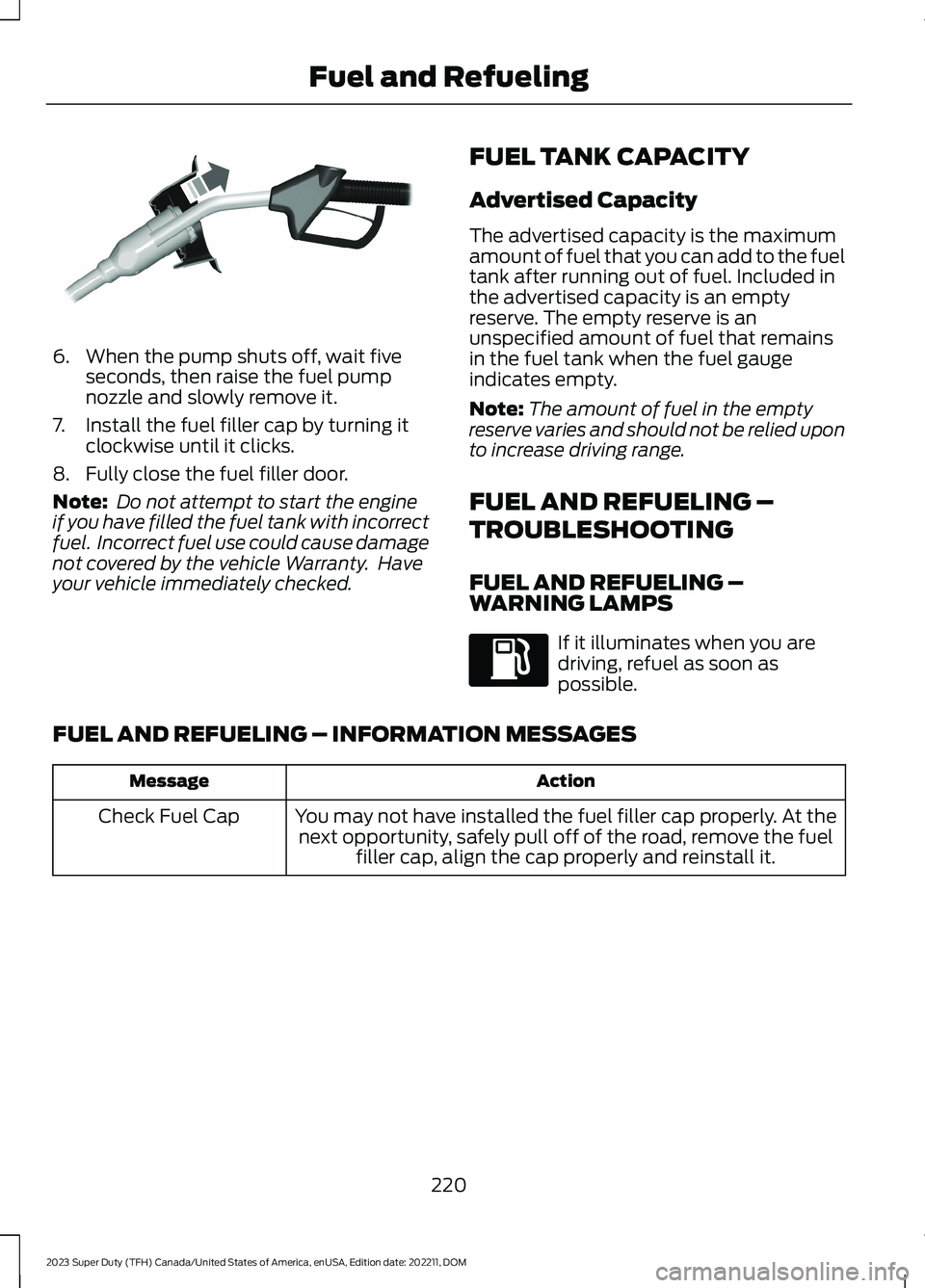
6.When the pump shuts off, wait fiveseconds, then raise the fuel pumpnozzle and slowly remove it.
7.Install the fuel filler cap by turning itclockwise until it clicks.
8.Fully close the fuel filler door.
Note: Do not attempt to start the engineif you have filled the fuel tank with incorrectfuel. Incorrect fuel use could cause damagenot covered by the vehicle Warranty. Haveyour vehicle immediately checked.
FUEL TANK CAPACITY
Advertised Capacity
The advertised capacity is the maximumamount of fuel that you can add to the fueltank after running out of fuel. Included inthe advertised capacity is an emptyreserve. The empty reserve is anunspecified amount of fuel that remainsin the fuel tank when the fuel gaugeindicates empty.
Note:The amount of fuel in the emptyreserve varies and should not be relied uponto increase driving range.
FUEL AND REFUELING –
TROUBLESHOOTING
FUEL AND REFUELING –WARNING LAMPS
If it illuminates when you aredriving, refuel as soon aspossible.
FUEL AND REFUELING – INFORMATION MESSAGES
ActionMessage
You may not have installed the fuel filler cap properly. At thenext opportunity, safely pull off of the road, remove the fuelfiller cap, align the cap properly and reinstall it.
Check Fuel Cap
220
2023 Super Duty (TFH) Canada/United States of America, enUSA, Edition date: 202211, DOMFuel and RefuelingE119081