2023 FORD MUSTANG engine
[x] Cancel search: enginePage 214 of 535

No Lift Shift (If Equipped)
This feature provides you with the abilityto keep the accelerator pedal firmlypressed down during high engine speed,wide open throttle accelerations. Duringwide open throttle gear shifts, the enginecontroller prevents the engine speed fromflaring with the clutch disengaged duringa rapid upshift. This allows reducedmanual transmission upshift time, resultingin quicker acceleration and smoother nolift shifts.
DRIVE CONTROL (IF EQUIPPED)
Selectable Drive Modes (If Equipped)
Selectable drive modes deliver acustomized driving experience using avariety of electronic vehicle systems. Thesystems optimize vehicle dynamics andpowertrain response based on yourselected mode. Systems associated withselectable drive modes are:
•Electronically power assisted steering.See Steering (page 202).
•Electronic stability control and tractioncontrol maintain your vehicle controlin adverse conditions or highperformance driving. See StabilityControl (page 175).
•Electronic throttle control enhancesthe powertrain response to your drivinginput.
•Adaptive dampers (if equipped).
•Active exhaust adjusts the soundcharacteristics of your vehicle (ifequipped).
Using Selectable Drive Modes
Note:Your vehicle may have some of thedrive modes that follow.
To change the drive mode setting, pressthe mode button on the instrument panelunder the display. The first pressilluminates the selected mode, subsequentpresses change the selected mode.
Note:Mode changes are not available whenthe ignition is off or when the transmissionis in reverse (R). Some modes may beunavailable when the transmission is in drive(D) or sport (S).
Modes:
•Normal – Best suited for everydaydriving. If your vehicle has adaptivedampers, the suspension delivers abalanced combination of comfort andhandling. Selectable steering defaultsto normal but can be changed usingthe steering button.
•Sport – Engages when you shift yourautomatic transmission into sport (S).Sport mode increases throttleresponse and helps your vehicleaccelerate faster, but does not changethe vehicle dynamics or stabilitysystem.
•Sport+ – Best suited for spirited driving.This mode increases throttle response,and if your vehicle has active exhaust,it takes on a more powerful tone. If yourvehicle has adaptive dampers, thesuspension becomes stiffer, body
210
2023 Mustang (CZG) Canada/United States of America, Vehicles Built From: 14-11-2022, enUSA, Edition date: 202209, First-PrintingDriving AidsE294773
Page 215 of 535
motion reduces and the steeringbecomes more precise. Selectablesteering defaults to sport. Dependingon vehicle configuration, you may beable to change the selectable steeringsetting by pressing the steering button.
•Track – Provides a performance drivingexperience. Throttle responseincreases, and if your vehicle has activeexhaust, it takes on a more powerfultone. A performance oriented tractioncontrol mode is automatically utilized.In this mode, traction controlintervention is reduced and tunedspecifically for track usage only. Thismode is not intended for public roads.See Using Stability Control (page176).If your vehicle is equipped withadaptive dampers, the suspension isoptimized for transient handlingmaneuvers. This mode offersmaximum control and confidence inhandling on road courses or auto-crossstyle events. Selectable steeringdefaults to sport. Depending on vehicleconfiguration, you could change theselectable steering setting by pressingthe steering button.
•Drag Strip - Provides a performancedriving experience tailored to drivingon a drag strip. The engine respondsdirectly to your inputs, and if yourvehicle has active exhaust, it takes ona more powerful tone. This mode is notintended for public roads. If yourvehicle has adaptive dampers, thesetting is optimized for straight linemaximum acceleration. Selectablesteering defaults to sport. Dependingon vehicle configuration, you couldchange the selectable steering settingby pressing the steering button.
•Snow/Wet - Provides a confidenthandling driving experience during poorweather. If your vehicle has adaptivedampers, the suspension delivers abalanced combination of comfort andhandling. Selectable steering defaultsto normal. Depending on vehicleconfiguration, you could change theselectable steering setting by pressingthe steering button.
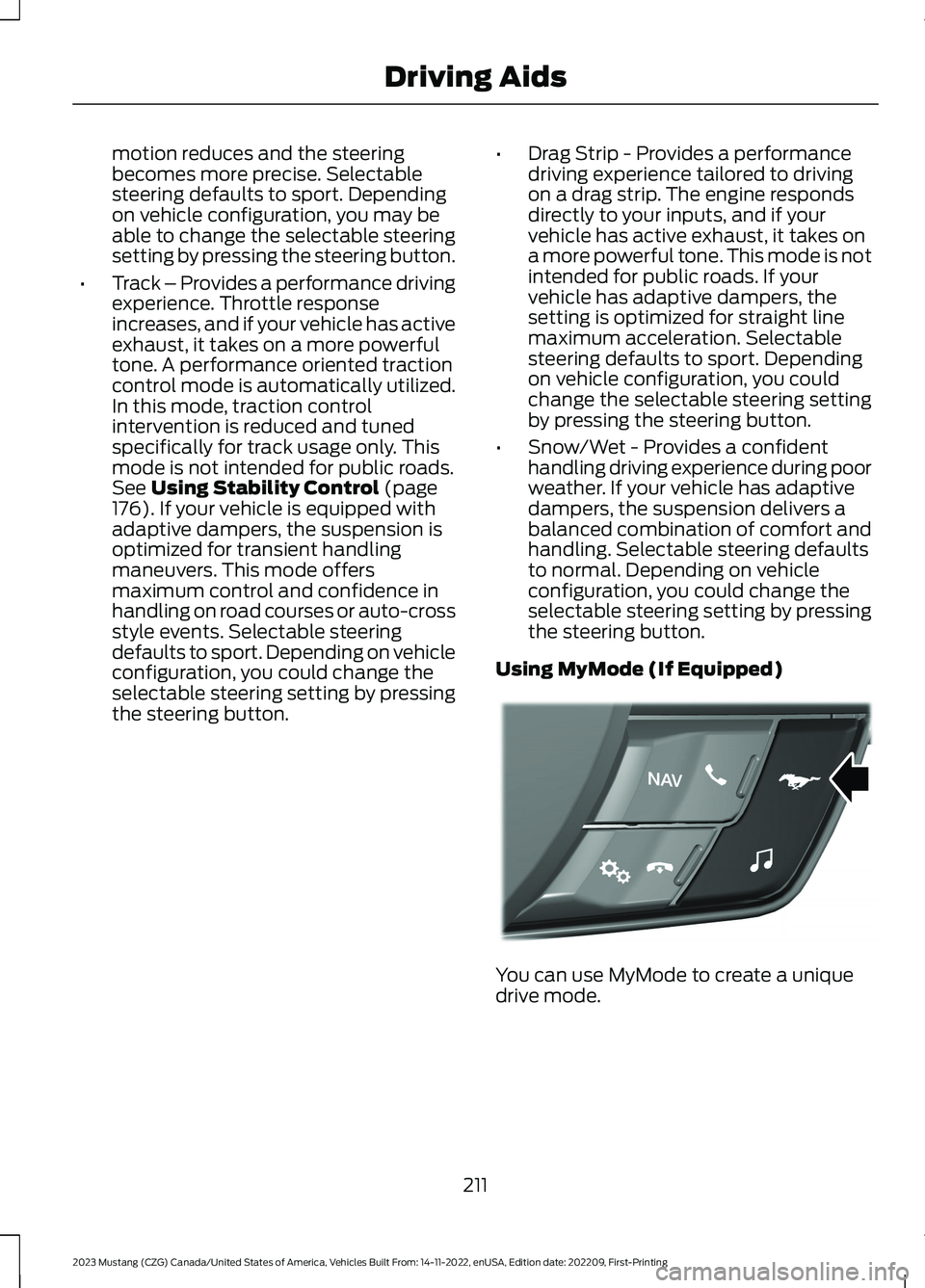
Using MyMode (If Equipped)
You can use MyMode to create a uniquedrive mode.
211
2023 Mustang (CZG) Canada/United States of America, Vehicles Built From: 14-11-2022, enUSA, Edition date: 202209, First-PrintingDriving AidsE294774
Page 217 of 535

Rev Match (If Equipped)
This feature provides a smoother drivingexperience, particularly during a downshiftevent. This is accomplished by a shiftposition prediction that commands a quickengine RPM match to the selected gear.You can switch this feature on and offthrough the information display. SeeGeneral Information (page 98).
Note:The system remembers your lastselection through ignition cycles.
213
2023 Mustang (CZG) Canada/United States of America, Vehicles Built From: 14-11-2022, enUSA, Edition date: 202209, First-PrintingDriving Aids
Page 223 of 535

TOWING A TRAILER - MACH 1
WARNING: Your vehicle isnot approved for trailer towing.Never tow a trailer with yourvehicle.
TOWING A TRAILER
WARNING: Do not exceedthe GVWR or the GAWRspecified on the certificationlabel.
WARNING: Towing trailersbeyond the maximumrecommended gross trailerweight exceeds the limit of yourvehicle and could result in enginedamage, transmission damage,structural damage, loss ofvehicle control, vehicle rolloverand personal injury.
Note:There may be electricalitems such as fuses or relays thatcan affect trailer towing operation.See Fuses (page 246).
The load capacity of your vehicleis designated by weight notvolume. You may not necessarilybe able to use all available spacewhen loading your vehicle ortrailer.
Towing a trailer places extra loadon the engine, transmission, axle,brakes, tires, and suspension.Inspect these components before,during and after towing.
Load Placement
To help minimize how trailermovement affects the vehiclewhen driving:
•Load the heaviest items closestto the trailer floor.
•Load the heaviest items in thecenter of the left and right sidetrailer tires.
•Load the heaviest items abovethe trailer axles or just slightlyforward toward the trailertongue. Do not allow the finaltrailer tongue weight to go
above or below 10-15% of theloaded trailer weight.
•Select a ball mount with thecorrect rise or drop. When boththe loaded vehicle and trailerare connected, the trailer frameshould be level, or slightlyangled down toward thevehicle, when viewed from theside.
When driving with a trailer orpayload, a slight takeoff vibration
or shudder may be present due tothe increased payload weight.Additional information regardingproper trailer loading and settingyour vehicle up for towing islocated in the Load Carryingchapter. See Load Limit (page214).
219
2023 Mustang (CZG) Canada/United States of America, Vehicles Built From: 14-11-2022, enUSA, Edition date: 202209, First-PrintingTowing
Page 226 of 535

When Towing a Trailer
•Do not drive faster than 70 mph(113 km/h) during the first 500 mi(800 km).
•Do not make full-throttle starts.
•Check your hitch, electrical connectionsand trailer wheel lug nuts thoroughlyafter you have traveled 50 mi (80 km).
•When stopped in congested or heavytraffic during hot weather, place thetransmission in park (P) or neutral (N)to aid engine and transmission coolingand to help air conditioningperformance.
•Switch off the speed control withheavy loads or in hilly terrain. Thespeed control may turn offautomatically when you are towing onlong, steep grades.
•Shift to a lower gear when driving downa long or steep hill. Do not apply thebrakes continuously, as they mayoverheat and become less effective.
•If your transmission is equipped with aGrade Assist or Tow/Haul feature, usethis feature when towing. This providesengine braking and helps eliminateexcessive transmission shifting foroptimum fuel economy andtransmission cooling.
•Allow more distance for stopping witha trailer attached. Anticipate stops andbrake gradually.
•Avoid parking on a slope. However, ifyou must park on a slope:
1.Turn the steering wheel to point yourvehicle tires away from traffic flow.
2.Set your vehicle parking brake.
3.Place the automatic transmission inpark (P) or manual transmission in alow gear.
4.Place wheel chocks in front and backof the trailer wheels. Chocks are notincluded with your vehicle.
Launching or Retrieving a Boat orPersonal Watercraft (PWC)
Note:Disconnect the wiring to the trailerbefore backing the trailer into the water.
Note:Reconnect the wiring to the trailerafter removing the trailer from the water.
When backing down a ramp during boatlaunching or retrieval:
•Do not allow the static water level torise above the bottom edge of the rearbumper.
•Do not allow waves to break higherthan 6 in (15 cm) above the bottomedge of the rear bumper.
Exceeding these limits may allow water toenter vehicle components:
•Causing internal damage to thecomponents.
•Affecting driveability, emissions, andreliability.
Any time the rear axle submerges in water,replace the rear axle lubricant. Water maycontaminate the rear axle lubricant, whichis not a normal maintenance inspectionitem unless there is a possibility of a leakor other axle repair is required.
222
2023 Mustang (CZG) Canada/United States of America, Vehicles Built From: 14-11-2022, enUSA, Edition date: 202209, First-PrintingTowing
Page 234 of 535

REDUCED ENGINE
PERFORMANCE
WARNING: If you continue to driveyour vehicle when the engine isoverheating, the engine could stopwithout warning. Failure to follow thisinstruction could result in the loss ofcontrol of your vehicle.
If the engine coolant temperature gaugeneedle moves to the upper limit position,the engine is overheating. See Gauges(page 90).
You must only drive your vehicle for a shortdistance if the engine overheats. Thedistance you can travel depends onambient temperature, vehicle load andterrain. The engine continues to operatewith limited power for a short period oftime.
If the engine temperature continues to rise,the fuel supply to the engine reduces. Theair conditioning switches off and the enginecooling fan operates continually.
1.Gradually reduce your speed and stopyour vehicle as soon as it is safe to doso.
2.Immediately switch the engine off toprevent severe engine damage.
3.Wait for the engine to cool down.
4.Check the coolant level. See EngineCoolant Check (page 265).
5.Have your vehicle checked as soon aspossible.
Reduced Vehicle Top Speed
Your vehicle's ability to reach and maintaintop speed is partially dependent uponambient temperature. Under certainenvironmental conditions, your vehicle'stop speed may be reduced to protectpowertrain components.
COLD WEATHER
PRECAUTIONS
The functional operation of somecomponents and systems can be affectedat temperatures below approximately-13°F (-25°C).
BREAKING-IN
Your vehicle requires a break-in period. Forthe first 1,000 mi (1,600 km), avoid drivingat high speeds, heavy braking, aggressiveshifting or using your vehicle to tow. Duringthis time, your vehicle may exhibit someunusual driving characteristics.
Ground Clearance
Since ground clearance is reduced, usecaution when approaching curbs or curbstops from the front and rear as vehicledamage may occur. Additionally, whencrossing speed bumps or driveway curbs,you should approach at a 45 degree angleto reduce the risk of vehicle damage.
DRIVING ECONOMICALLY
The following helps to improve fuelconsumption:
•Drive smoothly, accelerate gently andanticipate the road ahead to avoidheavy braking.
•Regularly check your tire pressures andmake sure that they are inflated to thecorrect pressure.
230
2023 Mustang (CZG) Canada/United States of America, Vehicles Built From: 14-11-2022, enUSA, Edition date: 202209, First-PrintingDriving Hints
Page 235 of 535

•Follow the recommended maintenanceschedule and carry out therecommended checks.
•Plan your journey and check the trafficbefore you set off. It is more efficientto combine errands into a single tripwhenever possible.
•Avoid idling the engine in cold weatheror for extended periods. Start theengine only when you are ready to setoff.
•Do not carry unnecessary weight in yourvehicle as extra weight wastes fuel.
•Do not add unnecessary accessoriesto the exterior of your vehicle, forexample running boards. If you use aroof rack, remember to fold it down orremove it when not in use.
•Do not shift into neutral when you arebraking or when your vehicle is slowingdown.
•Shut all windows when driving at highspeeds.
•Switch off all electric systems whennot in use, for example air conditioning.Make sure that you unplug anyaccessories from the auxiliary powerpoints when not in use.
DRIVING THROUGH SHALLOW
WATER
WARNING: Do not attempt tocross a deep or flowing body of water.Failure to follow this instruction couldresult in the loss of control of yourvehicle, personal injury or death.
Note:Driving through standing water cancause vehicle damage.
Note:Engine damage can occur if waterenters the air filter.
Before driving through standing water,check the depth. Never drive through waterthat is higher than the bottom of the frontrocker area of your vehicle.
When driving through standing water, drivevery slowly and do not stop your vehicle.Your brake performance and traction couldbe limited. After driving through water andas soon as it is safe to do so:
•Lightly press the brake pedal to dry thebrakes and to check that they work.
•Turn the steering wheel to check thatthe steering power assist works.
Check the function of the following:
•Horn
•Exterior lights
FLOOR MATS
WARNING: Use a floor matdesigned to fit the footwell of yourvehicle that does not obstruct the pedalarea. Failure to follow this instructioncould result in the loss of control of yourvehicle, personal injury or death.
WARNING: Pedals that cannotmove freely can cause loss of vehiclecontrol and increase the risk of seriouspersonal injury.
231
2023 Mustang (CZG) Canada/United States of America, Vehicles Built From: 14-11-2022, enUSA, Edition date: 202209, First-PrintingDriving Hints E266447
Page 238 of 535

Vehicles Sold in Canada: GettingRoadside Assistance
To fully assist you should you have avehicle concern, Ford Motor Company ofCanada, Limited offers a complimentaryroadside assistance program. This programis eligible within Canada or the continentalUnited States.
The service is available 24 hours a day,seven days a week.
This program is separate from the NewVehicle Limited Warranty, but the coverageis concurrent with the powertrain coverageperiod of your vehicle. Canadian roadsidecoverage and benefits may differ from theU.S. coverage.
If you require more information, please callus in Canada at 1-800-665-2006, or visitour website at www.ford.ca.
HAZARD FLASHERS
Note:The hazard flashers operate whenthe ignition is in any position, or if the key isnot in the ignition. If used when the vehicleis not running, the battery loses charge. Asa result, there may be insufficient power torestart your vehicle.
The flasher control is on theinstrument panel. Use yourhazard flashers when yourvehicle is creating a safety hazard for othermotorists.
•Press the flasher control and all frontand rear direction indicators flash.
•Press the button again to switch themoff.
FUEL SHUTOFF
WARNING: If your vehicle has beeninvolved in a crash, have the fuel systemchecked. Failure to follow this instructioncould result in fire, personal injury ordeath.
Note: When you try to restart your vehicleafter a fuel shutoff, the vehicle makes surethat various systems are safe to restart.Once the vehicle determines the systemsare safe, then the vehicle allows you torestart.
Note:In the event that your vehicle doesnot restart after your third attempt, contacta qualified technician.
The fuel pump shutoff stops the flow offuel to the engine in the event of amoderate to severe crash. Not everyimpact causes a shutoff.
Should your vehicle shut off after a crash,you may restart your vehicle.
1.Press START/STOP to switch off yourvehicle.
2.Press the brake pedal andSTART/STOP to switch on yourvehicle.
3.Remove your foot from the brake pedaland press START/STOP to switch offyour vehicle.
4.You can attempt to start the vehicleby pressing the brake pedal andSTART/STOP, or press START/STOPwithout pressing the brake pedal.
5.If the vehicle does not start, repeatsteps 1 through 4.
234
2023 Mustang (CZG) Canada/United States of America, Vehicles Built From: 14-11-2022, enUSA, Edition date: 202209, First-PrintingRoadside EmergenciesE75790