2023 FORD MUSTANG engine
[x] Cancel search: enginePage 165 of 535

On-Board Diagnostics (OBD-II)
Your vehicle has a computer known as theon-board diagnostics system (OBD-II) thatmonitors the engine’s emission controlsystem. The system protects theenvironment by making sure that yourvehicle continues to meet governmentemission standards. The OBD-II systemalso assists a service technician in properlyservicing your vehicle.
When the service engine soonindicator illuminates, the OBD-IIsystem has detected amalfunction. Temporary malfunctions maycause the service engine soon indicator toilluminate. Examples are:
1.Your vehicle has run out of fuel—theengine may misfire or run poorly.
2.Poor fuel quality or water in thefuel—the engine may misfire or runpoorly.
3.The fuel fill inlet may not have closedproperly. See Refueling (page 155).
4.Driving through deep water—theelectrical system may be wet.
You can correct these temporarymalfunctions by filling the fuel tank withgood quality fuel, properly closing the fuelfill inlet or letting the electrical system dryout. After three driving cycles without theseor any other temporary malfunctionspresent, the service engine soon indicatorshould stay off the next time you start theengine. A driving cycle consists of a coldengine startup followed by mixed city andhighway driving. No additional vehicleservice is required.
If the service engine soon indicator remainson, have your vehicle serviced at the firstavailable opportunity. Although somemalfunctions detected by the OBD-II maynot have symptoms that are apparent,continued driving with the service enginesoon indicator on can result in increasedemissions, lower fuel economy, reducedengine and transmission smoothness andlead to more costly repairs.
Readiness for Inspection andMaintenance (I/M) Testing
Some state and provincial and localgovernments may haveInspection/Maintenance (I/M) programsto inspect the emission control equipmenton your vehicle. Failure to pass thisinspection could prevent you from gettinga vehicle registration.
If the service engine soonindicator is on or the bulb doesnot work, your vehicle may needservice. See On-Board Diagnostics.
Your vehicle may not pass the I/M test ifthe service engine soon indicator is on ornot working properly (bulb is burned out),or if the OBD-II system has determinedthat some of the emission control systemshave not been properly checked. In thiscase, the vehicle is not ready for I/Mtesting.
If the vehicle’s engine or transmission hasjust been serviced, or the battery hasrecently run down or been replaced, theOBD-II system may indicate that thevehicle is not ready for I/M testing. Todetermine if the vehicle is ready for I/Mtesting, turn the ignition key to the onposition for 15 seconds without crankingthe engine. If the service engine soonindicator blinks eight times, it means thatthe vehicle is not ready for I/M testing; ifthe service engine soon indicator stays onsolid, it means that your vehicle is readyfor I/M testing.
161
2023 Mustang (CZG) Canada/United States of America, Vehicles Built From: 14-11-2022, enUSA, Edition date: 202209, First-PrintingEngine Emission ControlE67028 E67028
Page 166 of 535

The OBD-II system checks the emissioncontrol system during normal driving. Acomplete check may take several days.
If the vehicle is not ready for I/M testing,you can perform the following driving cycleconsisting of mixed city and highwaydriving:
1.15 minutes of steady driving on anexpressway or highway followed by 20minutes of stop-and-go driving with atleast four 30-second idle periods.
2.Allow your vehicle to sit for at leasteight hours with the ignition off. Then,start the vehicle and complete theabove driving cycle. The vehicle mustwarm up to its normal operatingtemperature. Once started, do not turnoff the vehicle until the above drivingcycle is complete.
If the vehicle is still not ready for I/Mtesting, you need to repeat the abovedriving cycle.
162
2023 Mustang (CZG) Canada/United States of America, Vehicles Built From: 14-11-2022, enUSA, Edition date: 202209, First-PrintingEngine Emission Control
Page 167 of 535
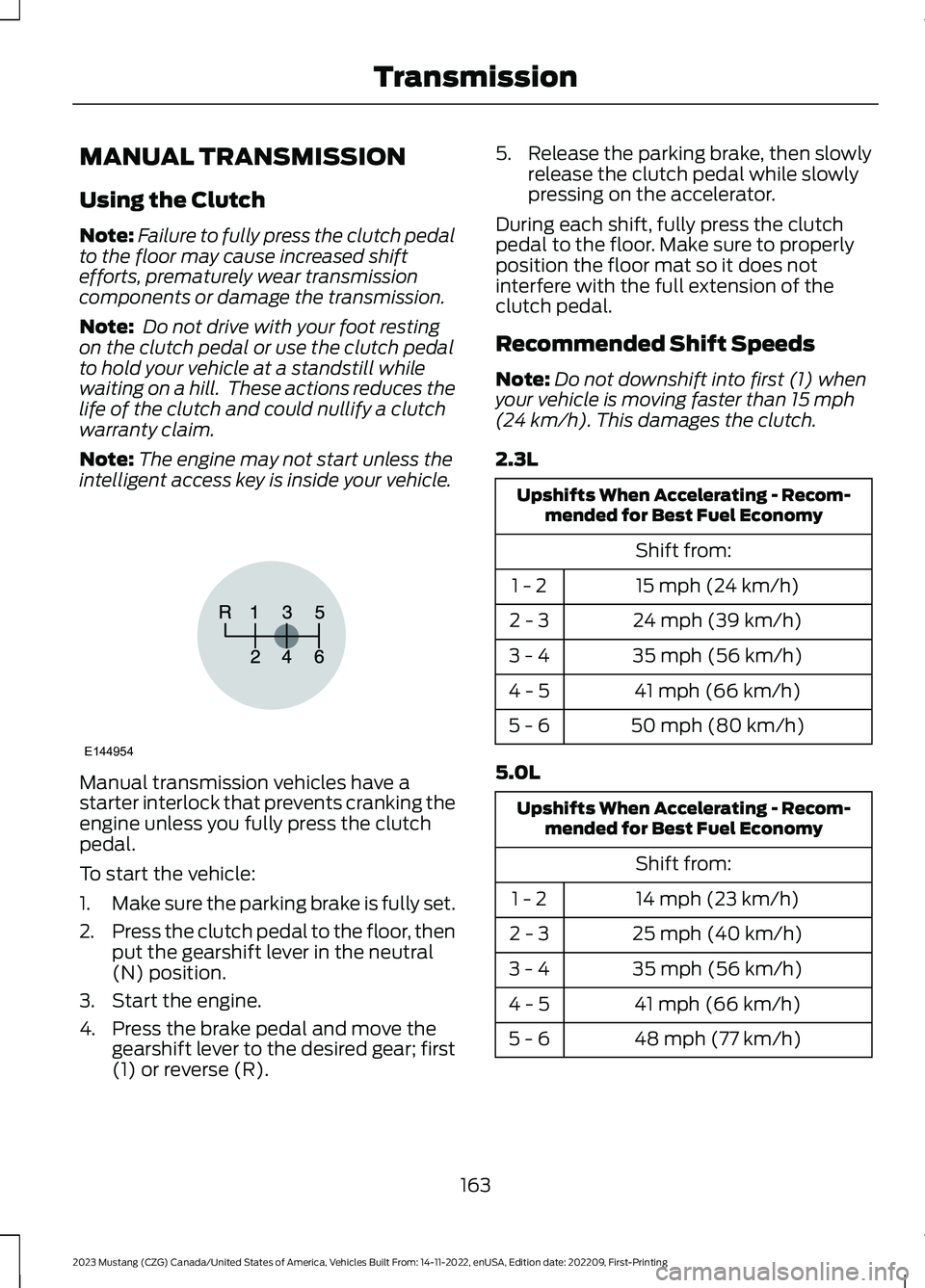
MANUAL TRANSMISSION
Using the Clutch
Note:Failure to fully press the clutch pedalto the floor may cause increased shiftefforts, prematurely wear transmissioncomponents or damage the transmission.
Note: Do not drive with your foot restingon the clutch pedal or use the clutch pedalto hold your vehicle at a standstill whilewaiting on a hill. These actions reduces thelife of the clutch and could nullify a clutchwarranty claim.
Note:The engine may not start unless theintelligent access key is inside your vehicle.
Manual transmission vehicles have astarter interlock that prevents cranking theengine unless you fully press the clutchpedal.
To start the vehicle:
1.Make sure the parking brake is fully set.
2.Press the clutch pedal to the floor, thenput the gearshift lever in the neutral(N) position.
3.Start the engine.
4.Press the brake pedal and move thegearshift lever to the desired gear; first(1) or reverse (R).
5.Release the parking brake, then slowlyrelease the clutch pedal while slowlypressing on the accelerator.
During each shift, fully press the clutchpedal to the floor. Make sure to properlyposition the floor mat so it does notinterfere with the full extension of theclutch pedal.
Recommended Shift Speeds
Note:Do not downshift into first (1) whenyour vehicle is moving faster than 15 mph(24 km/h). This damages the clutch.
2.3L
Upshifts When Accelerating - Recom-mended for Best Fuel Economy
Shift from:
15 mph (24 km/h)1 - 2
24 mph (39 km/h)2 - 3
35 mph (56 km/h)3 - 4
41 mph (66 km/h)4 - 5
50 mph (80 km/h)5 - 6
5.0L
Upshifts When Accelerating - Recom-mended for Best Fuel Economy
Shift from:
14 mph (23 km/h)1 - 2
25 mph (40 km/h)2 - 3
35 mph (56 km/h)3 - 4
41 mph (66 km/h)4 - 5
48 mph (77 km/h)5 - 6
163
2023 Mustang (CZG) Canada/United States of America, Vehicles Built From: 14-11-2022, enUSA, Edition date: 202209, First-PrintingTransmissionE144954
Page 168 of 535
Reverse (R)
Note:Make sure that your vehicle is at acomplete stop before you shift into reverse(R). Failure to do so could damage thetransmission.
1.Press the clutch pedal to the floor todisengage clutch.
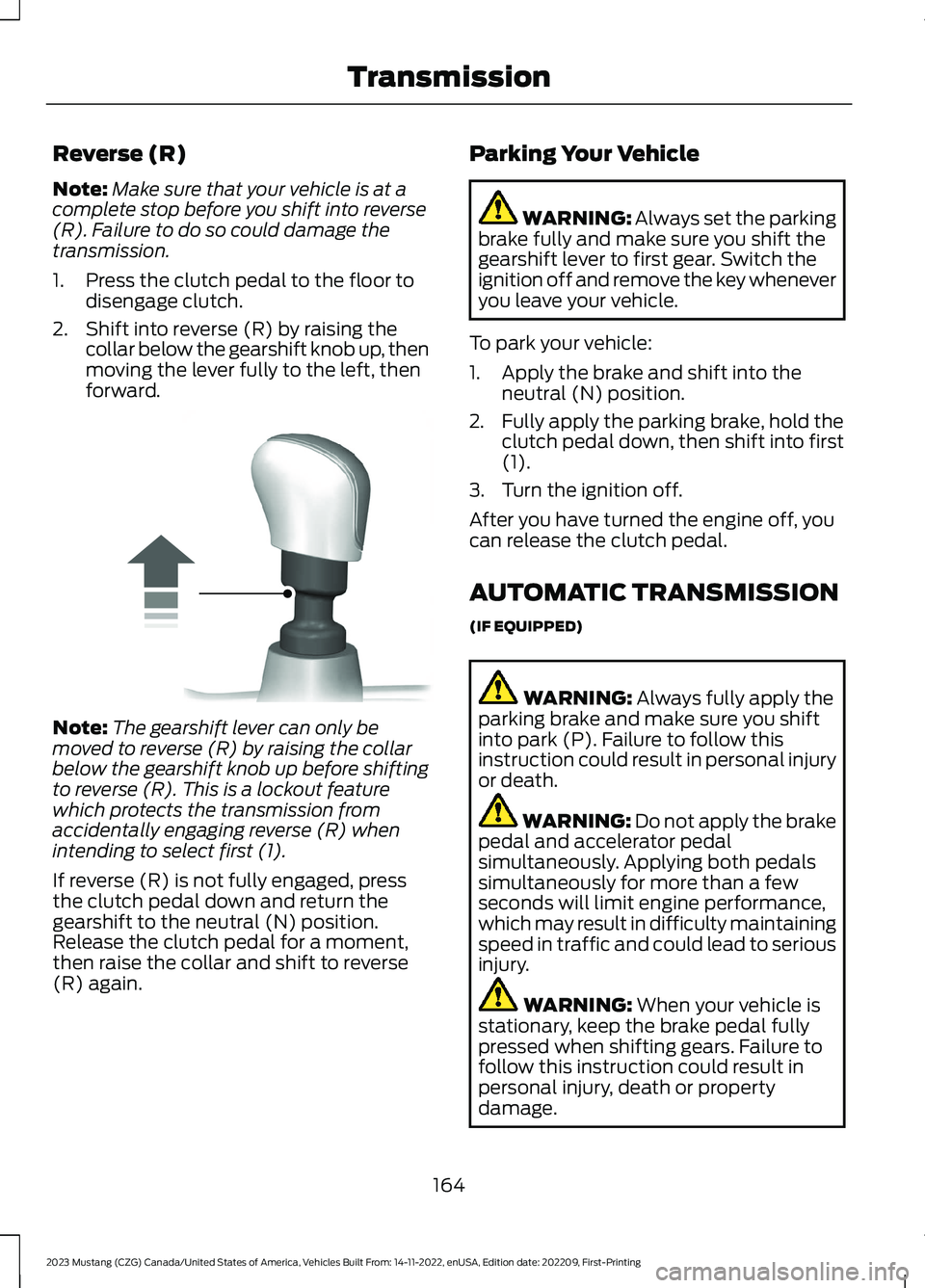
2.Shift into reverse (R) by raising thecollar below the gearshift knob up, thenmoving the lever fully to the left, thenforward.
Note:The gearshift lever can only bemoved to reverse (R) by raising the collarbelow the gearshift knob up before shiftingto reverse (R). This is a lockout featurewhich protects the transmission fromaccidentally engaging reverse (R) whenintending to select first (1).
If reverse (R) is not fully engaged, pressthe clutch pedal down and return thegearshift to the neutral (N) position.Release the clutch pedal for a moment,then raise the collar and shift to reverse(R) again.
Parking Your Vehicle
WARNING: Always set the parkingbrake fully and make sure you shift thegearshift lever to first gear. Switch theignition off and remove the key wheneveryou leave your vehicle.
To park your vehicle:
1.Apply the brake and shift into theneutral (N) position.
2.Fully apply the parking brake, hold theclutch pedal down, then shift into first(1).
3.Turn the ignition off.
After you have turned the engine off, youcan release the clutch pedal.
AUTOMATIC TRANSMISSION
(IF EQUIPPED)
WARNING: Always fully apply theparking brake and make sure you shiftinto park (P). Failure to follow thisinstruction could result in personal injuryor death.
WARNING: Do not apply the brakepedal and accelerator pedalsimultaneously. Applying both pedalssimultaneously for more than a fewseconds will limit engine performance,which may result in difficulty maintainingspeed in traffic and could lead to seriousinjury.
WARNING: When your vehicle isstationary, keep the brake pedal fullypressed when shifting gears. Failure tofollow this instruction could result inpersonal injury, death or propertydamage.
164
2023 Mustang (CZG) Canada/United States of America, Vehicles Built From: 14-11-2022, enUSA, Edition date: 202209, First-PrintingTransmissionE99067
Page 169 of 535

Note:You may not be able to shift out ofpark (P) unless the intelligent access key isinside your vehicle.
Automatic Transmission PositionIndicators
The instrument cluster displays the currentposition.
Note:The position could illuminate on thetransmission selector.
Understanding the Positions ofYour Automatic Transmission
Putting your vehicle in gear:
1.Fully press down on the brake pedal.
2.Press and hold the button on the topof the gearshift lever.
3.Move the gearshift lever into thedesired gear.
4.Release the button and yourtransmission remains in the selectedgear.
Transmission Selector Positions
The instrument cluster displays the currentgear.
Park (P)
This position locks the transmission andprevents the rear wheels from turning.Come to a complete stop before puttingyour vehicle into and out of park (P).
Reverse (R)
With the selector in reverse (R), yourvehicle moves backward. Always come toa complete stop before shifting into andout of reverse (R).
Neutral (N)
With the selector in neutral (N), you canstart your vehicle and it is free to roll. Holdthe brake pedal down when in this position.
Drive (D)
Drive (D) is the normal driving position forthe best fuel economy. The overdrivefunction allows automatic upshifts anddownshifts through all gears.
Sport (S)
Putting your vehicle in sport (S):
•Provides additional engine braking andextends lower gear operation toenhance performance for uphill climbs,hilly terrain or mountainous areas. Thisincreases engine RPM during enginebraking.
•Provides additional lower gearoperation through the automatictransmission shift strategy.
•Provides gear upshifts and downshiftsmore quickly at higher engine speeds.
165
2023 Mustang (CZG) Canada/United States of America, Vehicles Built From: 14-11-2022, enUSA, Edition date: 202209, First-PrintingTransmissionE357197PRNDS E174572
Page 170 of 535

Manually Shifting Gears (If Equipped)
Shifting Using Paddle Shifters
The instrument cluster displays the currentgear. The current gear flashes when yourvehicle cannot shift into the requestedgear. Your vehicle will not shift if therequested gear raises or lowers the enginespeed beyond the limit.
Your vehicle could shift when you fullypress the accelerator or brake pedal.
Note:Prolonged driving with high enginespeed could cause vehicle damage notcovered by the vehicle warranty.
Note:Drive modes could affect when thevehicle shifts into the requested gear.
Manually Shifting Gears in Drive (D)
Use this feature when overtaking anothervehicle, or to temporarily change gear.
•Pull any paddle to switch the featureon.
•Pull the right (+) paddle to upshift.
•Pull the left (-) paddle to downshift.
•Hold the (+) paddle for a few secondsto switch the feature off.
Note:The feature switches off after a shortperiod of time if you do not pull eitherpaddle.
Manually Shifting Gears in Sport (S)
Use this feature for engine braking on hillyor mountainous roads, or to select aspecific gear.
•Pull any paddle to switch the featureon.
•Pull the right (+) paddle to upshift.
•Pull the left (-) paddle to downshift.
•Hold the + paddle for a few secondsto switch the feature off.
Transmission Not in Park (P)Audible Warning
Sounds if any of the following occur:
•You switch your vehicle off beforeshifting into park (P).
•You open the driver door before shiftinginto park (P).
Brake-Shift Interlock
WARNING: Do not drive yourvehicle until you verify that thestoplamps are working.
WARNING: When doing thisprocedure, you need to take thetransmission out of park (P) whichmeans your vehicle can roll freely. Toavoid unwanted vehicle movement,always fully apply the parking brake priorto doing this procedure. Use wheelchocks if appropriate.
WARNING: If the parking brake isfully released, but the brake warninglamp remains illuminated, the brakesmay not be working properly. Have yourvehicle checked as soon as possible.
166
2023 Mustang (CZG) Canada/United States of America, Vehicles Built From: 14-11-2022, enUSA, Edition date: 202209, First-PrintingTransmissionE144821
Page 171 of 535

Use the brake shift interlock lever to movethe gearshift lever from the park (P)position in the event of an electricalmalfunction or if your vehicle has a deadbattery.
Apply the parking brake and switch theignition off before performing thisprocedure.
1.Using a flat head screwdriver or similartool, remove the chrome bezel andgearshift bracket at the base of thegearshift lever.
2.Locate the white release lever and slidethe lever forward when pulling thegearshift lever out of the park (P)position and into the neutral (N)position.
3.Reinstall the chrome bezel and thegearshift bracket.
4.Start your vehicle and release theparking brake.
Note:If you use this procedure, contact anauthorized dealer as soon as possible.
Note:For some markets, this feature isdisabled.
Automatic Transmission AdaptiveLearning
We design this feature to increasedurability and provide consistent shift feelover the life of your vehicle. A new vehicleor transmission may have firm or softshifts. This operation is normal and doesnot affect the function or durability of thetransmission. Over time, the adaptivelearning process fully updates transmissionoperation.
If Your Vehicle Gets Stuck in Mudor Snow
If your vehicle gets stuck in mud or snow,you could rock it out by shifting betweenforward and reverse gears, stoppingbetween shifts in a steady pattern. Presslightly on the accelerator in each gear.
Note:Do not rock your vehicle if the engineis not at normal operating temperature ordamage to the transmission could occur.
Note:Do not rock your vehicle for morethan a minute or damage to thetransmission and tires could occur, or theengine could overheat.
167
2023 Mustang (CZG) Canada/United States of America, Vehicles Built From: 14-11-2022, enUSA, Edition date: 202209, First-PrintingTransmissionE184747 E174501
Page 175 of 535

GENERAL INFORMATION
Note: Occasional brake noise is normal. Ifa metal-to-metal, continuous grinding orcontinuous squeal sound is present, thebrake linings may be worn-out and anauthorized dealer should check them. If thevehicle has continuous vibration or shudderin the steering wheel while braking, anauthorized dealer should check your vehicle.
Note: Brake dust may accumulate on thewheels, even under normal drivingconditions. Some dust is inevitable as thebrakes wear and does not contribute tobrake noise. See Cleaning the Wheels(page 298).
Wet brakes result in reduced brakingefficiency. Gently press the brake pedal afew times when driving from a car wash orstanding water to dry the brakes.
Brake Over Accelerator
In the event the accelerator pedalbecomes stuck or entrapped, apply steadyand firm pressure to the brake pedal toslow the vehicle and reduce engine power.If you experience this condition, apply thebrakes and bring your vehicle to a safestop. Move the transmission to park (P),switch the engine off and apply the parkingbrake. Inspect the accelerator pedal forany interference. If none are found and thecondition persists, have your vehicle towedto the nearest authorized dealer.
Emergency Brake Assist
Emergency brake assist detects when youbrake heavily by measuring the rate atwhich you press the brake pedal. Itprovides maximum braking efficiency aslong as you press the pedal. Emergencybrake assist can reduce stopping distancesin critical situations.
Note:Depending on applicable laws andregulations in the country for which yourvehicle was originally built, your brake lampscould flash during heavy braking. Followingthis, your hazard lights may also flash whenyour vehicle comes to a stop.
Anti-lock Brake System
This system helps you maintain steeringcontrol during emergency stops by keepingthe brakes from locking.
This lamp momentarilyilluminates when you switch theignition on. If the light does notilluminate during start up, remains on orflashes, the anti-lock braking system maybe disabled. Have the system checked byan authorized dealer. If the anti-lock brakesystem is disabled, normal braking is stilleffective.
See Warning Lamps and Indicators(page 93).
Note:Indicators vary depending on region.
This lamp also illuminatesmomentarily when you switchthe ignition on to confirm thelamp is functional. If it does notilluminate when you switch theignition on, or begins to flash atany time, have the system checked by anauthorized dealer. If the brake warninglamp illuminates with the parking brakereleased, have the system checkedimmediately.
HINTS ON DRIVING WITH
ANTI-LOCK BRAKES
The anti-lock brake system does noteliminate the risks when:
•You drive too closely to the vehicle infront of you.
•Your vehicle is hydroplaning.
171
2023 Mustang (CZG) Canada/United States of America, Vehicles Built From: 14-11-2022, enUSA, Edition date: 202209, First-PrintingBrakesE67020 E270480 E67024