2022 TOYOTA YARIS CROSS coolant temperature
[x] Cancel search: coolant temperaturePage 270 of 618
268
CV Owner's Manual_Europe_M52N20_en
4-5. Using the driving support systems
When the engine starts, the Stop &
Start indicator will turn off.
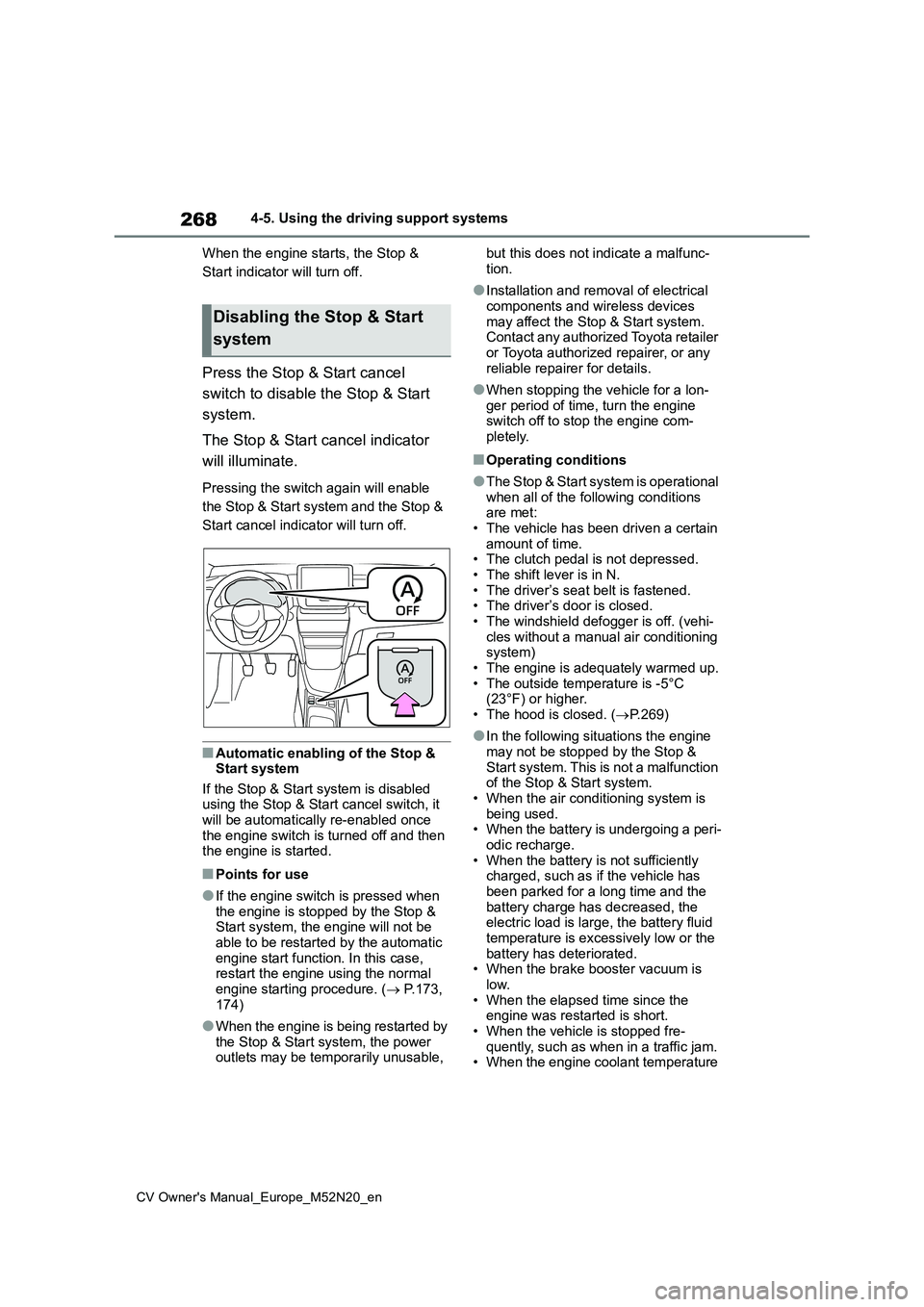
Press the Stop & Start cancel
switch to disable the Stop & Start
system.
The Stop & Start cancel indicator
will illuminate.
Pressing the switch again will enable
the Stop & Start system and the Stop &
Start cancel indicator will turn off.
■Automatic enabling of the Stop & Start system
If the Stop & Start system is disabled using the Stop & Start cancel switch, it will be automatically re-enabled once
the engine switch is turned off and then the engine is started.
■Points for use
●If the engine switch is pressed when the engine is stopped by the Stop & Start system, the engine will not be
able to be restarted by the automatic engine start function. In this case, restart the engine using the normal
engine starting procedure. ( P.173, 174)
●When the engine is being restarted by the Stop & Start system, the power outlets may be temporarily unusable,
but this does not indicate a malfunc-
tion.
●Installation and removal of electrical
components and wireless devices may affect the Stop & Start system. Contact any authorized Toyota retailer
or Toyota authorized repairer, or any reliable repairer for details.
●When stopping the vehicle for a lon-ger period of time, turn the engine switch off to stop the engine com-
pletely.
■Operating conditions
●The Stop & Start system is operational
when all of the following conditions are met:• The vehicle has been driven a certain
amount of time. • The clutch pedal is not depressed.• The shift lever is in N.
• The driver’s seat belt is fastened. • The driver’s door is closed.• The windshield defogger is off. (vehi-
cles without a manual air conditioning system)• The engine is adequately warmed up.
• The outside temperature is -5°C (23°F) or higher.• The hood is closed. ( P.269)
●In the following situations the engine may not be stopped by the Stop &
Start system. This is not a malfunction of the Stop & Start system.• When the air conditioning system is
being used. • When the battery is undergoing a peri-odic recharge.
• When the battery is not sufficiently charged, such as if the vehicle has been parked for a long time and the
battery charge has decreased, the electric load is large, the battery fluid temperature is excessively low or the
battery has deteriorated. • When the brake booster vacuum is low.
• When the elapsed time since the engine was restarted is short.• When the vehicle is stopped fre-
quently, such as when in a traffic jam. • When the engine coolant temperature
Disabling the Stop & Start
system
Page 351 of 618

349
6
CV Owner's Manual_Europe_M52N20_en
6-2. Maintenance
Maintenance and care
request that a record of maintenance
be kept.
■Does your vehicle need repairs?
Be on the alert for changes in perfor- mance and sounds, and visual tip-offs
that indicate service is needed. Some important clues are:
●Engine misses (misfire), stumbling or pinging
●Appreciable loss of power
●Strange engine noises
●A fluid leak under the vehicle (How-ever, water dripping from the air con-
ditioning system after use is normal.)
●Change in exhaust sound (This may
indicate a dangerous carbon monox- ide leak. Drive with the windows open and have the exhaust system checked
immediately.)
●Flat-looking tires, excessive tire
squeal when cornering, uneven tire wear
●Vehicle pulls to one side when driven straight on a level road
●Strange noises related to suspension movement
●Loss of brake effectiveness, spongy feeling brake pedal or clutch pedal (vehicles with a manual transmission),
pedal almost touches the floor, vehicle pulls to one side when braking
●Engine coolant temperature continu-ally higher than normal ( P.85, 89)
If you notice any of these clues, take
your vehicle to any authorized Toyota
retailer or Toyota authorized repairer, or
any reliable repairer as soon as possi-
ble. Your vehicle may need adjustment
or repair.
Page 353 of 618
351
6
CV Owner's Manual_Europe_M52N20_en
6-3. Do-it-yourself maintenance
Maintenance and care
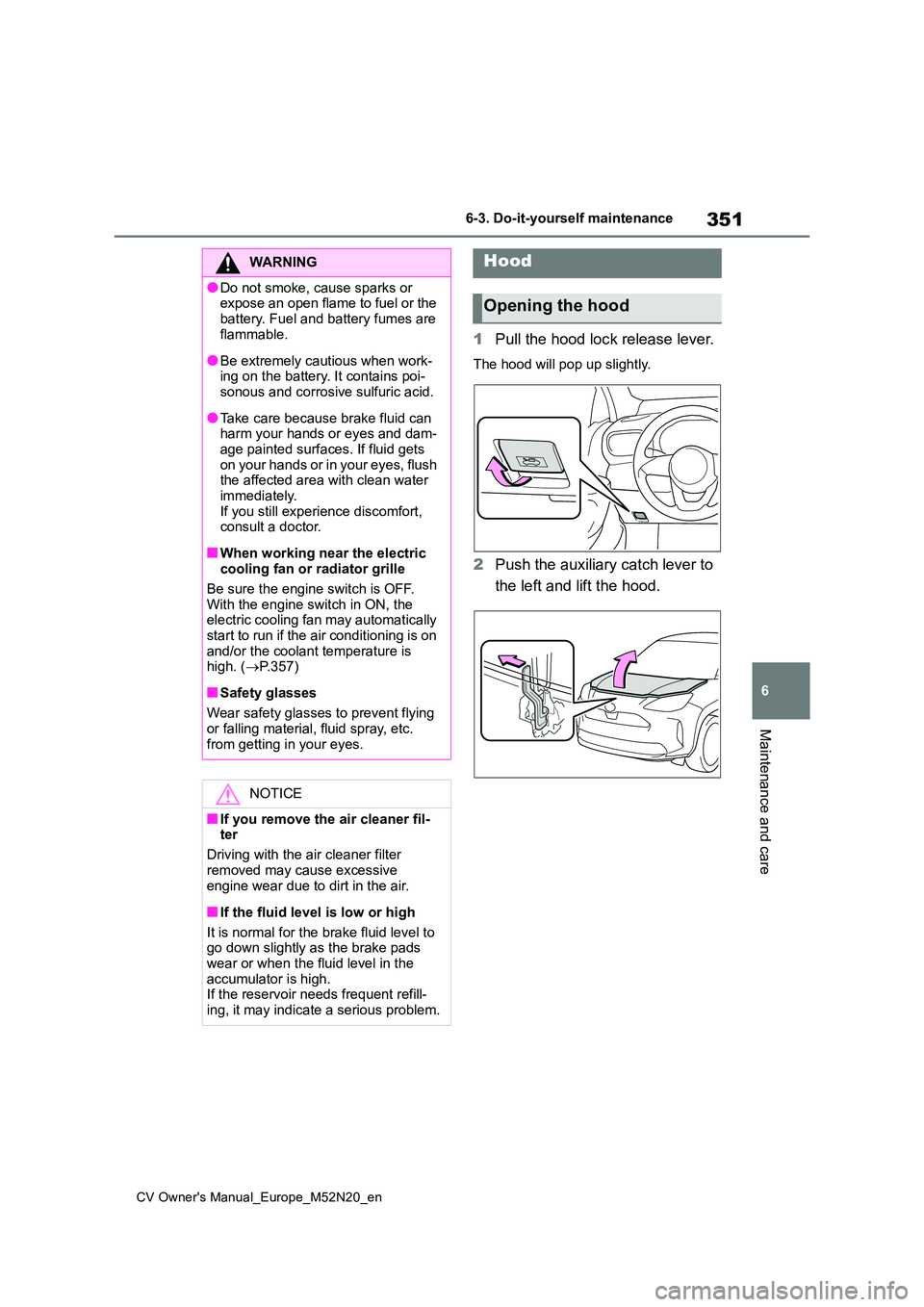
1Pull the hood lock release lever.
The hood will pop up slightly.
2Push the auxiliary catch lever to
the left and lift the hood.
WARNING
●Do not smoke, cause sparks or expose an open flame to fuel or the
battery. Fuel and battery fumes are flammable.
●Be extremely cautious when work-ing on the battery. It contains poi-sonous and corrosive sulfuric acid.
●Take care because brake fluid can harm your hands or eyes and dam-
age painted surfaces. If fluid gets on your hands or in your eyes, flush the affected area with clean water
immediately. If you still experience discomfort, consult a doctor.
■When working near the electric cooling fan or radiator grille
Be sure the engine switch is OFF. With the engine switch in ON, the electric cooling fan may automatically
start to run if the air conditioning is on and/or the coolant temperature is high. ( P.357)
■Safety glasses
Wear safety glasses to prevent flying
or falling material, fluid spray, etc. from getting in your eyes.
NOTICE
■If you remove the air cleaner fil-ter
Driving with the air cleaner filter
removed may cause excessive engine wear due to dirt in the air.
■If the fluid level is low or high
It is normal for the brake fluid level to go down slightly as the brake pads
wear or when the fluid level in the accumulator is high.If the reservoir needs frequent refill-
ing, it may indicate a serious problem.
Hood
Opening the hood
Page 359 of 618

357
6
CV Owner's Manual_Europe_M52N20_en
6-3. Do-it-yourself maintenance
Maintenance and care
cold.
Reservoir cap
“F” line
“L” line
If the level is on or below the “L” line,
add coolant up to the “F” line. ( P.442)
■Coolant selection
Only use “Toyota Super Long Life Cool- ant” or a similar high quality ethylene
glycol based non-silicate, non-amine, non-nitrite, and non-borate coolant with long-life hybrid organic acid technology.
“Toyota Super Long Life Coolant” is a mixture of 50% coolant and 50% deion-ized water. (Minimum temperature: -
35°C [-31°F])
For more details about coolant, contact any authorized Toyota retailer or Toyota
authorized repairer, or any reliable repairer.
■If the coolant level drops within a short time of replenishing
Visually check the radiator, hoses, engine coolant reservoir caps, drain cock and water pump.
If you cannot find a leak, have any authorized Toyota retailer or Toyota authorized repairer, or any reliable
repairer, test the cap and check for leaks in the cooling system.
Check the radiator, condenser clear
away any foreign objects. If either
of the above parts is extremely dirty
or you are not sure of their condi-
tion, have your vehicle inspected by
any authorized Toyota retailer or
Toyota authorized repairer, or any
reliable repairer.
WARNING
■When the engine is hot
Do not remove the engine coolant
reservoir cap. ( P.443)
The cooling system may be under pressure and may spray hot coolant if
the cap is removed, causing serious injuries, such as burns.
NOTICE
■When adding coolant
Coolant is neither plain water nor straight antifreeze. The correct mix-
ture of water and antifreeze must be used to provide proper lubrication, corrosion protection and cooling. Be
sure to read the antifreeze or coolant label.
■If you spill coolant
Be sure to wash it off with water to prevent it from damaging parts or
paint.
Checking the radiator, con-
denser
WARNING
■When the engine is hot
Do not touch the radiator or con- denser as they may be hot and cause serious injuries, such as burns.
Page 403 of 618
401
7
CV Owner's Manual_Europe_M52N20_en
7-2. Steps to take in an emergency
When trouble arises
Fluid leaks under the vehicle.
(Water dripping from the air con-
ditioning after use is normal.)
Flat-looking tires or uneven tire
wear
Engine coolant temperature
gauge needle continually points
higher than normal.
Changes in exhaust sound
Excessive tire squeal when cor-
nering
Strange noises related to the
suspension system
Pinging or other noises related to
the engine
Engine missing, stumbling or
running roughly
Appreciable loss of power
Vehicle pulls heavily to one side
when braking
Vehicle pulls heavily to one side
when driving on a level road
Loss of brake effectiveness,
spongy feeling, pedal almost
touches the floor
If you think something is
wrong
If you notice any of the follow-
ing symptoms, your vehicle
probably needs adjustment or
repair. Contact any authorized
Toyota retailer or Toyota autho-
rized repairer, or any reliable
repairer as soon as possible.
Visible symptoms
Audible symptoms
Operational symptoms
Page 405 of 618

403
7
CV Owner's Manual_Europe_M52N20_en
7-2. Steps to take in an emergency
When trouble arises
■Brake system warning light (warning buzzer)
■Brake system warning light (warning buzzer)
■High coolant temperature warning light* (warning buzzer)
*: This light illuminates on the multi-information display.
If a warning light turns on or a warning buzzer sounds
Calmly perform the following actions if any of the warning lights
comes on or flashes. If a light comes on or flashes, but then g oes
off, this does not necessarily indicate a malfunction in the sy stem.
However, if this continues to o ccur, have the vehicle inspected by
any authorized Toyota retailer or Toyota authorized repairer, o r any
reliable repairer.
Actions to the warning lights or warning buzzers
Warning lightDetails/Actions
(Red)
Indicates that:
The brake fluid level is low; or
The brake system is malfunctioning
Immediately stop the vehicle in a safe place and contact
any authorized Toyota retailer or Toyota authorized
repairer, or any reliable repairer. Continuing to drive the
vehicle may be dangerous.
Warning lightDetails/Actions
(Yellow)
Indicates a malfunction in the parking brake system
Have the vehicle inspected by any authorized Toyota
retailer or Toyota authorized repairer, or any reliable
repairer immediately.
Warning lightDetails/Actions
Indicates that the engine coolant temperature is excessively hi gh
Immediately stop the vehicle in a safe place.
Handling method ( P.442)
Page 445 of 618

443
7
CV Owner's Manual_Europe_M52N20_en
7-2. Steps to take in an emergency
When trouble arises
hoses and radiator core (radia-
tor) for any leaks.
Radiator
Cooling fan
If a large amount of coolant leaks,
immediately contact any authorized
Toyota retailer or Toyota authorized
repairer, or any reliable repairer.
4 The coolant level is satisfactory
if it is between the “F” or “L”
lines on the reservoir.
Reservoir
“F” line
“L” line
5 Add engine coolant if necessary.
Water can be used in an emergency if
engine coolant is unavailable.
6 Start the engine and turn the air
conditioning system on to check
that the radiator cooling fan
operate and to check for coolant
leaks from the radiator or hoses.
The fan operate when the air condition-
ing system is turned on immediately after a cold start. Confirm that the fan is operating by checking the fan sound
and air flow. If it is difficult to check these, turn the air conditioning system on and off repeatedly. (The fan may not
operate in freezing temperatures.)
7 If the fan is not operating: Stop
the engine immediately and
contact any authorized Toyota
retailer or Toyota authorized
repairer, or any reliable repairer.
If the fan is operating: Have the
vehicle inspected at the nearest
any authorized Toyota retailer or
Toyota authorized repairer, or
any reliable repairer.
WARNING
■When inspecting under the hood of your vehicle
Observe the following precautions.
Failure to do so may result in serious injury such as burns.
Page 446 of 618

444
CV Owner's Manual_Europe_M52N20_en
7-2. Steps to take in an emergency
1Stop the engine. Set the parking
brake and shift the shift lever to
P (Multidrive) or N (manual
transmission).
2 Remove the mud, snow or sand
from around the front wheels.
3 Place wood, stones or some
other material under the front
wheels to help provide traction.
4 Restart the engine.
5 Shift the shift lever to D or R
(Multidrive) or 1 or R (manual
transmission) and release the
parking brake. Then, while exer-
cising caution, depress the
accelerator pedal.
■When it is difficult to free the vehi- cle
Press the switch to turn off TRC.
A message will be shown on the multi-
information display.
WARNING
●If steam is seen coming from under the hood, do not open the hood
until the steam has subsided. The engine compartment may be very hot.
●Keep hands and clothing (espe-cially a tie, a scarf or a muffler)
away from the fan and belts. Failure to do so may cause the hands or clothing to be caught, resulting in
serious injury.
●Do not loosen the coolant reservoir
caps while the engine and radiator are hot.High temperature steam or coolant
could spray out.
NOTICE
■When adding engine coolant
Add coolant slowly after the engine
has cooled down sufficiently. Adding cool coolant to a hot engine too quickly can cause damage to the
engine.
■To prevent damage to the cooling system
Observe the following precautions:
●Avoid contaminating the coolant with foreign matter (such as sand or
dust etc.).
●Do not use any coolant additive.
If the vehicle becomes
stuck
Carry out the following proce-
dures if the tires spin or the
vehicle becomes stuck in mud,
dirt or snow:
Recovering procedure