2022 TOYOTA SUPRA reset
[x] Cancel search: resetPage 296 of 498
2945-1. MOBILITY
2Check the tyre inflation pressure
in all four tyres, using a pressure
gauge, for example.
3 Correct the tyre inflation pres-
sure if the current tyre inflation
pressure value deviates from
the specified value.
4 Check whether all valve caps
are screwed onto the tyre
valves.
Via Toyota Supra Command:
1 "My vehicle"
2 "Vehicle status"
3 "Tyre Pressure Monitor"
4 Check if the current tyre inflation
pressures match the specified
tyre pressure value.
5 Correct the tyre inflation pres-
sure if the current tyre inflation
pressure value deviates from
the specified value.
For Tyre Pressure Monitor (TPM):
The corrected tyre inflation pres-
sures are applied automatically.
Make sure that the correct tyre set-
tings have been performed.
For tyres that cannot be found in
the tyre inflation pressure informa-
tion on the Control Display, reset
the Tyre Pressure Monitor (TPM).
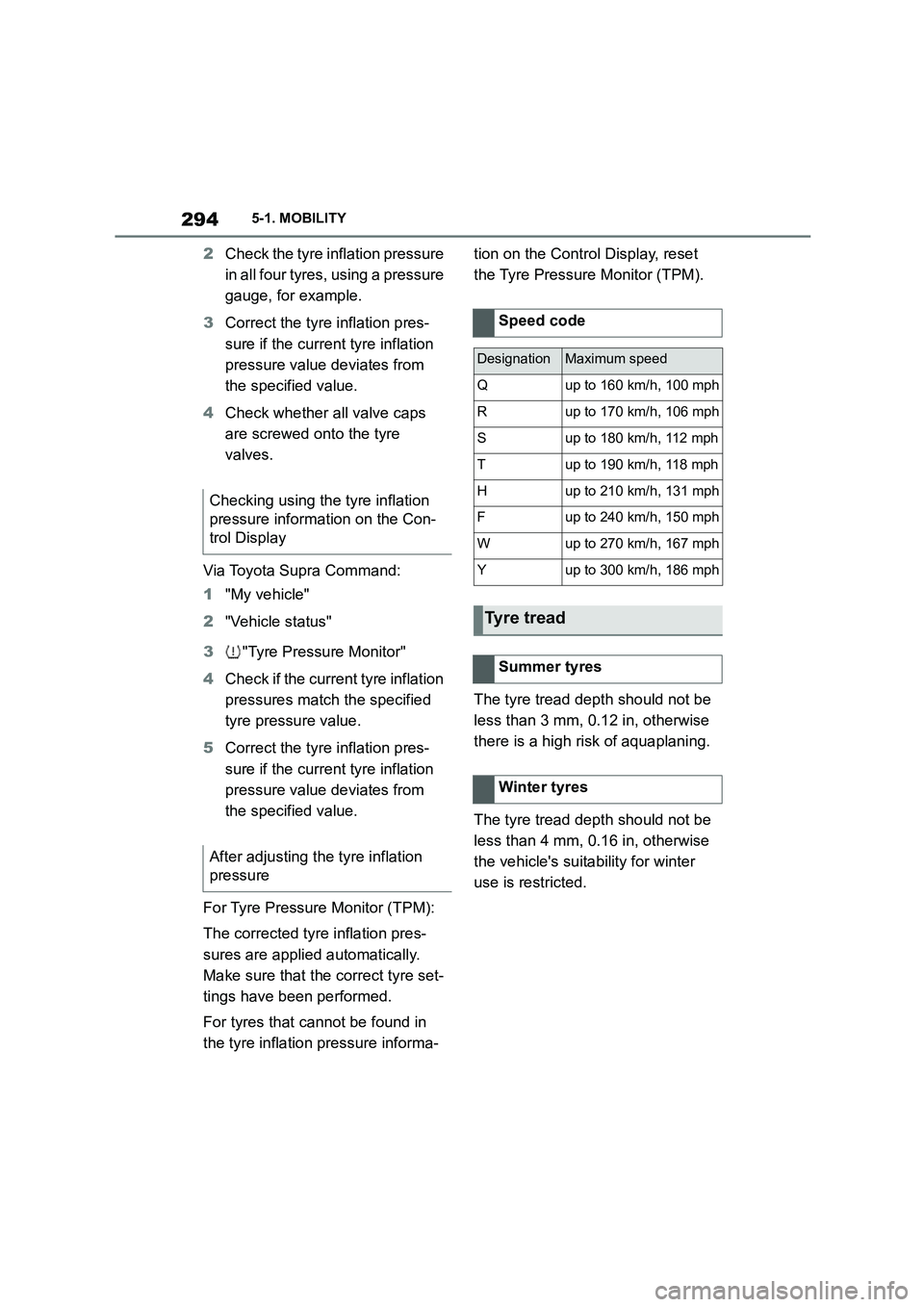
The tyre tread depth should not be
less than 3 mm, 0.12 in, otherwise
there is a high risk of aquaplaning.
The tyre tread depth should not be
less than 4 mm, 0.16 in, otherwise
the vehicle's suitability for winter
use is restricted.
Checking using the tyre inflation
pressure information on the Con-
trol Display
After adjusting the tyre inflation
pressure
Speed code
DesignationMaximum speed
Qup to 160 km/h, 100 mph
Rup to 170 km/h, 106 mph
Sup to 180 km/h, 112 mph
Tup to 190 km/h, 118 mph
Hup to 210 km/h, 131 mph
Fup to 240 km/h, 150 mph
Wup to 270 km/h, 167 mph
Yup to 300 km/h, 186 mph
Tyre tread
Summer tyres
Winter tyres
Page 306 of 498

3045-1. MOBILITY
3Insert the plug into the socket in
the vehicle interior.
4 Correct tyre inflation pressure to
at least 2.0 bar.
• To increase tyre inflation pres-
sure: switch on the compressor
with standby state switched on or
the engine running.
• To reduce tyre inflation pressure:
press the button on the compres-
sor.
5 Unscrew the connecting hose of
the compressor from the tyre
valve.
6 Unplug the connector from the
socket in the vehicle interior.
7 Store Mobility System in the
vehicle.
Do not exceed maximum permitted
speed of 80 km/h, approximately 50
mph.
Reset the Tyre Pressure Monitor
(TPM), see page 304.
Have the punctured tyre and the
sealant containe r of the Mobility
System replaced as soon as possi-
ble.
Tire chains cannot be mounted.
Snow tires should be used instead.
The system monitors the tyre infla-
tion pressure in the four fitted tyres.
The system warns if the tyre infla-
tion pressure in one or more tyres
has fallen.
Sensors in the tyre valves measure
the tyre inflation pressure and tyre
temperature.
The system detects the fitted tyres
automatically. The system shows
the preset specified pressures on
the Control Display and compares
them to the current tyre inflation
pressures.
If tyres are fitted which are not
listed on the tyre inflation pressure
labels in the vehicle, see page 292,
Resuming with journey
Snow chains
Selecting tire chains
NOTICE
■Driving with tire chains
Do not fit tire chains. Tire chains may
damage the vehicle body and sus- pension, and adversely affect driving
performance.
Tyre Pressure Monitor (TPM)
Principle
General
Page 307 of 498
305
5
5-1. MOBILITY
MOBILITY
for example tyres with special
approval, the system must be
actively reset. The current tyre
inflation pressures are then
accepted as the specified values.
When operating the system, please
also comply with the other informa-
tion and notes in the Tyre inflation
pressure chapter, see page 292.
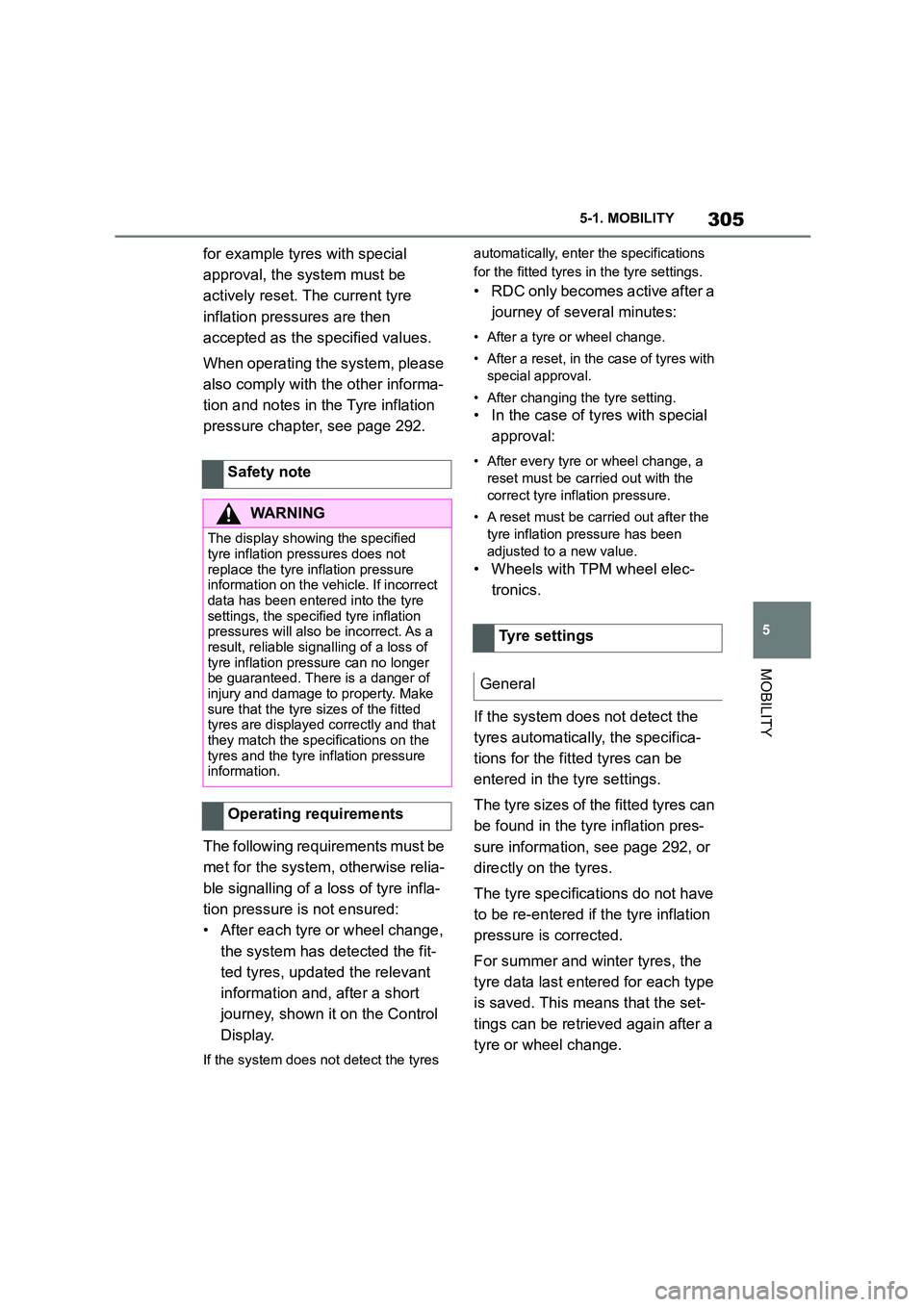
The following requirements must be
met for the system, otherwise relia-
ble signalling of a loss of tyre infla-
tion pressure is not ensured:
• After each tyre or wheel change,
the system has detected the fit-
ted tyres, updated the relevant
information and, after a short
journey, shown it on the Control
Display.
If the system does not detect the tyres
automatically, enter the specifications
for the fitted tyres in the tyre settings.
• RDC only becomes active after a
journey of several minutes:
• After a tyre or wheel change.
• After a reset, in the case of tyres with
special approval.
• After changing the tyre setting.
• In the case of tyres with special
approval:
• After every tyre or wheel change, a
reset must be carried out with the
correct tyre infl ation pressure.
• A reset must be carried out after the
tyre inflation pressure has been
adjusted to a new value.
• Wheels with TPM wheel elec-
tronics.
If the system does not detect the
tyres automatically, the specifica-
tions for the fitted tyres can be
entered in the tyre settings.
The tyre sizes of the fitted tyres can
be found in the tyre inflation pres-
sure information, see page 292, or
directly on the tyres.
The tyre specifications do not have
to be re-entered if the tyre inflation
pressure is corrected.
For summer and winter tyres, the
tyre data last entered for each type
is saved. This means that the set-
tings can be retrieved again after a
tyre or wheel change.
Safety note
WA R N I N G
The display showing the specified
tyre inflation pressures does not
replace the tyre inflation pressure information on the vehicle. If incorrect
data has been entered into the tyre
settings, the specified tyre inflation pressures will also be incorrect. As a
result, reliable signalling of a loss of
tyre inflation pressure can no longer be guaranteed. There is a danger of
injury and damage to property. Make
sure that the tyre sizes of the fitted tyres are displayed correctly and that
they match the specifications on the
tyres and the tyre inflation pressure information.
Operating requirements
Tyre settings
General
Page 309 of 498
307
5
5-1. MOBILITY
MOBILITY
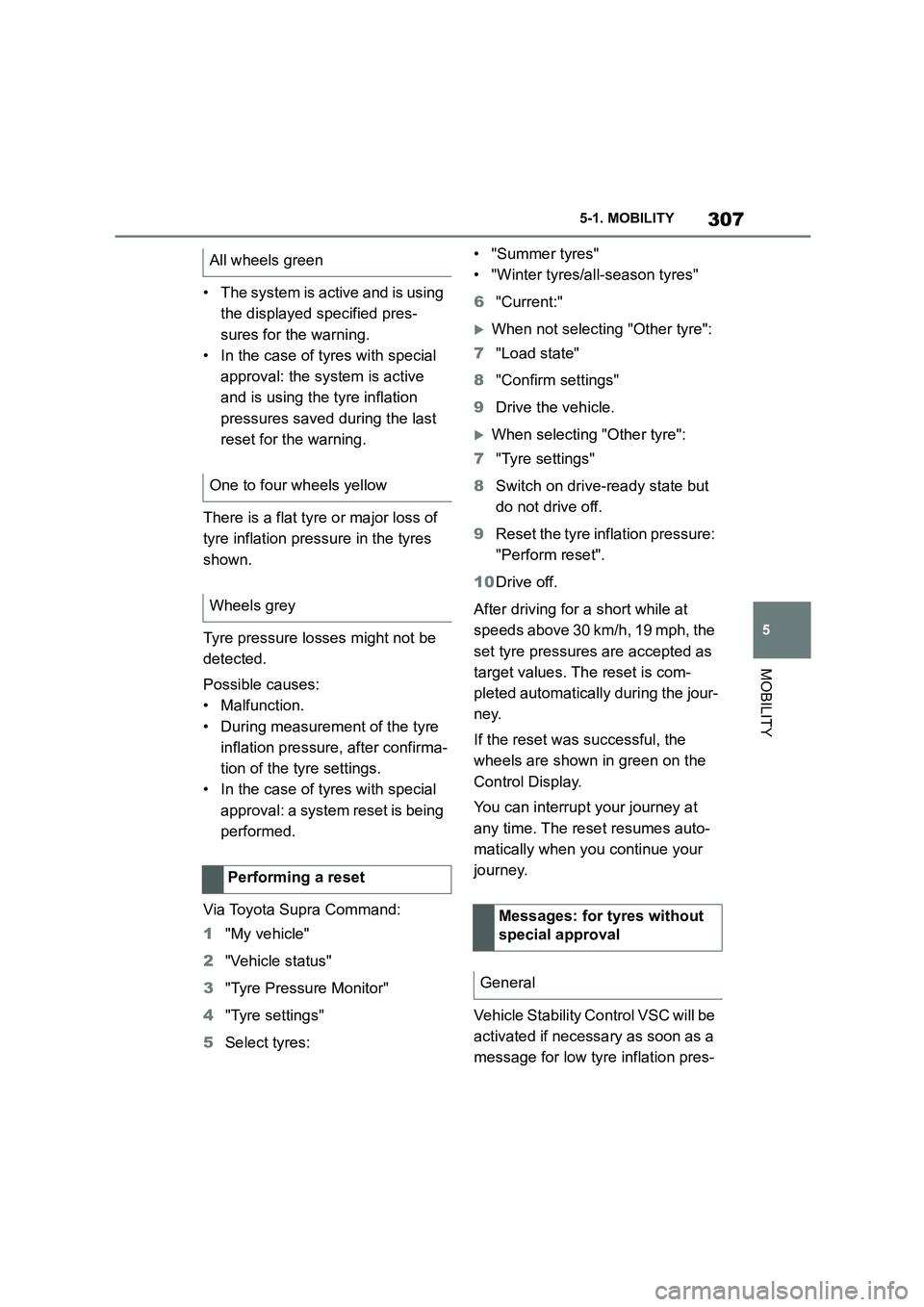
• The system is active and is using
the displayed specified pres-
sures for the warning.
• In the case of tyres with special
approval: the system is active
and is using the tyre inflation
pressures saved during the last
reset for the warning.
There is a flat tyre or major loss of
tyre inflation pre ssure in the tyres
shown.
Tyre pressure losses might not be
detected.
Possible causes:
• Malfunction.
• During measurement of the tyre
inflation pressure, after confirma-
tion of the tyre settings.
• In the case of tyres with special
approval: a system reset is being
performed.
Via Toyota Supra Command:
1 "My vehicle"
2 "Vehicle status"
3 "Tyre Pressure Monitor"
4 "Tyre settings"
5 Select tyres:
• "Summer tyres"
• "Winter tyres/all-season tyres"
6 "Current:"
When not selecting "Other tyre":
7 "Load state"
8 "Confirm settings"
9 Drive the vehicle.
When selecting "Other tyre":
7 "Tyre settings"
8 Switch on drive-ready state but
do not drive off.
9 Reset the tyre inflation pressure:
"Perform reset".
10 Drive off.
After driving for a short while at
speeds above 30 km/h, 19 mph, the
set tyre pressures are accepted as
target values. Th e reset is com-
pleted automatically during the jour-
ney.
If the reset was successful, the
wheels are shown in green on the
Control Display.
You can interrupt your journey at
any time. The reset resumes auto-
matically when you continue your
journey.
Vehicle Stability Control VSC will be
activated if necessary as soon as a
message for low tyre inflation pres-
All wheels green
One to four wheels yellow
Wheels grey
Performing a reset
Messages: for tyres without
special approval
General
Page 311 of 498
309
5
5-1. MOBILITY
MOBILITY
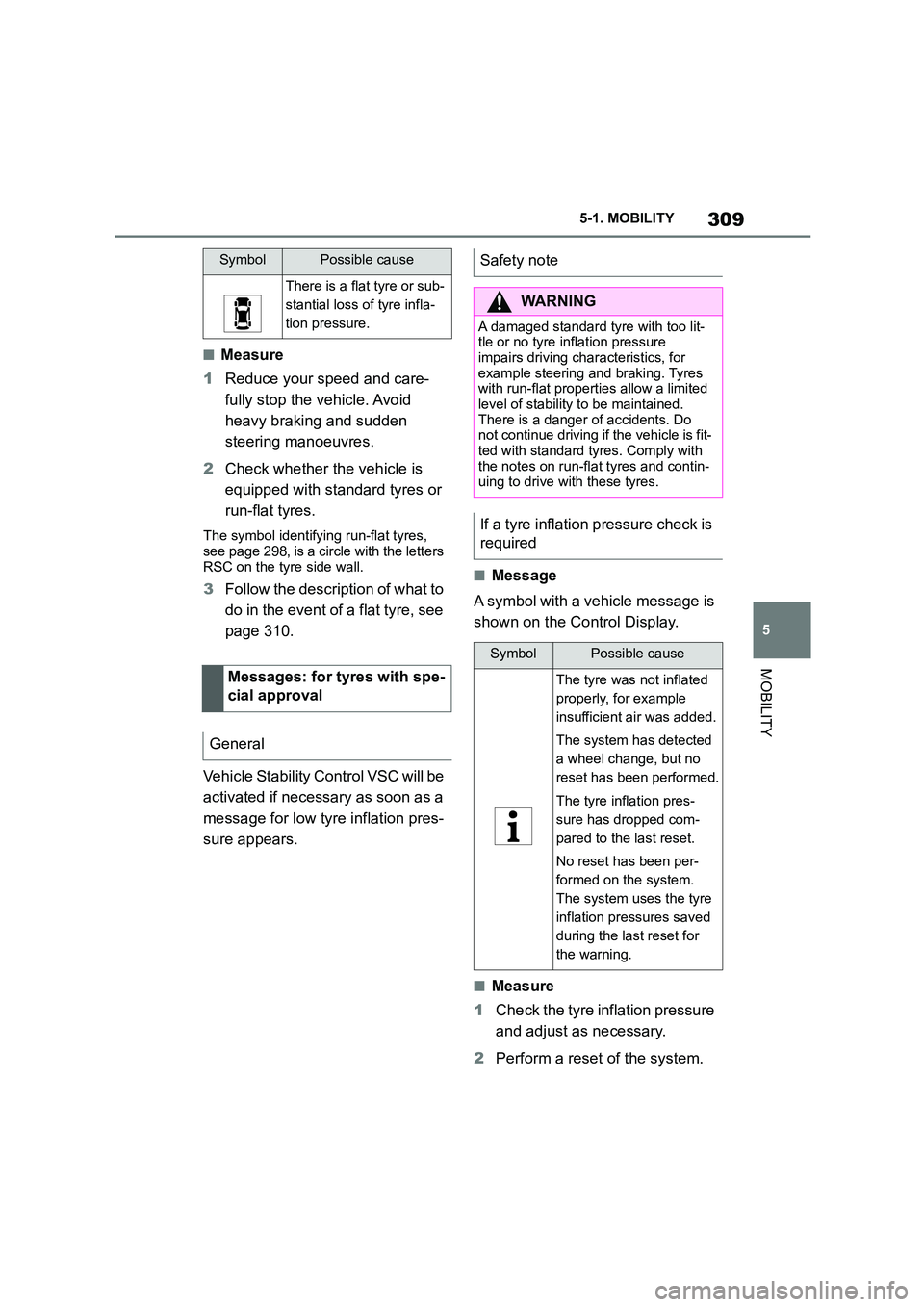
■Measure
1 Reduce your speed and care-
fully stop the vehicle. Avoid
heavy braking and sudden
steering manoeuvres.
2 Check whether the vehicle is
equipped with standard tyres or
run-flat tyres.
The symbol identifying run-flat tyres,
see page 298, is a circle with the letters
RSC on the tyre side wall.
3 Follow the description of what to
do in the event of a flat tyre, see
page 310.
Vehicle Stability Control VSC will be
activated if necessary as soon as a
message for low tyre inflation pres-
sure appears.
■Message
A symbol with a vehicle message is
shown on the Control Display.
■Measure
1 Check the tyre inflation pressure
and adjust as necessary.
2 Perform a reset of the system.
SymbolPossible cause
There is a flat tyre or sub-
stantial loss of tyre infla-
tion pressure.
Messages: for tyres with spe-
cial approval
General
Safety note
WA R N I N G
A damaged standard tyre with too lit-
tle or no tyre inflation pressure impairs driving char acteristics, for
example steering and braking. Tyres
with run-flat properties allow a limited level of stability to be maintained.
There is a danger of accidents. Do
not continue driving if the vehicle is fit-
ted with standard tyres. Comply with the notes on run-flat tyres and contin-
uing to drive with these tyres.
If a tyre inflation pressure check is
required
SymbolPossible cause
The tyre was not inflated
properly, for example
insufficient air was added.
The system has detected
a wheel change, but no
reset has been performed.
The tyre inflation pres-
sure has dropped com-
pared to the last reset.
No reset has been per-
formed on the system.
The system uses the tyre
inflation pressures saved
during the last reset for
the warning.
Page 312 of 498
3105-1. MOBILITY
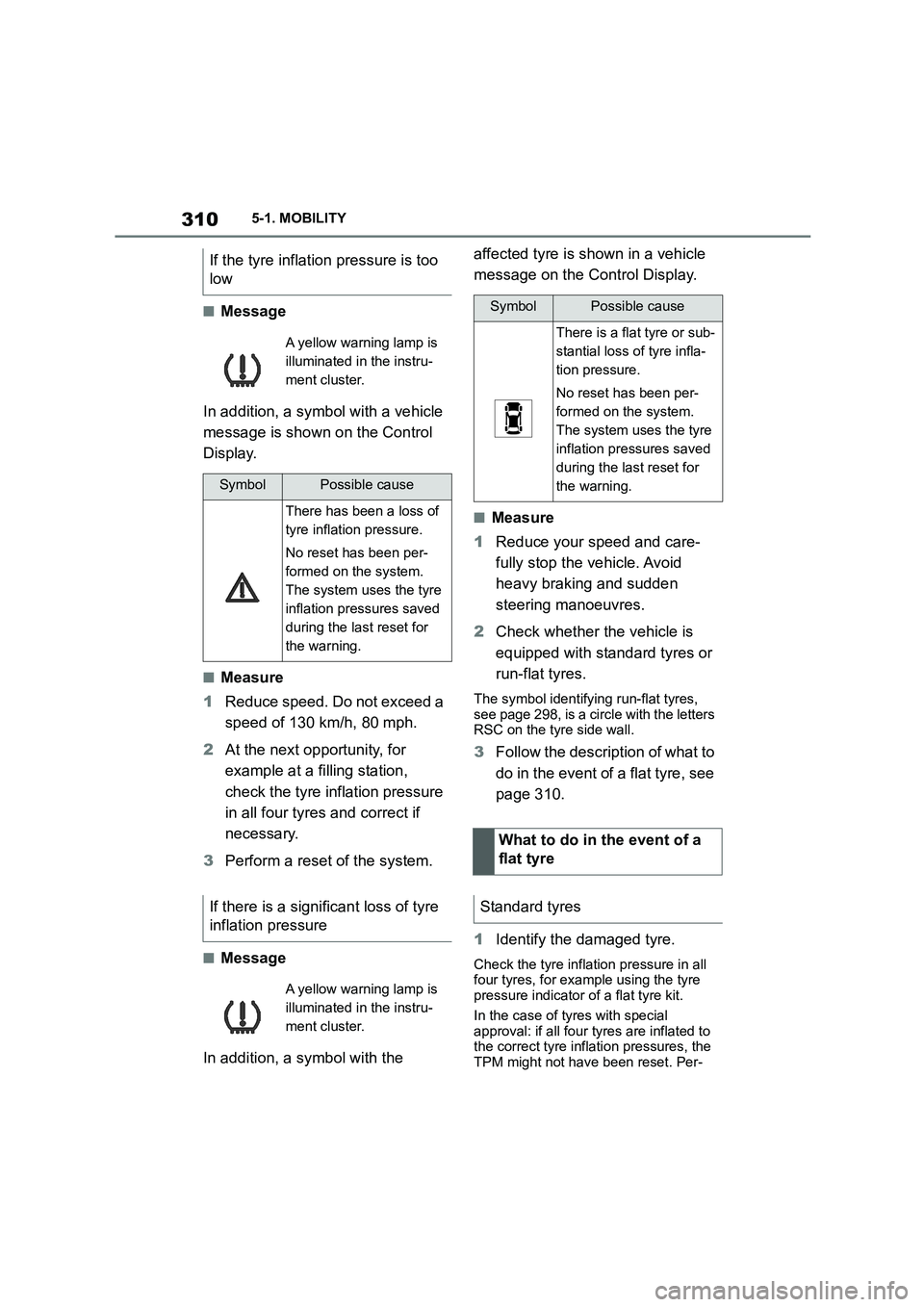
■Message
In addition, a symbol with a vehicle
message is shown on the Control
Display.
■Measure
1 Reduce speed. Do not exceed a
speed of 130 km/h, 80 mph.
2 At the next opportunity, for
example at a filling station,
check the tyre inflation pressure
in all four tyres and correct if
necessary.
3 Perform a reset of the system.
■Message
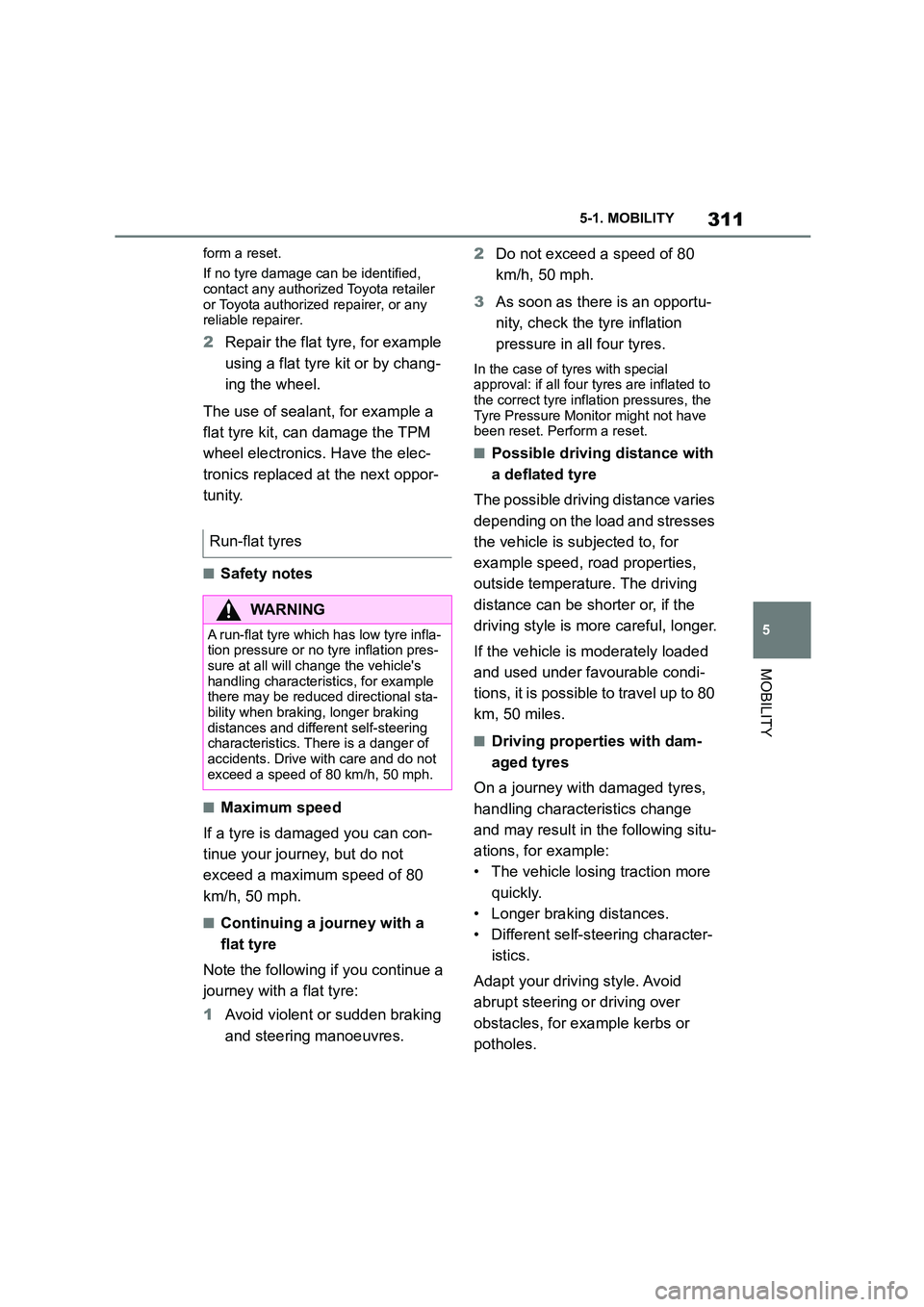
In addition, a symbol with the
affected tyre is shown in a vehicle
message on the Control Display.
■Measure
1 Reduce your speed and care-
fully stop the vehicle. Avoid
heavy braking and sudden
steering manoeuvres.
2 Check whether the vehicle is
equipped with standard tyres or
run-flat tyres.
The symbol identifying run-flat tyres,
see page 298, is a circle with the letters
RSC on the tyre side wall.
3 Follow the description of what to
do in the event of a flat tyre, see
page 310.
1 Identify the damaged tyre.
Check the tyre inflation pressure in all four tyres, for example using the tyre
pressure indicator of a flat tyre kit.
In the case of ty res with special approval: if all four tyres are inflated to
the correct tyre inflation pressures, the
TPM might not have been reset. Per-
If the tyre inflation pressure is too
low
A yellow warning lamp is
illuminated in the instru-
ment cluster.
SymbolPossible cause
There has been a loss of
tyre inflation pressure.
No reset has been per-
formed on the system.
The system uses the tyre
inflation pressures saved
during the last reset for
the warning.
If there is a significant loss of tyre
inflation pressure
A yellow warning lamp is
illuminated in the instru-
ment cluster.
SymbolPossible cause
There is a flat tyre or sub-
stantial loss of tyre infla-
tion pressure.
No reset has been per-
formed on the system.
The system uses the tyre
inflation pressures saved
during the last reset for
the warning.
What to do in the event of a
flat tyre
Standard tyres
Page 313 of 498
311
5
5-1. MOBILITY
MOBILITY
form a reset.
If no tyre damage can be identified, contact any authorized Toyota retailer
or Toyota authorized repairer, or any
reliable repairer.
2 Repair the flat tyre, for example
using a flat tyre kit or by chang-
ing the wheel.
The use of sealant, for example a
flat tyre kit, can damage the TPM
wheel electronics. Have the elec-
tronics replaced at the next oppor-
tunity.
■Safety notes
■Maximum speed
If a tyre is damaged you can con-
tinue your journey, but do not
exceed a maximum speed of 80
km/h, 50 mph.
■Continuing a journey with a
flat tyre
Note the following if you continue a
journey with a flat tyre:
1 Avoid violent or sudden braking
and steering manoeuvres.
2 Do not exceed a speed of 80
km/h, 50 mph.
3 As soon as there is an opportu-
nity, check the tyre inflation
pressure in all four tyres.
In the case of ty res with special approval: if all four tyres are inflated to
the correct tyre inflation pressures, the
Tyre Pressure Monitor might not have been reset. Perform a reset.
■Possible driving distance with
a deflated tyre
The possible driving distance varies
depending on the load and stresses
the vehicle is subjected to, for
example speed, road properties,
outside temperature. The driving
distance can be shorter or, if the
driving style is more careful, longer.
If the vehicle is moderately loaded
and used under favourable condi-
tions, it is possible to travel up to 80
km, 50 miles.
■Driving properties with dam-
aged tyres
On a journey with damaged tyres,
handling characteristics change
and may result in the following situ-
ations, for example:
• The vehicle losing traction more
quickly.
• Longer braking distances.
• Different self-steering character-
istics.
Adapt your driving style. Avoid
abrupt steering or driving over
obstacles, for example kerbs or
potholes.
Run-flat tyres
WA R N I N G
A run-flat tyre which has low tyre infla- tion pressure or no tyre inflation pres-
sure at all will change the vehicle's
handling characteristics, for example there may be reduced directional sta-
bility when braking, longer braking
distances and different self-steering characteristics. There is a danger of
accidents. Drive with care and do not
exceed a speed of 80 km/h, 50 mph.
Page 314 of 498
3125-1. MOBILITY
■Final tyre failure
Vibration or loud noises during the
journey may be an indication that
the tyre has finally failed.
Reduce your speed and stop the
vehicle. Parts of the tyre could
detach, which might lead to an acci-
dent.
Do not continue driving, but contact
any authorized Toyota retailer or
Toyota authorized repairer, or any
reliable repairer.
The tyre inflation pressure depends
on the temperature of the tyre.
The tyre inflation pressure
increases as the tyre temperature
increases, for example during driv-
ing or due to exposure to sunlight.
Tyre inflation pressure decreases if
the tyre temperature drops.
Due to the given warning thresh-
olds, therefore, this behaviour may
trigger a warning if there are major
temperature drops.
After a temperature-related warn-
ing, the specified pressures are dis-
played again on the Control Display
after driving a short distance.
No warning can be given in the
event of extreme, sudden tyre fail-
ure caused by external factors.
Tyres with special approval: the
system will not function correctly if
a reset has not been carried out, for
example, a flat ty re is reported in
spite of the correct tyre pressure.
• A wheel without TPM wheel elec-
tronics is fitted, for example
emergency wheel: have the
wheels checked if necessary.
• Malfunction: have the system
checked.
• Fault due to systems or devices
with the same radio frequency:
the system is automatically reac-
tivated upon leaving the field of
interference.
• Tyre Pressure Monitor malfunc-
tion: have the system checked
by any authorized Toyota retailer
or Toyota authorized repairer, or
System limits
Temperature
Sudden loss of tyre inflation pres-
sure
Reset not carried out
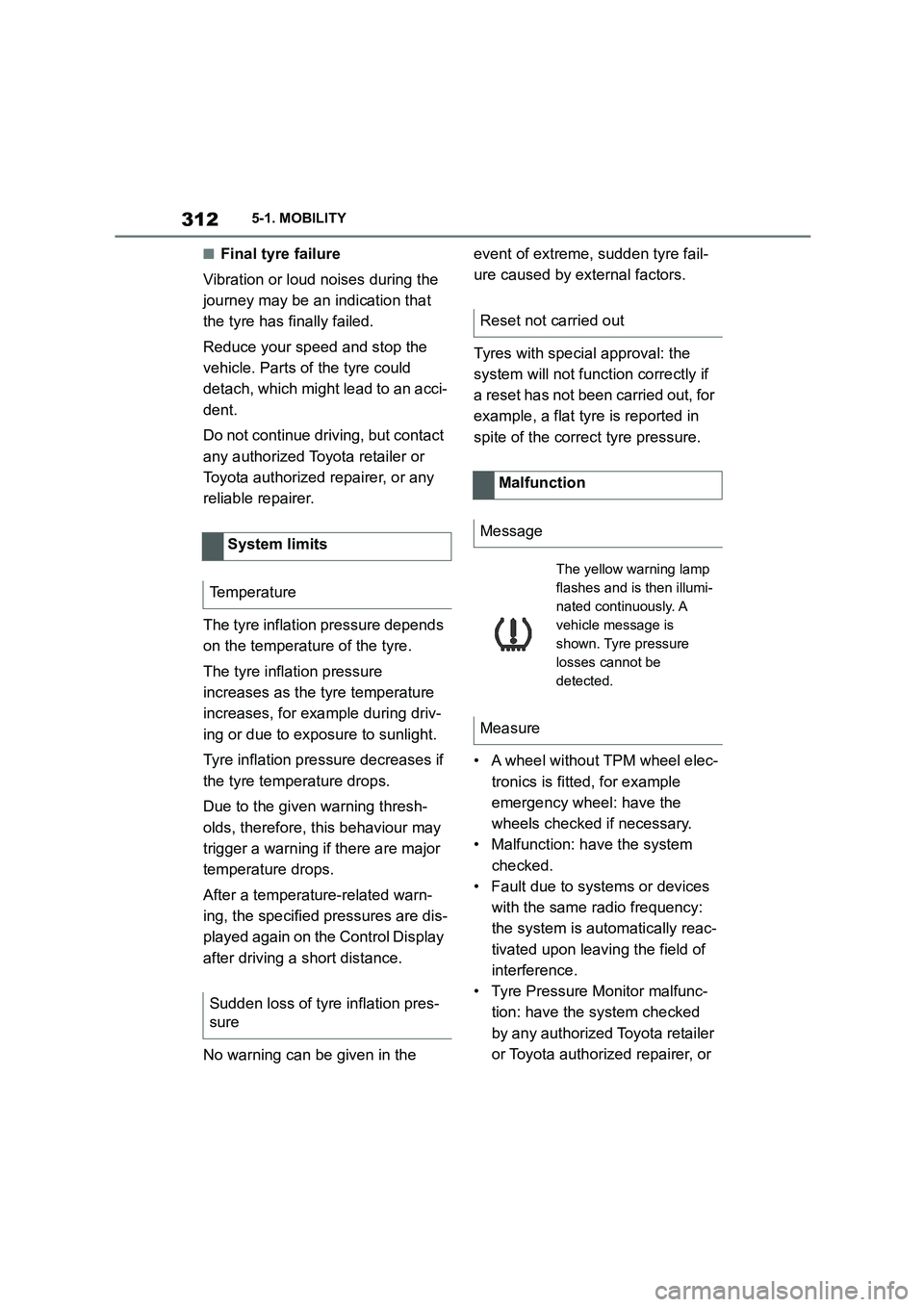
Malfunction
Message
The yellow warning lamp
flashes and is then illumi-
nated continuously. A
vehicle message is
shown. Tyre pressure
losses cannot be
detected.
Measure