2022 TOYOTA SUPRA maintenance
[x] Cancel search: maintenancePage 288 of 498
2864-1. DRIVING HINTS
This chapter describes all standard,
country-specific and special equip-
ment available for the model series.
It may therefore describe equip-
ment and functions which are not
installed in your vehicle, for exam-
ple on account of the special equip-
ment selected or the country
specification. This also applies to
safety-relevant functions and sys-
tems. Please comply with the rele-
vant laws and regulations when
using the corresponding functions
and systems.
The vehicle has a wide range of
technologies for reducing con-
sumption and emissions.
The fuel consumption depends on
various factors, for example driving
style, road conditions, service or
environmental factors.
A number of measures, such as a
moderate driving style and regular
maintenance, can influence fuel
consumption and reduce the bur-
den on the environment.
Extra weight increases fuel con-
sumption.
Add-on parts on the vehicle can
adversely affect its aerodynamic
performance and increase fuel con-
sumption.
Open windows increase drag and
consequently fuel consumption.
Tyres can have diff ering effects on
fuel consumption figures. The tyre
size, for example, can influence
how much fuel a vehicle uses.
Check and, if necessary, correct the
tyre inflation pressures at least
twice a month and before setting off
on a longer journey.
Insufficient tyre inflation pressure
increases rolling resistance and
consequently fuel consumption and
tyre wear.
Do not warm up the engine with the
vehicle at a stands till, but instead
Saving fuel
Vehicle equipment
Reducing fuel consumption
General
Remove unnecessary loads
Remove add-on parts after
use
Close windows
Ty r e s
General
Checking tyre inflation pressure
regularly
Drive off immediately
Page 289 of 498
287
4
4-1. DRIVING HINTS
DRIVING HINTS
set off straight away, driving at
moderate engine speeds.
This brings the cold engine up to
operating temperature as quickly as
possible.
Anticipating the road situation and
adopting a smooth driving style will
reduce fuel consumption.
Avoid accelerating and braking
unnecessarily.
Keep an appropriate distance from
the vehicle ahead.
Driving at low engine speeds
reduces fuel consumption and
wear.
Pay attention to the shift position
indicator, see page 171, in the vehi-
cle, if fitted.
When approaching a red traffic
light, take your foot off the accelera-
tor and allow the vehicle to coast to
a stop.
On downward stretc hes, take your
foot off the accelerator and allow
the vehicle to roll.
The fuel supply is interrupted in
overrun mode.
When you stop the vehicle for
longer periods, for example at traf-
fic lights, railway crossings or in
traffic jams, switch off the engine.
The Auto Start/Stop of the vehicle
shuts off the engine automatically
during a stop.
Switching the engine off and on
again reduces fuel consumption
and emissions compared with a
permanently running engine. Sav-
ings can be made just by shutting
down the engine for a few seconds.
Functions such as seat heating or
rear window heating require a great
deal of energy and increase fuel
consumption, especially in city traf-
fic and stop-and-go traffic.
Switch these functions off if they
are not required.
Have the vehicle serviced regularly
to achieve optimal economy and
lifetime. Toyota recommends hav-
ing maintenance work carried out
Think ahead
Avoid high engine speeds
Make use of overrun mode
Switch off the engine if stop-
ping for longer periods
Stopping the engine
Auto Start/Stop
Switch off functions which
are not currently required
Have maintenance work car-
ried out
Page 291 of 498
5
289
5
MOBILITY
MOBILITY
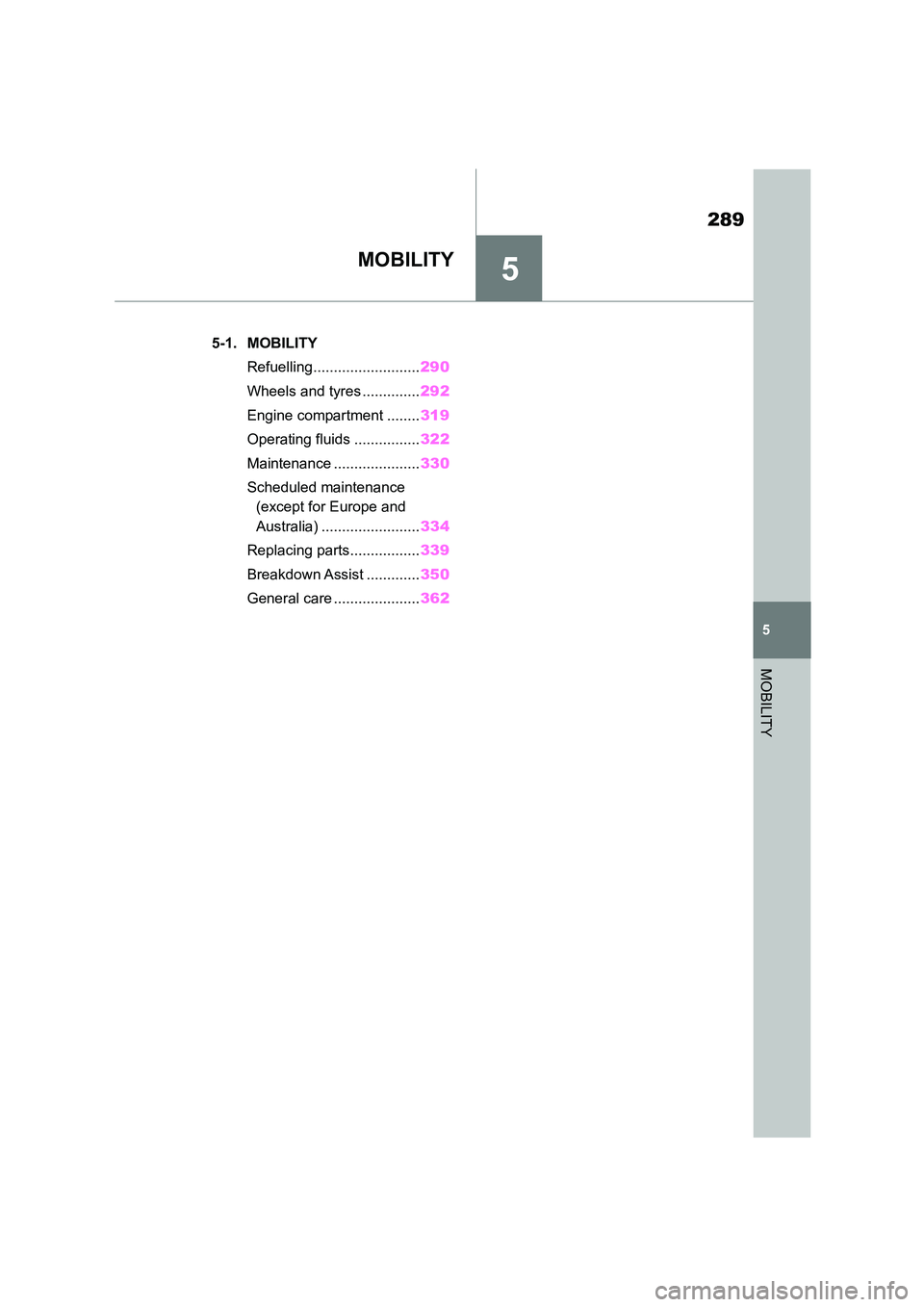
.5-1. MOBILITY
Refuelling.......................... 290
Wheels and tyres .............. 292
Engine compartment ........ 319
Operating fluids ................ 322
Maintenance ..................... 330
Scheduled maintenance
(except for Europe and
Australia) ........................ 334
Replacing parts................. 339
Breakdown Assist ............. 350
General care ..................... 362
Page 332 of 498

3305-1. MOBILITY
This chapter describes all standard,
country-specific and special equip-
ment available for the model series.
It may therefore describe equip-
ment and functions which are not
installed in your vehicle, for exam-
ple on account of the special equip-
ment selected or the country
specification. This also applies to
safety-relevant functions and sys-
tems. Please comply with the rele-
vant laws and regulations when
using the corresponding functions
and systems.
The maintenance system indicates
what maintenance measures are
required and thereby assists in
maintaining the road safety and
operational safety of the vehicle.
The exact work required and the
maintenance intervals may vary
depending on the country specifica-
tions. Replacement work, spare
parts, operating materials and wear
materials are calculated sepa-
rately. Additional information is
available from a dealer of the man-
ufacturer or another qualified dealer
or a specialist workshop.
Condition Based Service CBS
determines the maintenance
requirement using sensors and
special algorithms which monitor
the conditions in which the vehicle
is used.
The system thus enables the scope
of the maintenance work to be
adapted to the individual usage
profile.
Information on service require-
ments, see page 170, can be
shown on the Control Display.
Periods when the vehicle is out of
use with its battery disconnected
are not taken into account.
In such cases, have any
time-dependent maintenance pro-
cedures, for example for the brake
fluid and, where applicable, the
engine oil and microfilter/activated
charcoal filter, updated by a dealer
of the manufacturer or another
qualified dealer or a specialist
workshop.
Maintenance
Vehicle equipment
Maintenance System
Condition Based Service
CBS
Principle
General
Periods out of use
Page 333 of 498

331
5
5-1. MOBILITY
MOBILITY
Have maintenance and repairs car-
ried out by a deal er of the manufac-
turer or another qualified dealer or
a specialist workshop.
The maintenance work carried out
is entered in the maintenance
records and the vehicle data. As
with a service booklet, the entries
provide evidence of regular mainte-
nance.
Maintenance entered is shown on
the Control Display, see page 170.
Scheduled maintenance should be
performed at specified intervals
according to the maintenance
schedule.
For full details of your maintenance
schedule, read the "Toyota Service
Booklet" or "Toyota Warranty Booklet".
Scheduled maintenance should be
performed at specified intervals
according to the maintenance
schedule.
For full details of your maintenance
schedule, refer to the "Warranty and
Service Booklet".
Scheduled maintenance should
be performed at specified inter-
vals according to the mainte-
nance schedule.
The interval for scheduled maintenance
is determined by the odometer reading
or the time interval, whichever comes
first, shown in the schedule.
Maintenance beyond the last period
should be performed at the same inter-
vals.
Where to go for maintenance
service?
It makes good sense to take your vehi-
cle to your local Toyota dealer for main-
tenance service as well as other
inspections and repairs.
Toyota technicians are well-trained spe-
cialists receiving the latest service infor-
mation through technical bulletins,
service tips and in-dealership training
programs. They learn to work on Toyota
before they work on your vehicle, rather
than while they are working on it.
Doesn’t that seem like the best way?
Your Toyota dealer has invested a lot of
money in special Toyota tools and ser-
vice equipment. It helps them to do the
job better and at less cost.
Your Toyota dealer’s service depart-
ment will perform all of the scheduled
Service history
Maintenance and repairs
Entries
Displays
Scheduled maintenance (for
Europe)
Scheduled maintenance (for
Australia)
Scheduled maintenance
(except for Europe and
Australia)
Page 334 of 498

3325-1. MOBILITY
maintenance on your vehicle reliably
and economically.
Rubber hoses (for cooling and heater
system, brake system and fuel system)
should be inspected by a qualified tech-
nician according to the Toyota mainte-
nance schedule.
Rubber hoses are particularly important
maintenance items. Have any deterio-
rated or damaged hoses replaced
immediately. Note that rubber hoses
will deteriorate with age, resulting in
swelling, chafing or cracking.
No maintenance work other than
normal maintenance is required to
keep the emission levels of your
vehicle within the design limits.
Devices connected to the OBD
socket trigger the alarm system
when the vehicle is locked.
Remove any devices connected to
the OBD socket before locking the
vehicle.
The OBD socket for checking emis-
sions-relevant components is
located on the driver's side.
For Australia: maintenance
Socket for on-board diagno-
sis OBD
General
Safety note
NOTICE
Incorrect use of the OBD on-board
diagnosis socket can result in mal- functions in the vehicle. There is a
danger of damage to property. Only
have service and maintenance work involving the OBD on-board diagnosis
socket carried out by any authorized
Toyota retailer or Toyota authorized
repairer, or any reliable repairer or other authorised persons. Only con-
nect devices that have been tested
and found to be safe for use with the OBD on-board diagnosis socket.
Position
Page 336 of 498

3345-1. MOBILITY
Your vehicle needs to be serviced according to the normal maintenance
schedule.
Maintenance operations:
I = Inspect, correct or replace as necessary
R = Replace, change or lubricate
Scheduled maintenance (except for Europe and
Australia)
Perform maintenance by the schedule as follows:
Maintenance schedule requirements
Maintenance schedule (except for Korea, Mexico and South
Africa)
SERVICE
INTERVAL:ODOMETER READING
MONTHS(Odometer
reading or
months, which-
ever comes
first.)
x1000
km1224364860728496
x1000
miles7.214.421.628.83643.250.457.6
BASIC ENGINE COMPONENTS
1
Engine oil (Include
engine oil filter)
<
RRRRRRRR12
IGNITION SYSTEM
2Spark plugsRRRR24
FUEL AND EMISSION CONTROL SYSTEMS
3Air filterRRRR24
CHASSIS AND BODY
4Brake padsReplace when the brake warning light
appears.-
5Brake fluidFirst replace at 36 months, then replace at every 24
months.
Page 338 of 498

3365-1. MOBILITY
NOTE:
Replace both the engine oil and oil filter when the engine oil warning light
appears, even if 12 months have not passed or when driven less than
12000 km (7200 miles) since the last oil change.
Maintenance operations:
I = Inspect, correct or replace as necessary
R = Replace, change or lubricate
21Road safety and per-
forming a test driveII48
22Micro filterRRRR24
SERVICE
INTERVAL:ODOMETER READING
MONTHS(Odometer
reading or
months, which-
ever comes
first.)
x1000
km1224364860728496
x1000
miles7.214.421.628.83643.250.457.6
Maintenance schedule (for Korea, Mexico and South Africa)
SERVICE INTER-
VA L :ODOMETER READING
MONTHS(Odometer read-
ing or months,
whichever comes
first.)
x1000
km20406080100120
x1000
miles122436486072
BASIC ENGINE COMPONENTS
1
Engine oil (Include
engine oil filter) <
RRRRRR18
IGNITION SYSTEM
2Spark plugsRR54
FUEL AND EMISSION CONTROL SYSTEMS
3Air filterRR54
CHASSIS AND BODY