2022 TOYOTA GR86 air condition
[x] Cancel search: air conditionPage 293 of 582

291
6
6-3. Do-it-yourself maintenance
Maintenance and care
6-3.Do-it-yourself maintenance
Do-it-yourself ser vice
precautions
If you perform maintenance by
yourself, be sure to follow the
correct procedure as given in
these sections.
Maintenance
ItemsParts and tools
Battery condition
( P.298)
•Warm water
• Baking soda
•Grease
• Conventional
wrench (for termi-
nal clamp bolts)
• Distilled water
Engine coolant
level( P.297)
• “TOYOTA Genu-
ine 50/50
Pre-mixed Super
Long Life Coolant
BLUE” or a similar
high quality ethyl-
ene glycol-based
non-silicate,
non-amine,
non-nitrite and
non-borate cool-
ant with long-life
hybrid organic acid
technology.
• Funnel (used only
for adding coolant)
Engine oil level
( P.295)
• “Toyota Genuine
Motor Oil” or equiv-
alent
• Rag or paper towel
• Funnel (used only
for adding engine
oil)
Fuses ( P.319)
• Fuse with same
amperage rating
as original
Light bulbs
( P.321)
• Bulb with same
number and watt-
age rating as origi-
nal
• Phillips-head
screwdriver
• Flathead screw-
driver
Radiator and
condenser
( P.298)
Tire inflation
pressure
( P.312)
• Tire pressure
gauge
• Compressed air
source
Washer fluid
( P.300)
• Water or washer
fluid containing
antifreeze (for win-
ter use)
• Funnel (used only
for adding water or
washer fluid)
WA R N I N G
The engine compartment contains
many mechanisms and fluids that may move suddenly, become hot, or
become electrically energized. To
avoid death or serious injury, observe the following precautions.
ItemsParts and tools
Page 294 of 582

2926-3. Do-it-yourself maintenance
WA R N I N G
■When working on the engine
compartment
●Keep hands, clothing and tools away from the moving fans and
engine drive belt.
●Be careful not to touch the engine,
radiator, exhaust manifold, etc. right
after driving as they may be hot. Oil
and other fluids may also be hot.
●Do not leave anything that may
burn easily, such as paper and rags, in the engine compartment.
●Do not smoke, cause sparks or expose an open flame to fuel or the
battery. Fuel and battery fumes are
flammable.
●Be extremely cautious when work-
ing on the battery. It contains poi- sonous and corrosive sulfuric acid.
●Take care because brake fluid can harm your hands or eyes and dam-
age painted surfaces. If fluid gets
on your hands or in your eyes, flush the affected area with clean water
immediately.
If you still experience discomfort, con- sult a doctor.
■When working near the electric cooling fans or radiator grille
Be sure the engine switch is off.
With the engine switch in ON, the electric cooling fans may automati-
cally start to run if the air conditioning
is on and/or the coolant temperature is high. (P.298)
■Safety glasses
Wear safety glasses to prevent flying
or falling material, fluid spray, etc.
from getting in your eyes.
NOTICE
■If you remove the air cleaner fil-
ter
Driving with the air cleaner filter removed may cause excessive
engine wear due to dirt in the air.
■If the fluid level is low or high
It is normal for the brake fluid level to
go down slightly as the brake pads
wear or when the fluid level in the accumulator is high.
If the reservoir needs frequent refill-
ing, it may indicate a serious problem.
Page 300 of 582
![TOYOTA GR86 2022 Owners Manual (in English) 2986-3. Do-it-yourself maintenance
“TOYOTA Genuine 50/50 Pre-mixed
Super Long Life Coolant BLUE” is a mix- ture of 50% coolant and 50% deionized
water. (Minimum temperature: -35°C
[-31°F])](/manual-img/14/48545/w960_48545-299.png "TOYOTA GR86 2022 Owners Manual (in English) 2986-3. Do-it-yourself maintenance
“TOYOTA Genuine 50/50 Pre-mixed
Super Long Life Coolant BLUE” is a mix- ture of 50% coolant and 50% deionized
water. (Minimum temperature: -35°C
[-31°F])")
2986-3. Do-it-yourself maintenance
“TOYOTA Genuine 50/50 Pre-mixed
Super Long Life Coolant BLUE” is a mix- ture of 50% coolant and 50% deionized
water. (Minimum temperature: -35°C
[-31°F])
For more details about engine coolant,
contact any authorized Toyota dealer or
repairer, or another duly qualified and equipped professional.
■If the coolant level drops within a
short time of replenishing
Visually check the radiator, hoses, engine coolant reservoir caps, drain
cock and water pump.
If you cannot find a leak, have your Toyota dealer test the cap and check for
leaks in the cooling system.
Check the radiator and condenser
and clear away any foreign objects.
If either of the above parts is
extremely dirty or you are not sure
of their condition, have your vehicle
inspected by any authorized Toyota
retailer or Toyota authorized
repairer, or any reliable repairer.
Check the battery as follows.
■Battery exterior
Make sure that the battery termi-
nals are not corroded and that there
are no loose connections, cracks,
or loose clamps.
Hold-down clamp
Terminals
■Checking battery fluid
Check that the level is between the
“UPPER LEVEL” and “LOWER
LEVEL” lines.
WA R N I N G
■When the engine is hot
Do not remove the engine coolant reservoir cap. ( P.364)
The cooling system may be under
pressure and may spray hot coolant if the cap is removed, causing serious
injuries, such as burns.
NOTICE
■When adding coolant
Coolant is neither plain water nor
straight antifreeze. The correct mix-
ture of water and antifreeze must be used to provide proper lubrication,
corrosion protection and cooling. Be
sure to read the antifreeze or coolant label.
■If you spill coolant
Be sure to wash it off with water to
prevent it from damaging parts or
paint.
Checking the radiator and
condenser
WA R N I N G
■When the engine is hot
Do not touch the radiator or con-
denser as they may be hot and cause serious injuries, such as burns.
Battery
A
Page 304 of 582

3026-3. Do-it-yourself maintenance
Replace the tires if the treadwear indi-
cators are showing on a tire.
■When to replace your vehicle’s
tires
Tires should be replaced if:
●The treadwear indicators are showing on a tire.
●You have tire damage such as cuts, splits, cracks deep enough to expose
the fabric, and bulges indicating inter-
nal damage
●A tire goes flat repeatedly or cannot
be properly repaired due to the size or location of a cut or other damage
If you are not sure, consult with any
authorized Toyota dealer or repairer, or another duly qualified and equipped pro-
fessional.
■Tire life
Any tire over 6 years old must be checked by a qualified technician even if
it has seldom or never been used or
damage is not obvious.
■Low profile tires
Generally, low profile tires will wear
more rapidly and tire grip performance
will be reduced on snowy and/or icy roads when compared to standard tires.
Be sure to use snow tires or tire chains
on snowy and/or icy roads and drive
carefully at a speed appropriate for road and weather conditions.
■If the tread on snow tires wears
down below 4 mm (0.16 in.)
The effectiveness of the tires as snow tires is lost.
WA R N I N G
■When inspecting or replacing
tires
Observe the following precautions to prevent accidents.
Failure to do so may cause damage
to parts of the drive train as well as dangerous handling characteristics,
which may lead to an accident result-
ing in death or serious injury.
●Make sure to insta ll 4 tires that are
of the specified size, and that all 4
tires are the same size, same maker, same brand and tread pat-
tern.
●Do not use tire sizes other than
those recommended by Toyota.
●Only use radial tires.
●Do not mix summer, all season and snow tires.
●Do not use tires that have been used on another vehicle.
Do not use tires if you do not know
how they were used previously.
NOTICE
■Low profile tires
Low profile tires may cause greater
damage than usual to the tire wheel when sustaining impact from the road
surface. Therefore, pay attention to
the following:
●Be sure to use proper tire inflation
pressure. If tires are under-inflated, they may be damaged more
severely.
●Avoid potholes, uneven pavement,
curbs and other road hazards. Fail-
ure to do so may lead to severe tire and wheel damage.
Page 306 of 582

3046-3. Do-it-yourself maintenance
pressure has been adjusted.
●Tire inflation pressure changes with
temperature. The displayed values
may also be different from the values measured using a tire pressure
gauge.
■Situations in which the tire pres-
sure warning system may not oper- ate properly
●In the following cases, the tire pres-sure warning system may not operate
properly.
• If non-genuine Toyota wheels are used.
• A tire has been replaced with a tire
that is not an OE (Original Equipment) tire.
• A tire has been replaced with a tire
that is not of the specified size. • Tire chains, etc. are equipped.
• An auxiliary-supported run-flat tire is
equipped. • If a window tint that affects the radio
wave signals is installed.
• If there is a lot of snow or ice on the vehicle, particularly around the wheels
or wheel housings.
• If the tire inflation pressure is extremely higher than the specified
level.
• If tires not equipped with tire pressure warning valves and transmitters are
used.
• If the ID code on the tire pressure warning valves and transmitters is not
registered in the tire pressure warning
computer.
●Performance may be affected in the
following situations. • When driving near a TV tower, electric
power plant, gas station, radio station,
large display, airport or other facility
that generates strong radio waves or electrical noise
• When carrying a portable radio, cellu-
lar phone, cordless phone or other wireless communication device
If tire position information is not correctly
displayed due to the radio wave condi- tions, the display ma y be corrected by
driving and changing the radio wave
conditions.
●When the vehicle is parked, the time
taken for the warning to start or go off
could be extended.
●When tire inflation pressure declines
rapidly for example when a tire has burst, the warning may not function.
■Warning performance of the tire
pressure warning system
The warning of the tire pressure warning system will change in accordance with
driving conditions. For this reason, the
system may give a warning even if the tire pressure does not reach a low
enough level, or if the pressure is higher
than the pressure that was adjusted to when the system was initialized.
When replacing tires or wheels, tire
pressure warning valves and trans-
mitters must also be installed.
When new tire pressure warning
valves and transmitters are
installed, new ID codes must be
registered in the tire pressure warn-
ing computer and the tire pressure
warning system must be initialized.
Have tire pressu re warning valve
and transmitter ID codes regis-
tered by any authorized Toyota
retailer or Toyota authorized
repairer, or any reliable repairer.
( P. 3 0 6 )
■Replacing tires and wheels
If the ID code of the tire pressure warn-
ing valve and transmitter is not regis- tered, the tire pressure warning system
will not work properly. After driving for
about 10 minutes, the tire pressure warning light blinks for 1 minute and
Installing tire pressure warn-
ing valves and transmitters
Page 314 of 582

3126-3. Do-it-yourself maintenance
■Effects of incorrect tire inflation
pressure
Driving with incorrect tire inflation pres-
sure may result in the following:
●Reduced fuel economy
●Reduced driving comfort and poor handling
●Reduced tire life due to wear
●Reduced safety
●Damage to the drivetrain
If a tire needs frequent inflating, have it
checked by any authorized Toyota retailer or Toyota authorized repairer, or
any reliable repairer.
■Instructions for checking tire infla-
tion pressure
When checking tire inflation pressure, observe the following:
●Check only when the tires are cold.If your vehicle has been parked for at
least 3 hours or has not been driven
for more than 1.5 km or 1 mile, you will get an accurate cold tire inflation
pressure reading.
●Always use a tire pressure gauge.
It is difficult to judge if a tire is properly
inflated based only on its appearance.
●It is normal for the tire inflation pres-
sure to be higher after driving as heat is generated in the tire. Do not reduce
tire inflation pressure after driving.
●Passengers and luggage weight
should be placed so that the vehicle is
balanced.Tire inflation pressure
Make sure to maintain proper
tire inflation pressure. Tire
inflation pressure should be
checked at least once per
month. However, Toyota rec-
ommends that tire inflation
pressure be checked once
every two weeks.
WA R N I N G
■Proper inflation is critical to save
tire performance
Keep your tires properly inflated. If the tires are not properly inflated,
the following conditions may occur
which could lead to an accident
resulting in death or serious injury:
●Excessive wear
●Uneven wear
●Poor handling
●Possibility of blowouts resulting
from overheated tires
●Air leaking from between tire and
wheel
●Wheel deformation and/or tire dam-
age
●Greater possibility of tire damage
while driving (due to road hazards, expansion joints, sharp edges in the
road, etc.)
NOTICE
■When inspecting and adjusting tire inflation pressure
Be sure to put the tire valve caps back
on. If a valve cap is not installed, dirt or
moisture may get into the valve and
cause an air leak, resulting in decreased tire inflation pressure.
Page 316 of 582

3146-3. Do-it-yourself maintenance
Use only Toyota wheel nuts and
wrenches designed for use with
your aluminum wheels.
When rotating, repairing or
changing your tires, check that
the wheel nuts ar e still tight after
driving 1600 km (1000 miles).
Be careful not to damage the
aluminum wheels when using
tire chains.
Use only Toyota genuine balance
weights or equivalent and a plas-
tic or rubber hammer when bal-
ancing your wheels.
1 Turn the engine switch off.
2 Open the glove box. Slide off
the damper.
Left-hand drive vehicles
Right-hand drive vehicles
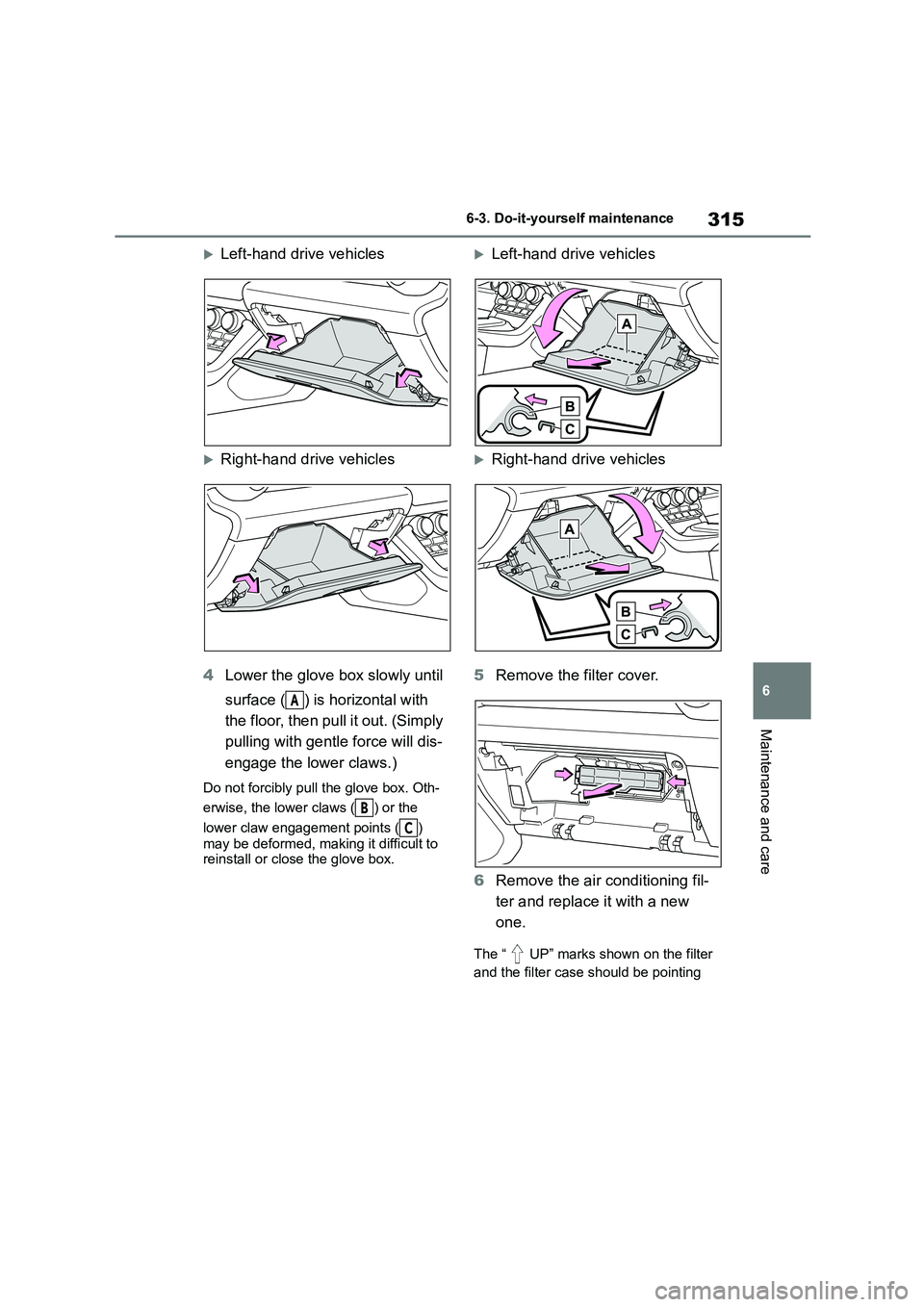
3 Push in each side of the glove
box and pull the glove box
toward you to disconnect the
claws.
NOTICE
●Ensure that only genuine Toyota
wheels are used on your vehicle.
Tire pressure warning valves and transmitters may not work properly
with non-genuine wheels.
Aluminum wheel precau-
tions
Air conditioning filter
The air conditioning filter must
be changed regularly to main-
tain air conditioning efficiency.
Removing the air condition-
ing filter
Page 317 of 582
315
6
6-3. Do-it-yourself maintenance
Maintenance and care
Left-hand drive vehicles
Right-hand drive vehicles
4 Lower the glove box slowly until
surface ( ) is horizontal with
the floor, then pull it out. (Simply
pulling with gentle force will dis-
engage the lower claws.)
Do not forcibly pull the glove box. Oth-
erwise, the lower claws ( ) or the
lower claw engagement points ( )
may be deformed, making it difficult to
reinstall or close the glove box.
Left-hand drive vehicles
Right-hand drive vehicles
5 Remove the filter cover.
6 Remove the air conditioning fil-
ter and replace it with a new
one.
The “ UP” marks shown on the filter
and the filter case should be pointing
A
B
C