2022 TOYOTA COROLLA Spare
[x] Cancel search: SparePage 503 of 678
501
8
8-2. Steps to take in an emergency
When trouble arises
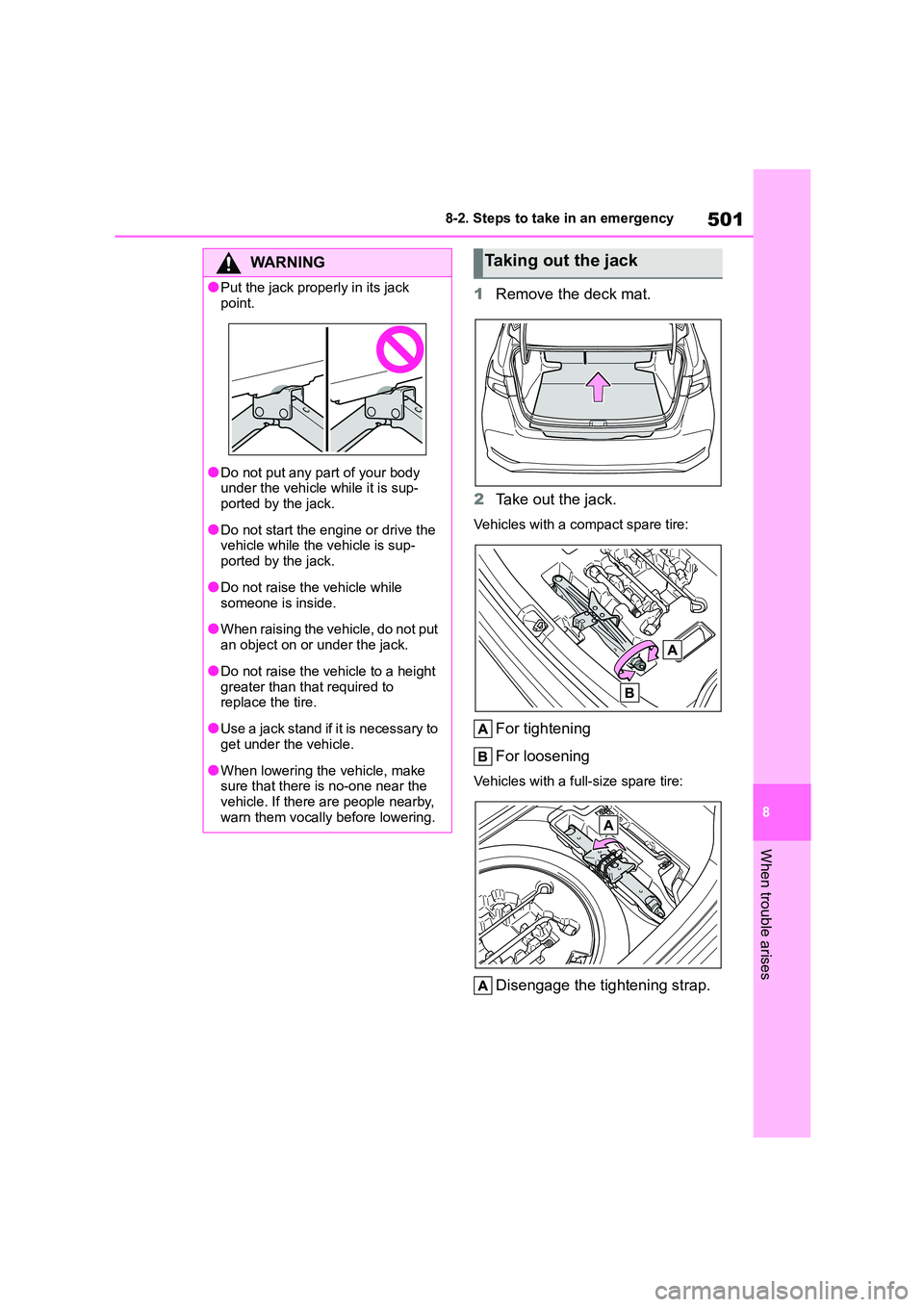
1 Remove the deck mat.
2 Take out the jack.
Vehicles with a compact spare tire:
For tightening
For loosening
Vehicles with a full-size spare tire:
Disengage the tightening strap.
WA R N I N G
●Put the jack properly in its jack
point.
●Do not put any part of your body under the vehicle while it is sup-
ported by the jack.
●Do not start the engine or drive the
vehicle while the vehicle is sup-
ported by the jack.
●Do not raise the vehicle while
someone is inside.
●When raising the vehicle, do not put
an object on or under the jack.
●Do not raise the vehicle to a height
greater than that required to replace the tire.
●Use a jack stand if it is necessary to get under the vehicle.
●When lowering the vehicle, make sure that there is no-one near the
vehicle. If there are people nearby,
warn them vocally before lowering.
Taking out the jack
Page 504 of 678
5028-2. Steps to take in an emergency
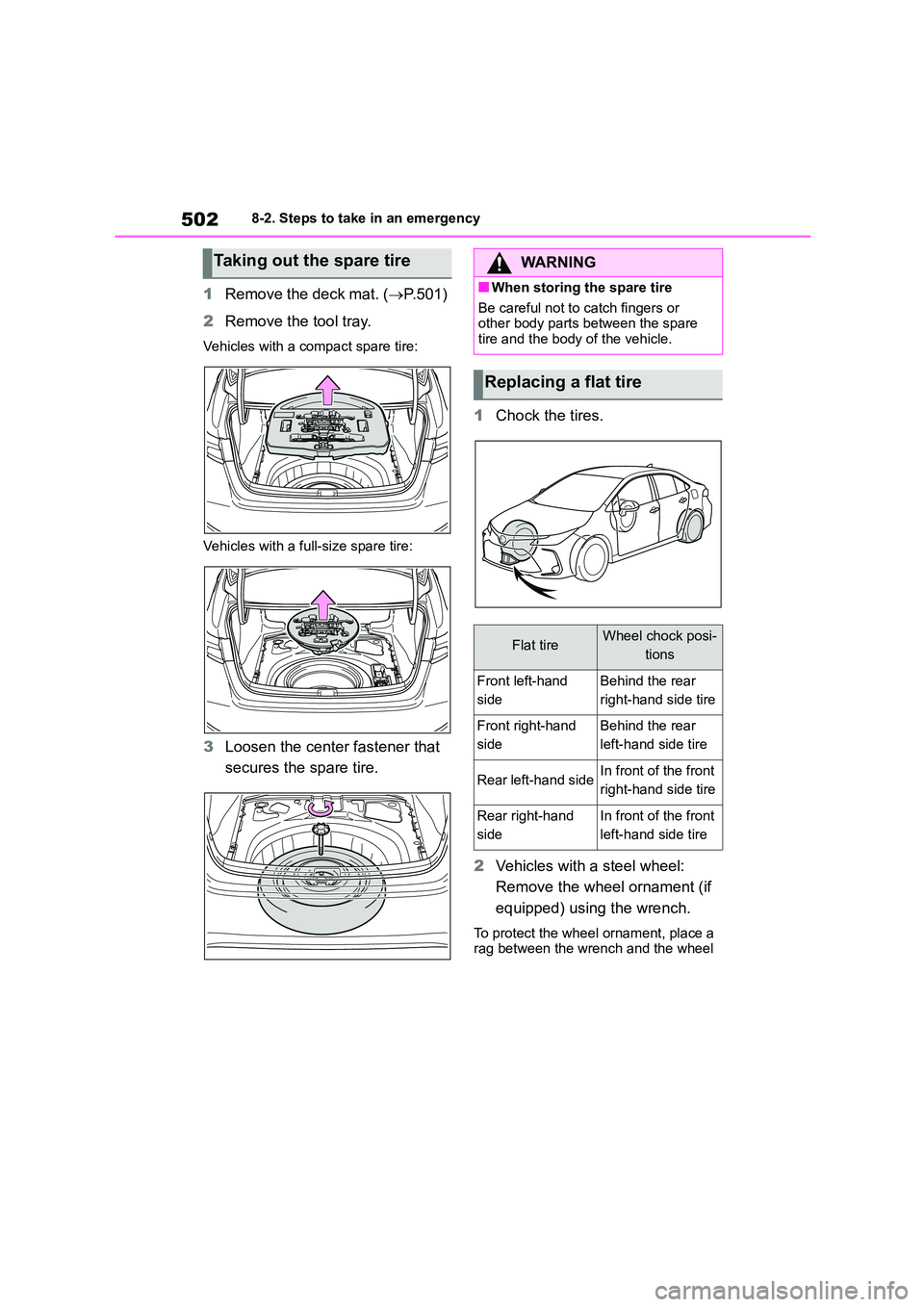
1Remove the deck mat. (P.501)
2 Remove the tool tray.
Vehicles with a compact spare tire:
Vehicles with a full-size spare tire:
3 Loosen the center fastener that
secures the spare tire.
1 Chock the tires.
2 Vehicles with a steel wheel:
Remove the wheel ornament (if
equipped) using the wrench.
To protect the wheel ornament, place a
rag between the wrench and the wheel
Taking out the spare tireWA R N I N G
■When storing the spare tire
Be careful not to catch fingers or
other body parts between the spare tire and the body of the vehicle.
Replacing a flat tire
Flat tireWheel chock posi-
tions
Front left-hand
side
Behind the rear
right-hand side tire
Front right-hand
side
Behind the rear
left-hand side tire
Rear left-hand sideIn front of the front
right-hand side tire
Rear right-hand
side
In front of the front
left-hand side tire
Page 506 of 678
5048-2. Steps to take in an emergency
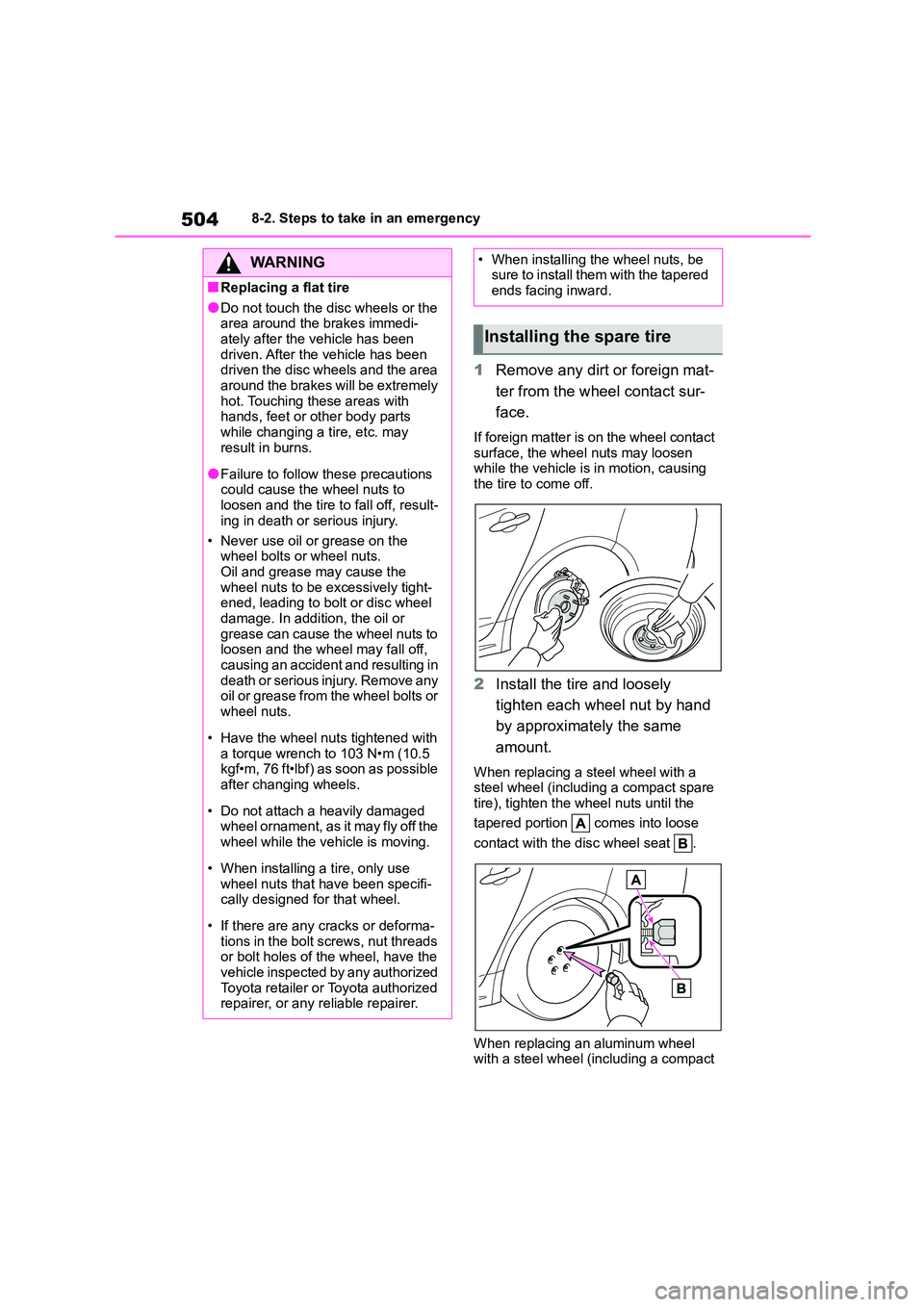
1Remove any dirt or foreign mat-
ter from the wheel contact sur-
face.
If foreign matter is on the wheel contact
surface, the wheel nuts may loosen while the vehicle is in motion, causing
the tire to come off.
2 Install the tire and loosely
tighten each wheel nut by hand
by approximately the same
amount.
When replacing a steel wheel with a
steel wheel (including a compact spare
tire), tighten the wheel nuts until the
tapered portion comes into loose
contact with the disc wheel seat .
When replacing an aluminum wheel
with a steel wheel (including a compact
WA R N I N G
■Replacing a flat tire
●Do not touch the disc wheels or the
area around the brakes immedi- ately after the vehicle has been
driven. After the vehicle has been
driven the disc wheels and the area around the brakes will be extremely
hot. Touching these areas with
hands, feet or other body parts
while changing a tire, etc. may result in burns.
●Failure to follow these precautions could cause the wheel nuts to
loosen and the tire to fall off, result-
ing in death or serious injury.
• Never use oil or grease on the
wheel bolts or wheel nuts.
Oil and grease may cause the wheel nuts to be excessively tight-
ened, leading to bolt or disc wheel
damage. In addition, the oil or grease can cause the wheel nuts to
loosen and the wheel may fall off,
causing an accident and resulting in death or serious injury. Remove any
oil or grease from the wheel bolts or
wheel nuts.
• Have the wheel nuts tightened with
a torque wrench to 103 N•m (10.5 kgf•m, 76 ft•lbf) as soon as possible
after changing wheels.
• Do not attach a heavily damaged
wheel ornament, as it may fly off the
wheel while the vehicle is moving.
• When installing a tire, only use
wheel nuts that have been specifi- cally designed for that wheel.
• If there are any cracks or deforma- tions in the bolt screws, nut threads
or bolt holes of the wheel, have the
vehicle inspected by any authorized Toyota retailer or Toyota authorized
repairer, or any reliable repairer.
• When installing the wheel nuts, be sure to install them with the tapered
ends facing inward.
Installing the spare tire
Page 507 of 678
505
8
8-2. Steps to take in an emergency
When trouble arises
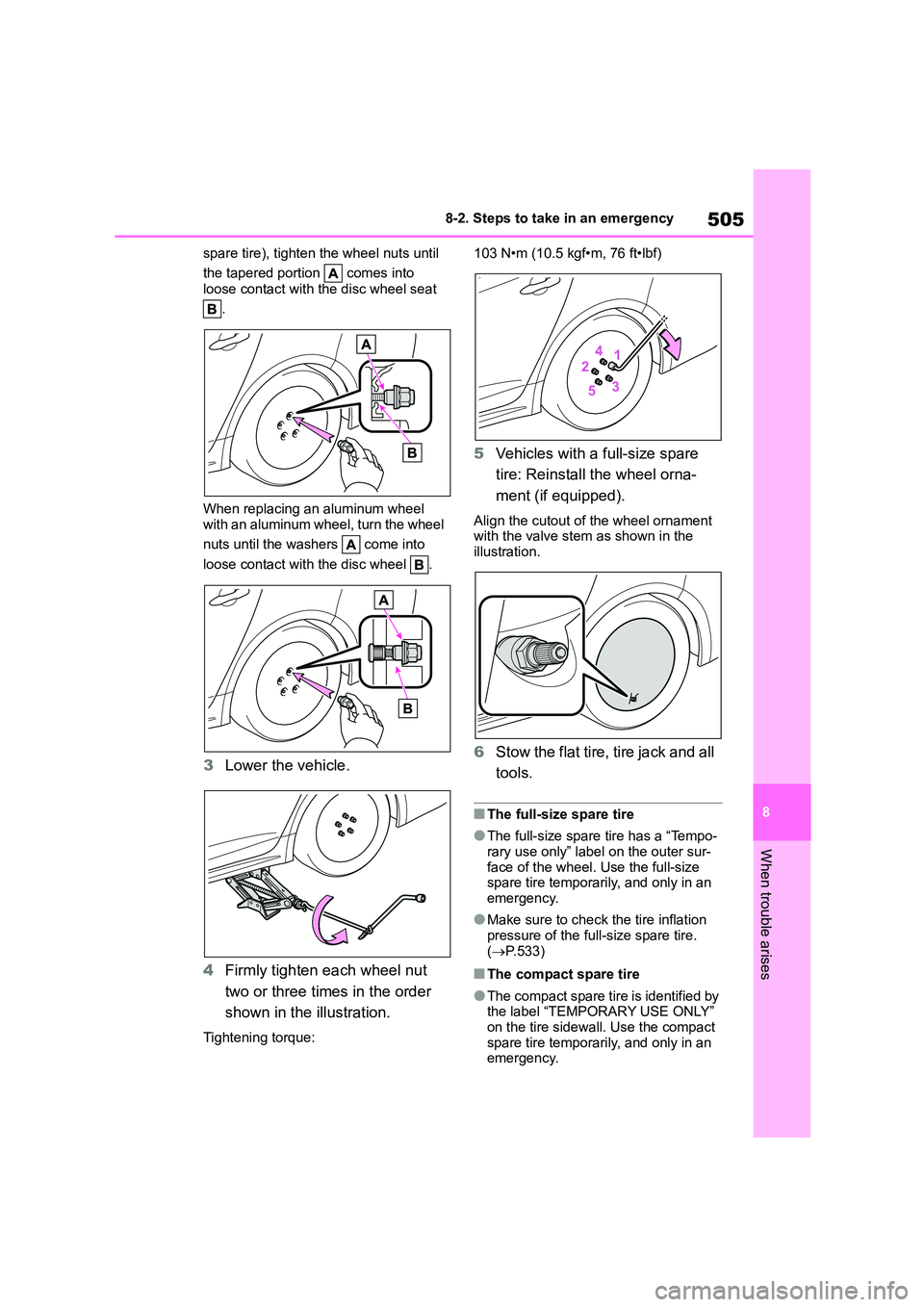
spare tire), tighten the wheel nuts until
the tapered portion comes into
loose contact with the disc wheel seat
.
When replacing an aluminum wheel
with an aluminum wheel, turn the wheel
nuts until the washers come into
loose contact with the disc wheel .
3 Lower the vehicle.
4 Firmly tighten each wheel nut
two or three times in the order
shown in the illustration.
Tightening torque:
103 N•m (10.5 kgf•m, 76 ft•lbf)
5 Vehicles with a full-size spare
tire: Reinstall the wheel orna-
ment (if equipped).
Align the cutout of the wheel ornament
with the valve stem as shown in the
illustration.
6 Stow the flat tire, tire jack and all
tools.
■The full-size spare tire
●The full-size spare tire has a “Tempo-
rary use only” label on the outer sur-
face of the wheel. Use the full-size spare tire temporarily, and only in an
emergency.
●Make sure to check the tire inflation
pressure of the full-size spare tire.
( P.533)
■The compact spare tire
●The compact spare tire is identified by
the label “TEMPORARY USE ONLY” on the tire sidewall. Use the compact
spare tire temporarily, and only in an
emergency.
Page 508 of 678
5068-2. Steps to take in an emergency
●Make sure to check the tire inflation
pressure of the compact spare tire. ( P.533)
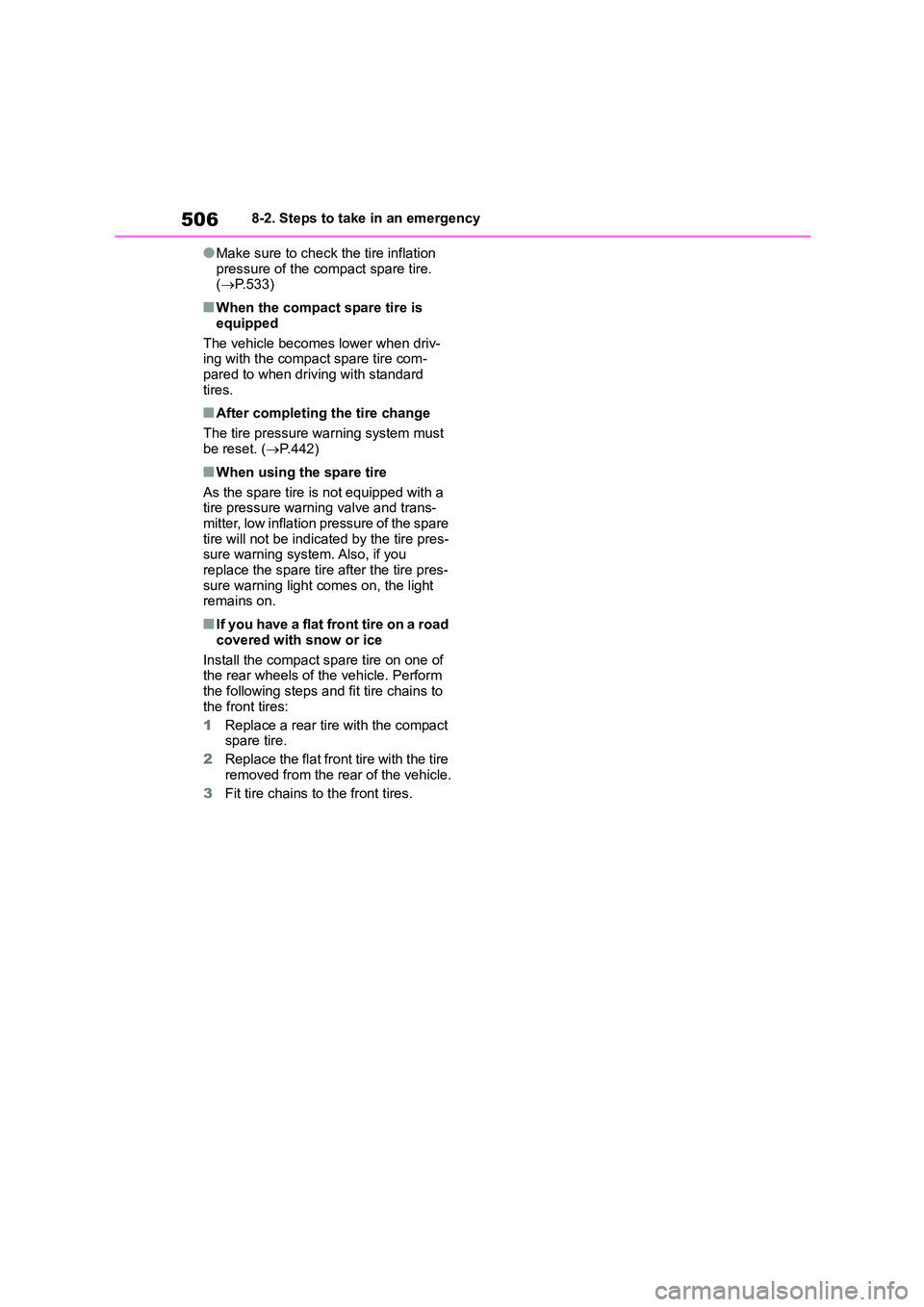
■When the compact spare tire is
equipped
The vehicle becomes lower when driv- ing with the compact spare tire com-
pared to when driving with standard
tires.
■After completing the tire change
The tire pressure warning system must
be reset. ( P.442)
■When using the spare tire
As the spare tire is not equipped with a tire pressure warning valve and trans-
mitter, low inflation pressure of the spare
tire will not be indicated by the tire pres- sure warning system. Also, if you
replace the spare tire after the tire pres-
sure warning light comes on, the light remains on.
■If you have a flat front tire on a road
covered with snow or ice
Install the compact spare tire on one of the rear wheels of the vehicle. Perform
the following steps and fit tire chains to
the front tires:
1 Replace a rear tire with the compact spare tire.
2 Replace the flat front tire with the tire
removed from the rear of the vehicle.
3 Fit tire chains to the front tires.
Page 510 of 678

5088-2. Steps to take in an emergency
WA R N I N G
■When using the full-size spare
tire
●Replace the full-size spare tire with a standard tire as soon as possible.
●Avoid sudden acceleration, abrupt steering, sudden braking and shift-
ing operations that cause sudden
engine braking.
■When using the compact spare
tire
●Remember that the compact spare tire provided is specifically
designed for use with your vehicle.
Do not use your compact spare tire on another vehicle.
●Do not use more than one compact spare tires simultaneously.
●Replace the compact spare tire with a standard tire as soon as possible.
●Avoid sudden acceleration, abrupt steering, sudden braking and shift-
ing operations that cause sudden
engine braking.
■When the compact spare tire is
attached
The vehicle speed may not be cor-
rectly detected, an d the following sys-
tems may not operate correctly:
• ABS & Brake assist
• VSC
•TRC
• Automatic High Beam (if equipped)
• Cruise control (if equipped)
• Dynamic radar cruise control with full-speed range (if equipped)
• Dynamic radar cruise control (if equipped)
• EPS
• PCS (Pre-Collision System) (if equipped)
• LDA (Lane Departure Alert with steering control) (if equipped)
• LTA (Lane Tracing Assist) (if equipped)
• Tire pressure warning system
• Toyota parking assist-sensor (if
equipped)
• PKSB (Parking Support Brake) (if
equipped)
• BSM (Blind Spot Monitor) (if
equipped)
• Rear view monitor system (if
equipped)
• S-IPA (Simple Intelligent Parking
Assist System) (if equipped)
• Navigation system (if equipped)
■Speed limit when using the com-
pact spare tire
Do not drive at speeds in excess of 80 km/h (50 mph) when a compact spare
tire is installed on the vehicle.
The compact spare tire is not
designed for driving at high speeds.
Failure to observe this precaution may lead to an accident causing
death or serious injury.
■After using the tools and jack
Before driving, make sure all the tools
and jack are securely in place in their storage location to reduce the possi-
bility of personal injury during a colli-
sion or sudden braking.
Page 511 of 678
509
8
8-2. Steps to take in an emergency
When trouble arises
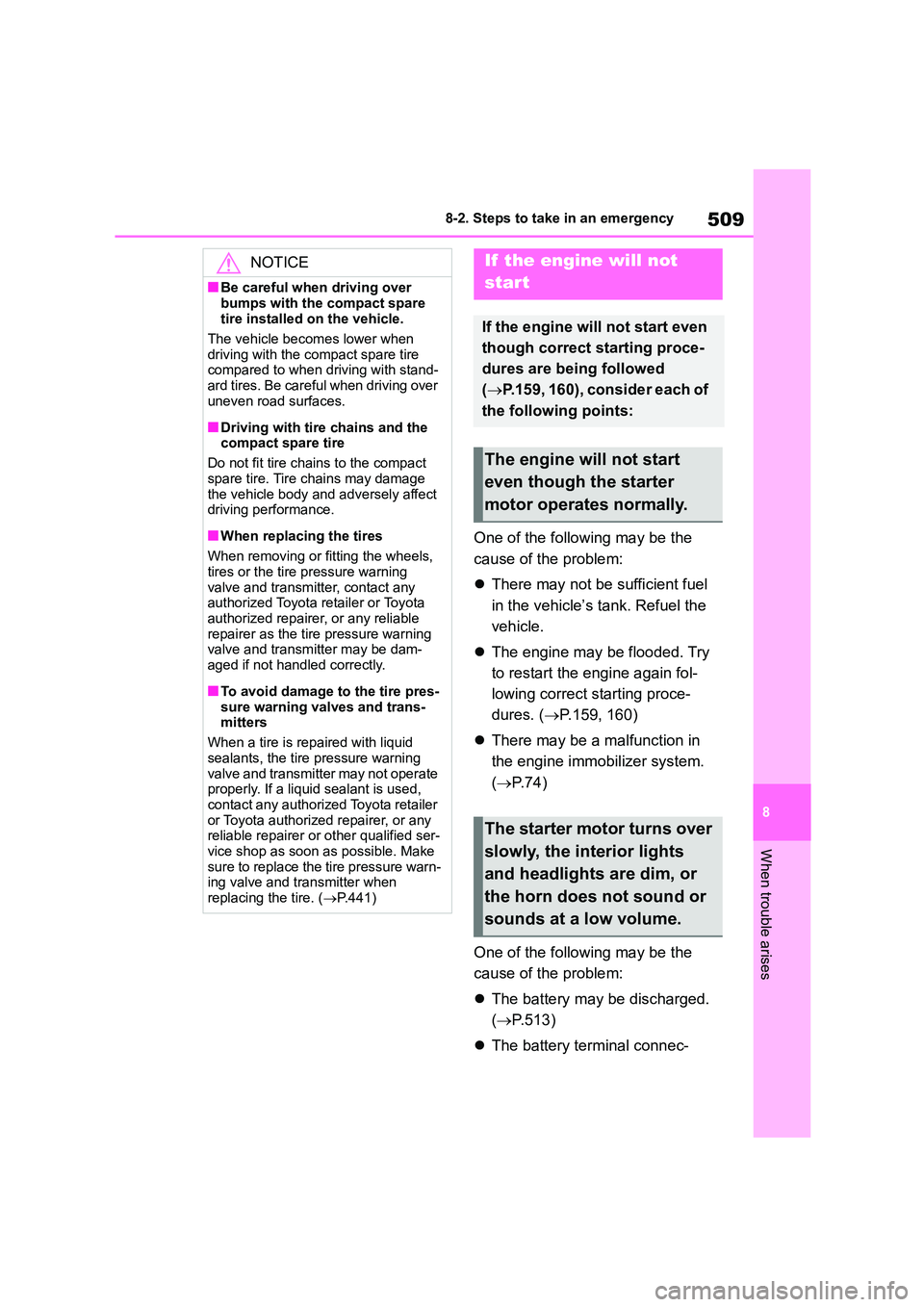
One of the following may be the
cause of the problem:
There may not be sufficient fuel
in the vehicle’s tank. Refuel the
vehicle.
The engine may be flooded. Try
to restart the engine again fol-
lowing correct starting proce-
dures. ( P.159, 160)
There may be a malfunction in
the engine immobilizer system.
( P. 7 4 )
One of the following may be the
cause of the problem:
The battery may be discharged.
( P.513)
The battery terminal connec-
NOTICE
■Be careful when driving over
bumps with the compact spare
tire installed on the vehicle.
The vehicle becomes lower when
driving with the compact spare tire
compared to when driving with stand- ard tires. Be careful when driving over
uneven road surfaces.
■Driving with tire chains and the compact spare tire
Do not fit tire chains to the compact
spare tire. Tire chains may damage the vehicle body and adversely affect
driving performance.
■When replacing the tires
When removing or fitting the wheels,
tires or the tire pressure warning valve and transmitter, contact any
authorized Toyota retailer or Toyota
authorized repairer, or any reliable repairer as the tire pressure warning
valve and transmitter may be dam-
aged if not handled correctly.
■To avoid damage to the tire pres-
sure warning valves and trans- mitters
When a tire is repaired with liquid
sealants, the tire pressure warning valve and transmitter may not operate
properly. If a liquid sealant is used,
contact any authorized Toyota retailer or Toyota authorized repairer, or any
reliable repairer or other qualified ser-
vice shop as soon as possible. Make sure to replace the tire pressure warn-
ing valve and transmitter when
replacing the tire. ( P.441)
If the engine will not
star t
If the engine will not start even
though correct starting proce-
dures are being followed
( P.159, 160), consider each of
the following points:
The engine will not start
even though the starter
motor operates normally.
The starter motor turns over
slowly, the interior lights
and headlights are dim, or
the horn does not sound or
sounds at a low volume.
Page 537 of 678
535
9
9-1. Specifications
Vehicle specifications
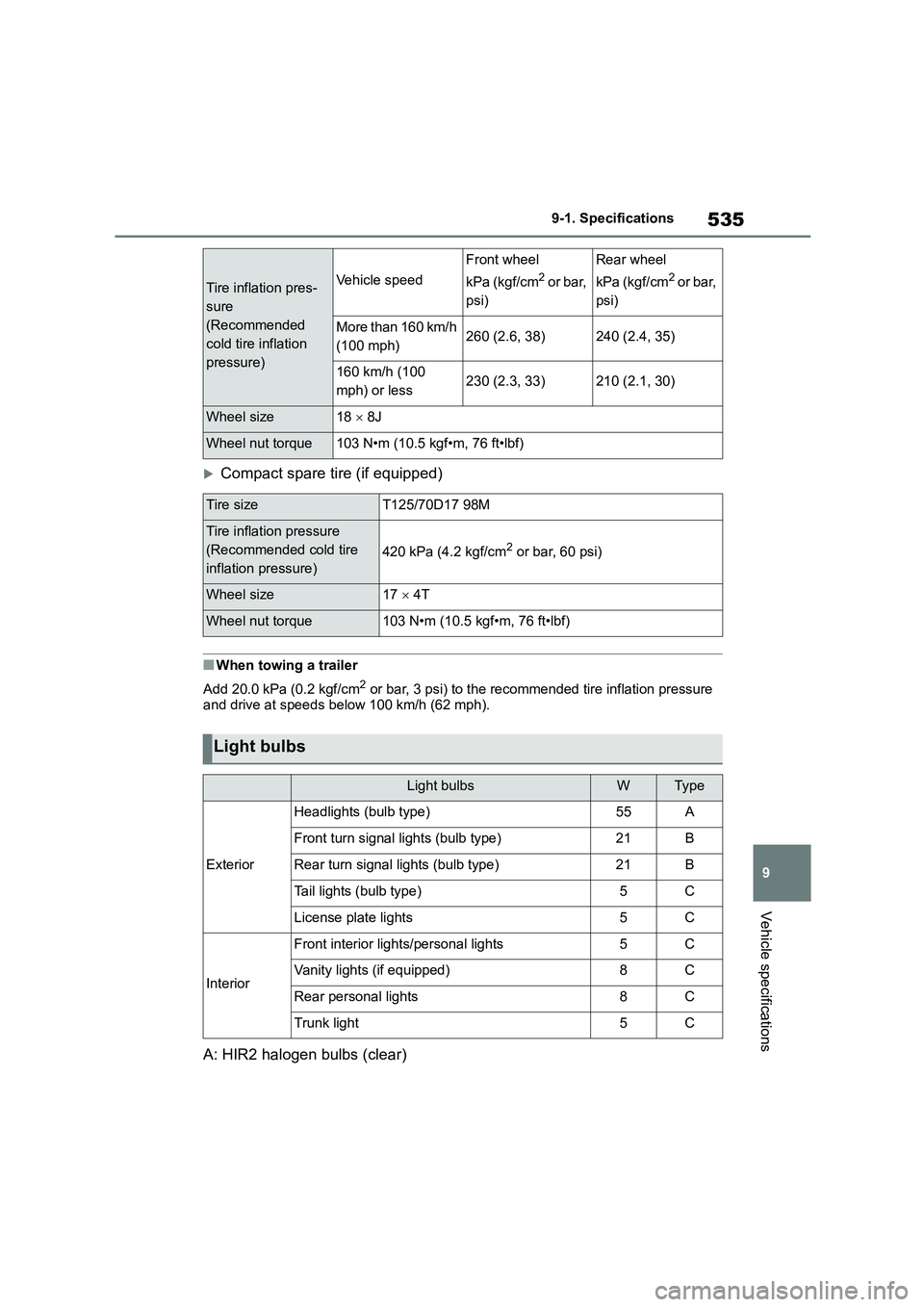
Compact spare tire (if equipped)
■When towing a trailer
Add 20.0 kPa (0.2 kgf/cm2 or bar, 3 psi) to the recommended tire inflation pressure
and drive at speeds below 100 km/h (62 mph).
A: HIR2 halogen bulbs (clear)
Tire inflation pres-
sure
(Recommended
cold tire inflation
pressure)
Vehicle speed
Front wheel
kPa (kgf/cm2 or bar,
psi)
Rear wheel
kPa (kgf/cm2 or bar,
psi)
More than 160 km/h
(100 mph)260 (2.6, 38)240 (2.4, 35)
160 km/h (100
mph) or less230 (2.3, 33)210 (2.1, 30)
Wheel size18 8J
Wheel nut torque103 N•m (10.5 kgf•m, 76 ft•lbf)
Tire sizeT125/70D17 98M
Tire inflation pressure
(Recommended cold tire
inflation pressure)
420 kPa (4.2 kgf/cm2 or bar, 60 psi)
Wheel size17 4T
Wheel nut torque103 N•m (10.5 kgf•m, 76 ft•lbf)
Light bulbs
Light bulbsWTy p e
Exterior
Headlights (bulb type)55A
Front turn signal lights (bulb type)21B
Rear turn signal lights (bulb type)21B
Tail lights (bulb type)5C
License plate lights5C
Interior
Front interior lights/personal lights5C
Vanity lights (if equipped)8C
Rear personal lights8C
Trunk light5C