2022 TOYOTA BZ4X frequency
[x] Cancel search: frequencyPage 9 of 674

7
Owners Manual_Europe_M42D76_en
Further information regarding fre-
quency bands, power levels,
antenna positions and installation
provisions for the installation of RF-
transmitters, is available on request
at any authorized Toyota retailer or
Toyota authorized repairer, or any
reliable repairer.
High voltage parts and cables on
the battery electric vehicles emit
approximately the same amount of
electromagnetic waves as the con-
ventional gasoline powered vehi-
cles or home electronic appliances
despite of their electromagnetic
shielding.
Unwanted noise may occur in the
reception of the radio frequency
transmitter (RF-transmitter).
The vehicle is equipped with
sophisticated computers that will
record certain data, such as:
• Engine speed/Electric motor
speed (traction motor speed)
• Accelerator status
• Brake status
• Vehicle speed
• Operation status of the driving
assist systems
• Images from the cameras
Your vehicle is equipped with cameras.
Contact any authorized Toyota retailer
or Toyota authorized repairer, or any
reliable repairer for the location of
recording cameras.
The recorded data varies according
to the vehicle grade level, options
and destinations with which it is
equipped.
These computers do not record
conversations or sounds, and only
record images outside of the vehi-
cle in certain situations.
Data usage
Toyota may use the data recorded in
this computer to diagnose malfunc-
tions, conduct research and develop-
ment, and improve quality.
Toyota will not disclose the recorded
data to a third party except:
• With the consent of the vehicle owner
or with the consent of the lessee if
the vehicle is leased
• In response to an official request by
the police, a court of law or a govern-
ment agency
• For use by Toyota in a lawsuit
• For research purposes where the
data is not tied to a specific vehicle or
vehicle owner
Recorded image information can
be erased by any authorized
Toyota retailer or Toyota autho-
rized repairer, or any reliable
repairer
The image recording function can
be disabled. However, if the func-
tion is disabled, data from when the
system operates will not be avail-
able.
The SRS airbag and seat belt
pretensioner devices in your Toyota
contain explosive chemicals. If the
Vehicle data recording
Scrapping of your Toyota
Page 109 of 674

107
2
Owners Manual_Europe_M42D76_en
2-2. Charging
Electric Vehicle system
■Rating
Voltage (Un): 220 V - 240 V ~
Frequency: 50 Hz / 60 Hz 1Φ
Current: 10 A
Residual operating current (IΔn): 6 mA
Ambient temperature: -30°C to 55°C
IP67
■Warning symbols
WARNING
■Maintaining the AC charging cable
When the AC charging cable is dirty, first remove the dirt with a hard, wringed cloth, and then wipe the
cable with a dry cloth.
However, never wash it with water. If the AC charging cable is washed with
water, fire or electric shock may occur during charging, possibly resulting in death or serious injury.
■When not using the AC charging cable for a long time
Remove the plug from the socket. Dust could accumulate on the plug or in the socket, possibly causing over-
heating which could lead to a fire.
Also, keep the cable in a place free from moisture.
Appendix
This device is for use with battery electric vehicles. (This
device does not require ventilation)
Do not attempt to disassemble or repair the AC charging
cable, charging connector, plug or CCID (Charging Circuit
Interrupting Device).
Page 185 of 674

183
4
Owners Manual_Europe_M42D76_en
4-1. Key information
Before driving
■If “A New Key has been Registered
Contact Your Dealer for Details” is shown on the multi-information display
This message will be displayed each time the driver’s door is opened when the doors are unlocked from the outside
for approximately 10 days after a new electronic key has been registered.
If this message is displayed but you
have not had a new electronic key regis- tered, ask any authorized Toyota retailer or Toyota authorized repairer, or any reli-
able repairer to check if an unknown electronic key (other than those in your possession) has been registered.
The electronic keys are equipped
with the following wireless remote
control:
Locks all the doors ( P.185)
Closes the windows*1 ( P.185)
Unlocks all the doors ( P.185)
Opens the windows*1 ( P.185)
Opens and closes the power
back door*2 ( P.192)
Operates Remote Air Condition-
NOTICE
■To prevent key damage
●Do not drop the keys, subject them to strong shocks, or bend them.
●Do not expose the keys to high temperatures for long periods of
time.
●Do not get the keys wet or wash
them in an ultrasonic washer, etc.
●Do not attach metallic or magnetic
materials to the keys or place the keys close to such materials.
●Do not disassemble the keys.
●Do not attach a sticker or anything
else to the surface of the electronic key.
●Do not place the keys near objects that produce magnetic fields, such as TVs, audio systems and induc-
tion cookers, or medical electrical equipment, such as low-frequency therapy equipment.
■Carrying the electronic key on your person
Carry the electronic key 10 cm (3.9
in.) or more away from electric appli- ances that are turned on. Radio waves emitted from electric appli-
ances within 10 cm (3.9 in.) of the electronic key may interfere with the key, causing the key to not function
properly.
■In case of a smart entry & start
system malfunction or other key- related problems
P. 5 4 2
■When an electronic key is lost
P. 5 4 1
Wireless remote control
Page 209 of 674

207
4
Owners Manual_Europe_M42D76_en
4-2. Opening, closing and locking the doors
Before driving
WARNING
■Caution regarding interference with electronic devices
●People with implantable cardiac pacemakers, cardiac resynchroni-zation therapy-pacemakers or
implantable cardioverter defibrilla- tors should maintain a reasonable distance between themselves and
the smart entry & start system antennas. ( P.203) The radio waves may affect the operation of
such devices. If necessary, the entry function can be disabled. Ask any authorized Toyota retailer or
Toyota authorized repairer, or any reliable repairer for details, such as the frequency of radio waves and
timing of the emitted radio waves. Then, consult your doctor to see if you should disable the entry func-
tion.
●Users of any electrical medical
device other than implantable car- diac pacemakers, cardiac resyn-chronization therapy-pacemakers
or implantable cardioverter defibril- lators should consult the manufac-turer of the device for information
about its operation under the influ- ence of radio waves.Radio waves could have unex-
pected effects on the operation of such medical devices.
Ask any authorized Toyota retailer or Toyota authorized repairer, or any reli-able repairer for details on disabling
the entry function.
Page 272 of 674
270
Owners Manual_Europe_M42D76_en
5-3. Operating the lights and wipers
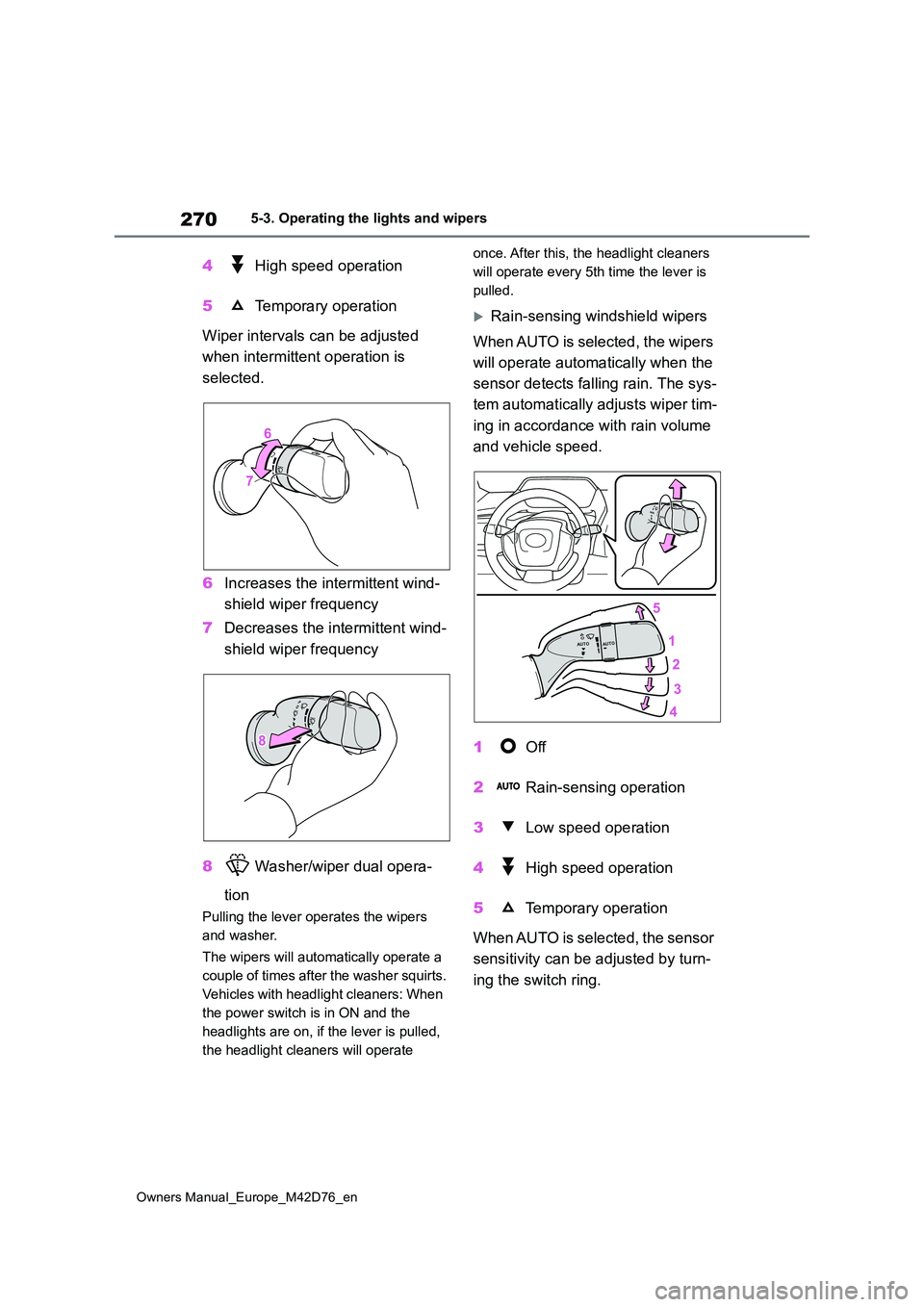
4 High speed operation
5 Temporary operation
Wiper intervals can be adjusted
when intermittent operation is
selected.
6 Increases the intermittent wind-
shield wiper frequency
7 Decreases the intermittent wind-
shield wiper frequency
8 Washer/wiper dual opera-
tion
Pulling the lever operates the wipers
and washer.
The wipers will automatically operate a
couple of times after the washer squirts.
Vehicles with headlight cleaners: When
the power switch is in ON and the
headlights are on, if the lever is pulled,
the headlight cleaners will operate
once. After this, the headlight cleaners
will operate every 5th time the lever is
pulled.
Rain-sensing windshield wipers
When AUTO is selected, the wipers
will operate automatically when the
sensor detects falling rain. The sys-
tem automatically adjusts wiper tim-
ing in accordance with rain volume
and vehicle speed.
1 Off
2 Rain-sensing operation
3 Low speed operation
4 High speed operation
5 Temporary operation
When AUTO is selected, the sensor
sensitivity can be adjusted by turn-
ing the switch ring.
Page 303 of 674

301
5
Owners Manual_Europe_M42D76_en
5-4. Using the driving support systems
Driving
• The steering wheel is not being turned
sufficiently to perform a lane change.*: Boundary between the asphalt and
grass, soil, etc., or structures, such as
a curb, guardrail, etc.
●Break suggestion function
This function is operable when all of the
following conditions are met:
• The vehicle speed is approximately 50 km/h (32 mph) or more.• The lane width is approximately 3 m
(9.8 ft.) or more.
■Temporary cancelation of functions
When the operating conditions are no longer met, a function may be temporar-
ily canceled. However, when the opera- tion conditions are met again, operation of the function will automatically be
restored. ( P.300)
■Operation of the lane departure alert function/lane departure pre-vention function
●Depending on the vehicle speed, road conditions, lane departure angle, etc.,
operation of the lane departure pre- vention function may not be felt or the function may not operate.
●Depending on the conditions, the warning buzzer may operate even if
vibration is selected through a cus- tomize setting.
●If a course* is not clear or straight, the
lane departure alert function or lane
departure prevention function may not operate.
●The lane departure alert function or lane departure prevention function may not operate if the system judges
that the vehicle is intentionally being steered to avoid a pedestrian or parked vehicle.
●It may not be possible for the system to judge if there is danger of a collision
with a vehicle in an adjacent lane.
●The steering assist operation of the
lane departure prevention function can be overridden by the steering
wheel operation of the driver.*: Boundary between the asphalt and
grass, soil, etc., or structures, such as
a curb, guardrail, etc.
■Hands off steering wheel warning
operation
In the following situations, a message urging the driver to operate the steering
wheel and an icon will be displayed and a buzzer will sound to warn the driver. When using the system, make sure to
grip the steering wheel firmly, regardless of whether the warning is operating or not.
●When the system determines that the driver is not securely holding the
steering wheel, or the steering wheel is not being operated when the steer-ing assist operation of the lane depar-
ture prevention function is operating
The length of time that the warning buzzer operates will become longer as
the frequency of the steering assist operating increases. Even if the system judges that the steering wheel has been
operated, the warning buzzer will sound for a certain amount of time.
■Break suggestion function
If the vehicle is swaying, a message will
be displayed and a warning buzzer will sound to urge the driver to take a break.