Page 528 of 616
5287-2. Steps to take in an emergency
4RUNNER (U)
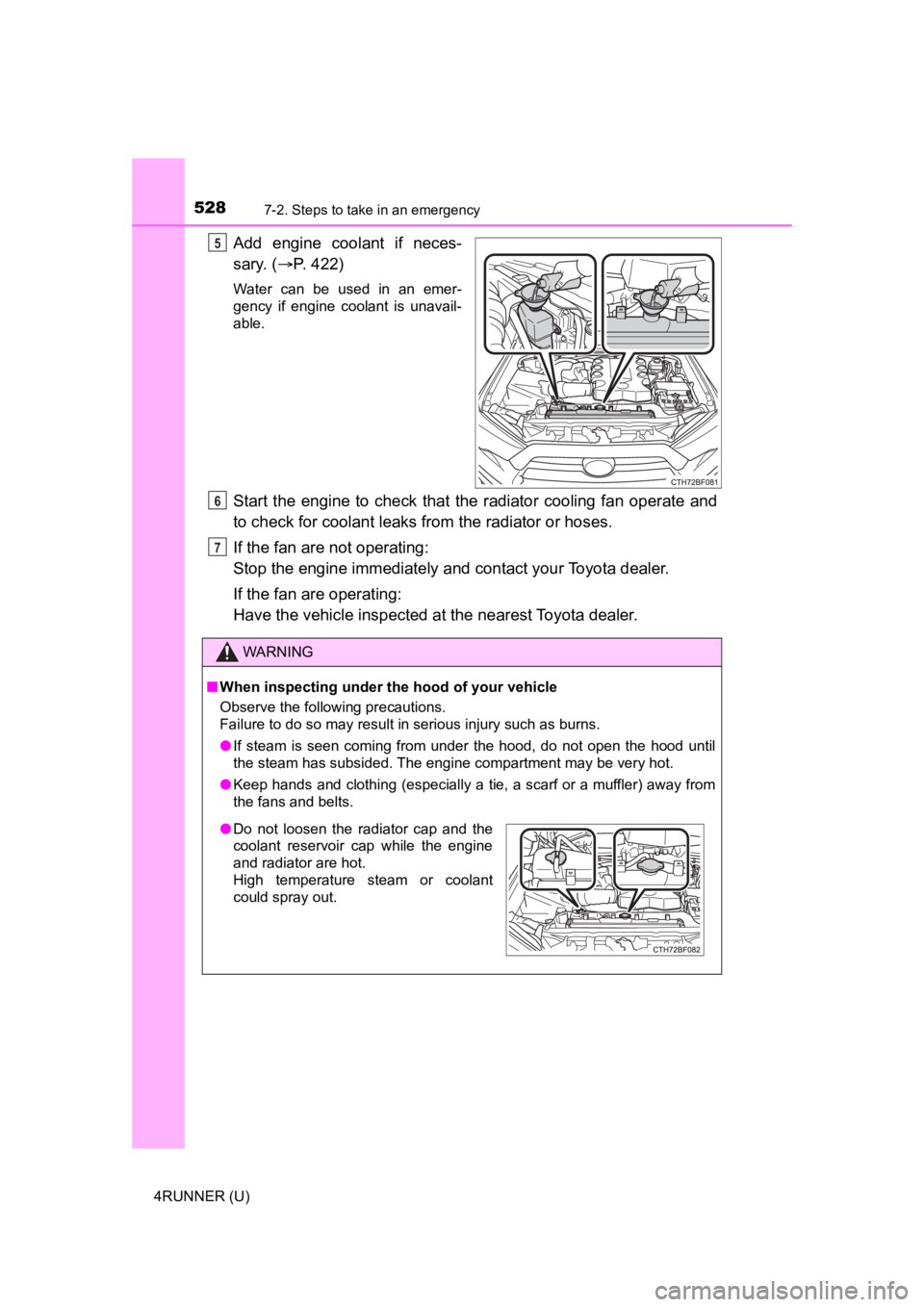
Add engine coolant if neces-
sary. (P. 422)
Water can be used in an emer-
gency if engine coolant is unavail-
able.
Start the engine to check that the radiator cooling fan operate and
to check for coolant leaks from the radiator or hoses.
If the fan are not operating:
Stop the engine immediately and contact your Toyota dealer.
If the fan are operating:
Have the vehicle inspected at the neare st Toyota dealer.
5
WARNING
■When inspecting under the hood of your vehicle
Observe the following precautions.
Failure to do so may result in serious injury such as burns.
● If steam is seen coming from under the hood, do not open the ho od until
the steam has subsided. The engine compartment may be very hot.
● Keep hands and clothing (especially a tie, a scarf or a muffler) away from
the fans and belts.
6
7
●Do not loosen the radiator cap and the
coolant reservoir cap while the engine
and radiator are hot.
High temperature steam or coolant
could spray out.
Page 530 of 616
5307-2. Steps to take in an emergency
4RUNNER (U)
Stop the engine. Set the parking brake and shift the shift lever to P.
Remove the mud, snow or sand from around the stuck tire.
Place wood, stones or some other material under the tires to help
provide traction.
Restart the engine.
Shift the shift lever to D or R position and carefully apply th e accel-
erator to free the vehicle.
Turn off TRAC and VSC if these functions are hampering your attempts to
free the vehicle. ( P. 335)
If the vehicle becomes stuck
Carry out the following procedures if the tires spin or the vehicle
becomes stuck in mud, dirt or snow:
WARNING
■When attempting to f ree a stuck vehicle
If you choose to push the vehicle back and forth to free it, make sure the
surrounding area is clear to avoid striking other vehicles, obj ects or people.
The vehicle may also lunge forward or lunge back suddenly as it becomes
free. Use extreme caution.
■ When shifting the shift lever
Be careful not to shift the shift lever with the accelerator pedal depressed.
This may lead to unexpected rapid acceleration of the vehicle t hat may
cause an accident resulting in death or serious injury.
NOTICE
■ To avoid damaging the transmission and other components
● Avoid spinning the wheels and depressing the accelerator pedal more
than necessary.
● If the vehicle remains stuck even after these procedures are pe rformed,
the vehicle may require towing to be freed.
● When a warning message for the automatic transmission fluid tem perature
is displayed while attempting to free a stuck vehicle, immediat ely remove
your foot from the accelerator pedal and wait until the warning message
disappears. Otherwise, the transmission may become damaged.
(
P. 497)
1
2
3
4
5
Page 549 of 616

5498-1. Specifications
8
Vehicle specifications
4RUNNER (U)
This information has been prepared in accordance with regulations
issued by the National Highway Tr affic Safety Administration of the
U.S. Department of Transportation.
It provides the purchasers and/or prospective purchasers of Toyota
vehicles with info rmation on uniform ti re quality grading.
Your Toyota dealer will help answer any questions you may have as
you read this information.
■DOT quality grades
All passenger vehicle tires must conform to Federal Safety Requ ire-
ments in addition to these grades. Quality grades can be found
where applicable on the tire sidewall between tread shoulder an d
maximum section width.
For example: Treadwear 200 Traction AA Temperature A
■Treadwear
The treadwear grade is a comparative rating based on the wear
rate of the tire when tested under controlled conditions on a s peci-
fied government t est course.
For example, a tire graded 150 would wear one and a half (1 - 1 /2)
times as well on the governmen t course as a tire graded 100.
The relative performance of tires depends upon the actual condi -
tions of their use. Performance ma y differ significantly from the norm
due to variations in driving habits, service practices and diff erences
in road characteristics and climate.
■Traction AA, A, B, C
The traction grades, from highest to lowest, are AA, A, B and C ,
and they represent the tire’s ability to stop on wet pavement a s
measured under controlled conditions on specified government te st
surfaces of asphalt and concrete.
A tire marked C may have p oor traction performance.
Warning: The traction grade assigned to this tire is based on b raking
(straight ahead) traction tests and does not include cornering (turn-
ing) traction.
Uniform Tire Quality Grading
Page 550 of 616
5508-1. Specifications
4RUNNER (U)■
Temperature A, B, C
The temperature grades are A (
the highest), B, and C, representing
the tire’s resistance to the ge neration of heat and its ability to dissi-
pate heat when tested under contr olled conditions on a specified
indoor laboratory test wheel.
Sustained high temperature can c ause the material of the tire to
degenerate and reduce tire life, and excessive temperature can lead
to sudden tire failure.
Grade C corresponds to a level of performance which all passeng er
car tires must meet under the Fe deral Motor Vehicle Safety Stan-
dard No. 109.
Grades B and A represent higher levels of performance on the labo-
ratory test wheel than the minimum required by law.
Warning: The temperature grades of a tire assume that it is pro perly
inflated and not overloaded.
Excessive speed, underinflation, or excessive loading, either sepa-
rately or in combination, can c ause heat buildup and possible t ire
failure.
Page 559 of 616
5598-2. Customization
8
Vehicle specifications
4RUNNER (U)■
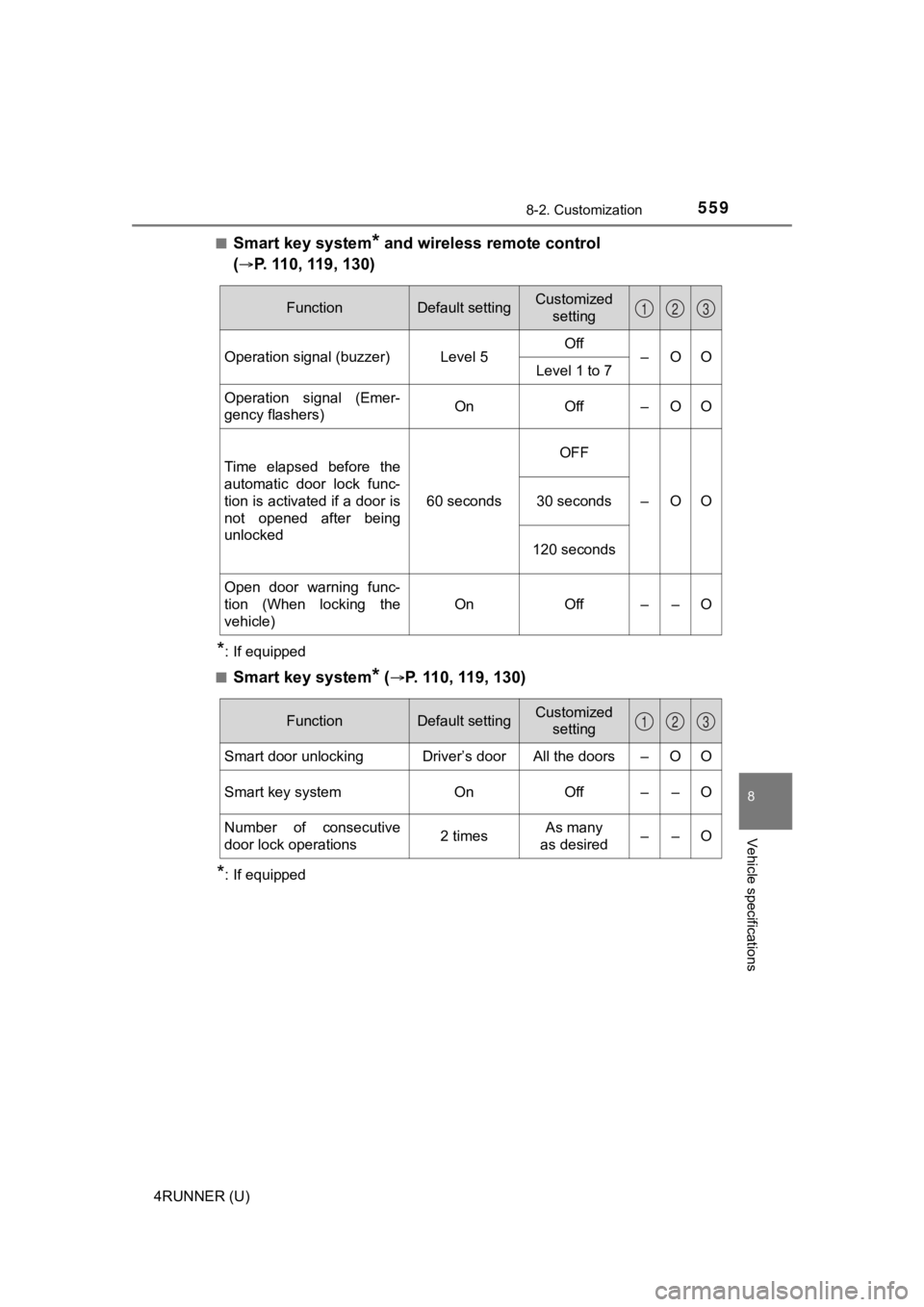
Smart key system* and wireless remote control
(
P. 110, 119, 130)
*: If equipped
■
Smart key system* (P. 110, 119, 130)
*: If equipped
FunctionDefault settingCustomized setting
Operation signal (buzzer) Level 5 Off
–OO
Level 1 to 7
Operation signal (Emer-
gency flashers) On Off – O O
Time elapsed before the
automatic door lock func-
tion is activated if a door is
not opened after being
unlocked 60 secondsOFF
–OO
30 seconds
120 seconds
Open door warning func-
tion (When locking the
vehicle) On Off – – O
123
FunctionDefault settingCustomized
setting
Smart door unlocking Driver’s door All the doors – O O
Smart key system On Off – – O
Number of consecutive
door lock operations 2 timesAs many
as desired ––O
123
Page 568 of 616
5688-2. Customization
4RUNNER (U)■
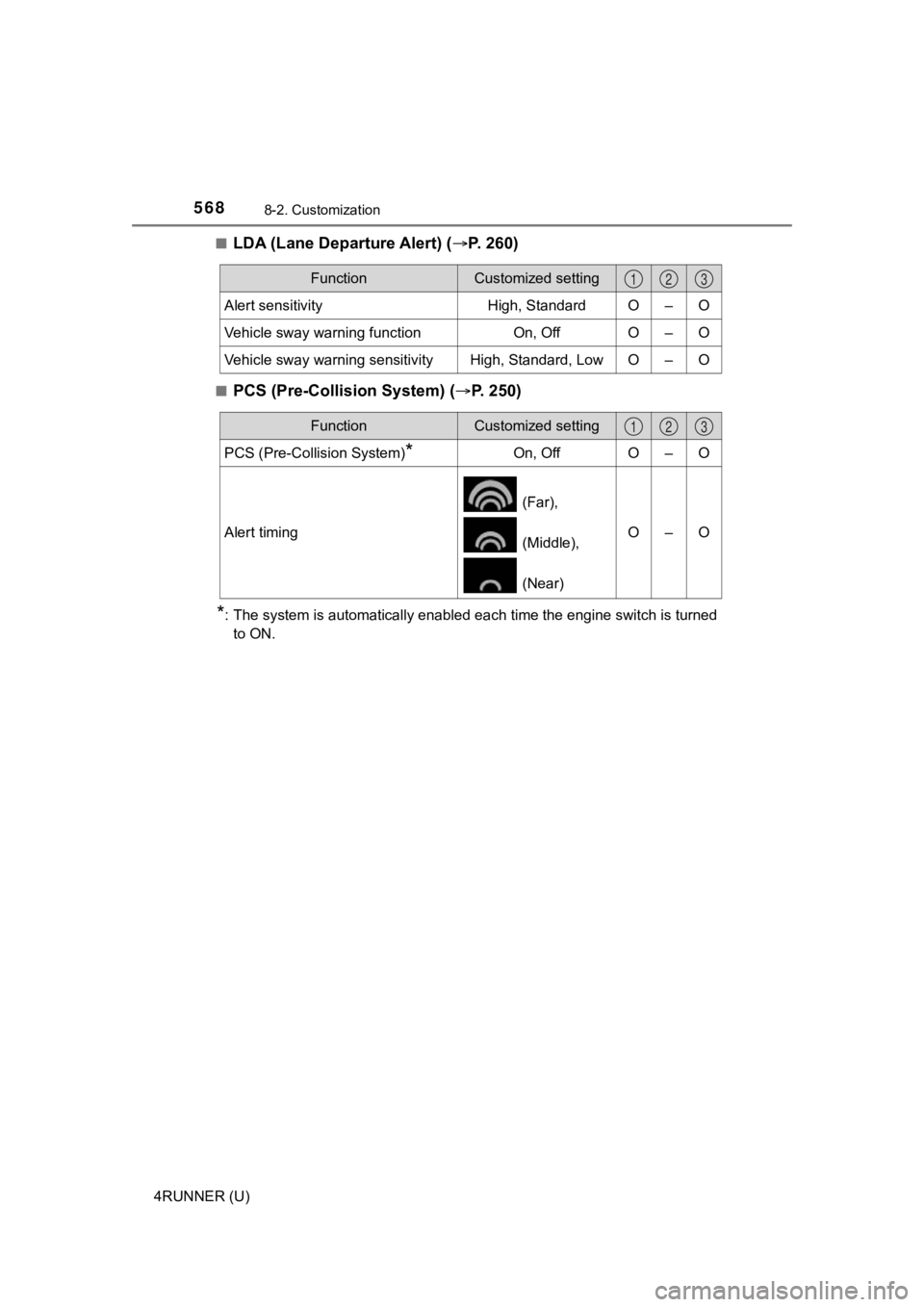
LDA (Lane Departure Alert) (
P. 260)
■PCS (Pre-Collision System) ( P. 250)
*: The system is automatically enabled each time the engine switc h is turned
to ON.
FunctionCustomized setting
Alert sensitivityHigh, StandardO–O
Vehicle sway warning functionOn, OffO–O
Vehicle sway warning sensitivityHigh, Standard, LowO–O
123
FunctionCustomized setting
PCS (Pre-Collision System)*On, OffO–O
Alert timing
(Far),
(Middle),
(Near)
O–O
123
Page 569 of 616
5698-2. Customization
8
Vehicle specifications
4RUNNER (U)
■In the following situations, customize mode will automatically be turned
off.
● A warning message appears after the customize mode screen is displayed.
● The engine switch is turned to the “LOCK” position (without a smart key sys-
tem) or the engine switch is turned to OFF (with a smart key sy stem).
● The vehicle begins to move while the customize mode screen is displayed.
WARNING
■ During customization
As the engine needs to be running during customization, ensure that the
vehicle is parked in a place with adequate ventilation. In a closed area such
as a garage, exhaust gases including harmful carbon monoxide (CO) may
collect and enter the vehicle. This may lead to death or a seri ous health
hazard.
NOTICE
■ During customization
To prevent battery discharge, ensure that the engine is running while cus-
tomizing features.
Page 570 of 616
570
4RUNNER (U)
8-3. Items to initialize
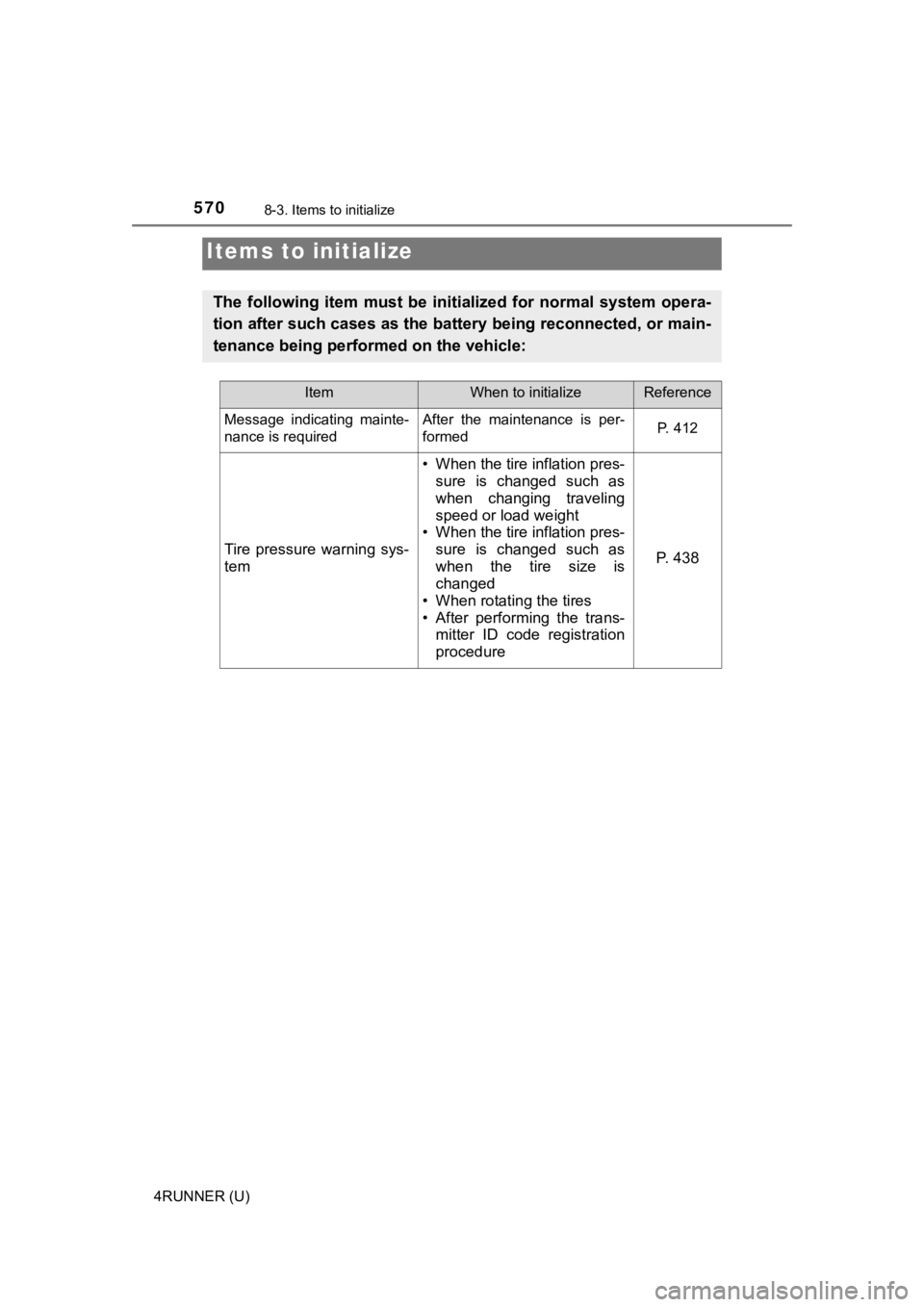
Items to initialize
The following item must be initialized for normal system opera-
tion after such cases as the battery being reconnected, or main -
tenance being performed on the vehicle:
ItemWhen to initializeReference
Message indicating mainte-
nance is requiredAfter the maintenance is per-
formedP. 412
Tire pressure warning sys-
tem
• When the tire inflation pres- sure is changed such as
when changing traveling
speed or load weight
• When the tire inflation pres-
sure is changed such as
when the tire size is
changed
• When rotating the tires
• After performing the trans- mitter ID code registration
procedure
P. 438