Page 452 of 616
4526-3. Do-it-yourself maintenance
4RUNNER (U)
■When replacing wheels
The wheels of your vehicle are equipped with tire pressure warning
valves and transmitters that allow the tire pressure warning sy stem to
provide advance warning in the event of a loss in tire inflatio n pressure.
Whenever wheels are replaced, tir e pressure warning valves and trans-
mitters must be installed. ( P. 438)
WARNING
■
When replacing wheels
●Do not use wheels that are a different size from those recommen ded in
the Owner’s Manual, as this may result in a loss of handling control.
●Never use an inner tube in a leaking wheel which is designed fo r a
tubeless tire. Doing so may result in an accident, causing deat h or seri-
ous injury.
■When installing the wheel nuts
Never use oil or grease on the wheel bolts or wheel nuts.
Oil and grease may cause the wheel nuts to be excessively tight ened, lead-
ing to bolt or disc wheel damage. In addition, the oil or greas e can cause the
wheel nuts to loosen and the wheel may fall off, causing an accident and
resulting in death or serious injury. Remove any oil or grease from the wheel
bolts or wheel nuts.
NOTICE
■Replacing tire pressure warning valves and transmitters
●Because tire repair or replacement may affect the tire pressure warn-
ing valves and transmitters, make sure to have tires serviced b y your
Toyota dealer or other qualified service sh op. In addition, make sure to
purchase your tire pressure warning valves and transmitters at your
Toyota dealer.
●Ensure that only genuine Toyota wheels are used on your vehicle .
Tire pressure warning valves and transmitters may not work prop erly
with non-genuine wheels.
Page 457 of 616
4576-3. Do-it-yourself maintenance
6
Maintenance and care
4RUNNER (U)
■When replacing the key battery
Be careful not to lose the battery or any other small parts.
■ Use a CR2016 (vehicles without a smart key system) or CR2032 (vehicles
with a smart key system) lithium battery
●Batteries can be purchased at your Toyota dealer, local electrical appliance
shops or camera stores.
● Replace only with the same or equivalent type recommended by the manu-
facturer.
● Dispose of used batteries according to local laws.
■ If the electronic key battery is depleted
The following symptoms may occur:
●The smart key system and wireless remote control will not funct ion properly.
● The operational range will be reduced.
WARNING
■ Battery precautions
Observe the following precautions.
Failure to do so may result in death or serious injury.
● Do not swallow the battery. Doing so may cause chemical burns.
● A coin battery or button battery is used in the wireless remote control/elec-
tronic key. If a battery is swallowed, it may cause severe chem ical burns in
as little as 2 hours and may result in death or serious injury.
● Keep away new and removed batteries from children.
● If the cover cannot be firmly closed, stop using the wireless r emote con-
trol/electronic key and stow the key in the place where childre n cannot
reach, and then contact your Toyota dealer.
● If you accidentally swallow a battery or put a battery into a part of your
body, get emergency medical attention immediately.
■ To prevent battery explosion or leakage of flammable liquid or gas
● Replace the battery with a new battery of the same type. If a w rong type of
battery is used, it may explode.
● Do not expose batteries to extremely low pressure due to high altitude or
extremely high temperatures.
● Do not burn, break or cut a battery.
Page 461 of 616
4616-3. Do-it-yourself maintenance
6
Maintenance and care
4RUNNER (U)
■After a fuse is replaced
●If the lights do not turn on even after the fuse has been repla ced, a bulb may
need replacement. ( P. 462)
● If the replaced fuse blows again, have the vehicle inspected by your Toyota
dealer.
■ If there is an overload in a circuit
The fuses are designed to blow, protecting the wiring harness f rom damage.
WARNING
■ To prevent system breakdowns and vehicle fire
Observe the following precautions.
Failure to do so may cause damage to the vehicle, and possibly a fire or
injury.
● Never use a fuse of a higher amperage rating than that indicated, or use
any other object in place of a fuse.
● Always use a genuine Toyota fuse or equivalent.
Never replace a fuse with a wire, even as a temporary fix.
● Do not modify the fuses or fuse boxes.
NOTICE
■Before replacing fuses
Have the cause of electrical overload determined and repaired b y your
Toyota dealer as soon as possible.
Page 472 of 616
4726-3. Do-it-yourself maintenance
4RUNNER (U)■
Replacing the following bulbs
If any of the lights listed below has burnt out, have it replaced by
your Toyota dealer.
●
Headlight low beams (if equipped)
● Headlight low/high beams (if equipped)
● Fog lights
● Side turn signal lights
● Stop/tail lights
● Rear side marker lights
● High mounted stoplight
● Outer foot lights (if equipped)
■LED light bulbs
The headlight low beams (if equipped), headlight low/high beams (if
equipped), fog lights, side turn signal lights, stop/tail lights, rear side marker
lights, high mounted stoplight and outer foot lights consist of a number of
LEDs. If any LEDs burn out, take your vehicle to your Toyota dealer to have
the light replaced.
■ Condensation build-up on the inside of the lens
Temporary condensation build-up on the inside of the lens does not indicate a
malfunction. Contact your Toyota dealer for more information in the following
situations:
● Large drops of water have built up on the inside of the lens.
● Water has built up inside the lens.
WARNING
■Replacing light bulbs
● Turn off the lights. Do not attempt to replace the bulb immediately after
turning off the lights.
The bulbs become very hot and may cause burns.
● Do not touch the glass portion of the light bulb with bare hand s. When it is
unavoidable to hold the glass portion, use and hold with a clea n dry cloth
to avoid getting moisture and oils on the bulb.
Also, if the bulb is scratched or dropped, it may blow out or crack.
● Fully install light bulbs and any parts used to secure them. Failure to do so
may result in heat damage, fire, or water entering the headligh t unit. This
may damage the headlights or cause condensation to build up on the lens.
■ To prevent damage or fire
● Make sure bulbs are fully seated and locked.
● Check the wattage of the bulb before installing to prevent heat damage.
Page 473 of 616

473
When trouble arises7
4RUNNER (U)7-1. Essential information
Emergency flashers .......... 474
If your vehicle has to be stopped in
an emergency ................. 475
If the vehicle is submerged or water
on the road is rising ........ 477
7-2. Steps to take in an emergency
If your vehicle needs to be towed ..................... 478
If you think something is wrong .......................... 484
Fuel pump shut off system ............................ 485
If a warning light turns on or a warning
buzzer sounds ................ 486
If a warning message is displayed ..................... 497
If you have a flat tire.......... 502
If the engine will not start ................................. 517
If you cannot operate back door opener ............ 519
If the electronic key does not operate properly
(vehicles with a
smart key system) ........... 520
If the vehicle battery is discharged ................... 523
If your vehicle overheats ........................ 527
If the vehicle becomes stuck ............................... 530
Page 476 of 616
4767-1. Essential information
4RUNNER (U)
WARNING
■If the engine has to be turned off while driving
● Power assist for the brakes and steering wheel will be lost, making the
brake pedal harder to depress and the steering wheel heavier to turn.
Decelerate as much as possible before turning off the engine.
● Vehicles without a smart key system:
Never attempt to remove the key, as doing so will lock the stee ring wheel.
Page 477 of 616
4777-1. Essential information
7
When trouble arises
4RUNNER (U)
●If the door can be opened, open the door and exit the vehicle.
● If the door can not be opened, open the window using the power
window switch and ens ure an escape route.
● If the window can be opened, exit the vehicle through the windo w.
● If the door and window cannot be opened due to the rising water ,
remain calm, wait until the water level inside the vehicle rises to the
point that the water pressure inside of the vehicle equals the water
pressure outside of the vehicle and then open the door after wa iting
for the rising water to enter the vehicle, and exit the vehicle . When
the outside water level exc eeds half the height of the door, the door
cannot be opened from the inside due to water pressure.
■ Water level exceeds the floor
When the water level exceeds the floor and time has passed, the electrical
equipment will get damaged, the power windows will not operate, the engine
stop, and the vehicle may not be able to get moving.
■ Using an emergency escape hammer
*
Laminated glass is used in the windshield on this vehicle. Laminated glass
cannot be shattered with an emergency hammer
*.
Tempered glass is used in the windows on this vehicle.
*: Contact your Toyota dealer or aftermarket accessory manufacturer for fur-
ther information about an emergency hammer.
If the vehicle is submerged or water on the
road is rising
This vehicle is not designed to be able to drive on roads that are
deeply flooded with water. Do not drive on roads where the
roads may be submerged or the water may be rising. It is dan-
gerous to remain in the vehicle, if it anticipated that the veh icle
will be flooded or set a drift. Re main calm and follow the follow-
ing.
WARNING
■ Caution while driving
Do not drive on roads where the roads may be submerged or the w ater may
be rising. Otherwise the vehicle may be damaged and cannot move, as well
as become flooded and set a drift, which may lead to death.
Page 478 of 616
478
4RUNNER (U)
7-2. Steps to take in an emergency
If your vehicle needs to be towed
If towing is necessary, we recommend having your vehicle
towed by your Toyota dealer or commercial towing service,
using a wheel-lift type t ruck or flatbed truck.
Use a safety chain system for all towing, and abide by all stat e/
provincial and local laws.
WARNING
Observe the following precautions.
Failure to do so may result in death or serious injury.
■ When towing the vehicle
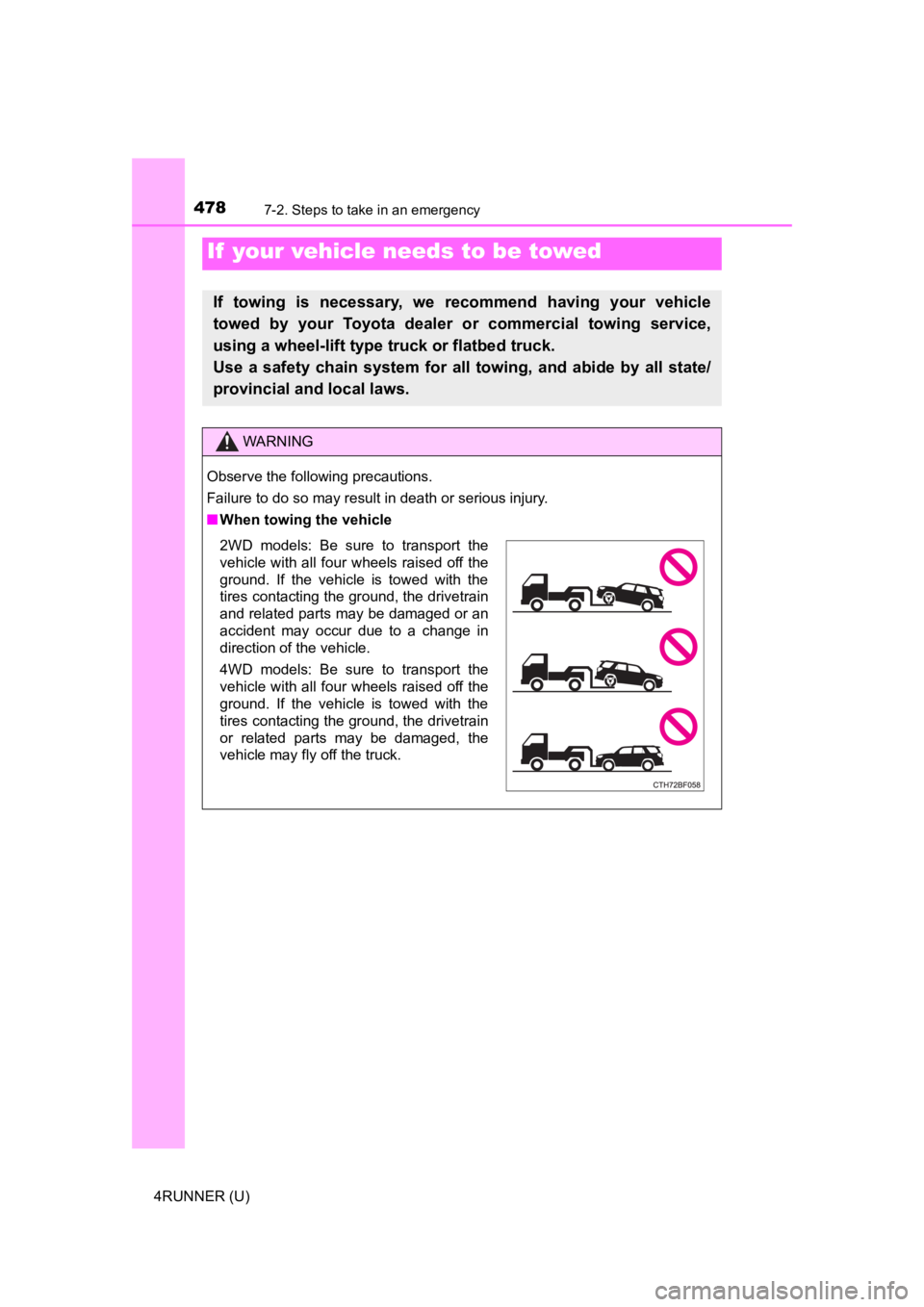
2WD models: Be sure to transport the
vehicle with all four wheels raised off the
ground. If the vehicle is towed with the
tires contacting the ground, the drivetrain
and related parts may be damaged or an
accident may occur due to a change in
direction of the vehicle.
4WD models: Be sure to transport the
vehicle with all four wheels raised off the
ground. If the vehicle is towed with the
tires contacting the ground, the drivetrain
or related parts may be damaged, the
vehicle may fly off the truck.