2022 RAM PROMASTER CITY load capacity
[x] Cancel search: load capacityPage 225 of 260

SERVICING AND MAINTENANCE223
(4) The resulting figure equals the
available amount of cargo and luggage
load capacity. For example, if “XXX”
amount equals 1400 lbs. and there will
be five 150 lb passengers in your
vehicle, the amount of available cargo
and luggage load capacity is 650 lbs.
(1400-750 (5x150) = 650 lbs.)
(5) Determine the combined weight of
luggage and cargo being loaded on the
vehicle. That weight may not safely
exceed the available cargo and luggage
load capacity calculated in Step 4. (6) If your vehicle will be towing a trailer,
load from your trailer will be transferred
to your vehicle. Consult this manual to
determine how this reduces the
available cargo and luggage load
capacity of your vehicle.
Metric Example For Load Limit
For example, if “XXX” amount equals 635 kg and
there will be five 68 kg passengers in your vehicle,
the amount of available cargo and luggage load
capacity is 295 kg (635-340 (5x68) = 295 kg) as
shown in step 4.
NOTE:
If your vehicle will be towing a trailer, load from
your trailer will be transferred to your vehicle.
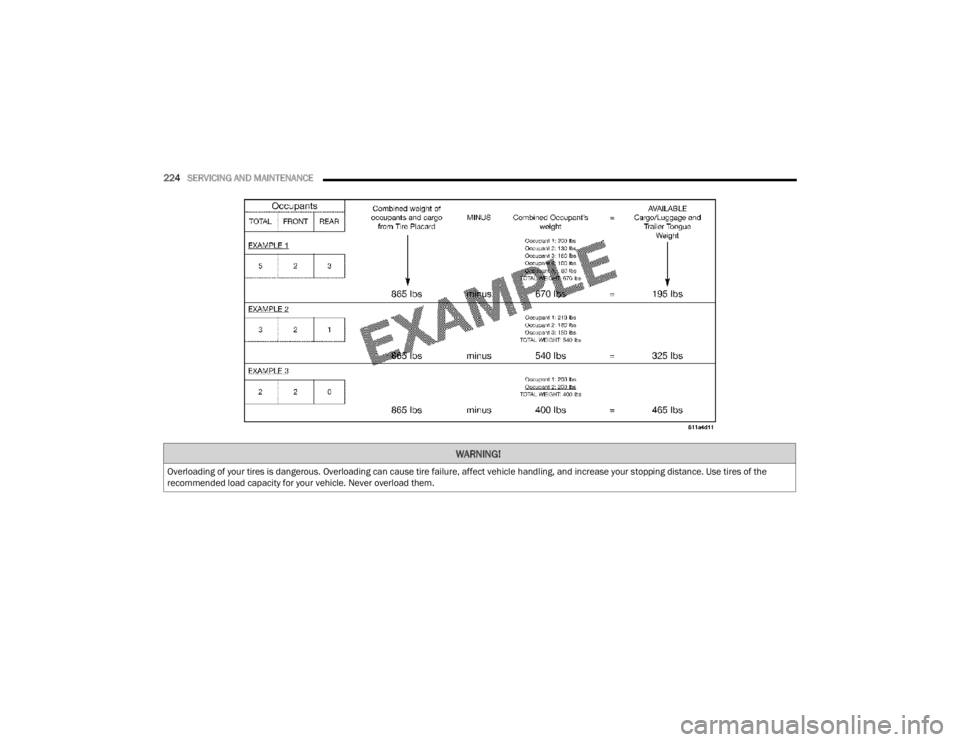
The following table shows examples on how to
calculate total load, cargo/luggage, and towing
capacities of your vehicle with varying seating
configurations and number and size of occu
-
pants. This table is for illustration purposes only
and may not be accurate for the seating and
load carry capacity of your vehicle.
For the following example, the combined weight
of occupants and cargo should never exceed
865 lb (392 kg).
8
22_VM_OM_EN_USC_t.book Page 223
Page 226 of 260
224SERVICING AND MAINTENANCE
WARNING!
Overloading of your tires is dangerous. Overloading can cause tire failure, affect vehicle handling, and increase your stopping distance. Use tires of the
recommended load capacity for your vehicle. Never overload them.
22_VM_OM_EN_USC_t.book Page 224
Page 228 of 260

226SERVICING AND MAINTENANCE
Inflation pressures specified on the placard are
always “cold tire inflation pressure”. Cold tire
inflation pressure is defined as the tire pressure
after the vehicle has not been driven for at least
three hours, or driven less than 1 mile (1.6 km)
after sitting for a minimum of three hours. The cold
tire inflation pressure must not exceed the
maximum inflation pressure molded into the tire
sidewall.
Check tire pressures more often if subject to a
wide range of outdoor temperatures, as tire
pressures vary with temperature changes.
Tire pressures change by approximately 1 psi
(7 kPa) per 12°F (7°C) of air temperature change.
Keep this in mind when checking tire pressure
inside a garage, especially in the Winter.
Example: If garage temperature = 68°F (20°C)
and the outside temperature = 32°F (0°C) then
the cold tire inflation pressure should be increased
by 3 psi (21 kPa), which equals 1 psi (7 kPa) for
every 12°F (7°C) for this outside temperature
condition.
Tire pressure may increase from 2 to 6 psi (13 to
40 kPa) during operation. DO NOT reduce this
normal pressure build up or your tire pressure will
be too low.
Tire Pressures For High Speed Operation
The manufacturer advocates driving at safe
speeds and within posted speed limits. Where
speed limits or conditions are such that the vehicle
can be driven at high speeds, maintaining correct
tire inflation pressure is very important. Increased
tire pressure and reduced vehicle loading may be
required for high-speed vehicle operation. Refer to
an authorized tire dealer or original equipment
vehicle dealer for recommended safe operating
speeds, loading and cold tire inflation pressures.
Radial Ply Tires
Tire Repair
If your tire becomes damaged, it may be repaired if
it meets the following criteria:
The tire has not been driven on when flat.
The damage is only on the tread section of your
tire (sidewall damage is not repairable).
The puncture is no greater than a ¼ of an inch
(6 mm).
Consult an authorized tire dealer for tire repairs
and additional information.
Damaged Run Flat tires, or Run Flat tires that have
experienced a loss of pressure should be replaced
immediately with another Run Flat tire of identical
size and service description (Load Index and
Speed Symbol). Replace the tire pressure sensor
as well as it is not designed to be reused.
WARNING!
High speed driving with your vehicle under
maximum load is dangerous. The added strain
on your tires could cause them to fail. You could
have a serious collision. Do not drive a vehicle
loaded to the maximum capacity at continuous
speeds above 75 mph (120 km/h).
WARNING!
Combining radial ply tires with other types of
tires on your vehicle will cause your vehicle to
handle poorly. The instability could cause a
collision. Always use radial ply tires in sets of
four. Never combine them with other types of
tires.
22_VM_OM_EN_USC_t.book Page 226
Page 229 of 260

SERVICING AND MAINTENANCE227
Run Flat Tires — If Equipped
Run Flat tires allow you the capability to drive
50 miles (80 km) at 50 mph (80 km/h) after a
rapid loss of inflation pressure. This rapid loss of
inflation is referred to as the Run Flat mode. A Run
Flat mode occurs when the tire inflation pressure is
of/or below 14 psi (96 kPa). Once a Run Flat tire
reaches the Run Flat mode it has limited driving
capabilities and needs to be replaced immediately.
A Run Flat tire is not repairable. When a Run Flat
tire is changed after driving with under inflated tire
condition, please replace the TPMS sensor as it is
not designed to be reused when driven under Run
Flat mode 14 psi (96 kPa) condition.
NOTE:TPMS Sensor must be replaced after driving the
vehicle on a flat tire condition.
It is not recommended driving a vehicle loaded at
full capacity or to tow a trailer while a tire is in the
Run Flat mode.
For more information Úpage 135.
Tire Spinning
When stuck in mud, sand, snow, or ice conditions,
do not spin your vehicle's wheels above 30 mph
(48 km/h) or for longer than 30 seconds
continuously without stopping.
For further information Ú page 185.
Tread Wear Indicators
Tread wear indicators are in the original equipment
tires to help you in determining when your tires
should be replaced.
These indicators are molded into the bottom of the
tread grooves. They will appear as bands when the
tread depth becomes a 1/16 of an inch (1.6 mm).
When the tread is worn to the tread wear
indicators, the tire should be replaced.
For further information Úpage 228.
Life Of Tire
The service life of a tire is dependent upon varying
factors including, but not limited to:
Driving style.
Tire pressure - Improper cold tire inflation pres -
sures can cause uneven wear patterns to
develop across the tire tread. These abnormal
wear patterns will reduce tread life, resulting in
the need for earlier tire replacement.
Distance driven.
Performance tires, tires with a speed rating of V
or higher, and Summer tires typically have a
reduced tread life. Rotation of these tires per
the vehicle scheduled maintenance is highly
recommended.
WARNING!
Fast spinning tires can be dangerous. Forces
generated by excessive wheel speeds may
cause tire damage or failure. A tire could
explode and injure someone. Do not spin your
vehicle's wheels faster than 30 mph (48 km/h)
for more than 30 seconds continuously when
you are stuck, and do not let anyone near a
spinning wheel, no matter what the speed.
WARNING!
Tires and the spare tire should be replaced after
six years, regardless of the remaining tread.
Failure to follow this warning can result in
sudden tire failure. You could lose control and
have a collision resulting in serious injury or
death.
8
22_VM_OM_EN_USC_t.book Page 227
Page 230 of 260

228SERVICING AND MAINTENANCE
NOTE:Wheel valve stem must be replaced as well when
installing new tires due to wear and tear in existing
tires.
Keep dismounted tires in a cool, dry place with as
little exposure to light as possible. Protect tires
from contact with oil, grease, and gasoline.
Replacement Tires
The tires on your new vehicle provide a balance of
many characteristics. They should be inspected
regularly for wear and correct cold tire inflation
pressures. The manufacturer strongly
recommends that you use tires equivalent to the
originals in size, quality and performance when
replacement is needed Úpage 227. Refer to the
Tire and Loading Information placard or the
Vehicle Certification Label for the size designation
of your tire. The Load Index and Speed Symbol for
your tire will be found on the original equipment
tire sidewall.
For more information relating to the Load Index
and Speed Symbol of a tire Ú page 218.
It is recommended to replace the two front tires or
two rear tires as a pair. Replacing just one tire can
seriously affect your vehicle’s handling. If you ever
replace a wheel, make sure that the wheel’s
specifications match those of the original wheels.
It is recommended you contact an authorized tire
dealer or original equipment dealer with any questions you may have on tire specifications or
capability. Failure to use equivalent replacement
tires may adversely affect the safety, handling, and
ride of your vehicle.
TIRE TYPES
All Season Tires — If Equipped
All Season tires provide traction for all seasons
(Spring, Summer, Autumn, and Winter). Traction
levels may vary between different all season tires.
All season tires can be identified by the M+S, M&S,
M/S or MS designation on the tire sidewall. Use all
season tires only in sets of four; failure to do so
may adversely affect the safety and handling of
your vehicle.
Summer Or Three Season Tires —
If Equipped
Summer tires provide traction in both wet and dry
conditions, and are not intended to be driven in
snow or on ice. If your vehicle is equipped with
Summer tires, be aware these tires are not
designed for Winter or cold driving conditions.
Install Winter tires on your vehicle when ambient
temperatures are less than 40°F (5°C) or if roads
are covered with ice or snow. For more
information, contact an authorized dealer.
WARNING!
Do not use a tire, wheel size, load rating, or
speed rating other than that specified for your
vehicle. Some combinations of unapproved
tires and wheels may change suspension
dimensions and performance characteristics,
resulting in changes to steering, handling, and
braking of your vehicle. This can cause unpre
-
dictable handling and stress to steering and
suspension components. You could lose
control and have a collision resulting in
serious injury or death. Use only the tire and
wheel sizes with load ratings approved for
your vehicle.
Never use a tire with a smaller load index or
capacity, other than what was originally
equipped on your vehicle. Using a tire with a
smaller load index could result in tire over -
loading and failure. You could lose control and
have a collision.
Failure to equip your vehicle with tires having
adequate speed capability can result in
sudden tire failure and loss of vehicle control.
CAUTION!
Replacing original tires with tires of a different
size may result in false speedometer and
odometer readings.
22_VM_OM_EN_USC_t.book Page 228
Page 252 of 260

250 Park
...................................................... 24, 49Passing........................................................ 24Seat Belt Reminder..................................... 46Service...................................................... 213Tire Pressure Monitoring (TPMS)............... 135Traction Control......................................... 133Turn Signals....................................... 49, 170Warning Instrument Cluster Descriptions..................................... 46, 49Loading Vehicle........................................ 67, 68Capacities................................................... 68Tires.......................................................... 221LocksPower Door.................................................. 13Low Tire Pressure System............................. 135Lubrication, Body........................................... 197Lug Nuts/Bolts.............................................. 236
M
Maintenance Free Battery............................. 194Maintenance Schedule.................................. 189
Malfunction Indicator Light (Check Engine).. 48, 51
ManualService...................................................... 245Master CylinderBrakes....................................................... 202Methanol....................................................... 238
Mirrors............................................................. 22Electric Powered.......................................... 23Electric Remote........................................... 23Exterior Folding............................................ 23Heated......................................................... 23Outside........................................................ 22Rearview...................................................... 22Modifications/AlterationsVehicle........................................................... 7Monitor, Tire Pressure System...................... 135Mopar Parts.................................................. 244
N
New Vehicle Break-In Period............................ 54
O
Occupant Restraints..................................... 137Octane Rating, Gasoline (Fuel)............ 237, 240Oil Change Indicator........................................ 41Reset........................................................... 41Oil Filter, Change.......................................... 196Oil Filter, Selection........................................ 196Oil Pressure Light............................................. 46Oil Reset.......................................................... 41Oil, Engine............................................ 195, 240Capacity.................................................... 240Checking................................................... 194Dipstick.................................................... 194
Disposal.................................................... 196Filter................................................ 196, 240Filter Disposal........................................... 196Identification Logo.................................... 195Materials Added To................................... 196Pressure Warning Light................................46Recommendation............................ 195, 240Synthetic................................................... 196Viscosity.................................................... 240Onboard Diagnostic System.............................50Operating Precautions.....................................50Operator ManualOwner's Manual........................................ 245Outside Rearview Mirrors.................................22Overheating, Engine...................................... 183
P
Paint Care..................................................... 233Parking Brake..................................................54ParkSense System, Rear..................................62Passing Light....................................................24Personal Settings.............................................79Pets............................................................... 168Phone Mode.................................................. 100Placard, Tire And Loading Information.......... 221PowerMirrors.........................................................23Steering.......................................................60Windows......................................................34
22_VM_OM_EN_USC_t.book Page 250
Page 254 of 260

252 Speed Control Cancel
......................................................... 62Speed Control (Cruise Control)........................ 60Starting............................................................ 52Automatic Transmission.............................. 52Cold Weather.............................................. 52Engine Fails To Start................................... 53Steering........................................................... 16Power.......................................................... 60Tilt Column.................................................. 16Wheel, Tilt................................................... 16Steering Wheel Audio Controls...................... 128Steering Wheel Mounted Sound
System Controls............................................ 128Storage............................................................ 31Storage, Vehicle...................................... 30, 233Storing Your Vehicle...................................... 233Sun Visor Extension......................................... 22Sway Control, Trailer...................................... 134Symbol Glossary................................................ 8Synthetic Engine Oil....................................... 196
T
Telescoping Steering Column.......................... 16Tie Down Hooks, Cargo.................................... 37Tilt Steering Column........................................ 16Tire And Loading Information Placard........... 221Tire Markings................................................. 217Tire Safety Information.................................. 217Tire Service Kit.............................................. 179
Tires...................................169, 225, 229, 232Aging (Life Of Tires).................................. 227Air Pressure.............................................. 225Chains...................................................... 232Changing.................................................. 171Compact Spare......................................... 229General Information........................ 225, 229High Speed............................................... 226Inflation Pressure..................................... 225Jacking..................................................... 171Life Of Tires.............................................. 227Load Capacity.................................. 221, 222Pressure Monitoring System (TPMS)..47, 135Quality Grading......................................... 232Radial....................................................... 226Replacement............................................ 228Rotation.................................................... 232Safety.............................................. 217, 225Sizes......................................................... 218Snow Tires................................................ 229Spare Tires...................................... 229, 230Spinning................................................... 227Trailer Towing.............................................. 72Tread Wear Indicators.............................. 227Wheel Nut Torque..................................... 236To Open Hood.................................................. 36Tongue Weight/Trailer Weight......................... 71
Towing..............................................................68Disabled Vehicle....................................... 187Guide...........................................................71Recreational................................................75Weight.........................................................71Towing Behind A Motorhome...........................75Traction............................................................76Traction Control............................................ 134Trailer Sway Control (TSC)............................. 134Trailer Towing...................................................68Hitches........................................................70Minimum Requirements..............................71Tips..............................................................74Trailer And Tongue Weight...........................71Wiring..........................................................73Trailer Towing Guide........................................71Trailer Weight...................................................71Transmission....................................................56Automatic................................... 55, 56, 203Fluid.......................................................... 241Maintenance............................................ 203Transporting Pets.......................................... 168Tread Wear Indicators................................... 227Trip Computer..................................................43Turn Signals.....................................................49
22_VM_OM_EN_USC_t.book Page 252