2022 HYUNDAI KONA EV Capacity
[x] Cancel search: CapacityPage 12 of 548
01
1 -7
main ComponenTs oF eleCTriC VeHiCle
Main Components of Electric
Vehicle
• On-Board Charger (OBC) : A device
that charges the high voltage battery
by converting AC power from a
charging station to DC power. Inverter
: A device that transforms direct
current (DC) from the high voltage
battery into alternating current (AC)
to supply power to the electric motor
and transforms AC back into DC when
available to charge the high voltage
battery.
• LDC : An LDC is a Low Voltage DC-to-
DC converter that transforms power
from the high voltage battery to the
low voltage battery (12V) in order
to supply electrical power to the
vehicle to operate the lights, wipers,
multimedia, etc.
• Electric Motor : A device that
converts electrical energy from the
high voltage battery into mechanical
energy which is then transferred as
rotational torque to the wheels in
order to drive the vehicle.
• Reduction gear : Delivers rotational
force of the motor to the tires at
appropriate speeds and torque.
• EV Battery (Lithium-ion) : On board
high voltage storage device with a
capacity up to 64 kWh
à OBC : On-Board Charger
à LDC : Low Voltage DC-DC Converter
WARNING
• Do not intentionally remove
or disassemble high voltage
components and high voltage
battery connectors and wires. Also,
be careful not to damage high
voltage components and the high
voltage battery. It may cause serious
injury and significantly impact the
performance and durability of the
vehicle.
• When inspection and maintenance
is required for high voltage
components and the high voltage
battery, we recommend that you
contact an authorized HYUNDAI
dealer.
High Voltage Battery
(lithium-ion polymer)
• The charge amount of the high
voltage battery may gradually
decrease when the vehicle is not
being driven.
• The battery capacity of the high
voltage battery may decrease when
the vehicle is stored in high/low
temperatures.
• Electric range may vary depending
on the driving conditions, even if the
charge amount is the same. The high
voltage battery may expend more
energy when driving at high speed or
uphill. These actions may reduce the
vehicle electric range.
• The high voltage battery is used when
using the air-conditioner / heater. This
may reduce the vehicle range. Make
sure to set moderate temperatures
when using the air-conditioner/heater.
• Natural degradation may occur with
the high voltage battery depending
on the number of years the vehicle
is used. This may reduce the vehicle
range.
Page 13 of 548

Foreword / Electric Vehicle System Overview
1-8
•
If over time the maximum charge capacity and the maximum electric
range begin to degrade, contact
an authorized HYUNDAI dealer for
inspection and maintenance.
• If the vehicle will not be used for
an extended amount of time, it is
recommended to fully charge the
vehicle to 100% before storing, and
then charge the vehicle periodically
(approximately every 3 months)
to prevent the EV battery from
discharging completely.
• AC charge is recommended to keep
the high voltage battery in optimal condition.
Avoid storing the vehicle with a low
battery SOC % (e.g. below 20%).
Storing the vehicle with the EV battery
capacity at a low SOC may damage
the battery over time.
• Make sure to use a designated
charger when charging the high
voltage battery. Using different types
of chargers may have a serious impact
on vehicle durability.
CAUTION
• If the vehicle is kept at “H (High)”
for a long period, it may damage
the high voltage battery and the
high voltage battery may have to be
replaced depending on the level of
degradation.
• If the vehicle is in a collision, we
recommend that you contact an
authorized HYUNDAI dealer to
inspect whether the high voltage
battery is still connected.
EV Battery Coolant Heater (if equipped)
When charging your vehicle, the EV
battery coolant heater may be turned on
to increase battery temperature when
the battery temperature is low (i.e. in
cold weather conditions). This allows
the EV battery to charge at nominal
temperatures and helps to improve
battery life.
Note that when the vehicle is being
charged some of the electrical current
coming from the charger is being
used to operate the EV battery coolant
heater. Electrical power consumption
for charging may be slightly higher than normal.
CAUTION
The high voltage battery warmer
system operates when the charging
connector is connected to the vehicle.
However, the high voltage warmer
system may not operate when battery
temperature drops below -35°C (-31°F).
Page 18 of 548
01
1-13
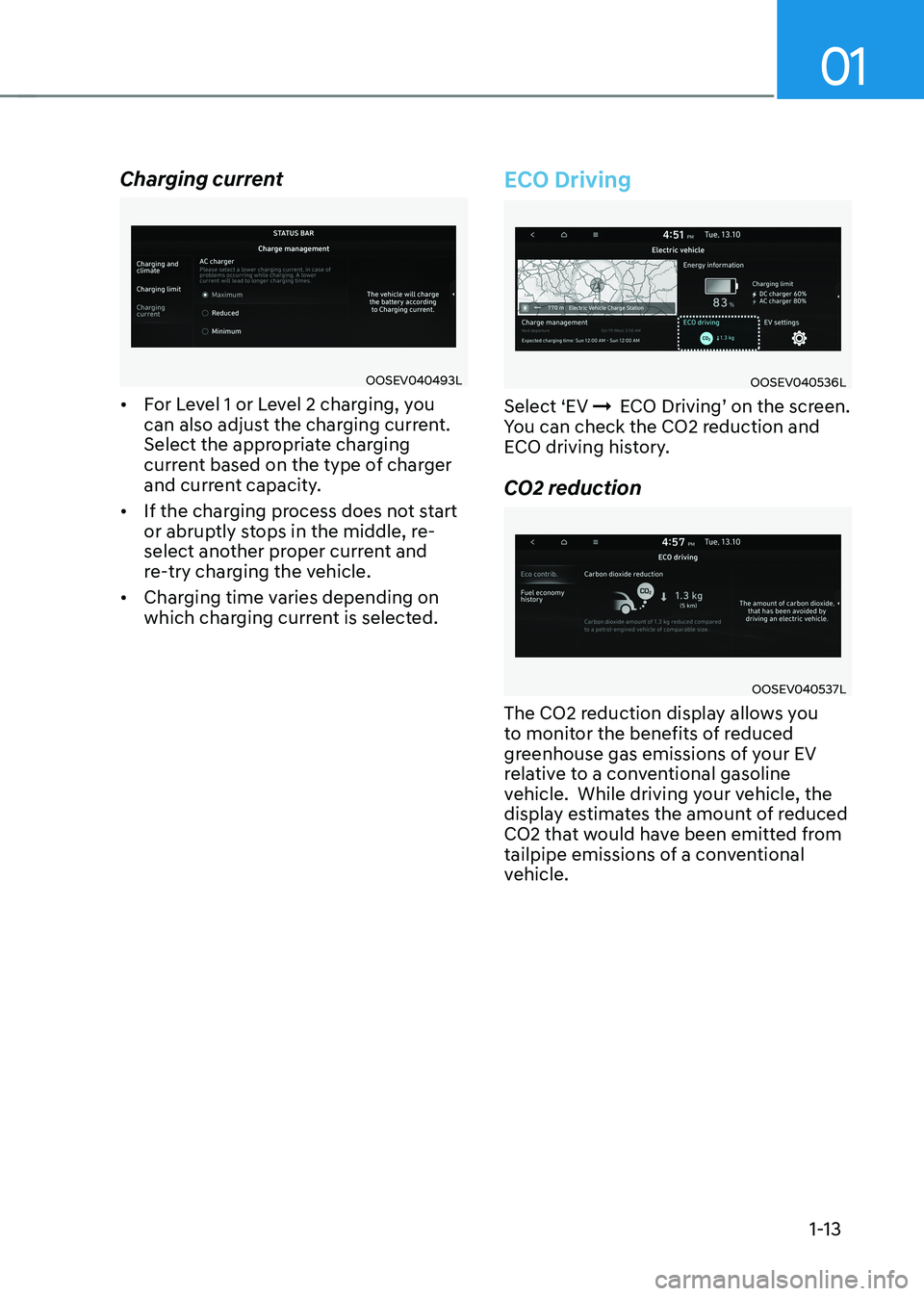
Charging current
OOSEV040493L
• For Level 1 or Level 2 charging, you
can also adjust the charging current.
Select the appropriate charging
current based on the type of charger
and current capacity.
• If the charging process does not start
or abruptly stops in the middle, re-
select another proper current and
re-try charging the vehicle.
• Charging time varies depending on
which charging current is selected.
ECO Driving
OOSEV040536L
Select ‘EV ÞECO Driving’ on the screen.
You can check the CO2 reduction and
ECO driving history.
CO2 reduction
OOSEV040537L
The CO2 reduction display allows you
to monitor the benefits of reduced
greenhouse gas emissions of your EV
relative to a conventional gasoline
vehicle. While driving your vehicle, the
display estimates the amount of reduced
CO2 that would have been emitted from
tailpipe emissions of a conventional
vehicle.
Page 39 of 548

Foreword / Electric Vehicle System Overview
1-34
à Example for setting the ICCB charge level
The example is only for reference and may vary according to the surrounding
environment.
Outlet current ICCB charge level Control box display window
14-16A 12A
OOSEVQ018055
13-12A
10A
11-10A 8A
CAUTION
Please make sure that charge level selection matches the capacity of your circuit
breaker to avoid blown fuse.
Page 72 of 548

02
2-7
DiMensions
Itemsmm (in)
Overall length 4205 (165.6)
Overall width 1800 (70.9)
Overall height 1555 (61.2) / 1570 (61.8) * 1
Front tread 1564 (61.6)
Rear tread 1575 (62.0)
Wheelbase 2600 (102.4)
*1 : with roof rack
eLectric VeHicLe speciFications
Items Specifications
Motor Max. output 150 kW
Max. torque 395 Nm
Battery
(Lithium-ion Polymer) Capacity 64 kWh
Power output 170 kW
Voltage 356 V
Charger (OBC) Max. Output 7.2 kW
OBC : On-Board Battery Chargers
Page 89 of 548
Safety system
3-10
OOS037008
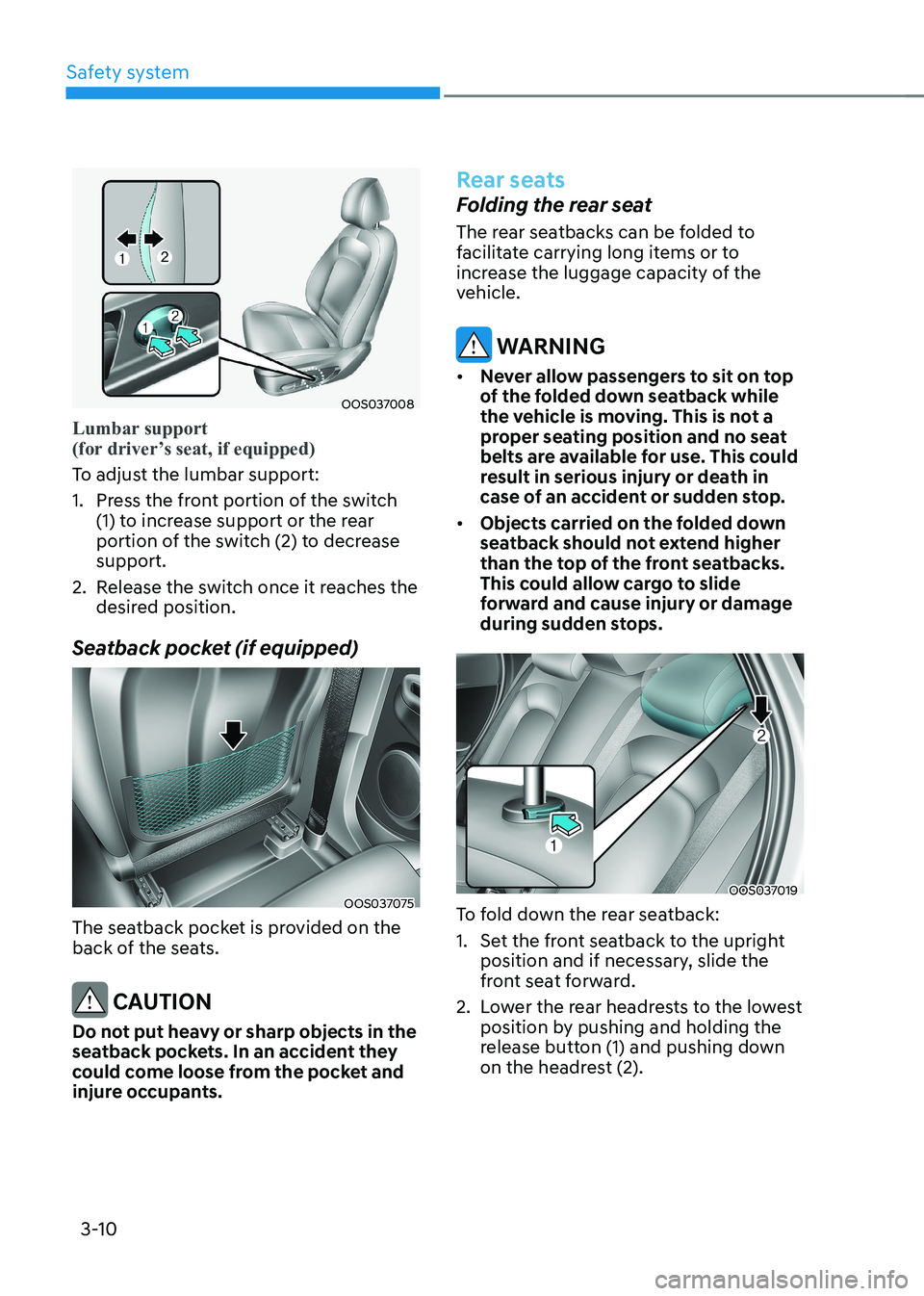
Lumbar support
(for driver’s seat, if equipped)
To adjust the lumbar support:
1. Press the front portion of the switch (1) to increase support or the rear
portion of the switch (2) to decrease support.
2. Release the switch once it reaches the desired position.
Seatback pocket (if equipped)
OOS037075
The seatback pocket is provided on the
back of the seats.
CAUTION
Do not put heavy or sharp objects in the
seatback pockets. In an accident they
could come loose from the pocket and
injure occupants.
Rear seats
Folding the rear seat
The rear seatbacks can be folded to
facilitate carrying long items or to
increase the luggage capacity of the
vehicle.
WARNING
• Never allow passengers to sit on top
of the folded down seatback while
the vehicle is moving. This is not a
proper seating position and no seat
belts are available for use. This could
result in serious injury or death in
case of an accident or sudden stop.
• Objects carried on the folded down
seatback should not extend higher
than the top of the front seatbacks.
This could allow cargo to slide
forward and cause injury or damage
during sudden stops.
OOS037019
To fold down the rear seatback:
1. Set the front seatback to the upright position and if necessary, slide the
front seat forward.
2. Lower the rear headrests to the lowest position by pushing and holding the
release button (1) and pushing down
on the headrest (2).
Page 270 of 548
Convenient features
5-86
NOTICE
To prevent damage to the Power
Outlets : • Use the power outlet only when the
vehicle is in the ready (
) mode
and remove the accessory plug after
use. Using the accessory plug for
prolonged periods of time with the
vehicle off could cause the battery to
discharge.
• Only use 12V electric accessories
which are less than 180 W(Watt) in
electric capacity.
• Adjust the air-conditioner or heater
to the lowest operating level when
using the power outlet.
• Close the cover when not in use.
• Some electronic devices can
cause electronic interference
when plugged into a vehicle’s
power outlet. These devices may
cause excessive audio static and
malfunctions in other electronic
systems or devices used in your
vehicle.
• Push the plug in as far as it will go. If
good contact is not made, the plug
may overheat and the fuse may open.
• Plug in battery equipped electrical/
electronic devices with reverse
current protection. The current
from the battery may flow into the
vehicle’s electrical/electronic system
and cause system malfunction.
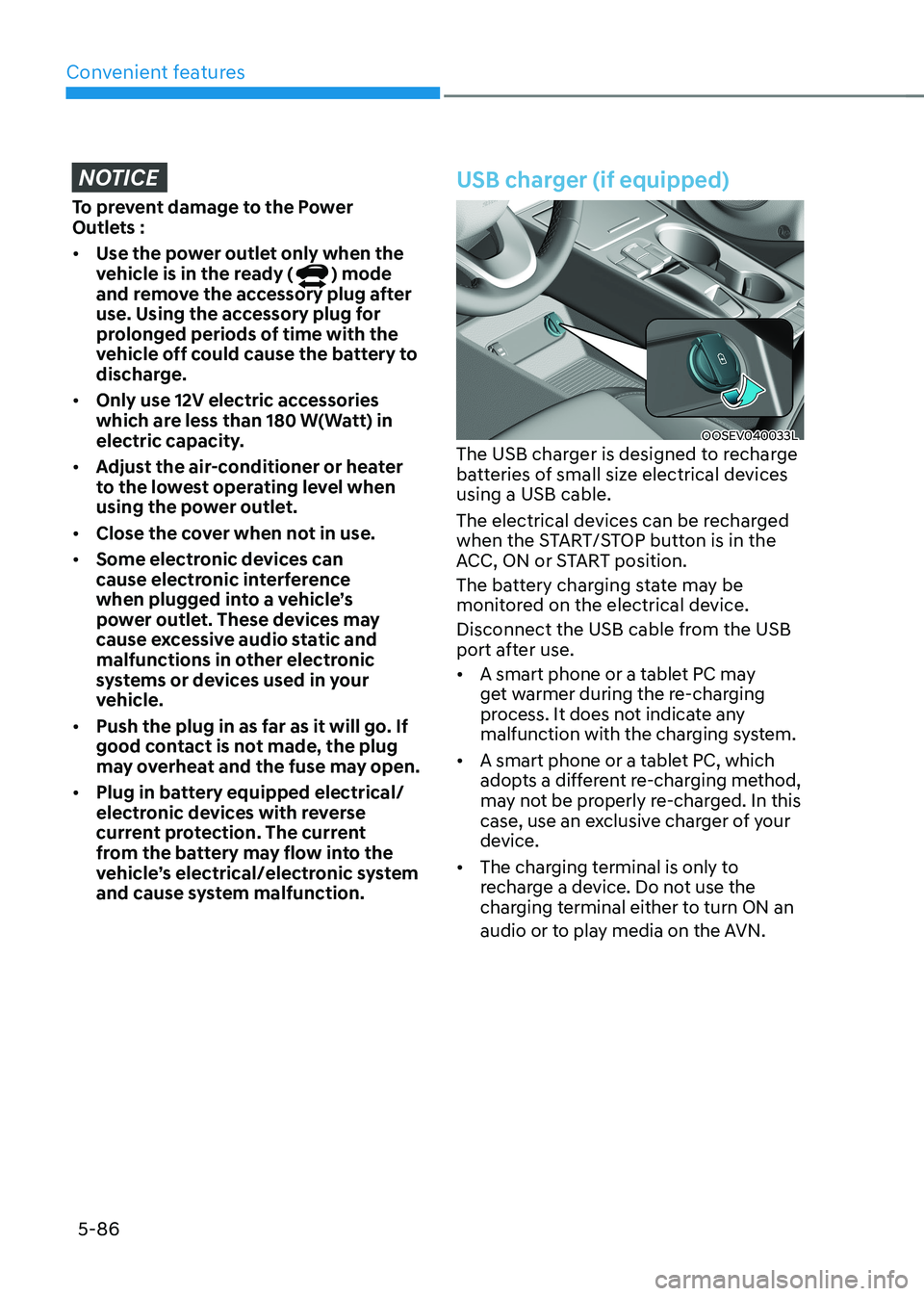
USB charger (if equipped)
OOSEV040033L
The USB charger is designed to recharge
batteries of small size electrical devices using a USB cable.
The electrical devices can be recharged
when the START/STOP button is in the
ACC, ON or START position.
The battery charging state may be
monitored on the electrical device.
Disconnect the USB cable from the USB
port after use. • A smart phone or a tablet PC may
get warmer during the re-charging
process. It does not indicate any
malfunction with the charging system.
• A smart phone or a tablet PC, which
adopts a different re-charging method,
may not be properly re-charged. In this
case, use an exclusive charger of your
device.
• The charging terminal is only to
recharge a device. Do not use the
charging terminal either to turn ON an
audio or to play media on the AVN.
Page 329 of 548
06
6-49
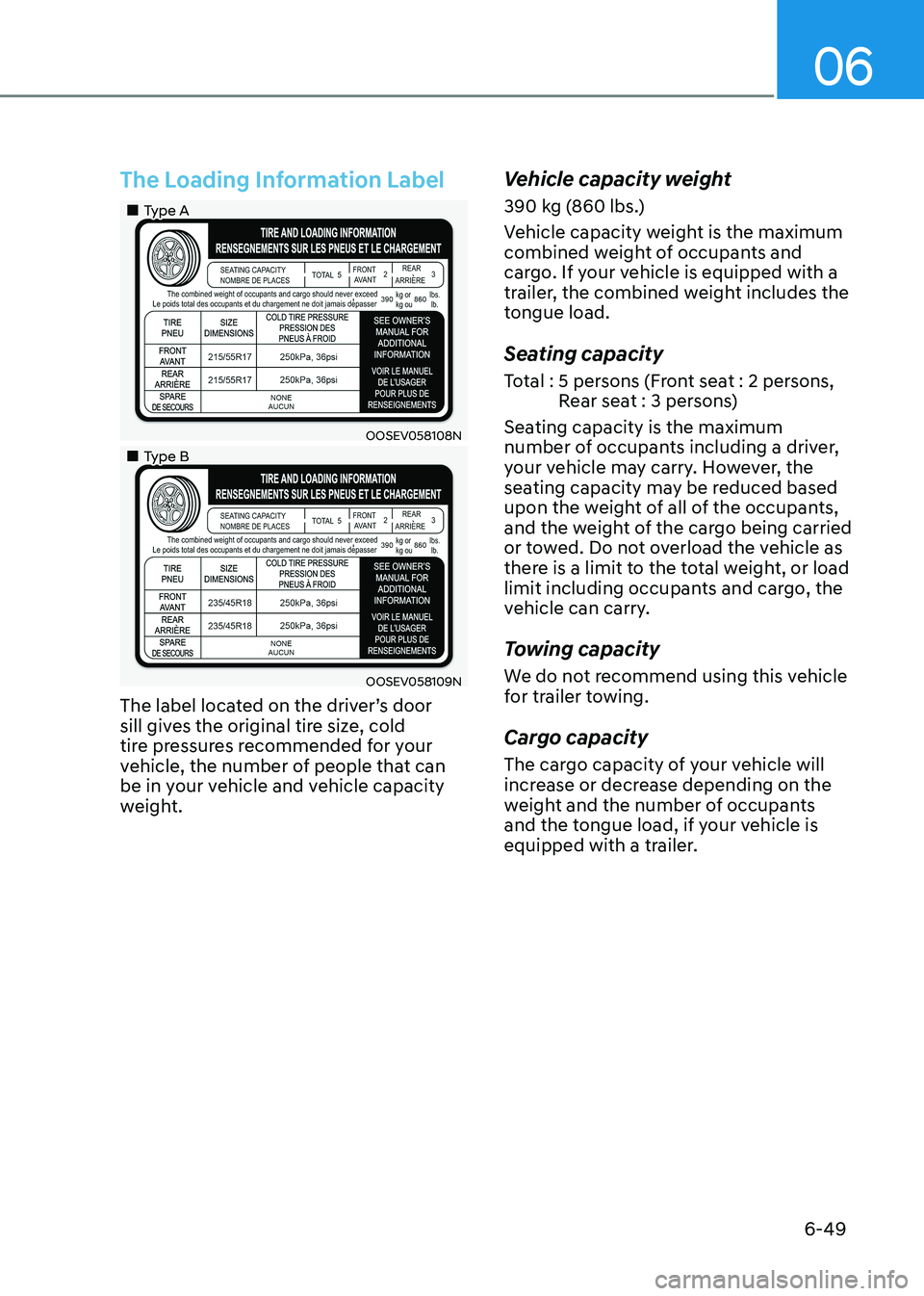
The Loading Information Label
„„Type A
OOSEV058108N
„„Type B
OOSEV058109N
The label located on the driver’s door
sill gives the original tire size, cold
tire pressures recommended for your
vehicle, the number of people that can
be in your vehicle and vehicle capacity
weight. Vehicle capacity weight
390 kg (860 lbs.)
Vehicle capacity weight is the maximum
combined weight of occupants and
cargo. If your vehicle is equipped with a
trailer, the combined weight includes the
tongue load.
Seating capacity
Total : 5 persons (Front seat : 2 persons,
Rear seat : 3 persons)
Seating capacity is the maximum
number of occupants including a driver,
your vehicle may carry. However, the
seating capacity may be reduced based
upon the weight of all of the occupants,
and the weight of the cargo being carried
or towed. Do not overload the vehicle as
there is a limit to the total weight, or load
limit including occupants and cargo, the
vehicle can carry.
Towing capacity
We do not recommend using this vehicle
for trailer towing.
Cargo capacity
The cargo capacity of your vehicle will
increase or decrease depending on the
weight and the number of occupants
and the tongue load, if your vehicle is
equipped with a trailer.