2022 HYUNDAI KONA EV tires
[x] Cancel search: tiresPage 501 of 548

09
9-25
Wheel size designation
Wheels are also marked with important
information that you need if you ever
have to replace one. The following
explains what the letters and numbers in
the wheel size designation mean.
Example wheel size designation:6.5JX166.5 - Rim width in inches.
J - Rim contour designation.
16 - Rim diameter in inches.
Tire speed ratings
The chart below lists many of the
different speed ratings currently being
used for passenger vehicle tires. The
speed rating is part of the tire size
designation on the sidewall of the tire.
This symbol corresponds to that tire’s
designed maximum safe operating speed.
Speed Rating Symbol Maximum Speed
S 180 km/h (112 mph)
T 190 km/h (118 mph)
H 210 km/h (130 mph)
V 240 km/h (149 mph)
W 270km/h (168mph) Y 300km/h (186mph) 3. Checking tire life
(TIN : Tire Identification Number)
Any tires that are over six years old,
based on the manufacturing date,
(including the spare tire) should be
replaced by new ones. You can find the
manufacturing date on the tire sidewall
(possibly on the inside of the wheel),
displaying the DOT Code. The DOT Code
is a series of numbers on a tire consisting
of numbers and English letters. The
manufacturing date is designated by the
last four digits (characters) of the DOT code.
DOT : XXXX XXXX OOOO
The front part of the DOT shows a plant
code number, tire size and tread pattern
and the last four numbers indicate week
and year manufactured.
For example:
DOT XXXX XXXX 1521 represents that the
tire was produced in the 15th week of 2021.
4. Tire ply composition and material
The number of layers or plies of
rubber-coated fabric in the tire. Tire
manufacturers also must indicate the
materials in the tire, which include steel,
nylon, polyester, and others. The letter
“R” means radial ply construction; the
letter “D“ means diagonal or bias ply
construction; and the letter “B” means
belted-bias ply construction.
Page 502 of 548
Maintenance
9-26
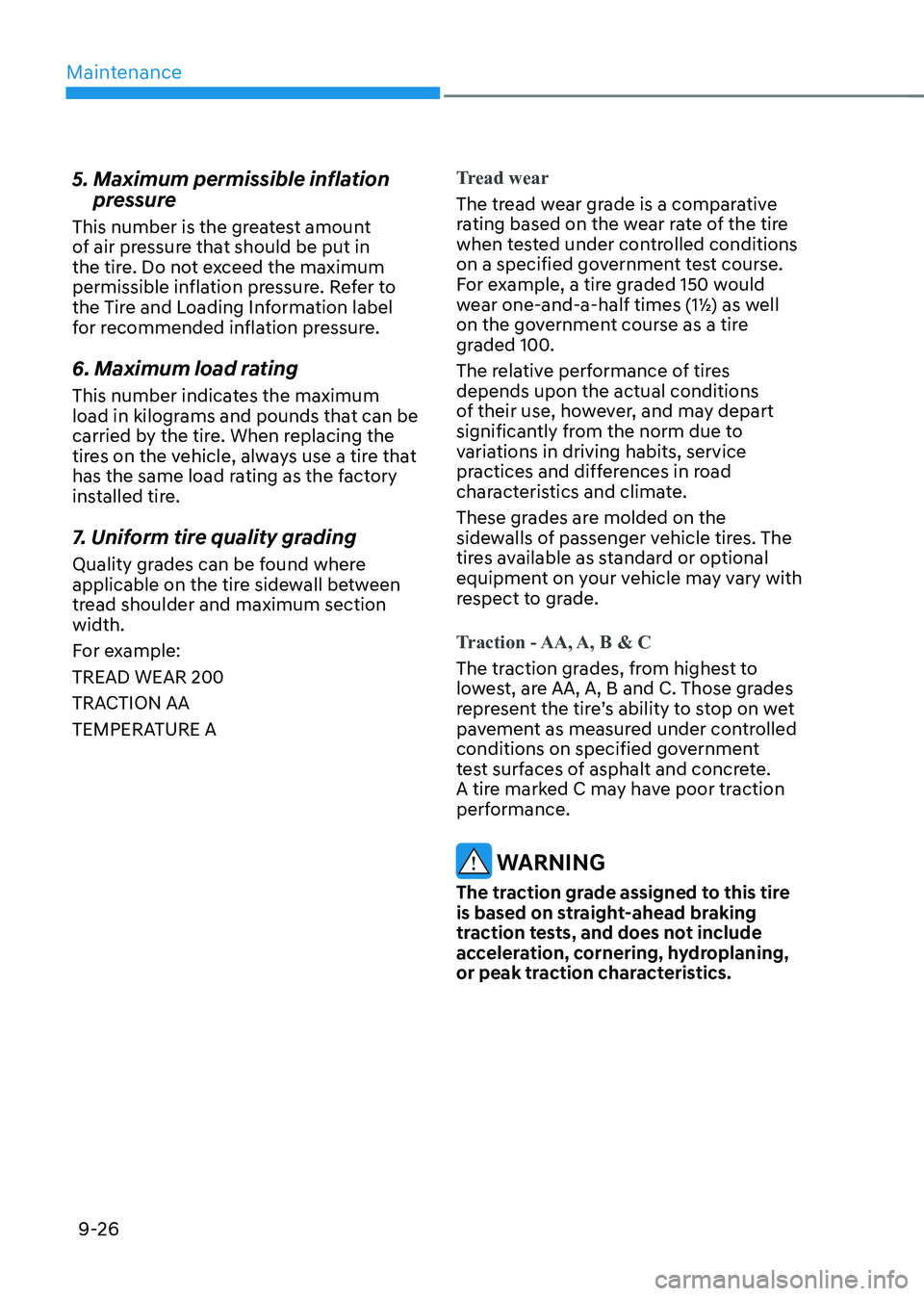
5. Maximum permissible inflation
pressure
This number is the greatest amount
of air pressure that should be put in
the tire. Do not exceed the maximum
permissible inflation pressure. Refer to
the Tire and Loading Information label
for recommended inflation pressure.
6. Maximum load rating
This number indicates the maximum
load in kilograms and pounds that can be
carried by the tire. When replacing the
tires on the vehicle, always use a tire that
has the same load rating as the factory
installed tire.
7. Uniform tire quality grading
Quality grades can be found where
applicable on the tire sidewall between
tread shoulder and maximum section width.
For example: TREAD WEAR 200
TRACTION AA
TEMpERATURE A
Tread wear
The tread wear grade is a comparative
rating based on the wear rate of the tire
when tested under controlled conditions
on a specified government test course.
For example, a tire graded 150 would
wear one-and-a-half times (1½) as well
on the government course as a tire
graded 100.
The relative performance of tires depends upon the actual conditions
of their use, however, and may depart
significantly from the norm due to
variations in driving habits, service
practices and differences in road
characteristics and climate.
These grades are molded on the
sidewalls of passenger vehicle tires. The
tires available as standard or optional
equipment on your vehicle may vary with
respect to grade.
Traction - AA, A, B & C
The traction grades, from highest to
lowest, are AA, A, B and C. Those grades
represent the tire’s ability to stop on wet
pavement as measured under controlled
conditions on specified government
test surfaces of asphalt and concrete.
A tire marked C may have poor traction
performance.
WARNING
The traction grade assigned to this tire
is based on straight-ahead braking
traction tests, and does not include
acceleration, cornering, hydroplaning,
or peak traction characteristics.
Page 506 of 548
Maintenance
9-30
Vehicle normal load on the tire
Load on an individual tire that is
determined by distributing to each
axle its share of the curb weight,
accessory weight, and normal
occupant weight and dividing by 2.
Vehicle placard
A label permanently attached
to a vehicle showing the
original equipment tire size and
recommended inflation pressure.
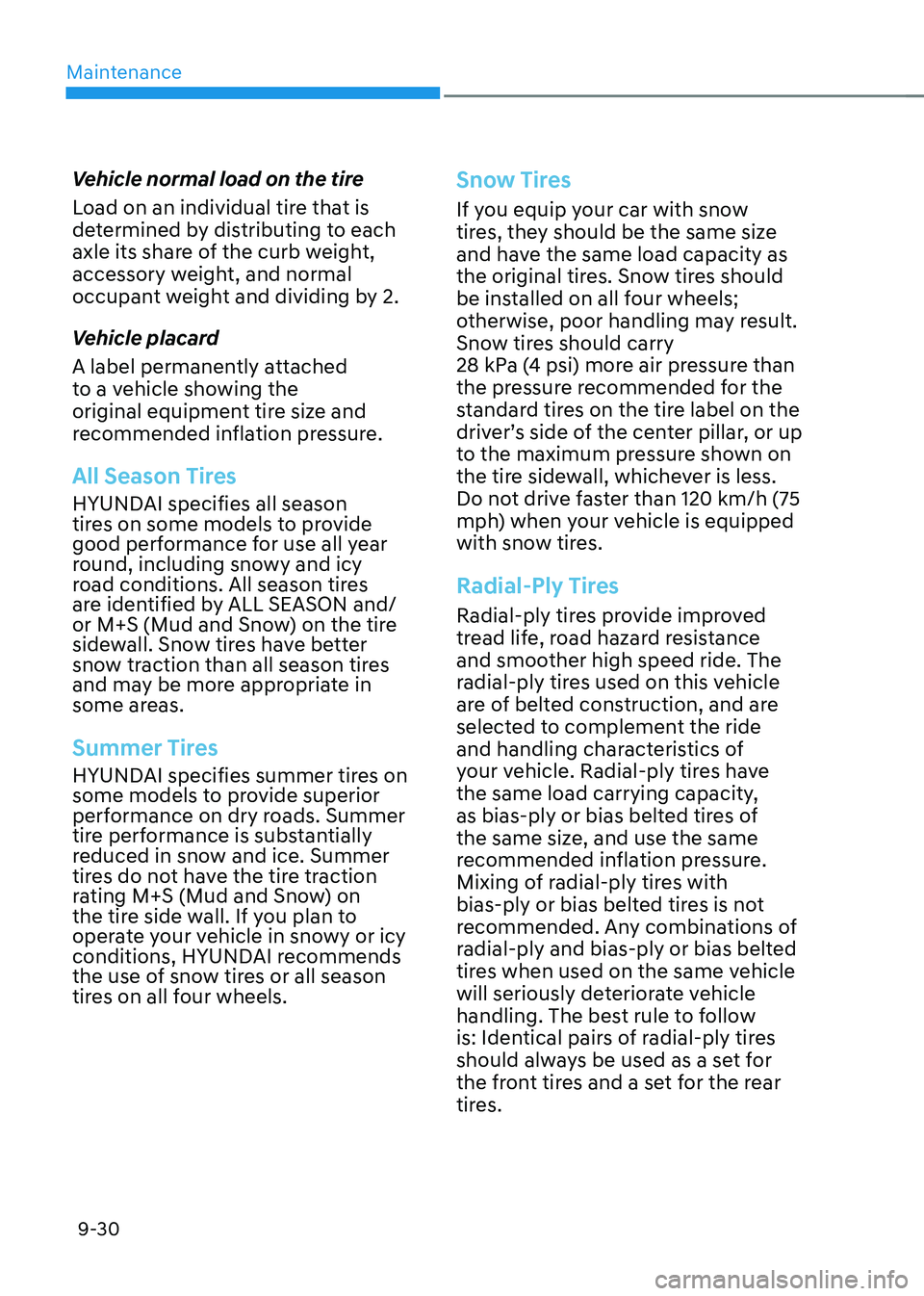
All Season Tires
HYUNDAI specifies all season
tires on some models to provide
good performance for use all year
round, including snowy and icy
road conditions. All season tires
are identified by ALL SEASON and/
or M+S (Mud and Snow) on the tire
sidewall. Snow tires have better
snow traction than all season tires
and may be more appropriate in
some areas.
Summer Tires
HYUNDAI specifies summer tires on
some models to provide superior
performance on dry roads. Summer
tire performance is substantially
reduced in snow and ice. Summer
tires do not have the tire traction
rating M+S (Mud and Snow) on
the tire side wall. If you plan to
operate your vehicle in snowy or icy
conditions, HYUNDAI recommends
the use of snow tires or all season
tires on all four wheels.
Snow Tires
If you equip your car with snow
tires, they should be the same size
and have the same load capacity as
the original tires. Snow tires should
be installed on all four wheels;
otherwise, poor handling may result.
Snow tires should carry
28 kPa (4 psi) more air pressure than
the pressure recommended for the
standard tires on the tire label on the
driver’s side of the center pillar, or up
to the maximum pressure shown on
the tire sidewall, whichever is less.
Do not drive faster than 120 km/h (75
mph) when your vehicle is equipped
with snow tires.
Radial-Ply Tires
Radial-ply tires provide improved
tread life, road hazard resistance
and smoother high speed ride. The
radial-ply tires used on this vehicle
are of belted construction, and are
selected to complement the ride
and handling characteristics of
your vehicle. Radial-ply tires have
the same load carrying capacity,
as bias-ply or bias belted tires of
the same size, and use the same
recommended inflation pressure.
Mixing of radial-ply tires with
bias-ply or bias belted tires is not
recommended. Any combinations of
radial-ply and bias-ply or bias belted
tires when used on the same vehicle
will seriously deteriorate vehicle
handling. The best rule to follow
is: Identical pairs of radial-ply tires
should always be used as a set for
the front tires and a set for the rear
tires.
Page 507 of 548
09
9-31
Longer wearing tires can be more
susceptible to irregular tread wear.
It is very important to follow the tire
rotation interval in this chapter to
achieve the tread life potential of
these tires. Cuts and punctures in
radial-ply tires are repairable only in
the tread area, because of sidewall
flexing. Consult your tire dealer for
radial-ply tire repairs.
WARNING
Do not mix bias ply and radial ply
tires under any circumstances.
This may cause unusual handling
characteristics that may cause loss
of vehicle control resulting in an
accident.
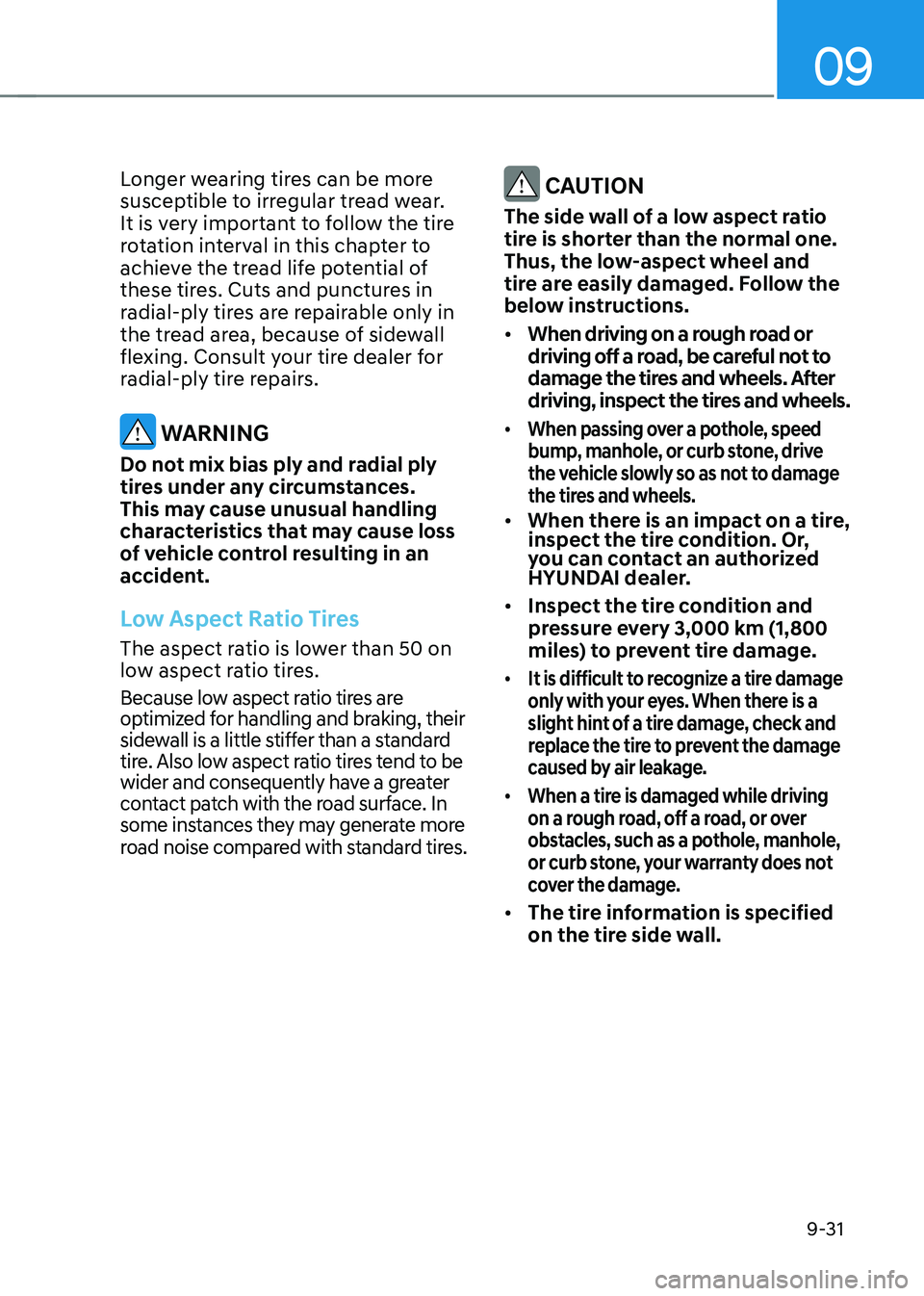
Low Aspect Ratio Tires
The aspect ratio is lower than 50 on
low aspect ratio tires.
Because low aspect ratio tires are
optimized for handling and braking, their
sidewall is a little stiffer than a standard
tire. Also low aspect ratio tires tend to be
wider and consequently have a greater
contact patch with the road surface. In
some instances they may generate more
road noise compared with standard tires.
CAUTION
The side wall of a low aspect ratio
tire is shorter than the normal one.
Thus, the low-aspect wheel and
tire are easily damaged. Follow the
below instructions. • When driving on a rough road or
driving off a road, be careful not to
damage the tires and wheels. After
driving, inspect the tires and wheels.
• When passing over a pothole, speed
bump, manhole, or curb stone, drive
the vehicle slowly so as not to damage
the tires and wheels.
• When there is an impact on a tire,
inspect the tire condition. Or,
you can contact an authorized
HYUNDAI dealer.
• Inspect the tire condition and
pressure every 3,000 km (1,800
miles) to prevent tire damage.
• It is difficult to recognize a tire damage
only with your eyes. When there is a
slight hint of a tire damage, check and
replace the tire to prevent the damage
caused by air leakage.
• When a tire is damaged while driving
on a rough road, off a road, or over
obstacles, such as a pothole, manhole,
or curb stone, your warranty does not
cover the damage.
• The tire information is specified
on the tire side wall.
Page 546 of 548
I
I-11
Storage compartment ........................................................................................... 5-81
Center console storage ..................................................................................... 5-81
Glove box ......................................................................................................... 5-81
Luggage tray ..................................................................................................... 5-82
Sunglasses holder ............................................................................................. 5-82
Sunroof ................................................................................................................ 5-37
Resetting the sunroof ........................................................................................ 5-39
Sliding the sunroof ........................................................................................... 5-38
Sunroof open warning ...................................................................................... 5-40
Sunroof opening and closing ............................................................................ 5-38
Sunshade ........................................................................................................... 5-39
Tilting the sunroof ............................................................................................ 5-39
T Theft-alarm system .............................................................................................. 5-15
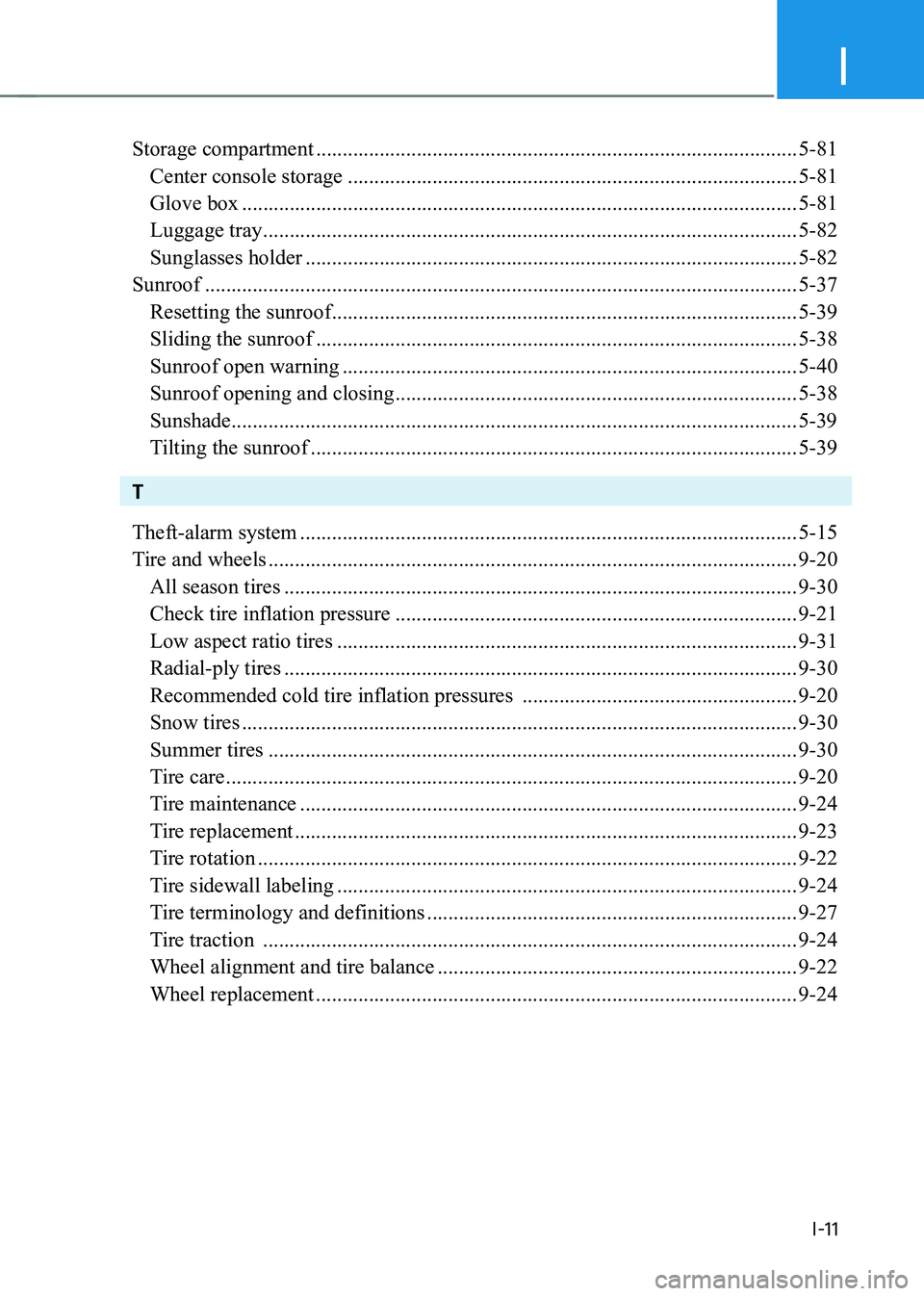
Tire and wheels .................................................................................................... 9-20
All season tires ................................................................................................. 9-30
Check tire inflation pressure ............................................................................ 9-21
Low aspect ratio tires ....................................................................................... 9-31
Radial-ply tires ................................................................................................. 9-30
Recommended cold tire inflation pressures ....................................................9-20
Snow tires ......................................................................................................... 9-30
Summer tires .................................................................................................... 9-30
Tire care ............................................................................................................ 9-20
Tire maintenance .............................................................................................. 9-24
Tire replacement ............................................................................................... 9-23
Tire rotation ...................................................................................................... 9-22
Tire sidewall labeling ....................................................................................... 9-24
Tire terminology and definitions ...................................................................... 9-27
Tire traction ..................................................................................................... 9-24
Wheel alignment and tire balance .................................................................... 9-22
Wheel replacement ........................................................................................... 9-24
Page 547 of 548
Index
I-12
Tire Pressure Monitoring System (TPMS) ............................................................8-6
Changing a tire with TPMS ................................................................................ 8-9
Check tire pressure ............................................................................................. 8-6
Low tire pressure position telltale and tire pressure telltale ...............................8-8
Low tire pressure telltale .................................................................................... 8-8
Tire pressure monitoring system ........................................................................ 8-7
TPMS (Tire Pressure Monitoring System) malfunction indicator .....................8-9
Tire specification and pressure label ................................................................... 2-13
Tires and wheels .................................................................................................... 2-9
Towing ................................................................................................................. 8-18
Emergency towing ............................................................................................ 8-20
Removable towing hook .................................................................................. 8-19
Towing service ................................................................................................. 8-18
Trailer towing ...................................................................................................... 6-53
Trip computer ...................................................................................................... 4-39
V
Vehicle certification label .................................................................................... 2-12
Vehicle identification number (VIN) ................................................................... 2-12
Vehicle load limit ................................................................................................. 6-48
Overloading ...................................................................................................... 6-48
The loading information label .......................................................................... 6-49
Volume and weight .............................................................................................. 2-10