Page 47 of 548
Foreword / Electric Vehicle System Overview
1-42
How to Disconnect Portable Charger
(ICCB: In-Cable Control Box)
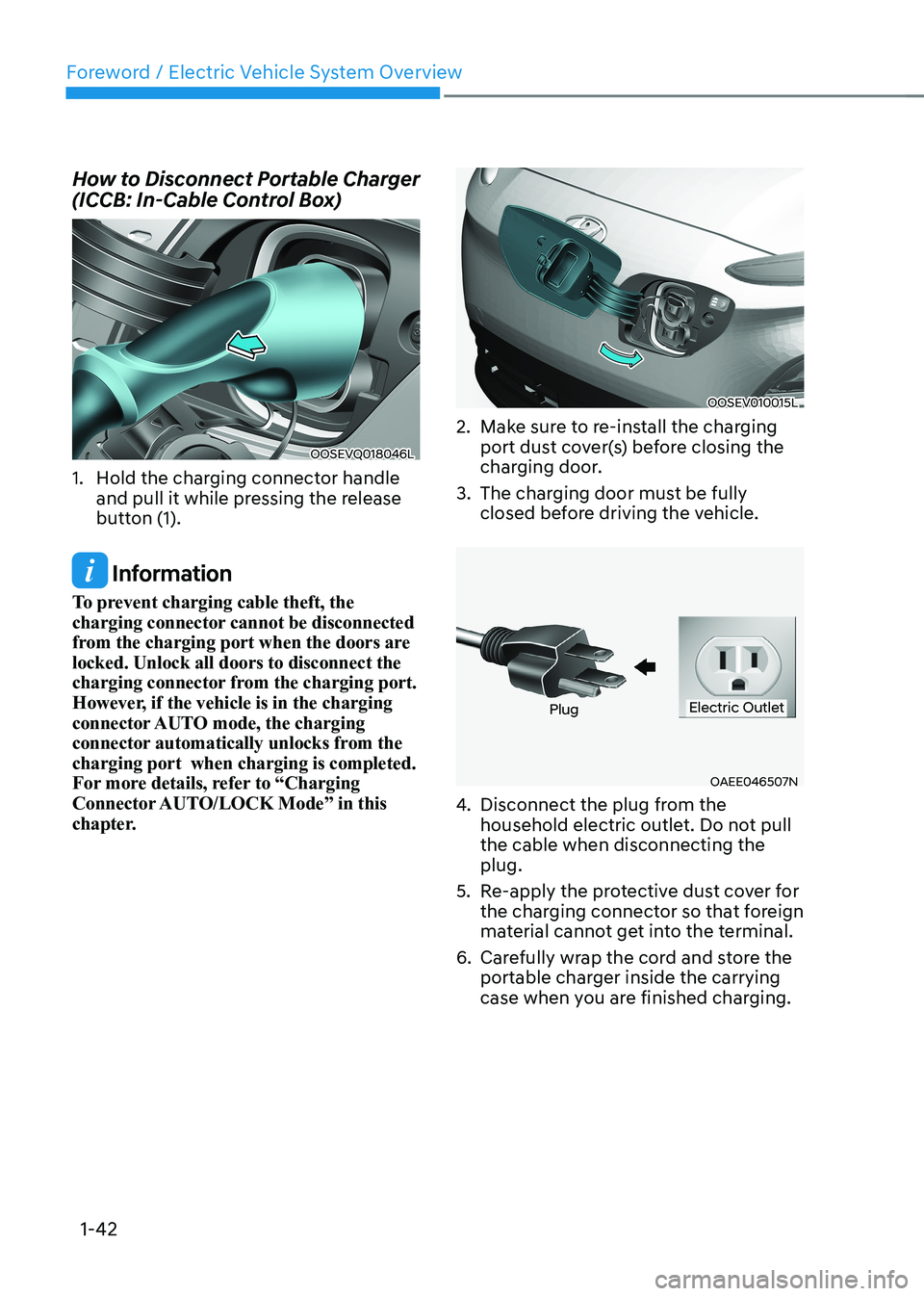
OOSEVQ018046L
1. Hold the charging connector handle and pull it while pressing the release
button (1).
Information
To prevent charging cable theft, the
charging connector cannot be disconnected
from the charging port when the doors are
locked. Unlock all doors to disconnect the
charging connector from the charging port.
However, if the vehicle is in the charging
connector AUTO mode, the charging
connector automatically unlocks from the
charging port when charging is completed.
For more details, refer to “Charging
Connector AUTO/LOCK Mode” in this
chapter.
OOSEV010015L
2. Make sure to re-install the charging port dust cover(s) before closing the
charging door.
3. The charging door must be fully closed before driving the vehicle.
OAEE046507N
PlugElectric Outlet
4. Disconnect the plug from the
household electric outlet. Do not pull the cable when disconnecting the plug.
5. Re-apply the protective dust cover for the charging connector so that foreign
material cannot get into the terminal.
6. Carefully wrap the cord and store the portable charger inside the carrying
case when you are finished charging.
Page 64 of 548
01
1-59
WARNING
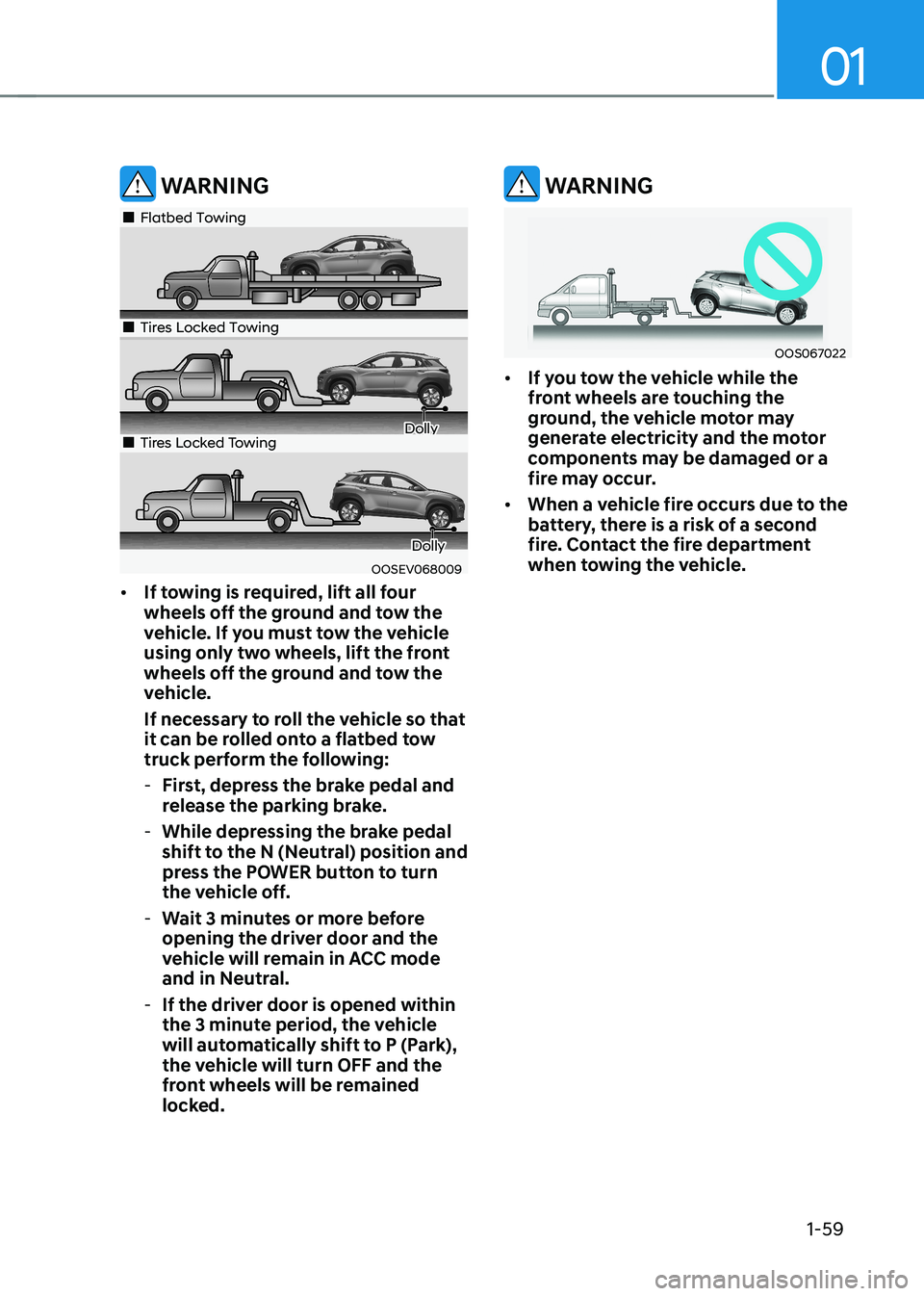
OOSEV068009
„„Flatbed Towing
„„Tires Locked Towing
Dolly„„Tires Locked Towing
Dolly
• If towing is required, lift all four
wheels off the ground and tow the
vehicle. If you must tow the vehicle
using only two wheels, lift the front
wheels off the ground and tow the
vehicle.
If necessary to roll the vehicle so that
it can be rolled onto a flatbed tow
truck perform the following:
- First, depress the brake pedal and
release the parking brake.
- While depressing the brake pedal
shift to the N (Neutral) position and
press the POWER button to turn
the vehicle off.
- Wait 3 minutes or more before
opening the driver door and the
vehicle will remain in ACC mode
and in Neutral.
- If the driver door is opened within
the 3 minute period, the vehicle
will automatically shift to P (Park),
the vehicle will turn OFF and the
front wheels will be remained
locked.
WARNING
OOS067022
• If you tow the vehicle while the
front wheels are touching the
ground, the vehicle motor may
generate electricity and the motor
components may be damaged or a
fire may occur.
• When a vehicle fire occurs due to the
battery, there is a risk of a second
fire. Contact the fire department
when towing the vehicle.
Page 65 of 548
Foreword / Electric Vehicle System Overview
1-60
Additional Precautions
• When you paint or apply heat
treatment to the vehicle as a result of
an accident, the performance of the
high voltage battery can be reduced.
If heat treatment is required, contact
an authorized HYUNDAI dealer.
• When you clean the motor
compartment, do not use high
pressure water to wash. This may
cause an electric shock due to a
discharge in high voltage electricity,
or damage the vehicle’s electric
system.
• Do not use, remodel, or install non-
genuine parts. This may damage the
electric power system.
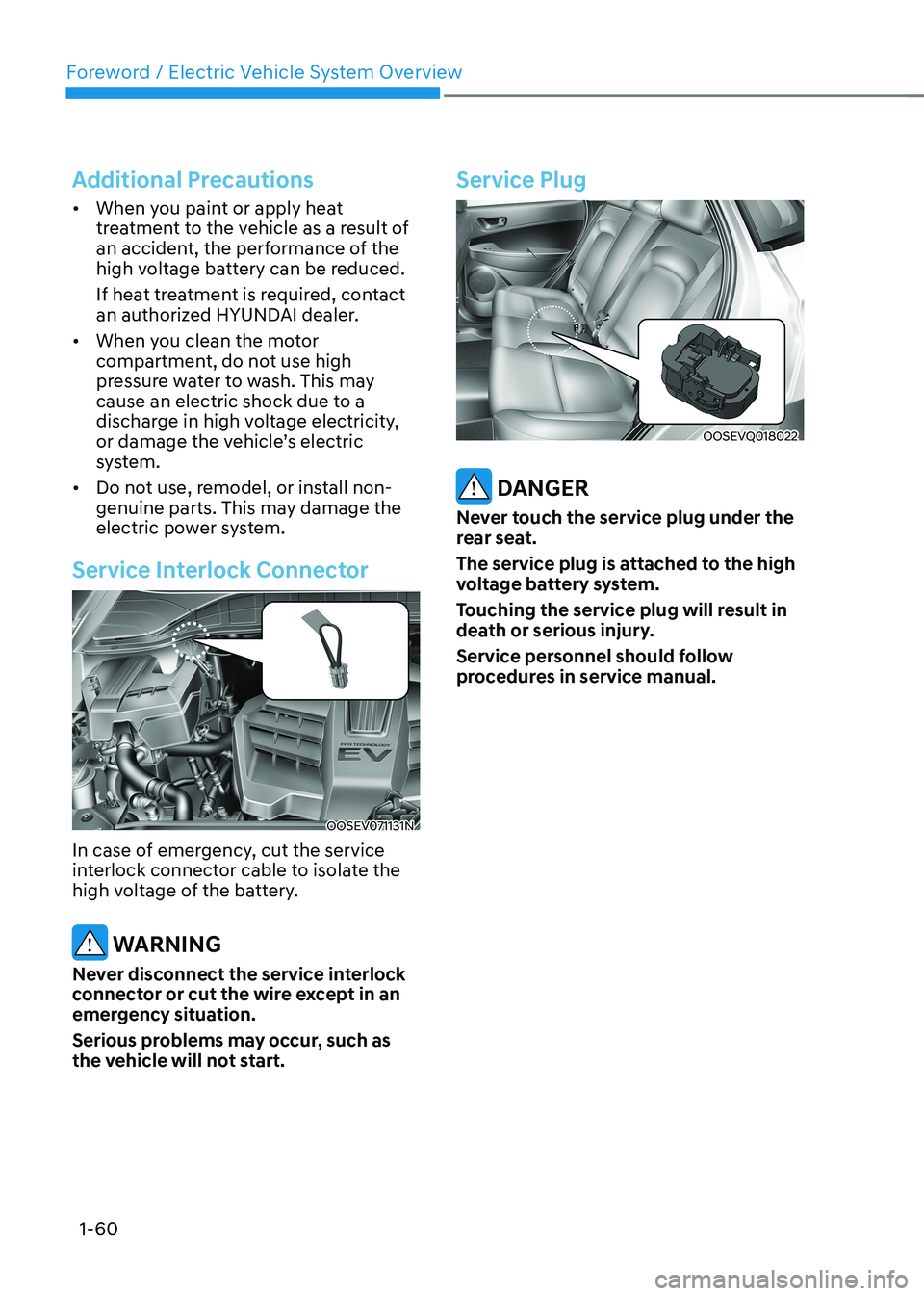
Service Interlock Connector
OOSEV071131N
In case of emergency, cut the service
interlock connector cable to isolate the
high voltage of the battery.
WARNING
Never disconnect the service interlock
connector or cut the wire except in an
emergency situation.
Serious problems may occur, such as
the vehicle will not start.
Service Plug
OOSEVQ018022
DANGER
Never touch the service plug under the
rear seat.
The service plug is attached to the high
voltage battery system.
Touching the service plug will result in
death or serious injury.
Service personnel should follow
procedures in service manual.
Page 69 of 548

2-4
Vehicle information
1. Door lock/unlock button ........................5-11
2. Outside rearview mirror
folding switch .......................................... 5-32
3. Outside rearview mirror control switch ..5-31
4. Central door lock switch .......................5-12
5. Power window lock switch ..................5-36
6. Power window switches ......................5-33
7. Instrument panel illumination control
switch ...................................................... 4-38. Parking Safety button
..........................7-126
9. Head-up display button .......................5-47
10. AUTO/LOCK mode selection button .....1-21
11. ESC OFF button .................................... 6-32
12. Hood release lever .................................5-41
13. Fuse box ................................................ 9-37
14. Steering wheel tilt/telescope lever ......5-17
15. Steering wheel ....................................... 5-16
16. Seat .......................................................... 3-3
intErior ovErviEw (i)
„„Left-hand drive type
The actual shape may differ from the illustration.
OOSEV011003N
Page 78 of 548
02
2-13
tire speciFication anD pressure LaBeL
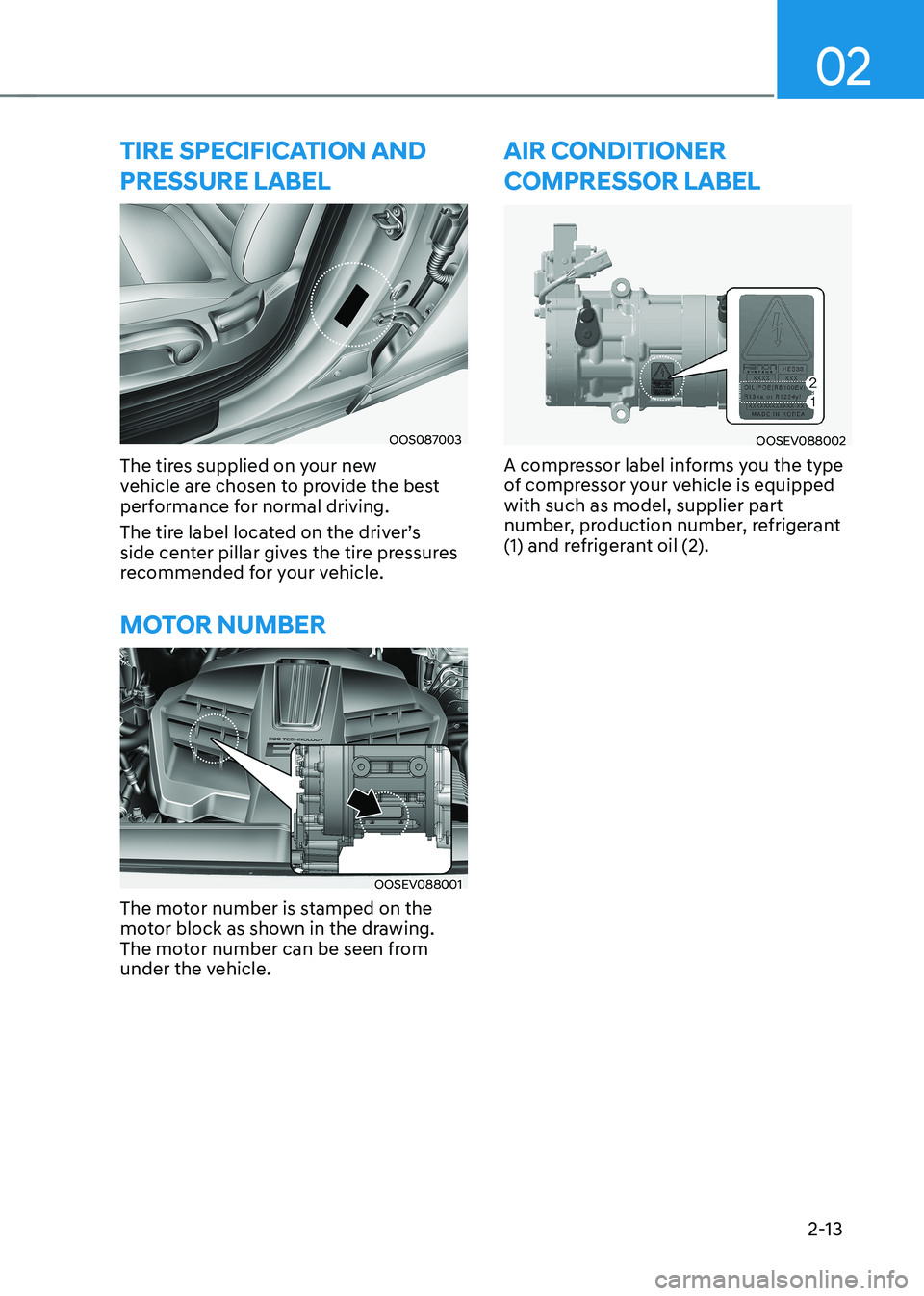
OOS087003
The tires supplied on your new
vehicle are chosen to provide the best
performance for normal driving.
The tire label located on the driver’s
side center pillar gives the tire pressures
recommended for your vehicle.
Motor nuMBer
OOSEV088001
The motor number is stamped on the
motor block as shown in the drawing.
The motor number can be seen from
under the vehicle.
air conDitioner
coMpressor LaBeL
OOSEV088002
A compressor label informs you the type
of compressor your vehicle is equipped with such as model, supplier part
number, production number, refrigerant
(1) and refrigerant oil (2).
Page 83 of 548
Safety system
3-4
Safety precautions
Adjusting the seats so that you are sitting
in a safe, comfortable position plays an
important role in driver and passenger
safety, together with seat belts and air
bags, in an accident.
WARNING
Do not use a cushion that reduces
friction between the seat and the
passenger. The passenger’s hips may
slide under the lap portion of the seat
belt during an accident or a sudden
stop.
Serious or fatal internal injuries could
result because the seat belt cannot
operate properly. Air bags
You can take steps to reduce the risk
of being injured by an inflating air bag.
Sitting too close to an air bag greatly
increases the risk of injury in the event
the air bag inflates. Move your seat as
far back as possible from front air bags,
while still maintaining control of the
vehicle.
WARNING
To reduce the risk of serious injury or
death from an inflating air bag, take the
following precautions: • Adjust the driver’s seat as far to the
rear as possible while maintaining
the ability to control the vehicle.
• Adjust the front passenger seat as far
to the rear as possible.
• Hold the steering wheel by the rim
with hands at the 9 o’clock and 3
o’clock positions to minimize the risk
of injuries to your hands and arms.
• NEVER place anything or anyone
between you and the air bag.
• Do not allow the front passenger to
place feet or legs on the dashboard
to minimize the risk of leg injuries.
Page 84 of 548
03
3-5
Seat belts
Always fasten your seat belt before
starting any trip. At all times, passengers
should sit upright and be properly
restrained. Infants and small children
must be restrained in appropriate Child
Restraint Systems. Children who have
outgrown a booster seat and adults must
be restrained using the seat belts.
WARNING
Take the following precautions when
adjusting your seat belt: • NEVER use one seat belt for more
than one occupant.
• Always position the seatback upright
with the lap portion of the seat belt
snug and low across the hips.
• NEVER allow children or small infants
to ride on a passenger’s lap.
• Do not route the seat belt across your
neck, across sharp edges, or reroute
the shoulder strap away from your
body.
• Do not allow the seat belt to become
caught or jammed.
Front seats
The front seat can be adjusted by using
the control lever (or knob) or switches
located on the outside of the seat
cushion. Before driving, adjust the seat
to the proper position so that you can
easily control the steering wheel, foot
pedals and controls on the instrument panel.
WARNING
Take the following precautions when
adjusting your seat: • NEVER attempt to adjust the seat
while the vehicle is moving. The seat
could respond with unexpected
movement and may cause loss
of vehicle control resulting in an
accident.
• Do not place anything under the
front seats. Loose objects in the
driver’s foot area could interfere
with the operation of the foot pedals,
causing an accident.
• Do not allow anything to interfere
with the normal position and proper
locking of the seatback.
• Do not place a cigarette lighter on
the floor or seat. When you operate
the seat, gas may exit out of the
lighter causing a fire.
• Use extreme caution when picking
up small objects trapped under the
seats or between the seat and the
center console. Your hands might be
cut or injured by the sharp edges of
the seat mechanism.
• If there are occupants in the rear
seats, be careful while adjusting the
front seat position.
• Make sure that the seat is locked in
place after the adjustment. If not,
the seat might move unexpectedly
resulting in an accident.
Page 85 of 548
Safety system
3-6
CAUTION
To prevent injury: • Do not adjust your seat while
wearing your seat belt.
Moving the seat cushion forward
may cause strong pressure on your abdomen.
• Do not allow your hands or fingers to
get caught in the seat mechanisms
while the seat is moving.
Manual adjustment (if equipped)
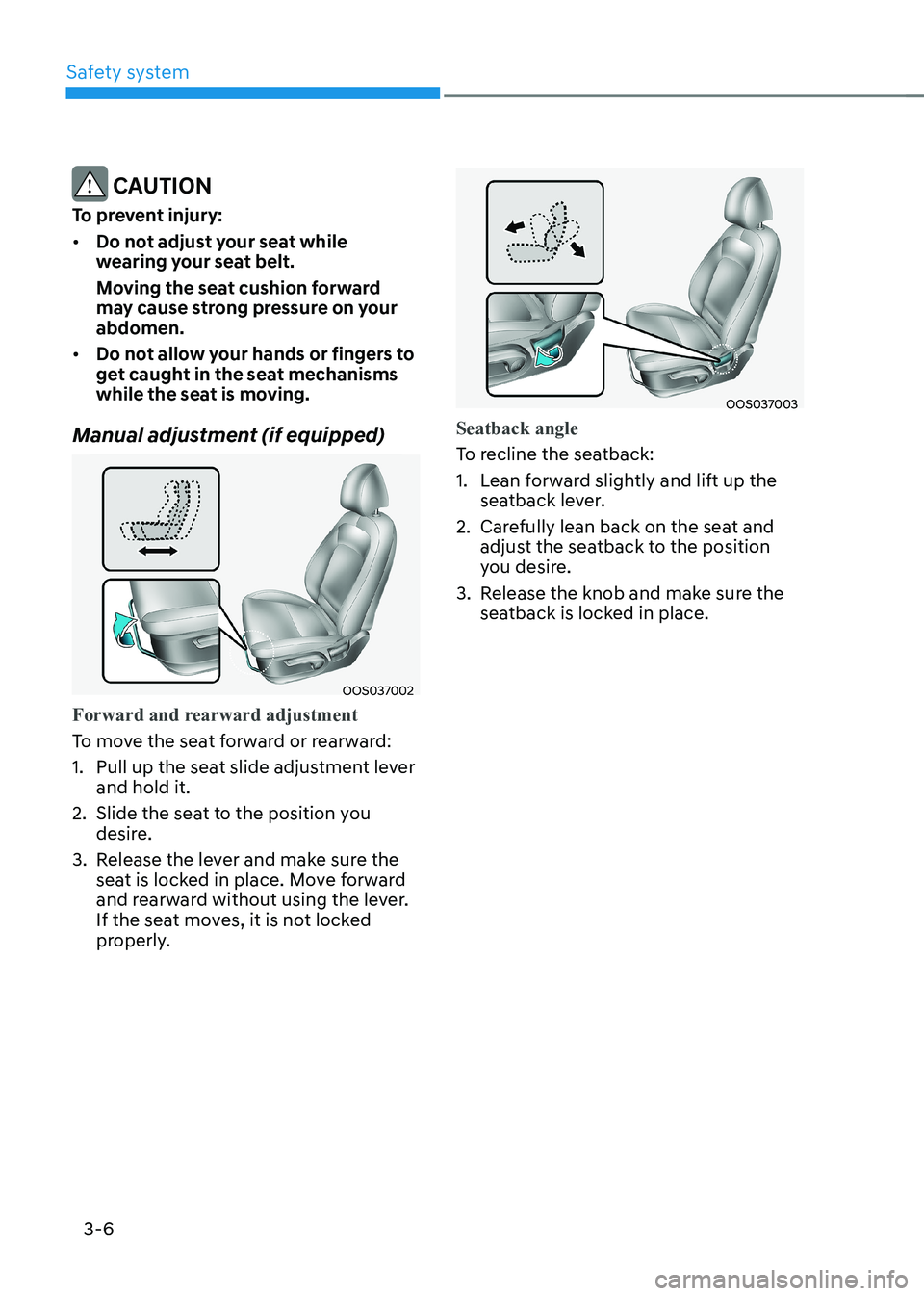
OOS037002
Forward and rearward adjustment
To move the seat forward or rearward:
1. Pull up the seat slide adjustment lever and hold it.
2. Slide the seat to the position you desire.
3. Release the lever and make sure the seat is locked in place. Move forward
and rearward without using the lever.
If the seat moves, it is not locked
properly.
OOS037003
Seatback angle
To recline the seatback:
1. Lean forward slightly and lift up the seatback lever.
2. Carefully lean back on the seat and adjust the seatback to the position
you desire.
3. Release the knob and make sure the seatback is locked in place.