2021 VOLKSWAGEN UP! engine
[x] Cancel search: enginePage 20 of 211
Introduction
This chapter contains information on the followingsubjects:
⇒ Vehicle key
⇒ Mechanical vehicle key
⇒ Indicator lamp in the vehicle key
⇒ Replacing the battery
⇒ Synchronising the vehicle key
Additional information and warnings:
•Settings in the Volkswagen information system ⇒ Volkswagen information system
•Central locking system ⇒ Central locking system
•Starting and stopping the engine ⇒ Starting and stopping the engine
•Consumer information ⇒ Consumer information
•Manual opening and closing⇒ Manual opening and closing
Vehicle key
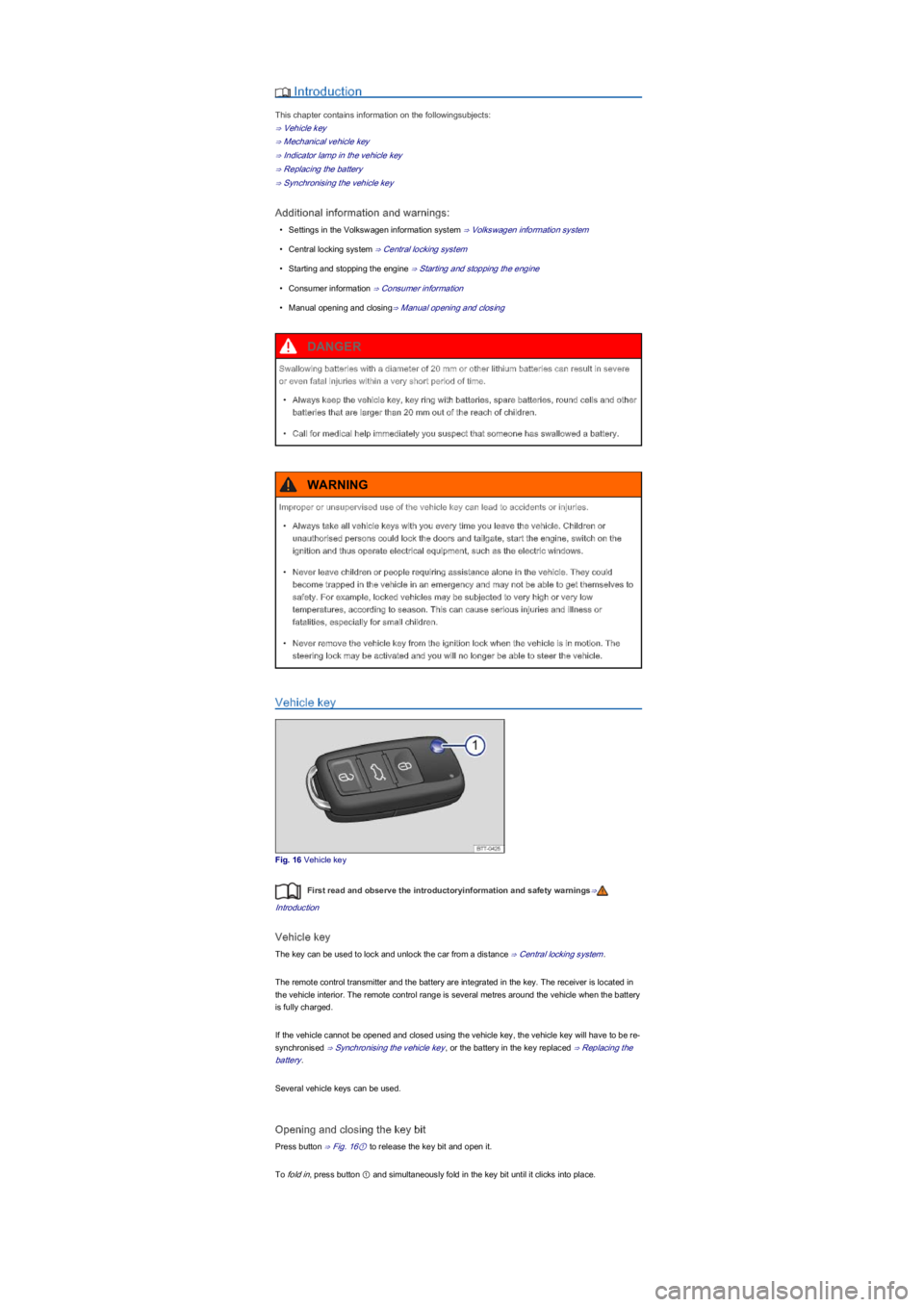
Fig. 16 Vehicle key
First read and observe the introductoryinformation and safety warnings⇒
Introduction
Vehicle key
The key can be used to lock and unlock the car from a distance ⇒ Central locking system.
The remote control transmitter and the battery are integrated in the key. The receiver is located in
the vehicle interior. The remote control range is several metres around the vehicle when the battery
is fully charged.
If the vehicle cannot be opened and closed using the vehicle key, the vehicle key will have to be re-
synchronised ⇒ Synchronising the vehicle key, or the battery in the key replaced ⇒ Replacing the
battery.
Several vehicle keys can be used.
Opening and closing the key bit
Press button ⇒ Fig. 16① to release the key bit and open it.
To fold in, press button ① and simultaneously fold in the key bit until it clicks into place.
Swallowing batteries with a diameter of 20 mm or other lithium batteries can result in severe
or even fatal injuries within a very short period of time.
•Always keep the vehicle key, key ring with batteries, spare batteries, round cells and other
batteries that are larger than 20 mm out of the reach of children.
•Call for medical help immediately you suspect that someone has swallowed a battery.
DANGER
Improper or unsupervised use of the vehicle key can lead to accidents or injuries.
•Always take all vehicle keys with you every time you leave the vehicle. Children or
unauthorised persons could lock the doors and tailgate, start the engine, switch on the
ignition and thus operate electrical equipment, such as the electric windows.
•Never leave children or people requiring assistance alone in the vehicle. They could
become trapped in the vehicle in an emergency and may not be able to get themselves to
safety. For example, locked vehicles may be subjected to very high or very low
temperatures, according to season. This can cause serious injuries and illness or
fatalities, especially for small children.
•Never remove the vehicle key from the ignition lock when the vehicle is in motion. The
steering lock may be activated and you will no longer be able to steer the vehicle.
WARNING
Page 23 of 211

•Press the button on the vehicle key. Remain standing close to the vehicle.
•Unlock the vehicle with the key bit within one minute. The synchronisation process is complete.
Central locking system
Introduction
This chapter contains information on the followingsubjects:
⇒ Description of the central locking system
⇒ Locking or unlocking the vehicle from outside
⇒ Locking or unlocking the vehicle from the inside
⇒ SAFELOCK mechanism
The central locking system will only work correctly when all doors and the tailgate are properly
closed. The vehicle cannot be locked with the key if the driver door is open.
If the vehicle is unlocked and not used for a long time (e.g. in your own garage) the vehicle battery
could discharge or the engine may not start.
Additional information and warnings:
•Exterior views ⇒ Exterior views
•Vehicle key set ⇒ Vehicle key set
•Doors ⇒ Doors
•Tailgate ⇒ Tailgate
•Electric windows ⇒ Windows
•Electric panorama sliding/tilting glass roof ⇒ Electric panorama sliding/tilting glass roof
•Manual opening and closing ⇒ Manual opening and closing
Description of the central locking system
First read and observe the introductoryinformation and safety warnings⇒
Introduction
The central locking system enables you to lock and unlock all doors and the tailgate from one point:
•From outside the vehicle with the vehicle key ⇒ Locking or unlocking the vehicle from outside.
•From inside the vehicle with the central locking button ⇒ Locking or unlocking the vehicle from
the inside.
Certain functions for the central locking system can be activated or deactivated by a qualified
workshop.
The doors and the tailgate can be locked or unlocked manually if the vehicle key or central locking
system fails.
Locking the vehicle after the airbags have been triggered
The entire vehicle is unlocked if the airbags are activated during an accident. After an accident, the
vehicle can be locked by one of the methods below, depending on the damage incurred.
FunctionAction
Locking the vehicle with the
central locking button.
– Switch off the ignition.
– Open one of the vehicle doors once.
– Press the central locking button .
Locking the vehicle using the
vehicle key.
– Switch off the ignition.
OR: remove the key from the ignition lock.
– Open one of the vehicle doors once.
– Lock the vehicle with the vehicle key.
Improper use of the central locking system could lead to serious injury.
•The central locking system locks all doors. Locking the vehicle from the inside may
prevent the doors from being opened unintentionally and unauthorised persons from
entering the vehicle. However, locked doors can delay assistance to passengers inside
the vehicle in the event of an accident or emergency.
•Never leave children or people requiring assistance alone in the vehicle. All doors can be
locked from the inside using the central locking button. This may mean that people lock
themselves in the vehicle. People locked in the vehicle may be subjected to very high or
very low temperatures.
•Temperatures inside a locked vehicle may reach extremes of heat or cold, according to
season. This can cause serious injuries and illness or fatalities, especially for small
children.
•Never leave anyone inside a locked vehicle. People in the vehicle could become trapped
in an emergency and may not be able to get themselves to safety.
WARNING
Page 31 of 211

Fig. 32 In the rear doors: closing the hinged windows
First read and observe the introductoryinformation and safety warnings⇒
Introduction
In 4-door vehicles, the rear windows can be opened and closed mechanically.
Opening hinged windows
•Pull the release lever in the direction of the arrow ⇒ Fig. 31.
•Push the release lever outwards until it clicks into place with the window fully open.
Closing the hinged window
•Pull the release lever ⇒ Fig. 32① inwards.
•Push the release lever back ② until it clicks into place and the window is closed.
Electric panorama sliding/tilting glass roof
Introduction
This chapter contains information on the followingsubjects:
⇒ Opening and closing the electric panorama sliding/tilting glass roof
⇒ Roll-back function of the electric panorama sliding/tilting glass roof
Additional information and warnings:
•Central locking system ⇒ Central locking system
•Roof carrier ⇒ Roof carrier
Always take care when using the mechanical hinged windows as you could cause serious
injuries.
•The mechanical hinged windows should only be opened or closed when you are sure that
nobody is in their operating areas.
WARNING
During sudden rain showers, water can enter the vehicle interior via open hinged windows and
cause damage to the vehicle.
NOTICE
Always take care when using the electric panorama sliding/tilting glass roof; otherwise you
could cause accidents or serious injuries.
•The electric panorama sliding/tilting glass roof should only be opened or closed when you
are sure that nobody is in its operating area.
•Always take all vehicle keys with you every time you leave the vehicle.
•Never leave children or people requiring assistance alone in the car, particularly if they
have access to the vehicle key. Unsupervised use of the vehicle key can result in the
vehicle being locked, the engine being started, the ignition being switched on and the
electric panorama sliding/tilting glass roof being operated.
•The electric panorama sliding/tilting glass roof can be operated for a short time after the
ignition has been switched off, provided the driver door or the front passenger door is not
opened.
WARNING
•In cold conditions, remove any ice and snow from the roof of the vehicle before you open
or tilt the electric panorama sliding/tilting glass roof to avoid the risk of damage.
•The electric panorama sliding/tilting glass roof should always be closed before you leave
the vehicle or if it starts to rain. Any rain entering the vehicle when the electric panorama
sliding/tilting glass roof is open could cause considerable damage to the electrical system.
This can result in further damage to the vehicle.
NOTICE
Page 64 of 211

Protection from the sun
Introduction
This chapter contains information on the followingsubjects:
⇒ Sun visors
Sun visors
Fig. 64 Sunblind (left-hand side). The right-hand side is a mirror image
First read and observe the introductoryinformation and safety warnings⇒
Introduction
Various positions for the driver and front passenger sun visors:
•Folded down over the windscreen.
•Pulled out of the bracket and swung over towards the door ⇒ Fig. 64 (arrow).
Vanity mirrors
Some vehicles have a vanity mirror on the folded-down sun visor.
Windscreen wiper and washer
Introduction
This chapter contains information on the followingsubjects:
⇒ Windscreen wiper lever
⇒ Windscreen wiper functions
⇒ Service position for the front windscreen wipers
⇒ Checking and refilling the windscreen washer fluid level
Additional information and warnings:
•Exterior views ⇒ Exterior views
•Air recirculation mode ⇒ Heating, ventilating, cooling
•Preparation for working in the engine compartment ⇒ Preparation for working in the engine
compartment
•Cleaning and caring for the vehicle exterior ⇒ Caring for and cleaning the vehicle exterior
Sun visors can restrict vision when folded down.
•Sun visors should always be replaced in their holder when not in use.
WARNING
Page 66 of 211

The windscreen wipers will only function when the ignition is switched on.
The interval wipe for the windscreen depends on the speed of the vehicle. The wipers will
wipe more frequently as the vehicle moves faster.
The rear window wiper is switched on automatically if the front windscreen wipers are
switched on and reverse gear is engaged.
Windscreen wiper functions
First read and observe the introductoryinformation and safety warnings⇒
Introduction
Windscreen wiper response in various situations:
When the vehicle is
stationary:
When switched on, the wipers will temporarily be switched to the next
setting down.
When the interval wipe is
switched on:
The wiper intervals are adjusted depending on the vehicle speed.
The faster the vehicle is travelling, the shorter the interval.
The wiper will try to wipe away any obstacles that are on the windscreen. The wiper will stop
moving if the obstacle blocks its path. Remove the obstacle and switch the wiper back on again.
Service position for the front windscreen wipers
Fig. 67 Wiper blades in service position
First read and observe the introductoryinformation and safety warnings⇒
Introduction
The windscreen wiper arms can be lifted off the windscreen when in the service position ⇒ Fig. 67.
Carry out the following steps to move the windscreen wipers to the service position:
•The bonnet must be closed ⇒ Preparation for working in the engine compartment.
•Switch the ignition on and then off again.
•Briefly press down the windscreen wiper lever ⇒ Fig. 65④.
Place the windscreen wiper arms back onto the windscreen before driving away. Briefly press the
windscreen wiper lever down to bring the windscreen wiper arms back to the original position.
Lifting the windscreen wiper blades
•Move the wiper arms to the service position before lifting ⇒.
•When lifting a wiper arm hold it only by the wiper blade mounting.
If the ignition is switched off while the windscreen wiper is switched on, the windscreen wiper
will continue to wipe on the same setting when the ignition is switched on again. Frost, snow
and other obstructions on the windscreen can cause damage to the windscreen wipers and
wiper motor.
•Remove any snow and ice from the wipers and the windows before setting off.
•Carefully loosen wiper blades that have become frozen onto the windscreen. Volkswagen
recommends using a de-icer spray for this.
NOTICE
Do not switch on the windscreen wipers when the window is dry. Using the wiper blades when
the rear windscreen is dry could cause damage to the rear windscreen.
NOTICE
Page 67 of 211

Checking and refilling the windscreen washer fluid level
Fig. 68 In the engine compartment: cap of washer fluid reservoir
First read and observe the introductoryinformation and safety warnings⇒
Introduction
The windscreen washer fluid level should be checked regularly and topped up as necessary.
•Open the bonnet ⇒ .
•The washer fluid reservoir is identified by the symbol on the cap ⇒ Fig. 68.
•Check whether there is enough windscreen washer fluid in the reservoir.
•To top up, mix clean water with a washer fluid recommended by Volkswagen ⇒. Observe the
dilution instructions on the packaging.
•At low temperatures, add a special anti-freeze agent so that the fluid cannot freeze ⇒.
Recommended windscreen washer fluid
•For warm weather: summer windscreen wash- G 052 184 A1 -. Dilution 1:100 (1 part
concentrate, 100 parts water) in the washer fluid reservoir.
•All-year washer fluid- G 052 164 A2 -. Dilution in winter to -18°C (0°F) approximately 1:2 (1 part
concentrate, 2 parts water), otherwise dilute one part concentrate to four parts water (1:4) in the
washer fluid reservoir.
Capacities
The windscreen washer fluid reservoir has a capacity of about 3 litres.
Mirrors
Introduction
This chapter contains information on the followingsubjects:
⇒ Interior mirror
⇒ Exterior mirrors
For safety reasons it is important that the driver positions the exterior and interior mirrors correctly
before starting a journey ⇒.
The driver can use the exterior mirrors and the interior mirror to observe rear traffic and then adjust
his or her driving style accordingly. Looking in the exterior mirrors and the interior mirror does not
•In order to prevent damage to the bonnet and the windscreen wiper arms, the windscreen
wiper arms should only be lifted when in the service position.
•Always return the windscreen wiper arms to the windscreen before starting your journey.
NOTICE
Never mix anti-freeze or other unsuitable additives into the windscreen washer fluid. An oily
film may otherwise be left on the screen, and restrict the field of vision.
•Use clean, clear water with a washer fluid recommended by Volkswagen.
•A suitable anti-freeze agent should be added to the windscreen washer fluid if necessary.
WARNING
•Never mix other cleaning agents with the cleaning agents recommended by Volkswagen.
This can cause the ingredients to separate and block the washer jets.
•Never mix up service fluids when refilling. Failure to observe this warning can result in
serious malfunctions and engine damage.
NOTICE
Page 71 of 211

Driving a loaded vehicle
First read and observe the introductoryinformation and safety warnings⇒
Introduction
For good vehicle handling when driving a loaded vehicle, please observe the following:
•Stow all items of luggage securely ⇒ Stowing items of luggage.
•Accelerate carefully and gently.
•Avoid sudden braking and driving manoeuvres.
•Brake earlier than in normal driving.
•If applicable, heed the information about driving with a roof carrier ⇒ Roof carrier.
Vehicle-specific weight ratings
First read and observe the introductoryinformation and safety warnings⇒
Introduction
All data in the official vehicle documents take precedence over these data. All data in this manual
apply to the basic model. The vehicle data sticker in the service schedule and the official vehicle
documents show which engine is installed in your vehicle.
The values quoted here may differ if additional equipment is fitted, for different models or for special
vehicles.
The values for the kerb weight in the following table apply for the road-ready vehicle with driver
(75 kg), service fluids including fuel tank carrying 90% of its capacity and, if applicable, tools and
Driving with an unlocked or open tailgate can cause serious injuries.
•Always drive with the tailgate closed.
•Always stow all items in the luggage compartment securely. Loose objects can fall out of
the luggage compartment and injure other road users.
•Always drive carefully and ensure that you think ahead.
•Avoid any abrupt or sudden driving and braking manoeuvres as this can cause the open
tailgate to move unpredictably.
•Any objects protruding from the luggage compartment must be marked to ensure that they
are visible to other road users. Comply with legal regulations.
•Any objects protruding from the luggage compartment must never be held in position by
the tailgate.
•If it is necessary to drive with the tailgate open, all luggage racks and cargo stowed on the
rack must be removed from the tailgate.
WARNING
Poisonous exhaust fumes can enter the vehicle interior when the tailgate is open. This could
result in loss of consciousness, carbon monoxide poisoning, serious injury and accidents.
•Always drive with the tailgate closed in order to prevent toxic gases from entering the
vehicle.
•If exceptional circumstances require you to drive with an open tailgate, you must do the
following to reduce the quantity of toxic exhaust fumes that could enter the vehicle:
- Close the electric panorama sliding/tilting glass roof.
- Switch off air recirculation mode.
- Open all vents in the dash panel.
- Switch the blowers to the highest setting.
WARNING
The vehicle length and height are different when the tailgate is open.
NOTICE
Moving loads can severely impair the vehicle's stability and driving safety, which can cause
accidents and severe injuries.
•Secure objects properly to prevent them from sliding.
•Use suitable straps when securing heavy objects.
•Engage the rear seat backrests securely in an upright position.
WARNING
Page 72 of 211

spare tyre ⇒. Additional equipment and retrofitted accessories increase the stated kerb weight
and reduce the maximum permitted load accordingly.
The load comprises the weights of the following:
•Passengers
•All luggage
•Roof load including roof carrier system
Petrol engines
Engine powerECGearbox
type
Kerb
weight
Gross
vehicle
weight
rating
Gross
axle
weight
rating,
front
Gross
axle
weight
rating,
rear
44 kWCHYA
MG5929 kg –
1,032 kg
1,290 kg680 kg640 kg
AG5932 kg –
1,035 kg
55 kWCHYB
MG5929 kg –
1,032 kg
1,290 kg680 kg640 kg
AG5932 kg –
1,035 kg
Natural gas engine
Engine powerECGearbox
type
Kerb
weight
Gross
vehicle
weight
rating
Gross
axle
weight
rating,
front
Gross
axle
weight
rating,
rear
50 kWCPGAMG5
1,031 kg
– 1,118
kg
1,370 kg700 kg700 kg
Luggage compartment
Introduction
This chapter contains information on the followingsubjects:
⇒ Folding the backrests on the rear bench seat forwards and backwards
⇒ Luggage compartment cover
⇒ Variable luggage compartment floor
⇒ Fastening rings
⇒ Bag hook
Heavy objects must always be transported in the luggage compartment and you must ensure that
the rear seat backrests are securely engaged in the upright position. Always use suitable securing
straps with the fastening rings. Never exceed the vehicle's maximum payload. Both the payload
and the distribution of the load in the vehicle will have an effect on the driving response and braking
distance ⇒.
Additional information and warnings:
•Airbag system ⇒ Airbag system
•Lights ⇒ Lights
•Transporting ⇒ Driving notes
•Wheels and tyres ⇒ Wheels and tyres
Exceeding the maximum permissible weights and axle loads can cause damage to the
vehicle, accidents and serious injuries.
•The actual axle loads must never exceed the maximum permissible axle loads.
•The payload and the distribution of the load in the vehicle have an effect on the driving
response and braking distance of the vehicle. Adjust your speed accordingly.
WARNING
The payload should be distributed as evenly as possible in the vehicle. When transporting
heavy objects in the luggage compartment, they should be placed either in front of or over the
rear axle in order to minimise the effect on the vehicle's handling.
NOTICE