2021 VOLKSWAGEN UP! engine
[x] Cancel search: enginePage 112 of 211

Points 1 to 3 must be fulfilled at the same time:
Manual gearboxAutomated manual gearbox
In order to start moving, remove your foot
from the brake pedal, then release the clutch
pedal (clutch engages) and press the
accelerator simultaneously. The brake will
gradually be released as the clutch is
engaged.
To start moving, remove your foot from the
brake pedal and press the accelerator
immediately. The brake will gradually be
released as the vehicle pulls away.
The Hill Hold Assist function will be deactivated immediately:
•As soon as one of the conditions indicated on ⇒ The Hill Hold Assist function is automatically
activated if the following conditions are met is not fulfilled.
•If the engine is not running smoothly or there is an engine fault.
•If the engine is switched off or has stalled.
•Vehicles with automated manual gearbox: if the selector lever in is the neutral position N.
ParkPilot
Introduction
This chapter contains information on the followingsubjects:
⇒ Operating ParkPilot
⇒ Acoustic and optical ParkPilot signals at the rear of the vehicle
The ParkPilot assists the driver when manoeuvring and parking.
The ultrasound sensors in the rear bumper transmit and receive ultrasonic waves. The system uses
the time difference between the ultrasonic waves (i.e. between the transmission and reflection from
obstacles and the point of reception) to continuously calculate the distance between the bumper
and the obstacle.
Additional information and warnings:
•Exterior views ⇒ Exterior views
•Braking, stopping and parking ⇒ Braking, stopping and parking
•Cleaning and caring for the vehicle exterior ⇒ Caring for and cleaning the vehicle exterior
•Accessories, modifications, repairs and renewal of parts ⇒ Accessories, modifications, repairs
and renewal of parts
•Portable navigation device (delivered by Volkswagen) ⇒ Accessories, modifications, repairs and
renewal of parts
•Radio ⇒BookletRadio,
Page 117 of 211
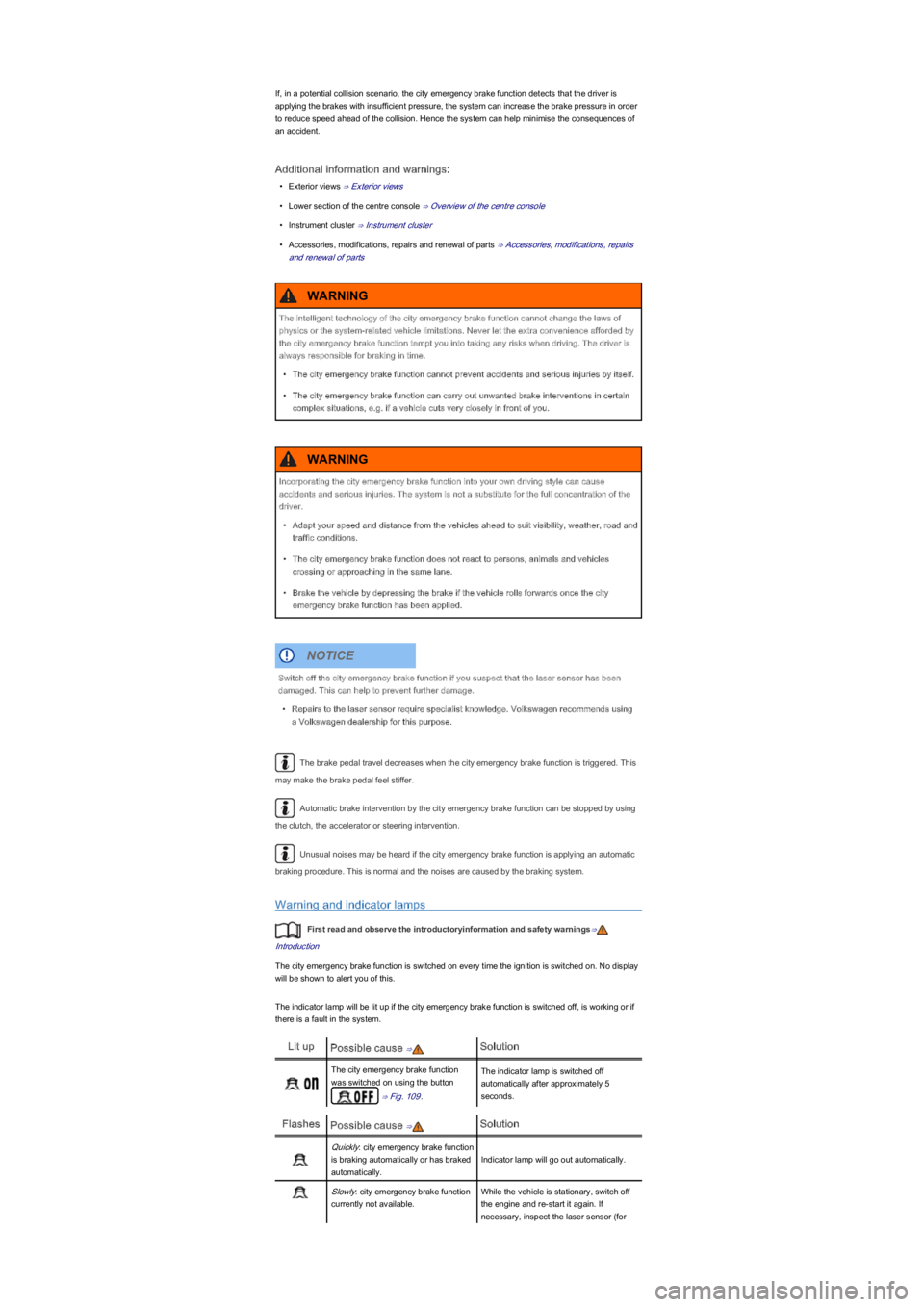
If, in a potential collision scenario, the city emergency brake function detects that the driver is
applying the brakes with insufficient pressure, the system can increase the brake pressure in order
to reduce speed ahead of the collision. Hence the system can help minimise the consequences of
an accident.
Additional information and warnings:
•Exterior views ⇒ Exterior views
•Lower section of the centre console ⇒ Overview of the centre console
•Instrument cluster ⇒ Instrument cluster
•Accessories, modifications, repairs and renewal of parts ⇒ Accessories, modifications, repairs
and renewal of parts
The brake pedal travel decreases when the city emergency brake function is triggered. This
may make the brake pedal feel stiffer.
Automatic brake intervention by the city emergency brake function can be stopped by using
the clutch, the accelerator or steering intervention.
Unusual noises may be heard if the city emergency brake function is applying an automatic
braking procedure. This is normal and the noises are caused by the braking system.
Warning and indicator lamps
First read and observe the introductoryinformation and safety warnings⇒
Introduction
The city emergency brake function is switched on every time the ignition is switched on. No display
will be shown to alert you of this.
The indicator lamp will be lit up if the city emergency brake function is switched off, is working or if
there is a fault in the system.
Lit upPossible cause ⇒Solution
The city emergency brake function
was switched on using the button
⇒ Fig. 109.
The indicator lamp is switched off
automatically after approximately 5
seconds.
FlashesPossible cause ⇒Solution
Quickly: city emergency brake function
is braking automatically or has braked
automatically.
Indicator lamp will go out automatically.
Slowly: city emergency brake function
currently not available.
While the vehicle is stationary, switch off
the engine and re-start it again. If
necessary, inspect the laser sensor (for
The intelligent technology of the city emergency brake function cannot change the laws of
physics or the system-related vehicle limitations. Never let the extra convenience afforded by
the city emergency brake function tempt you into taking any risks when driving. The driver is
always responsible for braking in time.
•The city emergency brake function cannot prevent accidents and serious injuries by itself.
•The city emergency brake function can carry out unwanted brake interventions in certain
complex situations, e.g. if a vehicle cuts very closely in front of you.
WARNING
Incorporating the city emergency brake function into your own driving style can cause
accidents and serious injuries. The system is not a substitute for the full concentration of the
driver.
•Adapt your speed and distance from the vehicles ahead to suit visibility, weather, road and
traffic conditions.
•The city emergency brake function does not react to persons, animals and vehicles
crossing or approaching in the same lane.
•Brake the vehicle by depressing the brake if the vehicle rolls forwards once the city
emergency brake function has been applied.
WARNING
Switch off the city emergency brake function if you suspect that the laser sensor has been
damaged. This can help to prevent further damage.
•Repairs to the laser sensor require specialist knowledge. Volkswagen recommends using
a Volkswagen dealership for this purpose.
NOTICE
Page 121 of 211

•If vehicles are travelling towards you in the same lane.
•If the surrounding vehicles are very dirty and therefore not very reflective.
•If there is a lot of dust.
Air conditioning system
Heating, ventilating, cooling
Introduction
This chapter contains information on the followingsubjects:
⇒ Controls
⇒ General information on the heating and fresh air system
⇒ Information on the air conditioning system
⇒ Vents
⇒ Air recirculation mode
Dust and pollen filter
The dust and pollen filter reduces the level of impurities in the outside air entering the vehicle.
The dust and pollen filter must be changed regularly to avoid impairing the performance of the air
conditioning system.
The dust and pollen filter must be changed more frequently than stated in the service schedule if
the efficiency of the filter declines prematurely due to the vehicle being used in areas with high
levels of air pollution.
Additional information and warnings:
•Exterior views ⇒ Exterior views
•Volkswagen information system ⇒ Volkswagen information system
•Windscreen wiper/washer ⇒ Windscreen wiper and washer
•Cleaning and caring for the vehicle exterior ⇒ Caring for and cleaning the vehicle exterior
If the cooling system is switched off, the outside air that is drawn into the vehicle is not
dehumidified. To prevent the windows misting over, Volkswagen recommends that you leave the air
conditioning (compressor) switched on. Press the button. The indicator lamp in the button
must light up.
Maximum heat output, which is needed to defrost the windows as quickly as possible, is only
available when the engine has reached its operating temperature.
Poor visibility through all windows increases the risk of collisions and accidents, which can
cause serious injuries.
•Always ensure that all windows are free of ice, snow and mist to ensure good visibility.
•Maximum heat output, which is needed to defrost the windows as quickly as possible, is
only available when the engine has reached its operating temperature. Do not start your
journey until you have good visibility.
•Always ensure that the heating and fresh air system or the air conditioning system and the
heated rear window are used correctly in order to have good visibility.
•Never use the air recirculation mode for an extended period. If the cooling system is
switched off, the windows can mist up very quickly in air recirculation mode and reduce
visibility considerably.
•Always switch off the air recirculation mode when it is not required.
WARNING
Stale air can quickly cause tiredness and lack of concentration in the driver, which in turn can
cause collisions, accidents and serious injuries.
•Never switch off the blowers or switch on the air recirculation mode for an extended period
as this prevents fresh air from entering the vehicle interior.
WARNING
•Switch off the air conditioning system if you suspect that it has been damaged. This can
help to prevent further damage. The air conditioning system should be checked by a
qualified workshop.
•Repairs to the air conditioning system require specialist knowledge and special tools.
Volkswagen recommends using a Volkswagen dealership for this purpose.
NOTICE
Page 122 of 211

Keep the air intake slots in front of the windscreen free of snow, ice and leaves to ensure
heating and cooling is not impaired, and to prevent the windows from misting over.
Controls
Fig. 112 In the centre console: rotary controls for the heating and fresh air system
Fig. 113 In the centre console: air conditioning controls
First read and observe the introductoryinformation and safety warnings⇒
Introduction
Button,
control
Additional information. Heating and fresh air system
⇒ Fig. 112 and air conditioning system ⇒ Fig. 113.
Temperature ①.
Turn the regulator to set the temperature as required.
...
Blowers ②.Setting 0: blower and system switched off, setting 4: highest blower setting.
Air distribution ③.Turn the control to direct the airflow exactly as required.
④Air conditioning system: slider for the air recirculation mode ⇒ Air
recirculation mode.
Heating and fresh air system: defrost function. Air distribution to the
windscreen and the side windows around the exterior mirrors.
Air conditioning system: defrost function. Air distribution to the windscreen
and the side windows around the exterior mirrors. press the button,
increase the blower level and switch the air recirculation mode ⇒ Air
recirculation mode off, in order to remove condensation from the windscreen
as quickly as possible.
Air distribution to the upper body via the air vents in the dash panel.
Air distribution to the footwell.
Heating and fresh air system, air conditioning system: air distribution to the
windscreen and in the footwell.
Air conditioning system: Press the button to switch the cooling system on or
off.
Rear window heating
The button for the rear window heating is located in the centre console. The rear window
heating only functions when the engine is running and will switch off automatically after
approximately 10 minutes.
Stale air can quickly cause tiredness and lack of concentration in the driver, which in turn can
cause collisions, accidents and serious injuries.
•Never switch off the blowers or switch on the air recirculation mode for an extended period
as this prevents fresh air from entering the vehicle interior.
WARNING
Page 123 of 211

General information on the heating and fresh air system
First read and observe the introductoryinformation and safety warnings⇒
Introduction
The required interior temperature cannot be lower than the outside temperature as the heating and
fresh air system cannot cool or dehumidify the air.
Settings for optimal road visibility
•Set blower ⇒ Fig. 112② to level 1 or 2.
•Open and position all vents on the dash panel ⇒ Vents.
•Turn the air distribution controller ⇒ Fig. 112③ to the defrost position.
Information on the air conditioning system
First read and observe the introductoryinformation and safety warnings⇒
Introduction
The cooling system for the vehicle interior only works when the engine is running and the blower is
switched on.
The air conditioning system operates most effectively with the windows and the electric panorama
sliding and tilting glass roof closed. However, if the vehicle has heated up after standing in the sun
for some time, the air inside can be cooled more quickly by opening the windows and the electric
panorama sliding and tilting glass roof for a short time.
Settings for optimal road visibility
Switching the cooling system on not only reduces the temperature of the vehicle interior, but also
the humidity. This improves comfort for the vehicle occupants and prevents the windows from
misting when the outside humidity is high.
•Switch off air recirculation mode ⇒ Air recirculation mode.
•Set the blowers to the required level.
•Open and position all vents on the dash panel ⇒ Vents.
•Turn the air distribution controller to the defrost position.
•Press the button to switch the cooling system on. The indicator lamp in the button
lights up.
The cooling system cannot be switched on
The following criteria may prevent the cooling system from being switched on:
•The engine is not running.
•The blower is switched off.
•The air conditioning system fuse has blown.
•The ambient temperature is lower than approximately +2℃ (+36°F).
•The compressor has been temporarily switched off because the coolant temperature is too high.
•There is a different fault in the vehicle. The air conditioning system should be checked by a
qualified workshop.
Things to note
If the humidity and temperature outside the vehicle are high, condensation can drip off the
evaporator in the cooling system and form a pool underneath the vehicle. This is normal and does
not indicate a leak.
The windscreen may mist up after starting the engine due to residual humidity in the air
conditioning system. Switch the defrost function on in order to clear the windscreen of condensation
or mist as quickly as possible.
Vents
Fig. 114 In the dash panel: vents
First read and observe the introductoryinformation and safety warnings⇒
Introduction
Page 125 of 211

•Preparation for working in the engine compartment ⇒ Preparation for working in the engine
compartment
Fuels can pollute the environment. Any spilt service fluids must be cleaned up and disposed
of properly.
Indicator lamps and fuel gauge
Filling the tank incorrectly and incorrect handling of fuel can cause explosions, fire and
serious burns and injuries.
•Always ensure that the tank cap is properly closed, to prevent the evaporation and spillage
of fuel.
•Fuel is highly explosive and inflammable and can cause serious burns and other injuries.
•Fuel can spill out if the engine is not switched off or the filler nozzle is not fully inserted
into the fuel filler neck when filling the tank. This can cause fires, explosions and serious
burns and injuries.
•When filling the tank with fuel, the engine and the ignition must be switched off for safety
reasons.
•When filling the tank, always switch off your mobile telephone and two-way radio or any
other radio equipment. Electromagnetic radiation can generate sparks which can in turn
start a fire.
•Never get back into the vehicle while filling the tank. If in exceptional cases you have to
enter the vehicle, close the door and touch a metal object before touching the filler nozzle
again. This will remove any electrostatic charge from you. Failure to do so could generate
a spark. Sparks can cause a fire when filling the tank.
•Never fill the tank or fill up a spare canister near open flames, sparks or glowing matter
(e.g. cigarettes).
•Electrostatic discharge and electromagnetic radiation must be avoided when filling the
tank.
•Follow all applicable safety information provided by the filling station when filling the tank.
•Never spill fuel in the vehicle or in the luggage compartment.
WARNING
For safety reasons, Volkswagen does not recommend carrying a spare fuel canister in the
vehicle. Fuel can spill out of the full or empty canister and catch fire, especially in the event of
an accident. This could cause explosions, fire and injuries.
•If, in exceptional circumstances, you have to transport a spare fuel canister, please note
the following:
- When refilling never place the canister in or on top of the vehicle, for example in the
luggage compartment. There may be an electrostatic charge during refilling causing
the fuel fumes to ignite.
- Always place the spare fuel canister on the ground.
- When filling a spare fuel canister, place the filler nozzle as far as possible into the
filler opening.
- If the spare fuel canister is made of metal, the filler nozzle must have constant
contact with the canister in order to avoid static charging.
- Please follow all legislation concerning the use, stowage and transport of a spare
fuel canister.
- Ensure that the spare fuel canister is accordance with the industry standard, such
as ANSI or ASTM F852-86.
WARNING
•Remove spilt fuel from all vehicle components as quickly as possible in order to avoid
damage to the wheel housing, tyres and vehicle paint.
•Filling the tank with diesel in a vehicle with a petrol engine can cause serious and
expensive engine damage and cause damage to the fuel system that is not covered by any
Volkswagen guarantee. Do not start the engine under any circumstances if you have
refilled using the incorrect fuel. Seek expert assistance. The substances in these fuels can
cause serious damage to the fuel system and to the engine itself if it is switched on.
NOTICE
Page 126 of 211
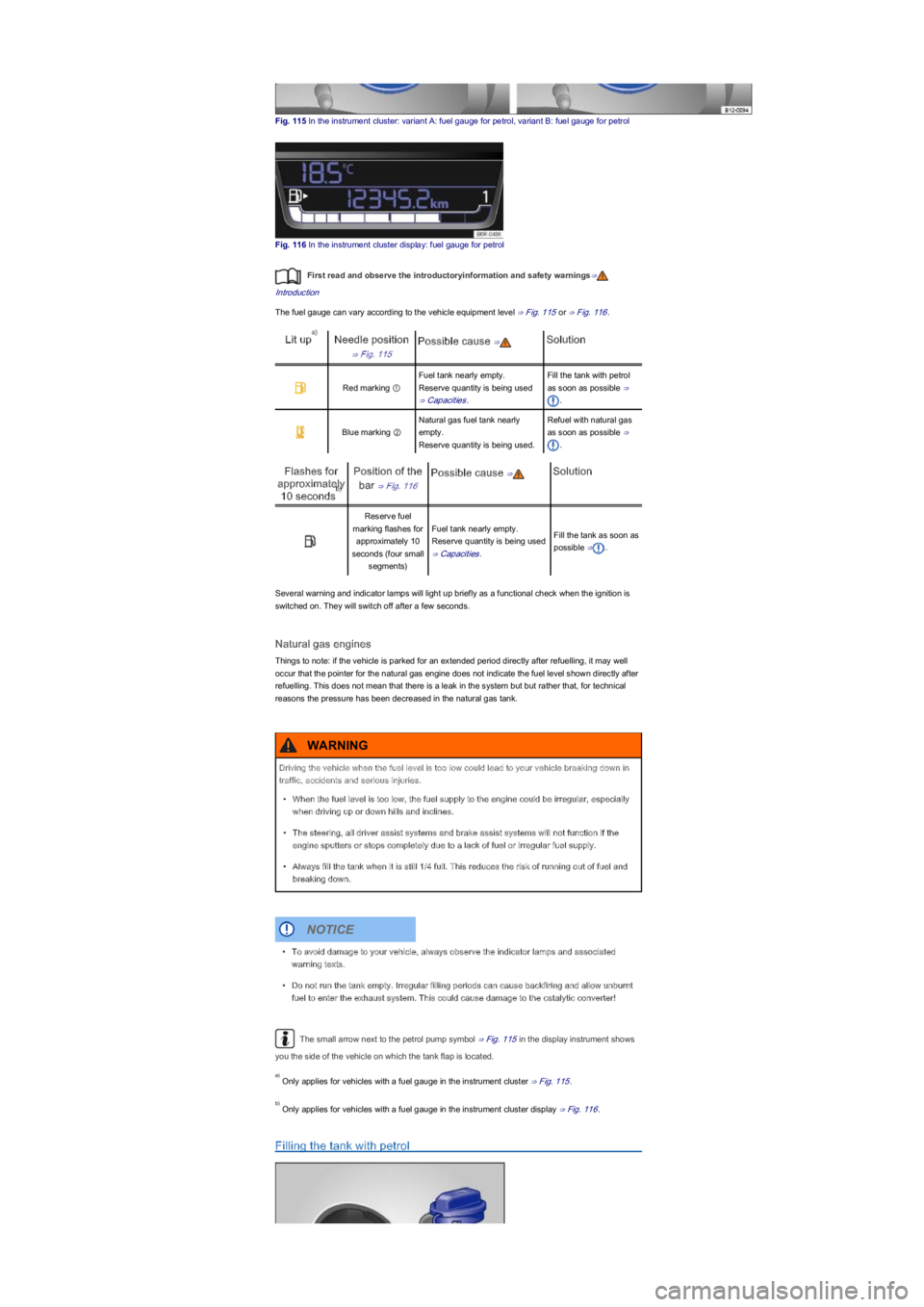
Fig. 115 In the instrument cluster: variant A: fuel gauge for petrol, variant B: fuel gauge for petrol
Fig. 116 In the instrument cluster display: fuel gauge for petrol
First read and observe the introductoryinformation and safety warnings⇒
Introduction
The fuel gauge can vary according to the vehicle equipment level ⇒ Fig. 115 or ⇒ Fig. 116.
Lit upNeedle position
⇒ Fig. 115
Possible cause ⇒Solution
Red marking ①
Fuel tank nearly empty.
Reserve quantity is being used
⇒ Capacities.
Fill the tank with petrol
as soon as possible ⇒
.
Blue marking ②
Natural gas fuel tank nearly
empty.
Reserve quantity is being used.
Refuel with natural gas
as soon as possible ⇒
.
Flashes for
approximately
10 seconds
Position of the
bar ⇒ Fig. 116
Possible cause ⇒Solution
Reserve fuel
marking flashes for
approximately 10
seconds (four small
segments)
Fuel tank nearly empty.
Reserve quantity is being used
⇒ Capacities.
Fill the tank as soon as
possible ⇒.
Several warning and indicator lamps will light up briefly as a functional check when the ignition is
switched on. They will switch off after a few seconds.
Natural gas engines
Things to note: if the vehicle is parked for an extended period directly after refuelling, it may well
occur that the pointer for the natural gas engine does not indicate the fuel level shown directly after
refuelling. This does not mean that there is a leak in the system but but rather that, for technical
reasons the pressure has been decreased in the natural gas tank.
The small arrow next to the petrol pump symbol ⇒ Fig. 115 in the display instrument shows
you the side of the vehicle on which the tank flap is located.
Only applies for vehicles with a fuel gauge in the instrument cluster ⇒ Fig. 115.
Only applies for vehicles with a fuel gauge in the instrument cluster display ⇒ Fig. 116.
Filling the tank with petrol
a)
b)
Driving the vehicle when the fuel level is too low could lead to your vehicle breaking down in
traffic, accidents and serious injuries.
•When the fuel level is too low, the fuel supply to the engine could be irregular, especially
when driving up or down hills and inclines.
•The steering, all driver assist systems and brake assist systems will not function if the
engine sputters or stops completely due to a lack of fuel or irregular fuel supply.
•Always fill the tank when it is still 1/4 full. This reduces the risk of running out of fuel and
breaking down.
WARNING
•To avoid damage to your vehicle, always observe the indicator lamps and associated
warning texts.
•Do not run the tank empty. Irregular filling periods can cause backfiring and allow unburnt
fuel to enter the exhaust system. This could cause damage to the catalytic converter!
NOTICE
a)
b)
Page 127 of 211

Fig. 117 Open tank flap with tank cap attached to the holder
First read and observe the introductoryinformation and safety warnings⇒
Introduction
Switch off the engine, ignition and the mobile telephone before filling the tank and leave them
switched off during the process.
Opening the tank cap
•The tank flap is at the rear of the vehicle on the right.
•Open the tank cap by the moulding to the rear.
•If necessary, fold the key bit out of the vehicle key ⇒ Vehicle key set.
•Insert the vehicle key in the tank flap lock and turn anticlockwise.
•Turn the tank cap anticlockwise and hook it on top of the tank flap ⇒ Fig. 117.
Filling the tank
The correct fuel grade for your vehicle is shown on a sticker on the inside of the tank flap ⇒ Fuel.
•The fuel tank is full when the (properly operated) automatic filler nozzle clicks off for the first
time ⇒.
•Do not continue filling the tank after it switches off. The expansion space in the fuel tank will
otherwise fill up and the fuel could spill out. This could also happen when the fuel warms up and
expands.
Closing the tank cap
•Turn the tank cap clockwise into the fuel filler neck until it perceptibly engages.
•Turn the vehicle key in the lock cylinder of the tank flap clockwise and pull it out.
•Close the tank flap. The tank flap must be flush with the vehicle bodywork.
Natural gas engines
Run the petrol tank empty every 6 months until the indicator lamp lights up. This is necessary to
maintain necessary system function for petrol mode and fuel quality.
Fuels can pollute the environment. Any spilt service fluids must be cleaned up and disposed
of properly.
Filling the tank with natural gas
Fig. 118 With the tank flap open: tank cap ①, gas filler neck ②, gas filler neck seal ③
First read and observe the introductoryinformation and safety warnings⇒
Introduction
Do not continue filling the tank once the filler nozzle stops automatically. The fuel tank could
be overfilled. This can cause fuel to splash out and overflow. This can cause fires, explosions
and serious injuries.
WARNING
Remove spilt fuel from all vehicle components as quickly as possible in order to avoid damage
to the wheel housing, tyres and vehicle paint.
NOTICE