2019 TOYOTA PRIUS PLUS spec
[x] Cancel search: specPage 48 of 568

481-1. For safe use
PRIUS +_OM_OM47D30E_(EE)
WARNING
■SRS airbag precautions
Observe the following precautions regarding the SRS airbags.
Failure to do so may cause death or serious injury.
● The driver and all passengers in the vehicle must wear their seat belts
properly.
The SRS airbags are supplemental devic es to be used with the seat belts.
● The SRS driver airbag deploys with considerable force, and can cause
death or serious injury especially if the driver is very close to the airbag.
Since the risk zone for the driver’s airbag is the first 50 - 75 mm (2 - 3 in.)
of inflation, placing yourself 250 mm ( 10 in.) from your driver airbag pro-
vides you with a clear margin of safety. This distance is measured from
the center of the steering wheel to your breastbone. If you sit less than
250 mm (10 in.) away now, you can change your driving position in sev-
eral ways:
• Move your seat to the rear as far as you can while still reaching the ped-
als comfortably.
• Slightly recline the back of the seat.
Although vehicle designs vary, many drivers can achieve the 250 mm
(10 in.) distance, even with the driver seat all the way forward, simply by
reclining the back of the seat somewhat. If reclining the back of your
seat makes it hard to see the road, raise yourself by using a firm, non-
slippery cushion, or raise the seat if your vehicle has that feature.
• If your steering wheel is adjustable, tilt it downward. This points the air-
bag toward your chest instead of your head and neck.
The seat should be adjusted as recommended above, while still maintaining
control of the foot pedals, steering wheel, and your view of the instrument
panel controls.
● The SRS front passenger airbag also deploys with considerable force, and
can cause death or serious injury especially if the front passenger is very
close to the airbag. The front passenger seat should be as far from the air-
bag as possible with the seatback adjusted, so the front passenger sits
upright.
● Improperly seated and/or restrained infants and children can be killed or
seriously injured by a deploying airbag. An infant or child who is too small
to use a seat belt should be properly secured using a child restraint sys-
tem. Toyota strongly recommends that all infants and children be placed in
the rear seats of the vehicle and proper ly restrained. The rear seats are
safer for infants and children than the front passenger seat. ( P. 59)
Page 54 of 568
541-1. For safe use
PRIUS +_OM_OM47D30E_(EE)
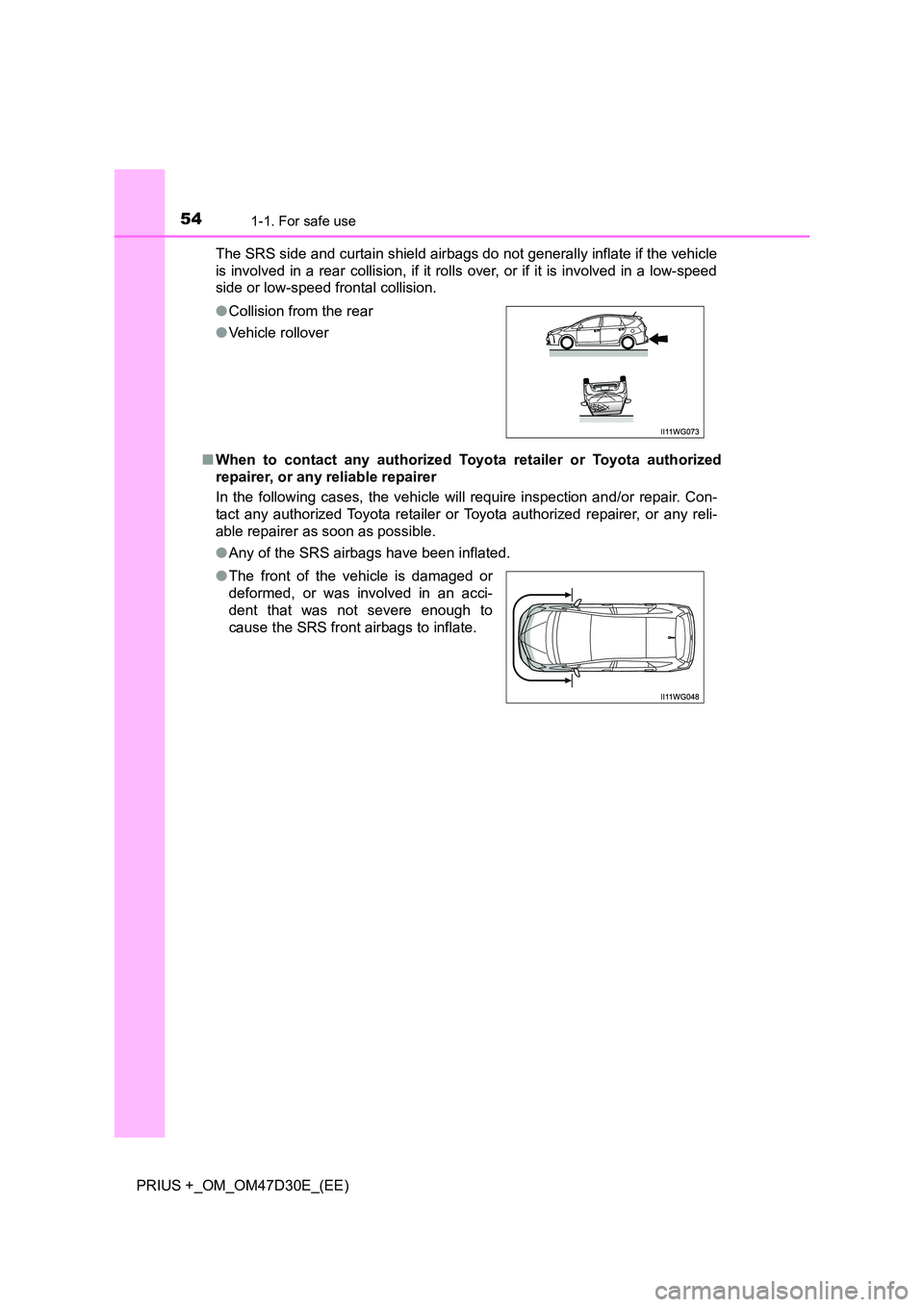
The SRS side and curtain shield airbags do not generally inflate if the vehicle
is involved in a rear collision, if it rolls over, or if it is involved in a low-speed
side or low-speed frontal collision.
■ When to contact any authorized Toyota retailer or Toyota authorized
repairer, or any reliable repairer
In the following cases, the vehicle will require inspection and/or repair. Con-
tact any authorized Toyota retailer or Toyota authorized repairer, or any reli-
able repairer as soon as possible.
● Any of the SRS airbags have been inflated.
● Collision from the rear
● Vehicle rollover
● The front of the vehicle is damaged or
deformed, or was involved in an acci-
dent that was not severe enough to
cause the SRS front airbags to inflate.
Page 57 of 568
571-1. For safe use
1
PRIUS +_OM_OM47D30E_(EE)
For safety and security
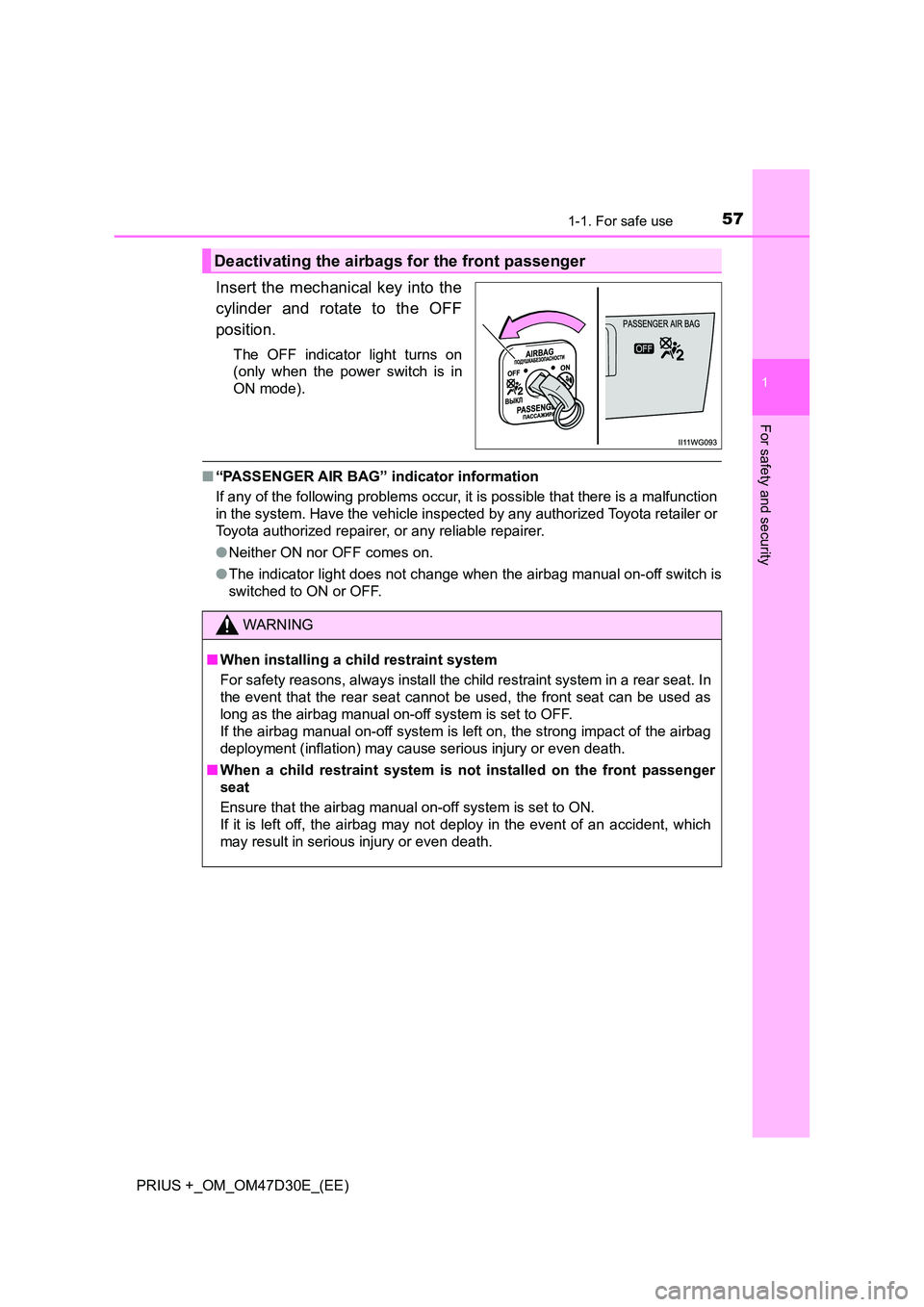
Insert the mechanical key into the
cylinder and rotate to the OFF
position.
The OFF indicator light turns on
(only when the power switch is in
ON mode).
■ “PASSENGER AIR BAG” indicator information
If any of the following problems occur, it is possible that there is a malfunction
in the system. Have the vehicle inspected by any authorized Toyota retailer or
Toyota authorized repairer, or any reliable repairer.
● Neither ON nor OFF comes on.
● The indicator light does not change when the airbag manual on-off switch is
switched to ON or OFF.
Deactivating the airbags for the front passenger
WARNING
■ When installing a child restraint system
For safety reasons, always install the child restraint system in a rear seat. In
the event that the rear seat cannot be used, the front seat can be used as
long as the airbag manual on-off system is set to OFF.
If the airbag manual on-off system is left on, the strong impact of the airbag
deployment (inflation) may cause serious injury or even death.
■ When a child restraint system is not installed on the front passenger
seat
Ensure that the airbag manual on-off system is set to ON.
If it is left off, the airbag may not deploy in the event of an accident, which
may result in serious injury or even death.
Page 64 of 568
641-1. For safe use
PRIUS +_OM_OM47D30E_(EE)
(1) For the CRS which do not carry the ISO/XX size class identifica-
tion (A to G), for the applicable mass group, the car manufacturer
shall indicate the vehicle specific ISOFIX child restraint system(s)
recommended for each position.
Key of letters inserted in the above table:
IUF: Suitable for ISOFIX forward-facing child restraints systems of
universal category approved for the use in this mass group.
IL: Toyota recommend to use “TOYOTA MIDI” approved for the use
in this mass group. When using this child restraint system, adjust
the support leg to 6th lock position from 1st lock position where
the support leg is shortest position. Move the seat to the rear
most lock position, and adjust the seat back to the 2nd lock posi-
tion from the most upright position.
X: ISOFIX position not suitable for ISOFIX child restraint systems in
this mass group and/or this size class.
*: When you use a child restraint system in this position, remove the head
restraint.
The child restraint systems mentioned in the table may not be avail-
able outside of the EU area.
Other child restraint systems different from the systems mentioned in
the table can be used, but the suitability of the systems must be care-
fully checked with the child restraint system manufacturer and retailer.
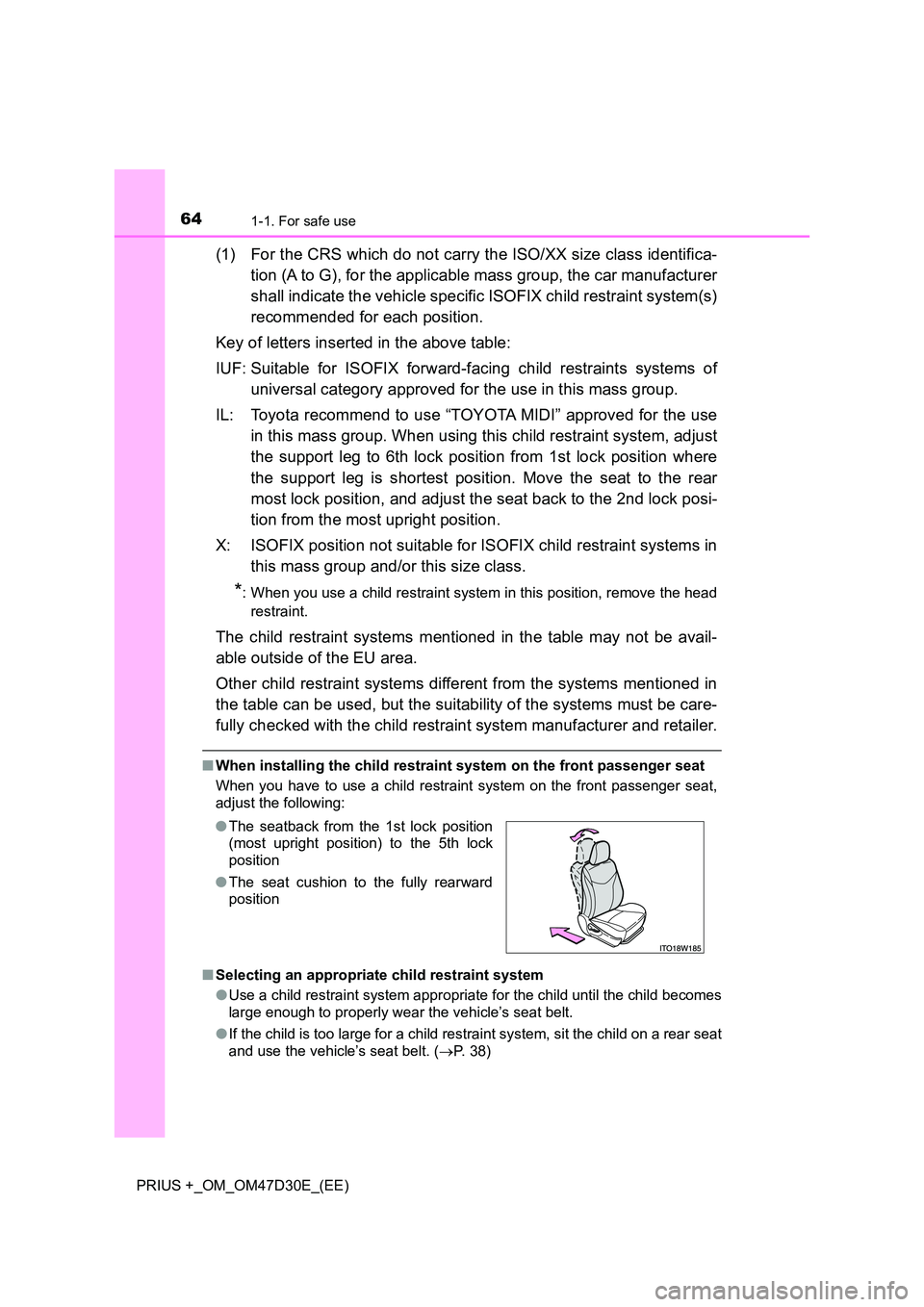
■ When installing the child restraint system on the front passenger seat
When you have to use a child restraint system on the front passenger seat,
adjust the following:
■ Selecting an appropriate child restraint system
● Use a child restraint system appropriate for the child until the child becomes
large enough to properly wear the vehicle’s seat belt.
● If the child is too large for a child restraint system, sit the child on a rear seat
and use the vehicle’s seat belt. ( P. 38)
● The seatback from the 1st lock position
(most upright position) to the 5th lock
position
● The seat cushion to the fully rearward
position
Page 80 of 568
801-1. For safe use
PRIUS +_OM_OM47D30E_(EE)
Exhaust gas precautions
Harmful substance to the human body is included in exhaust
gases if inhaled.
WARNING
Exhaust gases include harmful carbon monoxide (CO), which is colorless and
odorless. Observe the following precautions.
Failure to do so may cause exhaust gases enter the vehicle and may lead to
an accident caused by light-headedness, or may lead to death or a serious
health hazard.
■ Important points while driving
● Keep the back door closed.
● If you smell exhaust gases in the vehicle even when the back door is
closed, open the windows and have the vehicle inspected at any autho-
rized Toyota retailer or Toyota authorized repairer, or any reliable repairer
as soon as possible.
■ When parking
● If the vehicle is in a poorly ventilated area or a closed area, such as a
garage, stop the hybrid system.
● Do not leave the vehicle with the hybrid system on for a long time.
If such a situation cannot be avoided, park the vehicle in an open space
and ensure that exhaust fumes do not enter the vehicle interior.
● Do not leave the hybrid system operating in an area with snow build-up, or
where it is snowing. If snowbanks build up around the vehicle while the
hybrid system is operating, exhaust gases may collect and enter the vehi-
cle.
■ Exhaust pipe
The exhaust system needs to be checked periodically. If there is a hole or
crack caused by corrosion, damage to a joint or abnormal exhaust noise, be
sure to have the vehicle inspected and repaired by any authorized Toyota
retailer or Toyota authorized repairer, or any reliable repairer.
Page 84 of 568

841-2. Hybrid system
PRIUS +_OM_OM47D30E_(EE)
■ Sounds and vibrations specific to a hybrid vehicle
There may be no engine sound or vibration even though the vehicle is able to
move with the “READY” indicator is illuminated. For safety, apply the parking
brake and make sure to shift the shift position to P when parked.
The following sounds or vibrations may occur when the hybrid system is
operating and are not a malfunction:
● Motor sounds may be heard from the engine compartment.
● Sounds may be heard from the hybrid battery (traction battery) when the
hybrid system starts or stops.
● Relay operating sounds such as a snap or soft clank will be emitted from the
hybrid battery (traction battery), behind the rear seats, when the hybrid sys-
tem is started or stopped.
● Sounds from the hybrid system may be heard when the back door is open.
● Sounds may be heard from the transmission when the gasoline engine
starts or stops, when driving at low speeds, or during idling.
● Engine sounds may be heard when accelerating sharply.
● Sounds may be heard due to regenerative braking when the brake pedal is
depressed or as the accelerator pedal is released.
● Vibration may be felt when the gasoline engine starts or stops.
● Cooling fan sounds may be heard from the air intake vent under the right-
hand front seat.
■ Maintenance, repair, recycling, and disposal
Contact any authorized Toyota retailer or Toyota authorized repairer, or any
reliable repairer regarding maintenance, repair, recycling and disposal. Do
not dispose of the vehicle yourself.
Page 89 of 568
891-2. Hybrid system
1
PRIUS +_OM_OM47D30E_(EE)
For safety and security
WARNING
■Road accident cautions
Observe the following precautions to reduce the risk of death or serious
injury:
● Pull your vehicle off the road, apply the parking brake, shift the shift posi-
tion to P, and turn the hybrid system off.
● Do not touch the high voltage parts, cables and connectors.
● If electric wires are exposed inside or outside your vehicle, an electric
shock may occur. Never touch exposed electric wires.
● Do not touch the battery if liquid is leaking from or adhering to it.
If electrolyte (carbonic-based organic el ectrolyte) from the hybrid battery
(traction battery) comes into contact with the eyes or skin, it could cause
blindness or skin wounds. In the unlikely event that it comes into contact
with the eyes or skin, wash it off immediately with a large amount of water,
and seek immediate medical attention.
● If electrolyte is leaking from the hybrid battery (traction battery), do not
approach the vehicle.
Even in the unlikely event that the hybrid battery (traction battery) is dam-
aged, the internal construction of the battery will prevent a large amount of
electrolyte from leaking out. However, any electrolyte that does leak out
will give off a vapor. This vapor is an irritant to skin and eyes and could
cause acute poisoning if inhaled.
● Do not bring burning or high-temperature items close to the electrolyte.
The electrolyte may ignite and cause a fire.
● If a fire occurs in the hybrid vehicle, leave the vehicle as soon as possible.
Never use a fire extinguisher that is not meant for electric fires. Using even
a small amount of water may be dangerous.
● If your vehicle needs to be towed, do so with front wheels raised. If the
wheels connected to the electric motor (traction motor) are on the ground
when towing, the motor may continue to generate electricity. This may
cause a fire. ( P. 437)
● Carefully inspect the ground under the vehicle. If you find that liquid has
leaked onto the ground, the fuel system may have been damaged. Leave
the vehicle as soon as possible.
Page 90 of 568
901-2. Hybrid system
PRIUS +_OM_OM47D30E_(EE)
WARNING
■Hybrid battery (traction battery)
Your vehicle contains a sealed lithium-ion battery.
● Never resell, hand over or modify the hybrid battery. To prevent accidents,
hybrid batteries that have been removed from a disposed vehicle are col-
lected through any authorized Toyota retailer or Toyota authorized repairer,
or any reliable repairer. Do not dispose of the battery yourself.
Unless the battery is properly collected, the following may occur, resulting
in death or serious injury:
• The hybrid battery may be illegally disposed of or dumped, and it is haz-
ardous to the environment or someone may touch a high voltage part,
resulting in an electric shock.
• The hybrid battery is intended to be used exclusively with your hybrid
vehicle. If the hybrid battery is used outside of your vehicle or modified
in any way, accidents such as electric shock, heat generation, smoke
generation, an explosion and electrolyte leakage may occur.
When reselling or handing over your vehicle, the possibility of an accident
is extremely high because the person receiving the vehicle may not be
aware of these dangers.
● If your vehicle is disposed of without the hybrid battery having been
removed, there is a danger of serious electric shock if high voltage parts,
cables and their connectors are touched. In the event that your vehicle
must be disposed of, the hybrid battery must be disposed of by any autho-
rized Toyota retailer or Toyota authorized repairer, or any reliable repairer
or a qualified service shop. If the hybrid battery is not disposed of properly,
it may cause electric shock that can result in death or serious injury.
NOTICE
■ Hybrid battery (traction battery) air intake vent
● Do not place objects that will block the air intake vent. The hybrid battery
(traction battery) may overheat and be damaged.
● Clean the air intake vent regularly to prevent the hybrid battery (traction
battery) from overheating.
● Do not get water or foreign materials in the air intake vent as this may
cause a short circuit and damage the hybrid battery (traction battery).
● Do not carry large amounts of water such as water cooler bottles in the
vehicle. If water spills onto the hybrid battery (traction battery), the battery
may be damaged. Have the vehicle inspected by any authorized Toyota
retailer or Toyota authorized repairer, or any reliable repairer.