Page 496 of 698
ENGINE COMPARTMENT
3.6L Engine With Stop/Start
1 — Motor Generator Unit Coolant Reservoir Pressure Cap
2 — Engine Coolant Reservoir
3 — Engine Coolant Reservoir Pressure Cap
4 — Engine Oil Dipstick
5 — Engine Oil Fill
6 — Brake Fluid Reservoir7 — Battery
8 — Power Distribution Center (Fuses)
9 — Washer Fluid Reservoir
10 — Air Cleaner Filter
11 — Motor Generator Unit Coolant Reservoir
494 SERVICING AND MAINTENANCE
Page 497 of 698
5.7L Engine Without Stop/Start
1 — Air Cleaner Filter
2 — Engine Oil Fill
3 — Engine Oil Dipstick
4 — Brake Fluid Reservoir
5 — Battery6 — Power Distribution Center (Fuses)
7 — Washer Fluid Reservoir
8 — Engine Coolant Reservoir
9 — Engine Coolant Pressure Cap
8
SERVICING AND MAINTENANCE 495
Page 498 of 698
5.7L Engine With Stop/Start
1 — Air Cleaner Filter
2 — Engine Oil Fill
3 — Engine Oil Dipstick
4 — Brake Fluid Reservoir
5 — Battery6 — Power Distribution Center
7 — Washer Fluid Reservoir
8 — Engine Coolant Reservoir
9 — Engine Coolant Pressure Cap
496 SERVICING AND MAINTENANCE
Page 499 of 698

Checking Oil Level
To assure proper lubrication of your vehicle’s engine, the
engine oil must be maintained at the correct level. Check
the oil level at regular intervals, such as every fuel stop.
The best time to check the engine oil level is about five
minutes after a fully warmed up engine is shut off.
Checking the oil while the vehicle is on level ground will
improve the accuracy of the oil level readings. Always
maintain the oil level within the SAFE zone on the dipstick.
Adding one quart of oil when the reading is at the bottom
of the SAFE zone will result in a reading at the top of the
safe zone on these engines.
CAUTION!
Overfilling or underfilling will cause oil aeration or
loss of oil pressure. This could damage your engine.
Adding Washer Fluid
The fluid reservoir is located under the hood and should be
checked for fluid level at regular intervals. Fill the reservoir
with windshield washer solvent only (not radiator anti-
freeze). When refilling the washer fluid reservoir, take
some washer fluid and apply it to a cloth or towel and wipe
the wiper blades clean. This will help blade performance.To prevent freeze-up of your windshield washer system in
cold weather, select a solution or mixture that meets or
exceeds the temperature range of your climate. This rating
information can be found on most washer fluid containers.
WARNING!
Commercially available windshield washer solvents
are flammable. They could ignite and burn you. Care
must be exercised when filling or working around the
washer solution.
After the engine has warmed up, operate the defroster for
a few minutes to reduce the possibility of smearing or
freezing the fluid on the cold windshield. Windshield
washer solution used with water as directed on the con-
tainer, aids cleaning action, reduces the freezing point to
avoid line clogging, and is not harmful to paint or trim.
Maintenance-Free Battery
Your vehicle is equipped with a maintenance-free battery.
You will never have to add water, nor is periodic mainte-
nance required.
8
SERVICING AND MAINTENANCE 497
Page 507 of 698
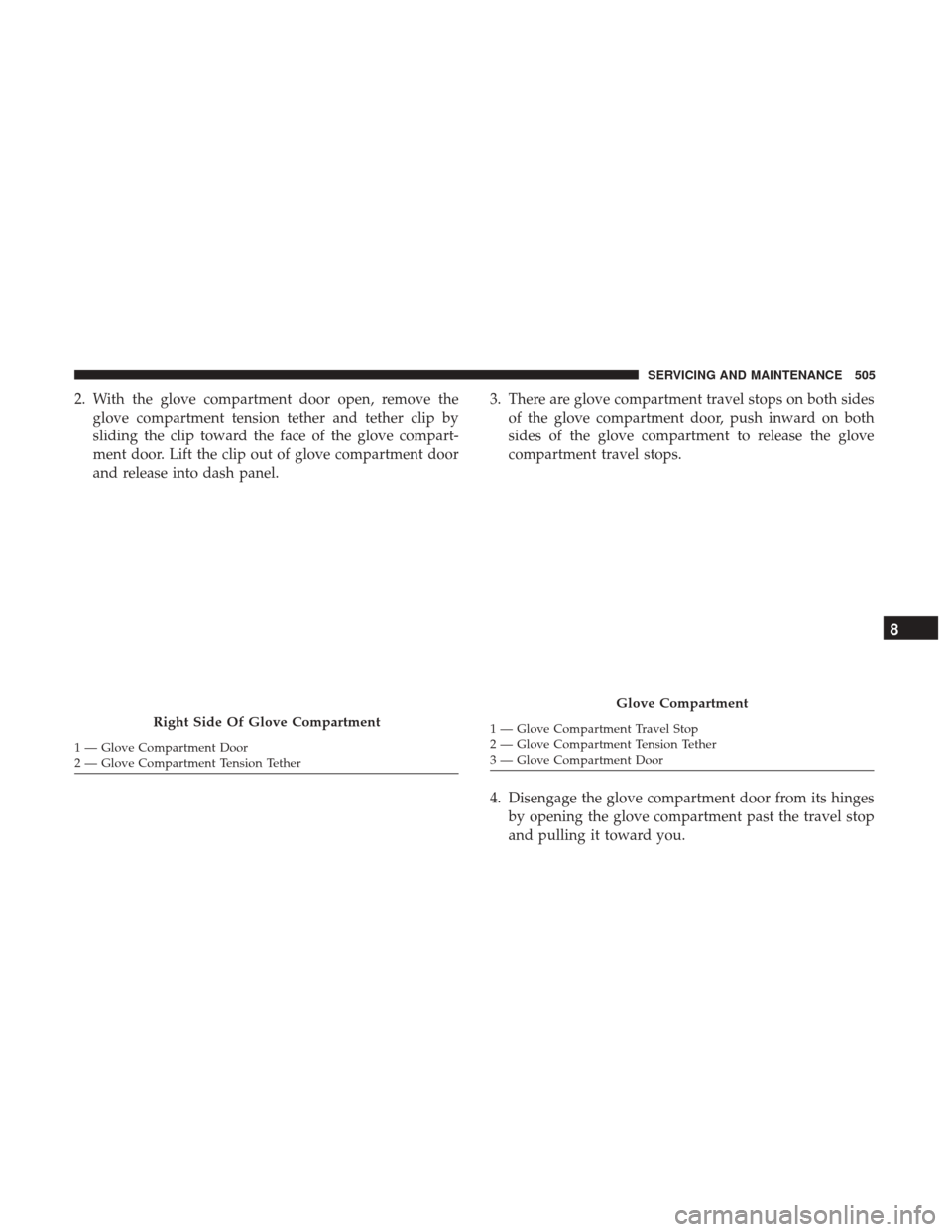
2. With the glove compartment door open, remove theglove compartment tension tether and tether clip by
sliding the clip toward the face of the glove compart-
ment door. Lift the clip out of glove compartment door
and release into dash panel. 3. There are glove compartment travel stops on both sides
of the glove compartment door, push inward on both
sides of the glove compartment to release the glove
compartment travel stops.
4. Disengage the glove compartment door from its hinges by opening the glove compartment past the travel stop
and pulling it toward you.
Right Side Of Glove Compartment
1 — Glove Compartment Door
2 — Glove Compartment Tension Tether
Glove Compartment
1 — Glove Compartment Travel Stop
2 — Glove Compartment Tension Tether
3 — Glove Compartment Door
8
SERVICING AND MAINTENANCE 505
Page 509 of 698
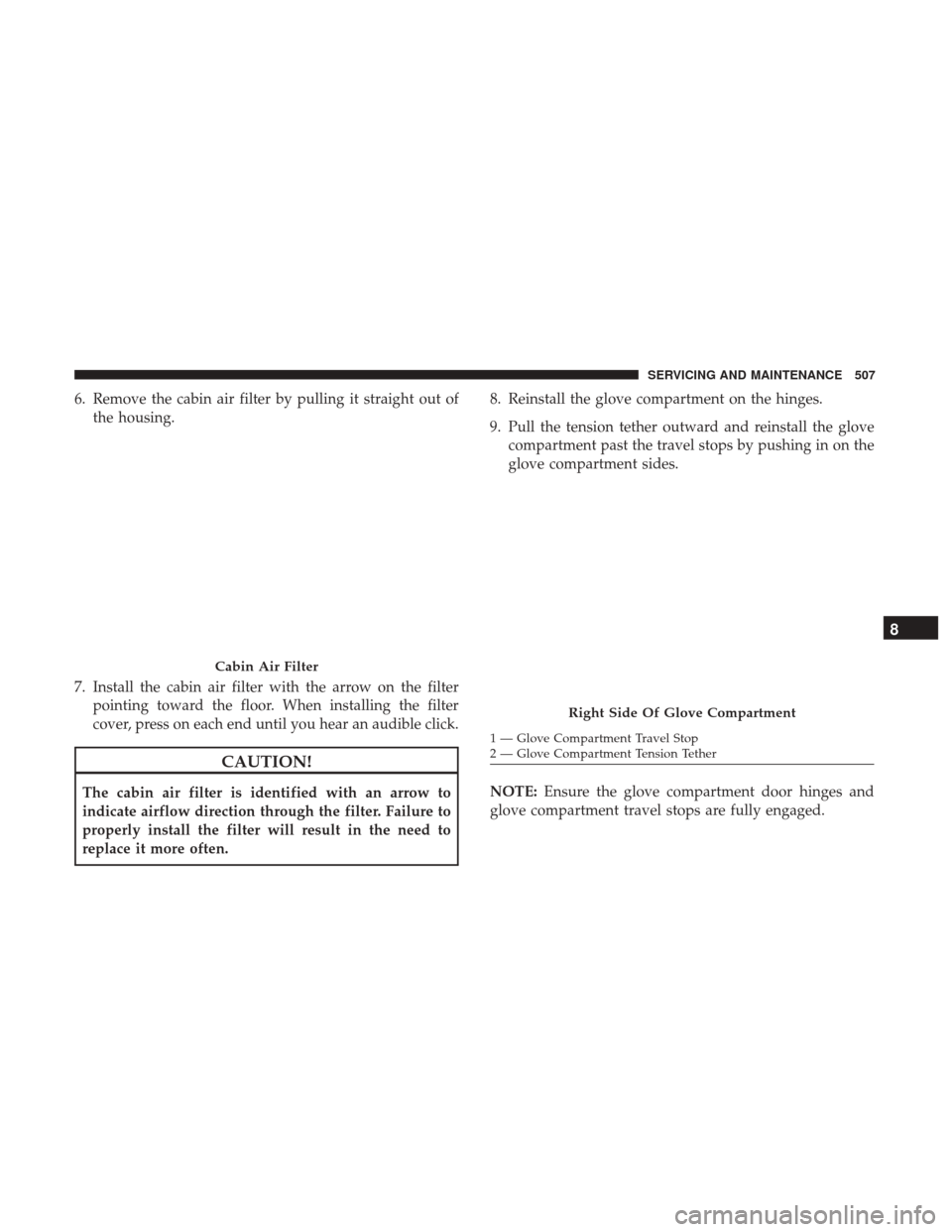
6. Remove the cabin air filter by pulling it straight out ofthe housing.
7. Install the cabin air filter with the arrow on the filter pointing toward the floor. When installing the filter
cover, press on each end until you hear an audible click.
CAUTION!
The cabin air filter is identified with an arrow to
indicate airflow direction through the filter. Failure to
properly install the filter will result in the need to
replace it more often. 8. Reinstall the glove compartment on the hinges.
9. Pull the tension tether outward and reinstall the glove
compartment past the travel stops by pushing in on the
glove compartment sides.
NOTE: Ensure the glove compartment door hinges and
glove compartment travel stops are fully engaged.
Cabin Air Filter
Right Side Of Glove Compartment
1 — Glove Compartment Travel Stop
2 — Glove Compartment Tension Tether
8
SERVICING AND MAINTENANCE 507
Page 511 of 698

•“Groove jumping� (belt does not maintain correct posi-
tion on pulley)
• Belt broken (note: identify and correct problem before
new belt is installed)
• Noise (objectionable squeal, squeak, or rumble is heard
or felt while drive belt is in operation)
NOTE: If your vehicle is equipped with Stop/Start belt
must be replaced with an OEM grade Mopar belt.
Some conditions can be caused by a faulty component such
as a belt pulley. Belt pulleys should be carefully inspected
for damage and proper alignment.
Belt replacement on some models requires the use of
special tools, we recommend having your vehicle serviced
at an authorized dealer.
Body Lubrication
Locks and all body pivot points, including such items as
seat tracks, door hinge pivot points and rollers, liftgate,
tailgate, decklid, sliding doors and hood hinges, should be
lubricated periodically with a lithium based grease, such as
Mopar Spray White Lube to assure quiet, easy operation
and to protect against rust and wear. Prior to the applica-
tion of any lubricant, the parts concerned should be wiped clean to remove dust and grit; after lubricating excess oil
and grease should be removed. Particular attention should
also be given to hood latching components to ensure
proper function. When performing other underhood ser-
vices, the hood latch, release mechanism and safety catch
should be cleaned and lubricated.
The external lock cylinders should be lubricated twice a
year, preferably in the Fall and Spring. Apply a small
amount of a high quality lubricant, such as Mopar Lock
Cylinder Lubricant directly into the lock cylinder.
Windshield Wiper Blades
Clean the rubber edges of the wiper blades and the
windshield periodically with a sponge or soft cloth and a
mild nonabrasive cleaner. This will remove accumulations
of salt or road film.
Operation of the wipers on dry glass for long periods may
cause deterioration of the wiper blades. Always use washer
fluid when using the wipers to remove salt or dirt from a
dry windshield.
Avoid using the wiper blades to remove frost or ice from
the windshield. Keep the blade rubber out of contact with
petroleum products such as engine oil, gasoline, etc.8
SERVICING AND MAINTENANCE 509
Page 514 of 698

the passenger compartment. In addition, have the exhaust
system inspected each time the vehicle is raised for lubri-
cation or oil change. Replace as required.
WARNING!
•Exhaust gases can injure or kill. They contain carbon
monoxide (CO), which is colorless and odorless.
Breathing it can make you unconscious and can
eventually poison you. To avoid breathing CO, refer
to “Safety Tips” in “Safety” for further information.
•
A hot exhaust system can start a fire if you park over
materials that can burn. Such materials might be grass
or leaves coming into contact with your exhaust system.
Do not park or operate your vehicle in areas where your
exhaust system can contact anything that can burn.
CAUTION!
• The catalytic converter requires the use of unleaded
fuel only. Leaded gasoline will destroy the effective-
ness of the catalyst as an emissions control device
and may seriously reduce engine performance and
cause serious damage to the engine.
(Continued)
CAUTION! (Continued)
•Damage to the catalytic converter can result if your
vehicle is not kept in proper operating condition. In
the event of engine malfunction, particularly involv-
ing engine misfire or other apparent loss of perfor-
mance, have your vehicle serviced promptly. Contin-
ued operation of your vehicle with a severe
malfunction could cause the converter to overheat,
resulting in possible damage to the converter and
vehicle.
Under normal operating conditions, the catalytic converter
will not require maintenance. However, it is important to
keep the engine properly tuned to assure proper catalyst
operation and prevent possible catalyst damage.
NOTE: Intentional tampering with emissions control sys-
tems can result in civil penalties being assessed against
you.
In unusual situations involving grossly malfunctioning
engine operation, a scorching odor may suggest severe and
abnormal catalyst overheating. If this occurs, stop the
vehicle, turn off the engine and allow it to cool. Service,
including a tune-up to manufacturer’s specifications,
should be obtained immediately.
512 SERVICING AND MAINTENANCE