Page 430 of 698

NOTE:
•Steps 2 and 3 are requirements that must be met before
pushing the NEUTRAL (N) button, and must continue
to be met until the shift has been completed. If any of
these requirements are not met before pushing the
NEUTRAL (N) button or are no longer met during the
shift, the NEUTRAL (N) indicator light will flash con-
tinuously until all requirements are met or until the
NEUTRAL (N) button is released.
• The ignition must be in the ON/RUN mode for a shift to
take place and for the position indicator lights to be
operable. If the ignition is not in the ON/RUN mode, the
shift will not take place and no position indicator lights
will be on or flashing.
• A flashing NEUTRAL (N) position indicator light indi-
cates that shift requirements have not been met.
• If the vehicle is equipped with air suspension, the engine
should be started and left running for a minimum of 60
seconds (with all the doors closed) at least once every 24
hours. This process allows the air suspension to adjust
the vehicle’s ride height to compensate for temperature
effects.Shifting Out Of NEUTRAL (N)
Use the following procedure to prepare your vehicle for
normal usage:
1. Bring the vehicle to a complete stop, leaving it con- nected to the tow vehicle.
2. Press and hold the brake pedal.
3. Start the engine. Apply the parking brake. Shift the transmission into NEUTRAL.
4. Using a ballpoint pen or similar object, push and hold the recessed transfer case NEUTRAL (N) button (at the
center of the transfer case switches).
5. When the NEUTRAL (N) indicator light turns off, release the NEUTRAL (N) button.
6. Turn the engine OFF. The transmission will automati- cally select PARK when the engine is turned off.
7. Release the brake pedal.
8. Disconnect vehicle from the tow vehicle.
9. Press and hold the brake pedal.
10. Start the engine.
11. Release the parking brake.
428 STARTING AND OPERATING
Page 432 of 698

Driving Through Water
Driving through water more than a few inches/centimeters
deep will require extra caution to ensure safety and pre-
vent damage to your vehicle.
Flowing/Rising Water
WARNING!
Do not drive on or across a road or path where water is
flowing and/or rising (as in storm run-off). Flowing
water can wear away the road or path’s surface and
cause your vehicle to sink into deeper water. Further-
more, flowing and/or rising water can carry your ve-
hicle away swiftly. Failure to follow this warning may
result in injuries that are serious or fatal to you, your
passengers, and others around you.
Shallow Standing Water
Although your vehicle is capable of driving through shal-
low standing water, consider the following Cautions and
Warnings before doing so.
WARNING!
•Driving through standing water limits your vehicle’s
traction capabilities. Do not exceed 5 mph (8 km/h)
when driving through standing water.
• Driving through standing water limits your vehicle’s
braking capabilities, which increases stopping dis-
tances. Therefore, after driving through standing
water, drive slowly and lightly press on the brake
pedal several times to dry the brakes.
• Failure to follow these warnings may result in inju-
ries that are serious or fatal to you, your passengers,
and others around you.
CAUTION!
• Always check the depth of the standing water before
driving through it. Never drive through standing
water that is deeper than the bottom of the tire rims
mounted on the vehicle.
• Determine the condition of the road or the path that
is under water and if there are any obstacles in the
way before driving through the standing water.
(Continued)
430 STARTING AND OPERATING
Page 442 of 698

WARNING!
•Ignoring the overhead console light could mean you
will not have SOS Call services. If the overhead
console light is illuminated, have your authorized
dealer service the SOS Call system immediately.
• The Occupant Restraint Control module turns on the
air bag Warning Light on the instrument panel if a
malfunction in any part of the system is detected. If
the Air Bag Warning Light is illuminated, have your
authorized dealer service the Occupant Restraint
Control system immediately.
Even if the SOS Call system is fully functional, factors
beyond FCA US LLC’s control may prevent or stop the SOS
Call system operation. These include, but are not limited
to, the following factors:
• Delayed accessories mode is active.
• The ignition is in the OFF position.
• The vehicle’s electrical systems are not intact.
• The SOS Call system software and/or hardware are
damaged during a crash. •
The vehicle battery loses power or becomes discon-
nected during a vehicle crash.
• LTE (voice/data) or 4G (data) network and/or Global
Positioning Satellite signals are unavailable or ob-
structed.
• Equipment malfunction at the SOS operator facility.
• Operator error by the SOS operator.
• LTE (voice/data) or 4G (data) network congestion.
• Weather.
• Buildings, structures, geographic terrain, or tunnels.
WARNING!
ALWAYS obey traffic laws and pay attention to the
road. ALWAYS drive safely with your hands on the
steering wheel. You have full responsibility and as-
sume all risks related to the use of the features and
applications in this vehicle. Only use the features and
applications when it is safe to do so. Failure to do so
may result in an accident involving serious injury or
death.
440 IN CASE OF EMERGENCY
Page 444 of 698
Bulb Number
Turn Signal / Front Posi-
tion (Halogen Reflector
Headlamp) 7444NA
Turn Signal / Front Posi-
tion (LED Headlamps) LED (Serviced at
authorized dealer)
Front Side Marker (Halo-
gen Reflector Headlamp) W5W
Front Side Marker (LED
Headlamps) LED (Serviced At An
Authorized Dealer)
Front Fog Lamps (Halo-
gen Reflector Headlamp) H11LL
Front Fog Lamps (LED
Headlamps) LED (Serviced At An
Authorized Dealer)
Side Indicators (Front And
Side View Mirror) LED (Serviced at autho-
rized dealer)
Base Rear Tail/Turn and
Stop Lamp 3157K
Premium Rear Tail/Turn
and Stop Lamp LED (Serviced At An
Authorized Dealer)
Premium Backup Lamp 7440/W21WBulb Number
Center High Mounted
Stop Lamp (CHMSL) 921
Backup Lamp 921
Rear License Plate Lamp 194
Replacing Exterior Bulbs
Base Quad: Low Beam Headlamp, High Beam
Headlamp, Front Park And Turn — If Equipped
Low Beam
1. Open the hood.
2. Disconnect and isolate the negative battery cable.
442 IN CASE OF EMERGENCY
Page 449 of 698
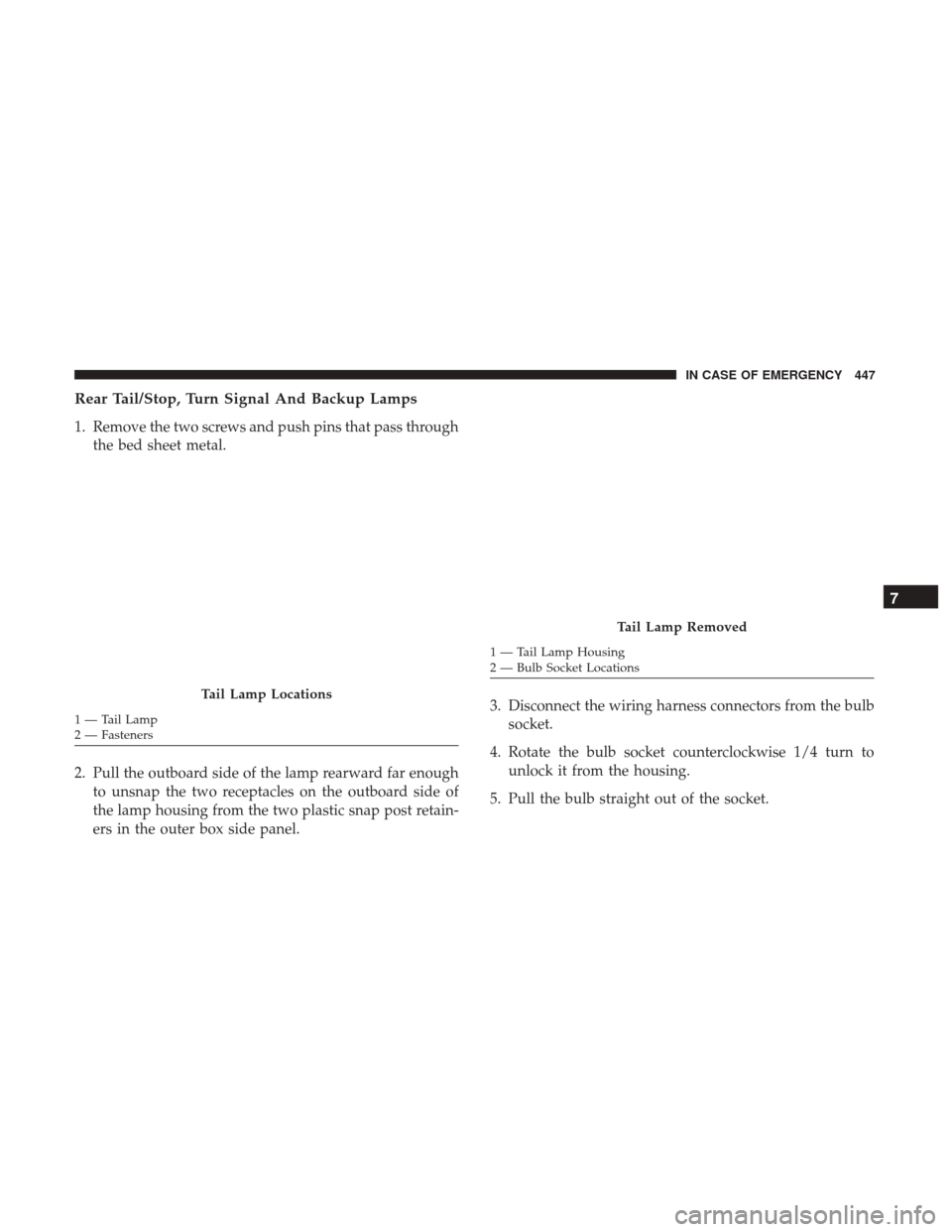
Rear Tail/Stop, Turn Signal And Backup Lamps
1. Remove the two screws and push pins that pass throughthe bed sheet metal.
2. Pull the outboard side of the lamp rearward far enough to unsnap the two receptacles on the outboard side of
the lamp housing from the two plastic snap post retain-
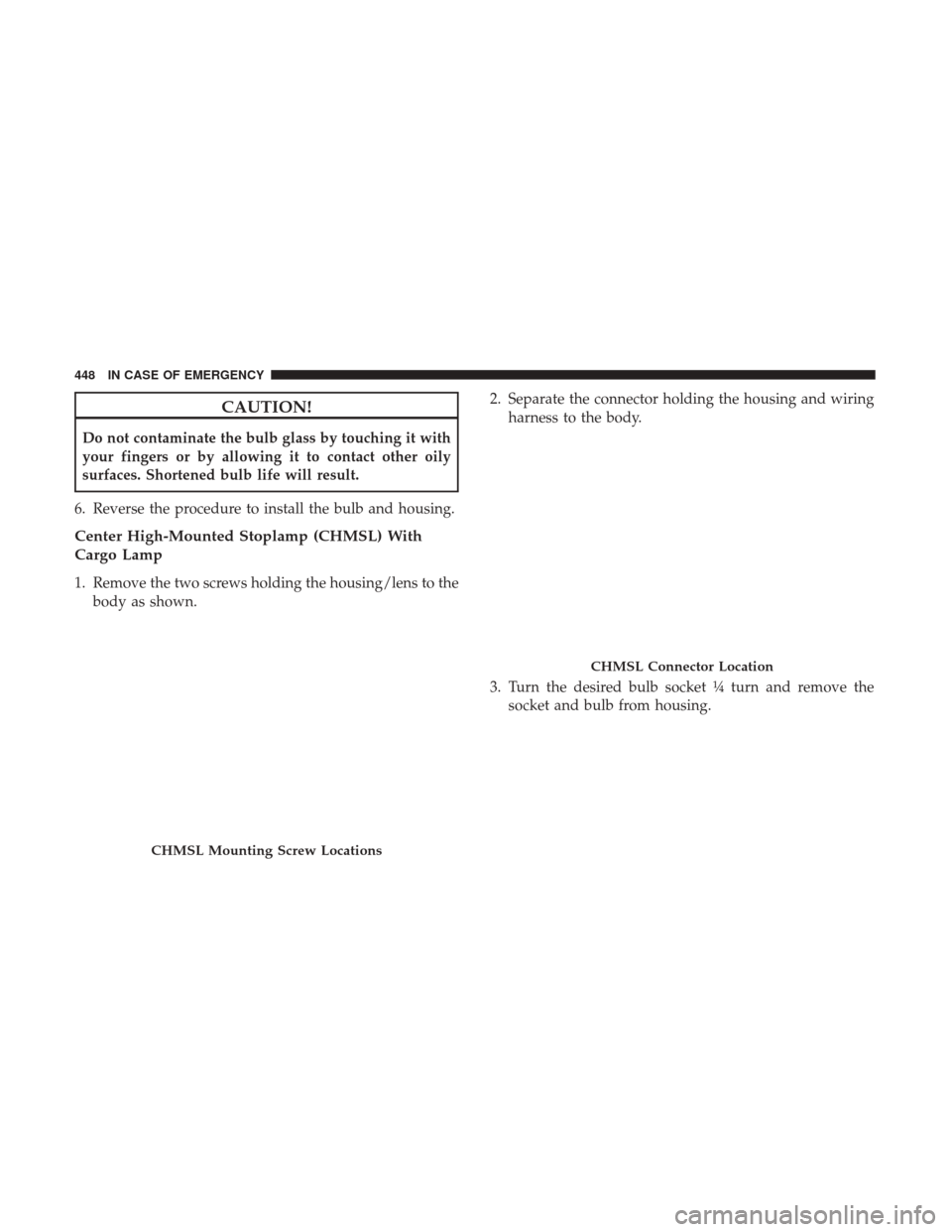
ers in the outer box side panel. 3. Disconnect the wiring harness connectors from the bulb
socket.
4. Rotate the bulb socket counterclockwise 1/4 turn to unlock it from the housing.
5. Pull the bulb straight out of the socket.
Tail Lamp Locations
1 — Tail Lamp
2 — Fasteners
Tail Lamp Removed
1 — Tail Lamp Housing
2 — Bulb Socket Locations
7
IN CASE OF EMERGENCY 447
Page 450 of 698
CAUTION!
Do not contaminate the bulb glass by touching it with
your fingers or by allowing it to contact other oily
surfaces. Shortened bulb life will result.
6. Reverse the procedure to install the bulb and housing.
Center High-Mounted Stoplamp (CHMSL) With
Cargo Lamp
1. Remove the two screws holding the housing/lens to the body as shown. 2. Separate the connector holding the housing and wiring
harness to the body.
3. Turn the desired bulb socket ¼ turn and remove the socket and bulb from housing.
CHMSL Mounting Screw Locations
CHMSL Connector Location
448 IN CASE OF EMERGENCY
Page 451 of 698

4. Pull the desired bulb straight from the socket.
CAUTION!
Do not contaminate the bulb glass by touching it with
your fingers or by allowing it to contact other oily
surfaces. Shortened bulb life will result.• Outside Bulbs: Cargo Lamps
• Inside Bulb: Center High-Mounted Stop Lamp
5. Reverse the procedure for installation of bulbs and housing.
FUSES
WARNING!
•When replacing a blown fuse, always use an appro-
priate replacement fuse with the same amp rating as
the original fuse. Never replace a fuse with another
fuse of higher amp rating. Never replace a blown
fuse with metal wires or any other material. Do not
place a fuse inside a circuit breaker cavity or vice
versa. Failure to use proper fuses may result in
serious personal injury, fire and/or property damage.
• Before replacing a fuse, make sure that the ignition is
off and that all the other services are switched off
and/or disengaged.
• If the replaced fuse blows again, contact an autho-
rized dealer.
• If a general protection fuse for safety systems (air
bag system, braking system), power unit systems
(engine system, transmission system) or steering
system blows, contact an authorized dealer.
CHMSL Bulb And Socket
7
IN CASE OF EMERGENCY 449
Page 452 of 698
Power Distribution Center
The Power Distribution Center is located in the engine
compartment near the battery. This center contains car-
tridge fuses, micro fuses, relays, and circuit breakers. A
description of each fuse and component may be stampedon the inside cover, otherwise the cavity number of each
fuse is stamped on the inside cover that corresponds to the
following chart.
Cavity
Cartridge Fuse Micro Fuse Description
F01 –25 Amp Clear Fuel Pump Motor
F03 –5 Amp Tan MGU – If Equipped
F04 –– Spare
F05 –– Spare
F06 –– Spare
F07 –– Spare
F08 20 Amp Blue –Trailer Tow Backup
F09 –20 Amp Yellow Trailer Stop / Turn Lamp Left
F10 –20 Amp Yellow Trailer Stop / Turn Lamp Right
F11 –– Spare
F12 20 Amp Blue –Trailer Tow Park Lamp
F13 –– Spare
F14 –10 Amp Red AC Clutch
F15 –5 Amp Tan IBS
F16 –– Spare
450 IN CASE OF EMERGENCY