Page 654 of 682
7 Do-it-yourself
Engine compartment check locations........... 7-2
Engine cooling system .......................... 7-3
Checking engine coolant level ................ 7-4
Changing engine coolant ..................... 7-4
Engine oil ........................................ 7-5
Checking engine oil level ..................... 7-5
Changing engine oil ..........................7-6
Changing engine oil filter .....................7-8 Fuel filter (CUMMINS 5.0L)
........................ 7-9
Fuel filter replacement (stage 1 and 2) ........ 7-9
Diesel Particulate Filter (DPF) .................... 7-10
Automatic regeneration ......................7-11
Drive belt ........................................7-11
Air cleaner ...................................... 7-12
In-cabin microfilter .......................... 7-12
Page 655 of 682
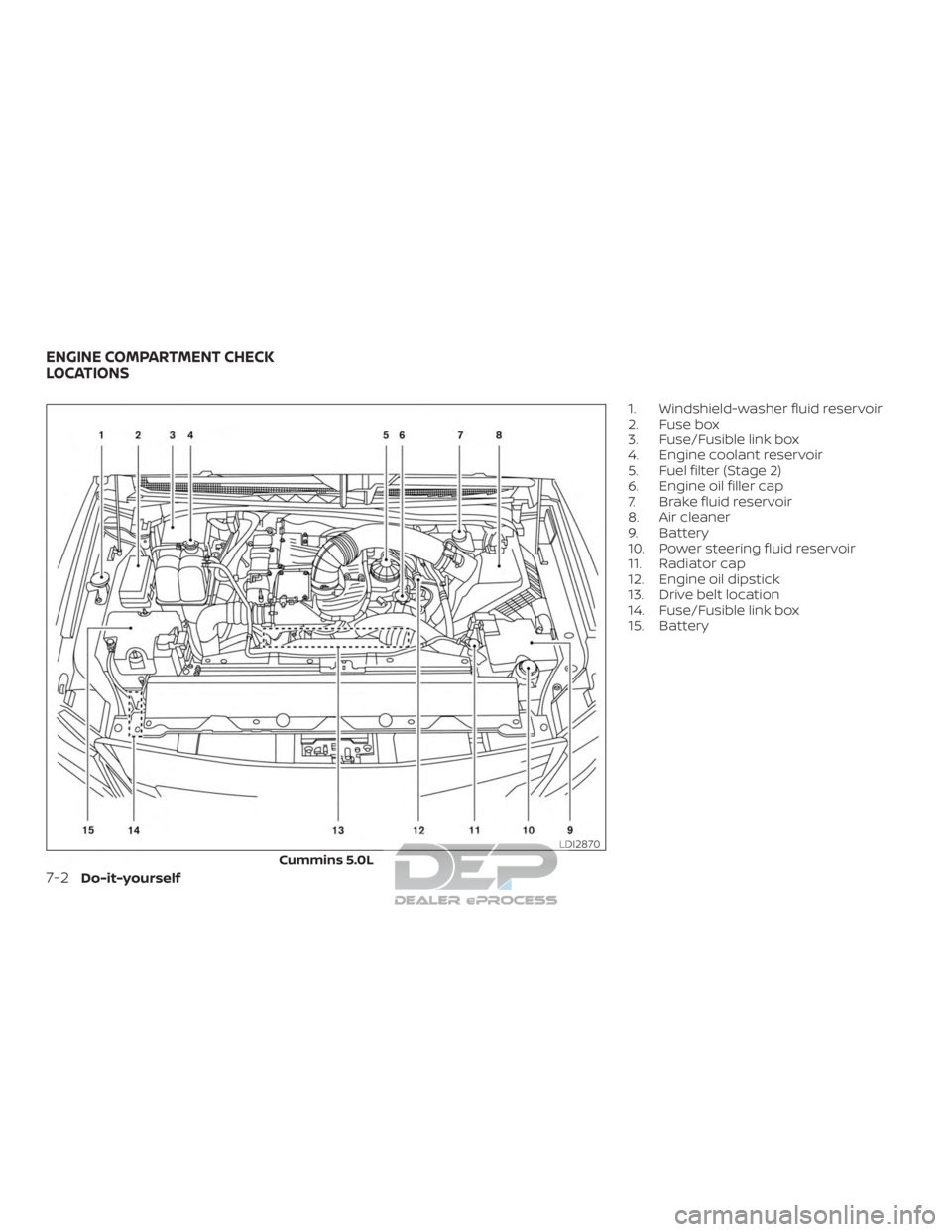
1. Windshield-washer fluid reservoir
2. Fuse box
3. Fuse/Fusible link box
4. Engine coolant reservoir
5. Fuel filter (Stage 2)
6. Engine oil filler cap
7. Brake fluid reservoir
8. Air cleaner
9. Battery
10. Power steering fluid reservoir
11. Radiator cap
12. Engine oil dipstick
13. Drive belt location
14. Fuse/Fusible link box
15. Battery
Cummins 5.0L
LDI2870
ENGINE COMPARTMENT CHECK
LOCATIONS
7-2Do-it-yourself
Page 656 of 682
The engine cooling system is filled at the
factory with a pre-diluted mixture of 50%
Genuine NISSAN Long Life
Antifreeze/Coolant (blue) and 50% water to
provide year-round antifreeze and coolant
protection. The antifreeze solution con-
tains rust and corrosion inhibitors. Addi-
tional engine cooling system additives are
not necessary.
WARNING
∙ Never remove the radiator or coolantreservoir cap when the engine is hot.
Wait until the engine and radiator cool
down. Serious burns could be caused
by high pressure fluid escaping from
the radiator. For additional informa-
tion on precautions, refer to “If your
vehicle overheats” in the “In case of
emergency ” section of the Titan Own-
er’s Manual.
∙ The radiator is equipped with a pres- sure type radiator cap. To prevent en-
gine damage, use only a Genuine
NISSAN radiator cap.
CAUTION
∙ Never use any cooling system addi-tives such as radiator sealer. Additives
may clog the cooling system and
cause damage to the engine, trans-
mission and/or cooling system.
∙ When adding or replacing coolant, be sure to use only Genuine NISSAN Long
Life Antifreeze/Coolant (blue) or
equivalent. Genuine NISSAN Long Life
Antifreeze/Coolant (blue) is pre-
diluted to provide antifreeze protec-
tion to -34° F (-37° C). If additional
freeze protection is needed due to
weather where you operate your ve-
hicle, add Genuine NISSAN Long Life
Antifreeze/Coolant (blue) concen-
trate following the directions on the
container. If an equivalent coolant
other than Genuine NISSAN Long Life
Antifreeze/Coolant (blue) is used, fol-
low the coolant manufacturer’s in-
structions to maintain minimum anti-
freeze protection to -34° F (-37° C). The
use of other types of coolant solu-
tions other than Genuine NISSAN Long
Life Antifreeze/Coolant (blue) or
equivalent may cause severe engine
damage. ∙ The life expectancy of the factory-fill
coolant is 45,000 miles (78,000 km) or
3 years. Mixing any other type of cool-
ant other than Genuine NISSAN Long
Life Antifreeze/Coolant (blue), includ-
ing Genuine NISSAN Long Life
Antifreeze/Coolant (green), or the use
of non-distilled water will reduce the
life expectancy of the factory-fill cool-
ant. For additional information, refer
to the Titan Owner’s Manual.
∙ Use Nitrite Free Coolant or equivalent. The use of coolant containing Nitrites,
could cause severe engine damage.
ENGINE COOLING SYSTEM
Do-it-yourself7-3
Page 657 of 682
CHECKING ENGINE COOLANT
LEVEL
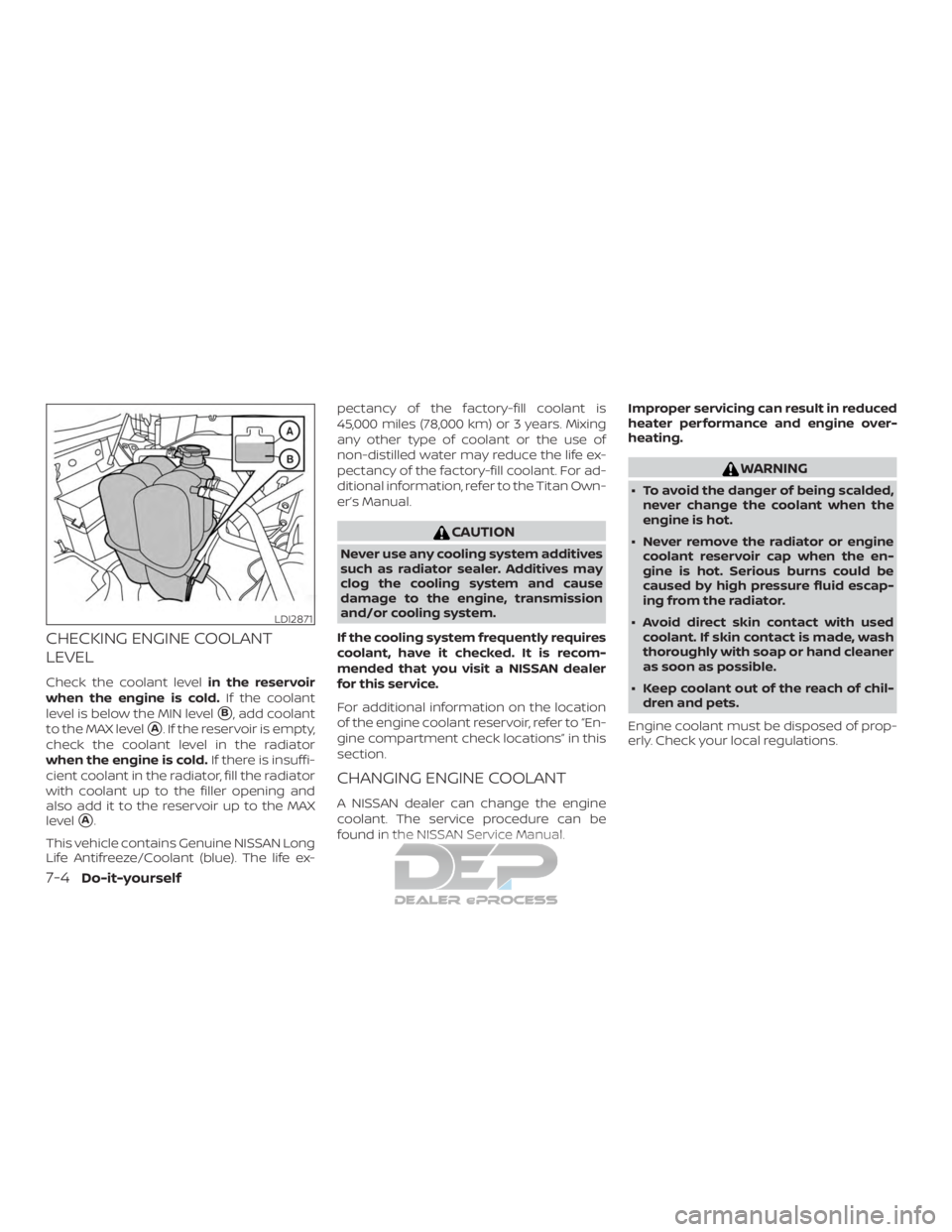
Check the coolant levelin the reservoir
when the engine is cold. If the coolant
level is below the MIN level
�B, add coolant
to the MAX level
�A. If the reservoir is empty,
check the coolant level in the radiator
when the engine is cold. If there is insuffi-
cient coolant in the radiator, fill the radiator
with coolant up to the filler opening and
also add it to the reservoir up to the MAX
level
�A.
This vehicle contains Genuine NISSAN Long
Life Antifreeze/Coolant (blue). The life ex- pectancy of the factory-fill coolant is
45,000 miles (78,000 km) or 3 years. Mixing
any other type of coolant or the use of
non-distilled water may reduce the life ex-
pectancy of the factory-fill coolant. For ad-
ditional information, refer to the Titan Own-
er’s Manual.
CAUTION
Never use any cooling system additives
such as radiator sealer. Additives may
clog the cooling system and cause
damage to the engine, transmission
and/or cooling system.
If the cooling system frequently requires
coolant, have it checked. It is recom-
mended that you visit a NISSAN dealer
for this service.
For additional information on the location
of the engine coolant reservoir, refer to “En-
gine compartment check locations” in this
section.
CHANGING ENGINE COOLANT
A NISSAN dealer can change the engine
coolant. The service procedure can be
found in the NISSAN Service Manual. Improper servicing can result in reduced
heater performance and engine over-
heating.
WARNING
∙ To avoid the danger of being scalded,
never change the coolant when the
engine is hot.
∙ Never remove the radiator or engine coolant reservoir cap when the en-
gine is hot. Serious burns could be
caused by high pressure fluid escap-
ing from the radiator.
∙ Avoid direct skin contact with used coolant. If skin contact is made, wash
thoroughly with soap or hand cleaner
as soon as possible.
∙ Keep coolant out of the reach of chil- dren and pets.
Engine coolant must be disposed of prop-
erly. Check your local regulations.
LDI2871
7-4Do-it-yourself
Page 658 of 682
CAUTION
Your vehicle may require more frequent
maintenance if it operates on biodiesel
blends between 6% and 10% (B6 and
B10). To avoid damage to your vehicle,
the oil, oil filter, and fuel filter will need
to be replaced af ter a shorter time in-
terval than if your vehicle was operat-
ing on pure petroleum-based diesel.
For additional information, refer to the
“Maintenance and schedules” section in
the Titan Owner’s Manual.
CHECKING ENGINE OIL LEVEL
NOTE:
The factory fill oil may include a red dye
that is added for manufacturing quality
processes. The dye makes the oil appear
to be red. This is normal. The red dye will
be flushed from the engine af ter ap-
proximately 4–5 oil changes.1. Park the vehicle on a level surface and
apply the parking brake.
2. Start the engine and let it idle until it reaches operating temperature.
3. Turn off the engine. Wait more than
10 minutes for the oil to drain back
into the oil pan.
4. Remove the dipstick and wipe it clean. Reinsert it all the way.
LDI2872
ENGINE OIL
Do-it-yourself7-5
Page 659 of 682
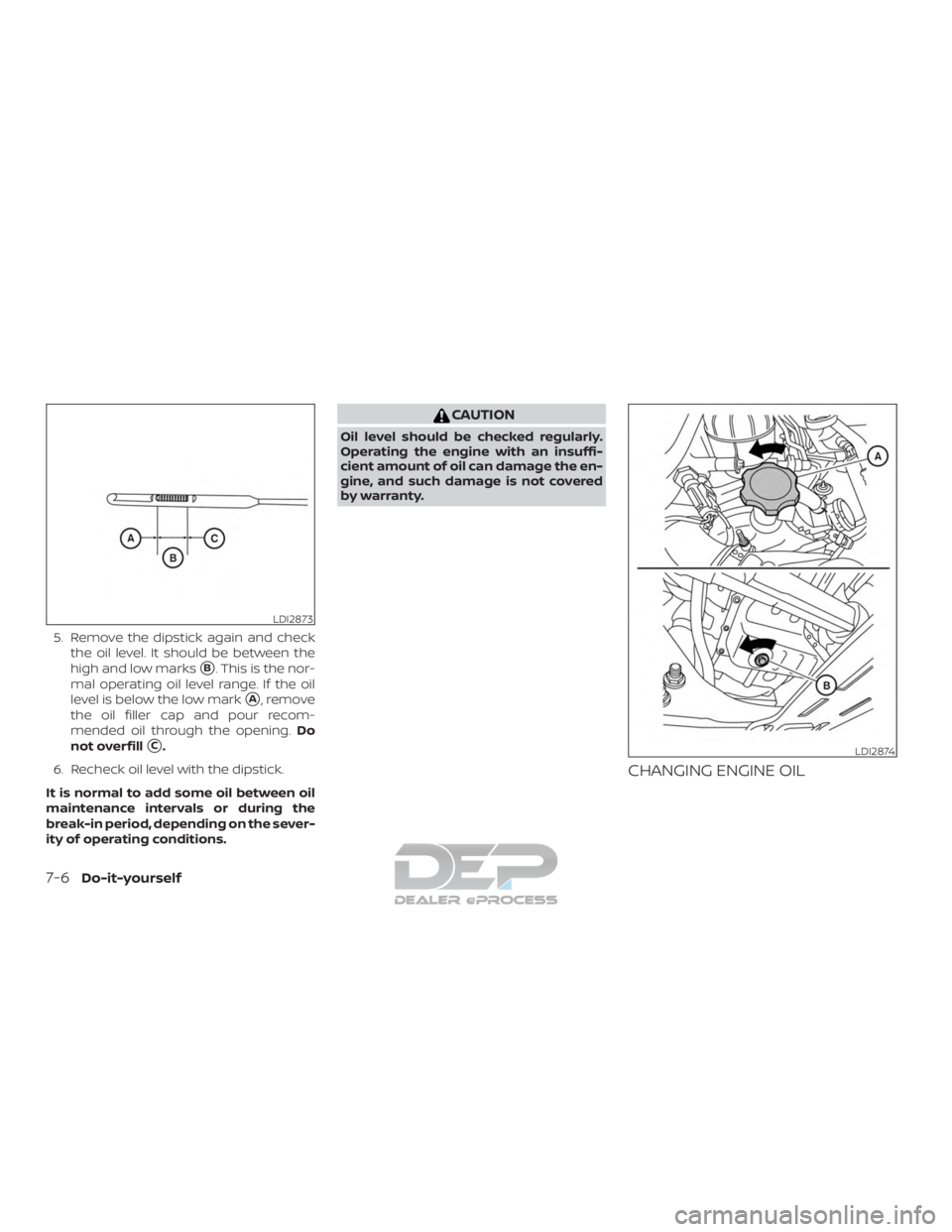
5. Remove the dipstick again and checkthe oil level. It should be between the
high and low marks
�B. This is the nor-
mal operating oil level range. If the oil
level is below the low mark
�A, remove
the oil filler cap and pour recom-
mended oil through the opening. Do
not overfill
�C.
6. Recheck oil level with the dipstick.
It is normal to add some oil between oil
maintenance intervals or during the
break-in period, depending on the sever-
ity of operating conditions.
CAUTION
Oil level should be checked regularly.
Operating the engine with an insuffi-
cient amount of oil can damage the en-
gine, and such damage is not covered
by warranty.
CHANGING ENGINE OIL
LDI2873
LDI2874
7-6Do-it-yourself
Page 660 of 682

NOTE:
The factory fill oil may include a red dye
that is added for manufacturing quality
processes. The dye makes the oil appear
to be red. This is normal. The red dye will
be flushed from the engine af ter ap-
proximately 4–5 oil changes.1. Park the vehicle on a level surface and apply the parking brake.
2. Start the engine and let it idle until it reaches operating temperature, then
turn it off.
3. Remove the oil filler cap
�Aby turning it
counterclockwise.
4. Place a large drain pan under the drain plug
�B.
5. Remove the drain plug
�Bwith a
wrench by turning it counterclockwise
and completely drain the oil.
Remove and replace the engine oil fil-
ter at this time. For additional informa-
tion, refer to “Changing engine oil filter”
in this section.
∙ Waste oil must be disposed of prop-
erly.
∙ Check your local regulations.
WARNING
∙ Prolonged and repeated contact with
used engine oil may cause skin
cancer.
∙ Try to avoid direct skin contact with used oil. If skin contact is made, wash
thoroughly with soap or hand cleaner
as soon as possible.
∙ Keep used engine oil out of reach of children.
CAUTION
Be careful not to burn yourself. The en-
gine oil may be hot.
6. Clean and reinstall the drain plug. Se- curely tighten the drain plug with a
wrench. Do not use excessive force.
Drain plug tightening torque: 25 f t-lb (34 N·m) 7. Refill engine with recommended oil
through the oil filler opening, then install
the oil filler cap securely.
For additional information on drain
and refill capacity, refer to “Recom-
mended fluids/lubricants and capaci-
ties” in the “Capacities and specifica-
tions” section of this manual.
The drain and refill capacity depends
on the oil temperature and drain time.
Use these specifications for reference
only. Always use the dipstick to deter-
mine when the proper amount of oil is
in the engine.
8. Start the engine. Check for leakage around the drain plug and oil filter. Cor-
rect as required.
9. Turn the engine off and wait more than 10 minutes. Check the oil level with the
dipstick. Add engine oil if necessary.
NOTE:
For additional information on resetting
the oil control system, refer to “Resetting
the oil control system” in the “Instrument
panel” section of this manual.
Do-it-yourself7-7
Page 661 of 682
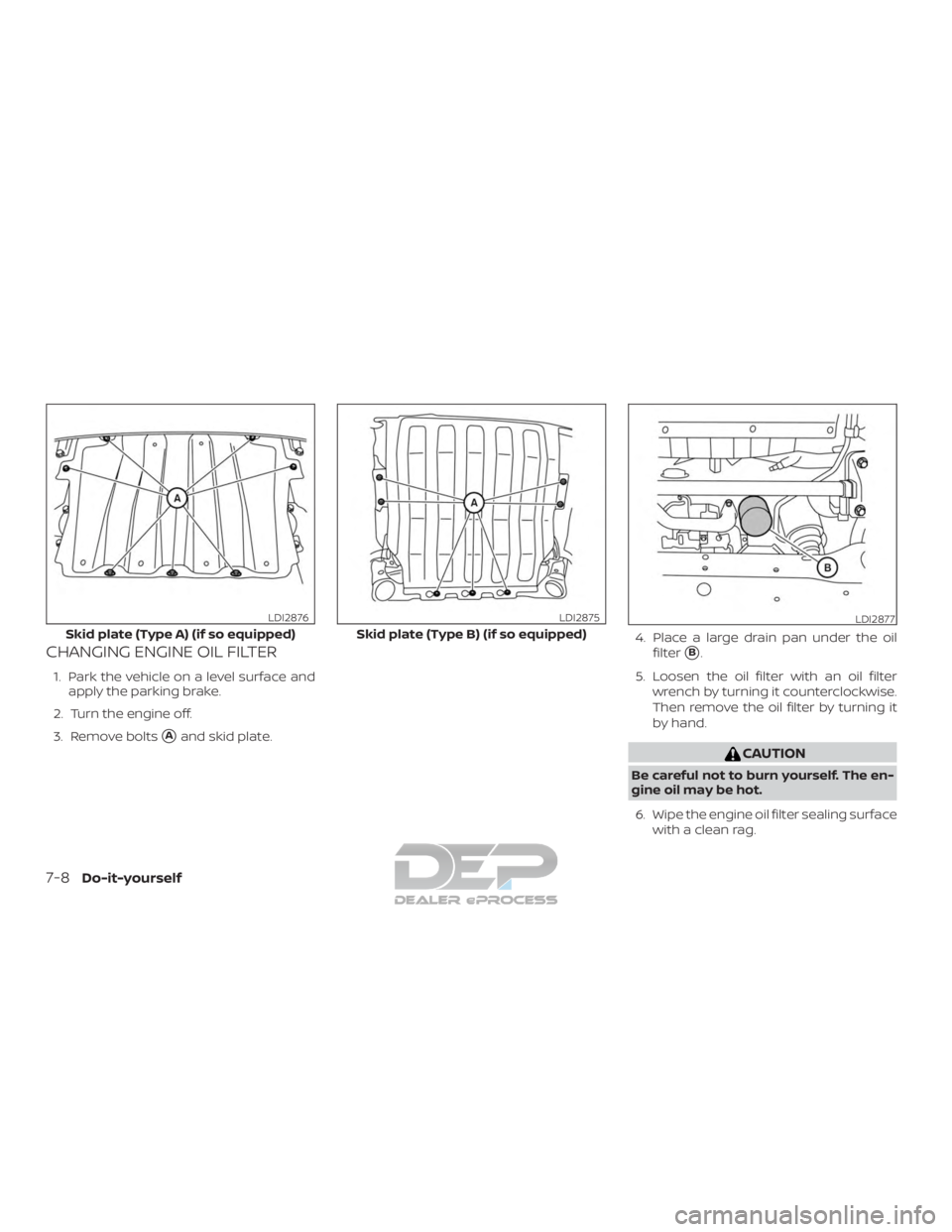
CHANGING ENGINE OIL FILTER
1. Park the vehicle on a level surface andapply the parking brake.
2. Turn the engine off.
3. Remove bolts
�Aand skid plate. 4. Place a large drain pan under the oil
filter
�B.
5. Loosen the oil filter with an oil filter wrench by turning it counterclockwise.
Then remove the oil filter by turning it
by hand.
CAUTION
Be careful not to burn yourself. The en-
gine oil may be hot.
6. Wipe the engine oil filter sealing surface with a clean rag.
Skid plate (Type A) (if so equipped)
LDI2876
Skid plate (Type B) (if so equipped)
LDI2875LDI2877
7-8Do-it-yourself