2019 NISSAN TITAN oil viscosity
[x] Cancel search: oil viscosityPage 397 of 682
∙ Cruise control is particularly effectivein providing fuel savings when driving
on flat terrains.
6. Plan for the Shortest Route
∙ Utilize a map or navigation system to determine the best route to save
time.
7. Avoid Idling
∙ Shutting off your engine when safe for stops exceeding 30–60 seconds
saves fuel and reduces emissions.
8.
Buy an Automated Pass for Toll Roads
∙ Automated passes permit drivers to use special lanes to maintain cruis-
ing speed through the toll and avoid
stopping and starting.
9. Winter Warm Up
∙ Limit idling time to minimize impact to fuel economy.
∙ Vehicles typically need no more than 30 seconds of idling at start-up to
effectively circulate the engine oil be-
fore driving.
∙ Your vehicle will reach its ideal oper- ating temperature more quickly
while driving versus idling. 10.
Keeping your Vehicle Cool
∙ Park your vehicle in a covered parking area or in the shade whenever pos-
sible.
∙ When entering a hot vehicle, opening the windows will help to reduce the
inside temperature faster, resulting in
reduced demand on your A/C sys-
tem. ∙ Keep your engine tuned up.
∙ Follow the recommended scheduled
maintenance.
∙ Keep the tires inflated to the correct pressure. Low tire pressure increases
tire wear and lowers fuel economy.
∙ Keep the wheels in correct alignment. Improper alignment increases tire wear
and lowers fuel economy.
∙ For vehicles equipped with
, use
4H or 4L position only when necessary.
4-Wheel Drive operation lowers fuel
economy.
∙ Use the recommended viscosity engine oil. For additional information, refer to
“Engine oil and oil filter recommenda-
tions” in the “Technical and consumer
information” section of this manual.
INCREASING FUEL ECONOMY
5-44Starting and driving
Page 507 of 682
Engine Oil and Oil Filter:Replace engine
oil and oil filter at the specified intervals. For
recommended oil grade and viscosity refer
to “Recommended fluids/lubricants and
capacities” in the “Technical and consumer
information” section of this manual.
Engine Valve Clearance* (gasoline en-
gine only):
Inspect only if valve noise in-
creases. Adjust valve clearance if necessary.
Evaporative Emissions Control Vapor
Lines* (gasoline engine only): Check va-
por lines for leaks or looseness. Tighten
connections or replace parts as necessary.
Fuel Filter (diesel engine only): Replace
the fuel filter and drain the water at the
specified intervals.
Fuel Lines*: Check the fuel hoses, piping
and connections for leaks, looseness, or
deterioration. Tighten connections or re-
place parts as necessary.
CHASSIS AND BODY
MAINTENANCE:
Brake Lines and Cables: Visually inspect
for proper installation. Check for chafing,
cracks, deterioration, and signs of leaking.
Replace any deteriorated or damaged
parts immediately. Brake Pads and Rotors:
Check for wear,
deterioration and fluid leaks. Replace any
deteriorated or damaged parts immedi-
ately.
Exhaust System: Visually inspect the ex-
haust pipes, muffler and hangers for leaks,
cracks, deterioration, and damage. Tighten
connections or replace parts as necessary.
In-Cabin Microfilter: Replace at specified
intervals. When driving for prolonged peri-
ods in dusty conditions, replace the filter
more frequently.
Propeller Shaf t(s): Check for damage,
looseness, and grease leakage.
(4WD/AWD/RWD).
Steering Gear and Linkage, Axle and Sus-
pension Parts, Drive Shaf t Boots: Check
for damage, looseness, and leakage of oil
or grease. Under severe driving conditions,
inspect more frequently.
Tire Rotation: Tires should be rotated ev-
ery 5,000 miles (8,000 km) according to the
instructions under “General maintenance”
in this section. When rotating tires, check
for damage and uneven wear. Replace if
necessary. Transmission Fluid/Oil, Differential Oil,
Transfer Case Oil:
Visually inspect for signs
of leakage at specified intervals.
Replace automatic transmission fluid at
specified intervals. (For diesel engine models)
If towing a trailer, using a camper or car-top
carrier, or driving on rough or muddy roads:
∙ Replace the differential oil every 20,000 miles (32,000 km) or 24 months.
∙
Replace the automatic transmission fluid
ever 30,000 miles (48,000 km) or
24 months. (For gasoline engine models)
Off-Road Maintenance: Check the follow-
ing items frequently whenever you drive
off-road through deep sand, mud or water:
∙ Brake pads and rotors
∙ Brake lines and hoses
∙ Differential, transmission and transfer case oil
∙ Steering linkage
∙ Propeller shaf t(s) and front drive shaf ts
∙ Engine air filter
∙ Clutch housing drain (4WD only)
9-6Maintenance and schedules
Page 530 of 682
Octane rating tips
Using unleaded gasoline with an octane
rating lower than recommended can
cause persistent, heavy “spark knock.”
(“Spark knock” is a metallic rapping
noise.) If severe, this can lead to engine
damage. If you detect a persistent heavy
spark knock even when using gasoline
of the stated octane rating, or if you hear
steady spark knock while holding a
steady speed on level roads, it is recom-
mended that you have a NISSAN dealer
correct the condition. Failure to correct
the condition is misuse of the vehicle, for
which NISSAN is not responsible.
Incorrect ignition timing may result in
spark knock, af ter-run and/or overheating,
which may cause excessive fuel consump-
tion or engine damage. If any of the above
symptoms are encountered, have your ve-
hicle checked. It is recommended that you
visit a NISSAN dealer for servicing.
However, now and then you may notice
light spark knock for a short time while
accelerating or driving up hills. This is not
a cause for concern, because you get the
greatest fuel benefit when there is light
spark knock for a short time under heavy
engine load.
ENGINE OIL AND OIL FILTER
RECOMMENDATIONS (for gas
engine only)
For diesel engine oil and oil filter recom-
mendations, refer to “Engine oil and oil filter
recommendations” section of the Titan
Diesel Owner’s Manual.
Selecting the correct oil
It is essential to choose the correct grade,
quality and viscosity engine oil to ensure
satisfactory engine life and performance.
For additional information, refer to “Recom-
mended fluids/lubricants and capacities”in this section. NISSAN recommends the
use of an energy conserving oil in order to
improve fuel economy.
Select only engine oils that meet the
American Petroleum Institute (API) certifi-
cation or International Lubricant Standard-
ization and Approval Committee (ILSAC)
certification and SAE viscosity standard.
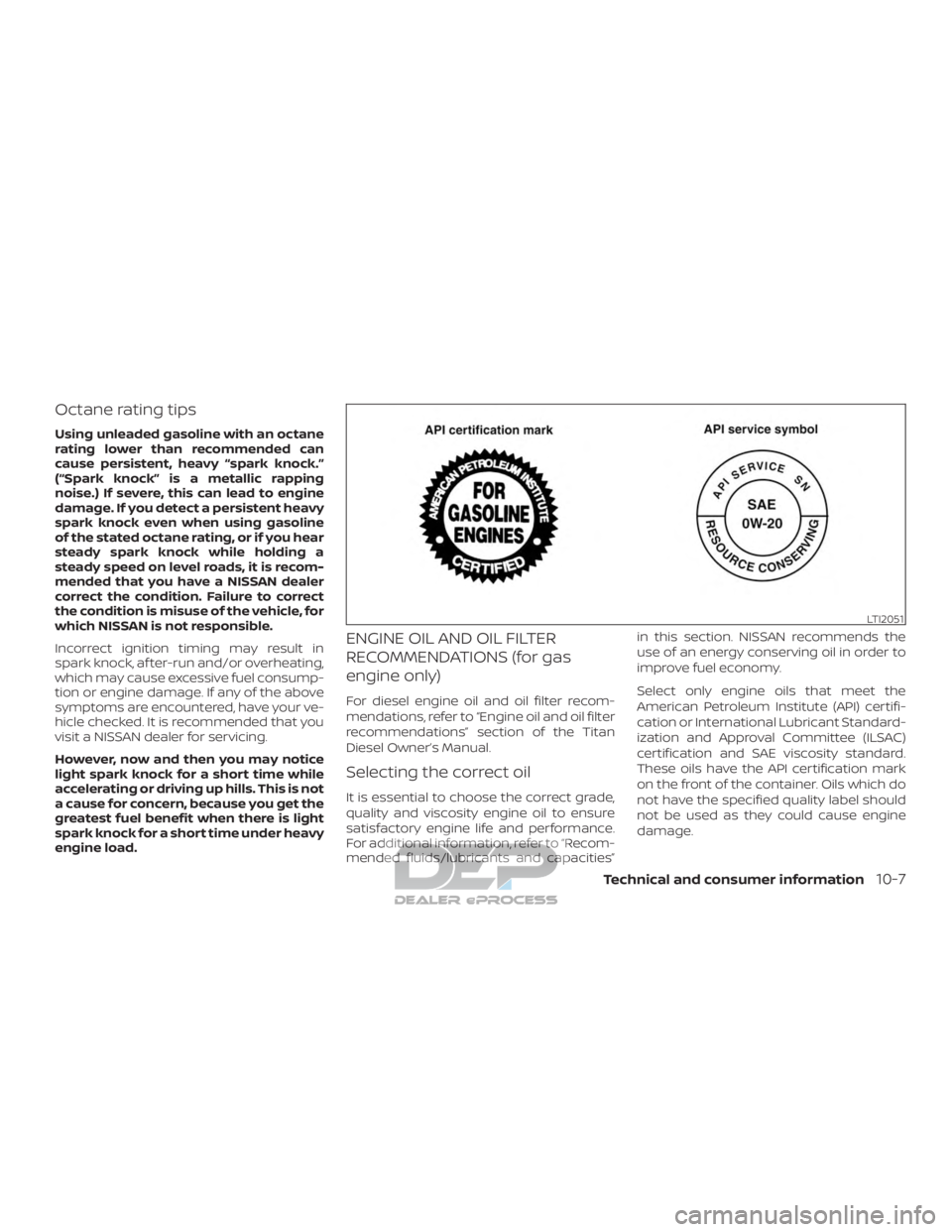
These oils have the API certification mark
on the front of the container. Oils which do
not have the specified quality label should
not be used as they could cause engine
damage.
LTI2051
Technical and consumer information10-7
Page 531 of 682
Oil additives
NISSAN does not recommend the use of oil
additives. The use of an oil additive is not
necessary when the proper oil type is used
and maintenance intervals are followed.
Oil which may contain foreign matter or
has been previously used should not be
used.
Oil viscosity
The engine oil viscosity or thickness
changes with temperature. Because of
this, it is important to select the engine oil
viscosity based on the temperatures at
which the vehicle will be operated before
the next oil change. Choosing an oil viscos-
ity other than that recommended could
cause serious engine damage.
Selecting the correct oil filter
Your new NISSAN vehicle is equipped with a
high-quality Genuine NISSAN oil filter. When
replacing, use a Genuine NISSAN oil filter or
its equivalent for the reason described in
“Change intervals.”
Change intervals
The oil and oil filter change intervals for
your engine are based on the use of thespecified quality oils and filters. Using en-
gine oil and filters that are not of the speci-
fied quality, or exceeding recommended oil
and filter change intervals could reduce
engine life. Damage to the engine caused
by improper maintenance or use of incor-
rect oil and filter quality and/or viscosity is
not covered by the NISSAN New Vehicle
Limited Warranty.
Your engine was filled with a high-quality
engine oil when it was built. You do not have
to change the oil before the first recom-
mended change interval. Oil and filter
change intervals depend upon how you
use your vehicle.
Operation under the following conditions
may require more frequent oil and filter
changes:
∙ repeated short distance driving at cold outside temperatures
∙ driving in dusty conditions
∙ extensive idling
∙ towing a trailer
∙ stop and go commuting
For additional information, refer to the
“Maintenance and schedules” section of
this manual.
AIR CONDITIONER SYSTEM
REFRIGERANT AND OIL
RECOMMENDATIONS
The air conditioner system in your
NISSAN vehicle must be charged with the
refrigerant HFO-1234yf (R-1234yf ) and
NISSAN A/C system oil Type PAG or the
exact equivalents.
CAUTION
The use of any other refrigerant or oil
may cause severe damage to the air
conditioning system and may require
the replacement of all air conditioner
system components.
The refrigerant HFO-1234yf (R-1234yf ) in
your NISSAN vehicle does not harm the
earth’s ozone layer. Although this refriger-
ant does not affect the earth’s atmo-
sphere, certain government regulations re-
quire the recovery and recycling of any
refrigerant during automotive air condi-
tioner system service. Air conditioner sys-
tem should only be service by trained and
certified technicians to ensure proper and
safe operation (SAE J2845). A NISSAN dealer
has the trained technicians and equip-
ment needed to recover and recycle your
air conditioner system refrigerant.
10-8Technical and consumer information
Page 593 of 682
Top tether strap anchor point
locations...................1-31
Child safety rear door lock ..........3-10
Chimes, audible reminders .........2-25
Cleaningexteriorandinterior......7-2,7-4
Climatecontrolseatswitch.........2-55
C.M.V.S.S. certification label .........10-20
Coldweatherdriving.............5-68
Compass ....................2-12
Console light ..................2-88
Controls Heater and air conditioner controls . .4-39
Heater and air conditioner controls
(manual) ...................4-29
Coolant Capacities and recommended
fuel/lubricants...............10-2
Changing engine coolant .........8-6
Checking engine coolant level ......8-6
Engine coolant temperature gauge . .2-8
Corrosionprotection..............7-7
Cruisecontrol...........5-41,5-41,5-42
Cupholders...................2-78
Curtain side-impact and rollover air
bag........................1-78
D
Daytime Running Light System . . .2-52, 8-30
Diesel Particulate Filter (DPF) .........8-11
DigitalvideodiscDVD ............4-44
Dimensions and weights ..........10-12
Dimmer switch for instrument panel . . .2-53
Display......................2-26
Door locks ..................3-5,3-6 Door open warning light
...........2-19
Drivebelt ....................8-19
Drive positioner, Automatic ......3-43,3-45
Driving Cold weather driving ...........5-68
Driving with automatic
transmission ................5-17
Precautions when starting and
driving..................5-2,5-9
Drivingthevehicle...............5-17
E
Eco Drive Report ................5-53
Economy - fuel .................5-44
Electronic locking rear differential (E-Lock)
system ......................5-52
Electronic locking rear differential (E-Lock)
system switch .................2-62
Emergency engine shutoff .......5-13,6-2
Emission control information label . . . .10-20
Emission control system warranty . . . .10-65
Engine Before starting the engine ........5-15
Blockheater................5-70
Capacities and recommended
fuel/lubricants...............10-2
Changing engine coolant .........8-6
Changing engine oil ............8-8
Changing engine oil filter .........8-9
Checking engine coolant level ......8-6
Checking engine oil level .........8-7
Engine compartment check
locations...................8-3
Engine coolant temperature gauge . .2-8 Engine cooling system
..........8-5
Engine oil ...................8-7
Engine oil and oil filter
recommendation .............10-7
Engine oil pressure gauge .....2-10,2-11
Engine oil pressure warning light ....2-19
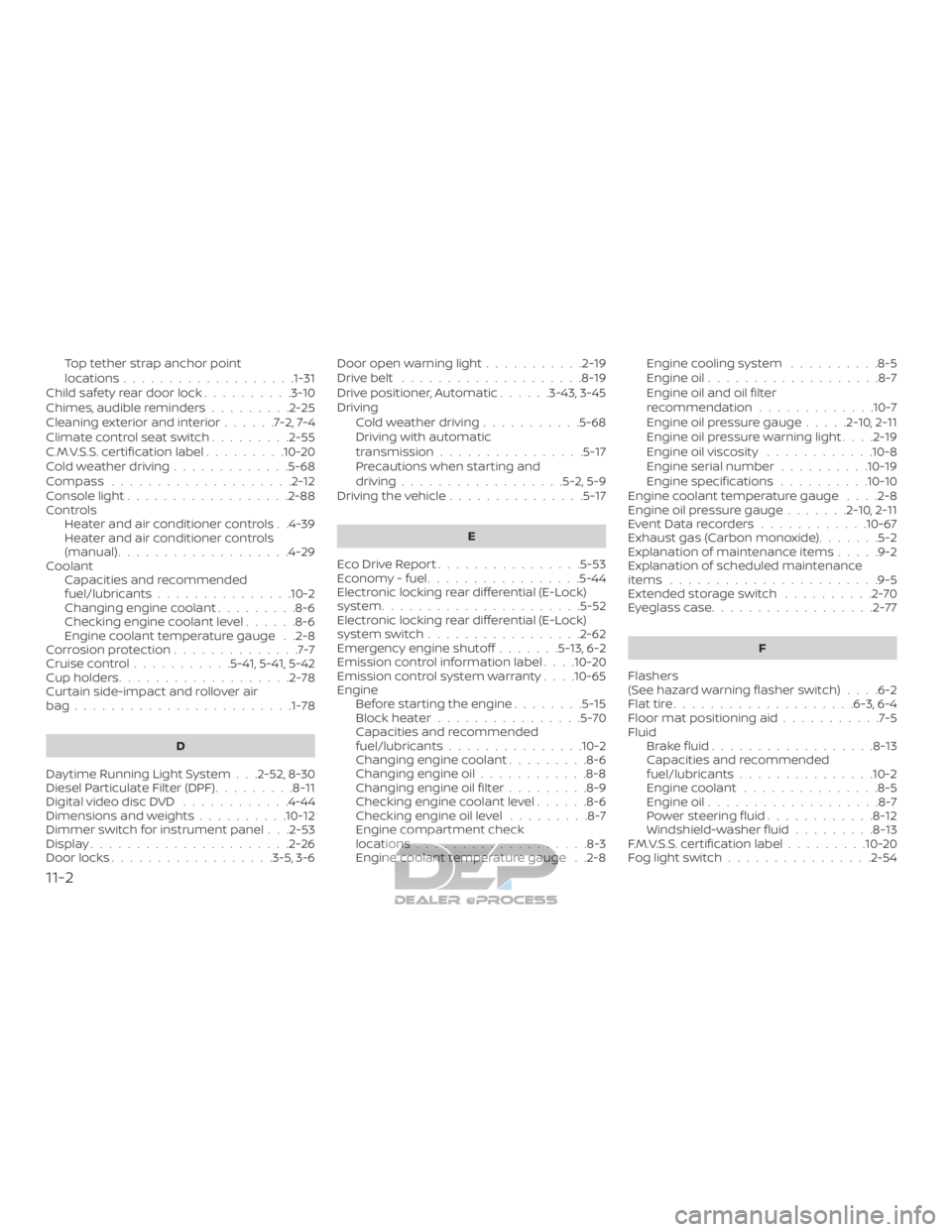
Engine oil viscosity ............10-8
Engine serial numbe r..........10-19
Engine specifications ..........10-10
Engine coolant temperature gauge ....2-8
Engine oil pressure gauge .......2-10,2-11
EventDatarecorders............10-67
Exhaust gas (Carbon monoxide) .......5-2
Explanation of maintenance items .....9-2
Explanation of scheduled maintenance
items .......................9-5
Extended storage switch ..........2-70
Eyeglasscase..................2-77
F
Flashers
(Seehazardwarningflasherswitch)....6-2
Flattire....................6-3,6-4
F lo
ormatpositioningaid...........7-5
Fluid Brakefluid..................8-13
Capacities and recommended
fuel/lubricants...............10-2
Engine coolant ...............8-5
Engine oil ...................8-7
Powersteeringfluid............8-12
Windshield-washer fluid .........8-13
F.M.V.S.S. certification label .........10-20
Foglightswitch................2-54
11-2
Page 596 of 682
OilCapacities and recommended
fuel/lubricants...............10-2
Changing engine oil ............8-8
Changing engine oil filter .........8-9
Checking engine oil level .........8-7
Engine oil ...................8-7
Engine oil and oil filter
recommendation .............10-7
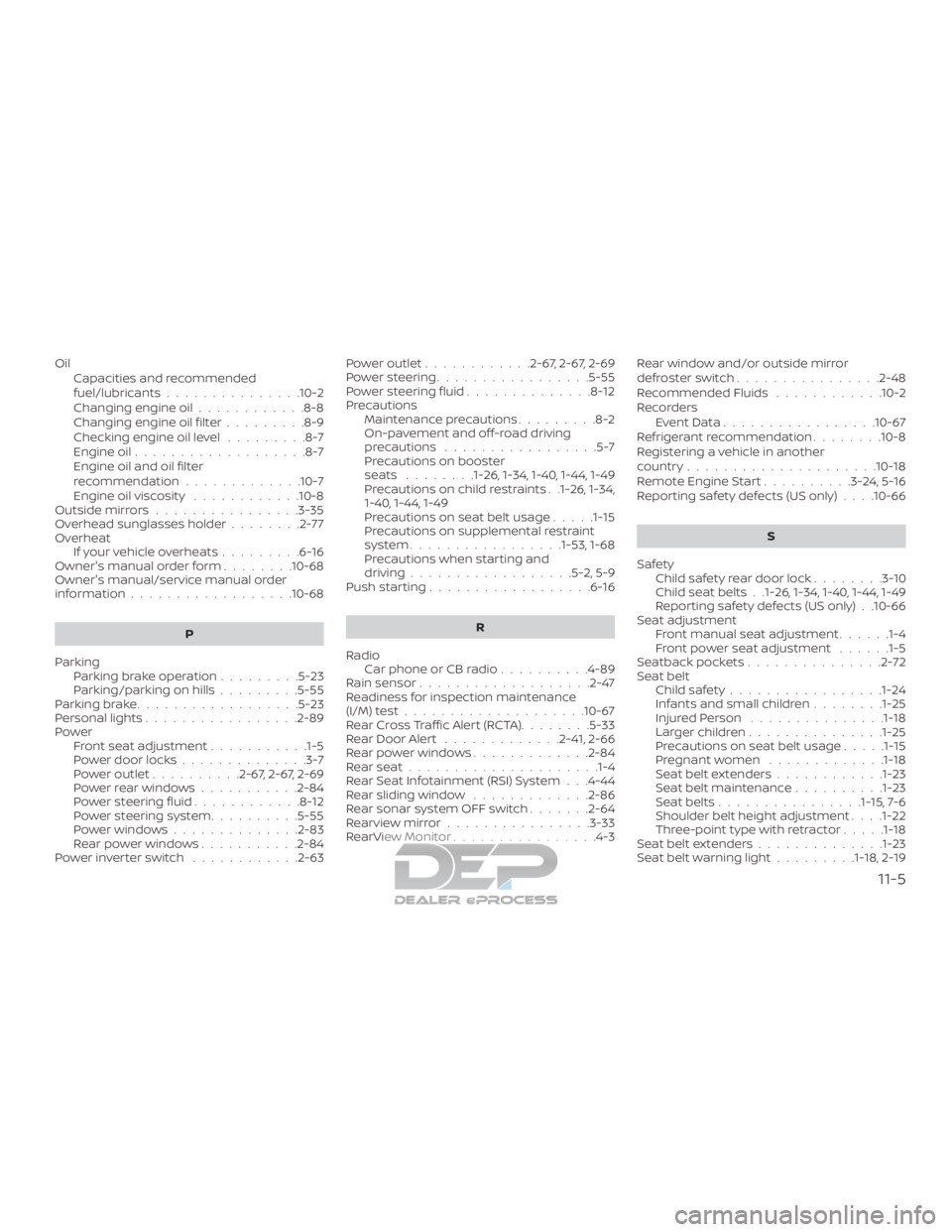
Engine oil viscosity ............10-8
Outsidemirrors................3-35
Overhead sunglasses holder ........2-77
Overheat Ifyourvehicleoverheats.........6-16
Owner's manual order form ........10-68
Owner's manual/service manual order
information..................10-68
P
Parking Parking brake operation .........5-23
Parking/parkingonhills.........5-55
Parkingbrake..................5-23
Personal lights .................2-89
Power Front seat adjustment ...........1-5
Power door locks ..............3-7
Poweroutlet..........2-67,2-67,2-69
Powerrearwindows...........2-84
Powersteeringfluid............8-12
Power steering system ..........5-55
Powerwindows..............2-83
Rearpowerwindows...........2-84
Powerinverterswitch ............2-63 Poweroutlet............2-67,2-67,2-69
Powersteering.................5-55
Powersteeringfluid..............8-12
Precautions
Maintenance precautions .........8-2
On-pavement and off-road driving
precautions .................5-7
Precautions on booster
seats ........1-26, 1-34, 1-40, 1-44, 1-49
Precautions on child restraints . .1-26, 1-34,
1-40, 1-44, 1-49
Precautions on seat belt usage .....1-15
Precautions on supplemental restraint
system .................1-53, 1-68
Precautions when starting and
driving..................5-2,5-9
Push starting ..................6-16
R
Radio Car phone or CB radio ..........4-89
Rain sensor ...................2-47
Readiness for inspection maintenance
(I/M) test ....................10-67
RearCrossTrafficAlert(RCTA)........5-33
Rear Door Alert .............2-41,2-66
Rearpowerwindows.............2-84
Rearseat.....................1-4
Rear Seat Infotainment (RSI) System . . .4-44
Rearslidingwindow .............2-86
Rear sonar system OFF switch .......2-64
Rearviewmirror................3-33
RearViewMonitor................4-3 Rear window and/or outside mirror
defrosterswitch................2-48
Recommended Fluids
............10-2
Recorders EventData.................10-67
Refrigerant recommendation ........10-8
Registering a vehicle in another
country .....................10-18
Remote Engine Start ..........3-24,5-16
Reporting safety defects (US only) . . . .10-66
S
Safety Child safety rear door lock ........3-10
Child seat belts . .1-26, 1-34, 1-40, 1-44, 1-49
Reporting safety defects (US only) . .10-66
Seat adjustment Front manual seat adjustment ......1-4
Front power seat adjustment ......1-5
Seatback pockets ...............2-72
Seat belt Childsafety.................1-24
Infants and small children ........1-25
InjuredPerson .............. .1-18
L a r
gerchildren.............. .1-25
Precautionsonseatbeltusage.....1-15
Pregnant women .............1-18
Seat belt extenders ............1-23
Seat belt maintenance ..........1-23
Seatbelts................1-15, 7-6
Shoulder belt height adjustment . . . .1-22
Three-pointtypewithretractor.....1-18
Seat belt extenders ..............1-23
Seatbeltwarninglight.........1-18, 2-19
11-5
Page 624 of 682
The stage 1 fuel filter separates water and
filters impurities from the fuel. The stage 2
fuel filter filters finer impurities from the
diesel fuel. The stage 1 and stage 2 fuel
filters should be changed at the recom-
mended service interval or when indicated
by the information display. For additional
information, refer to “Maintenance and
schedules” and “Instruments and controls”
sections of the Titan Owner’s Manual.
The water/fuel separator should be
drained when indicated by illumination of
the water in fuel warning light.
NOTE:
Proper fuel filter maintenance and
prompt water draining when the water
in the fuel filter warning light illuminates
is essential to prevent damage to fuel
injection system components. Ignoring
the water in fuel warning light can cause
your vehicle to go into a reduced power
mode and has the potential for fuel sys-
tem damage.ENGINE PROTECTION MODE
The diesel engine in this vehicle is equipped
with electronically controlled fuel and
emission systems. Both systems monitor
engine temperatures and pressures, and
then modif y engine operation accordingly.
It is normal for the diesel engine to operate
under these modified conditions for short
durations of time. If the engine operates
under the modified conditions for ex-
tended periods of time, and the service en-
gine soon light is illuminated, have the sys-
tem checked. It is recommended that you
visit a NISSAN dealer for this service as
soon as possible.
LUBRICATION SYSTEM
It is important to change the engine oil at
the recommended service intervals to
maintain oil viscosity. Extending the oil and
filter change interval beyond the recom-
mended interval can negatively affect en-
gine performance, fuel economy and en-
gine life. For additional information, refer to
the “Do-it-yourself ” section of this manual.
GLOW PLUGS
The diesel engine glow plug system con-
sists of:∙ Eight Glow Plugs (one per cylinder)
∙ Glow Plug Control Module - Uses input from the Engine Coolant Temperature
Sensor
The glow plugs are energized momentarily
when the ignition is first turned on. The
length of time that the glow plugs are en-
ergized varies depending on engine and
environmental conditions. The required
time for the glow plugs to be energized
decreases as coolant temperature in-
creases. For additional information, refer to
the “Starting and stopping the engine” sec-
tion of this manual.
Introduction1-3
Page 667 of 682
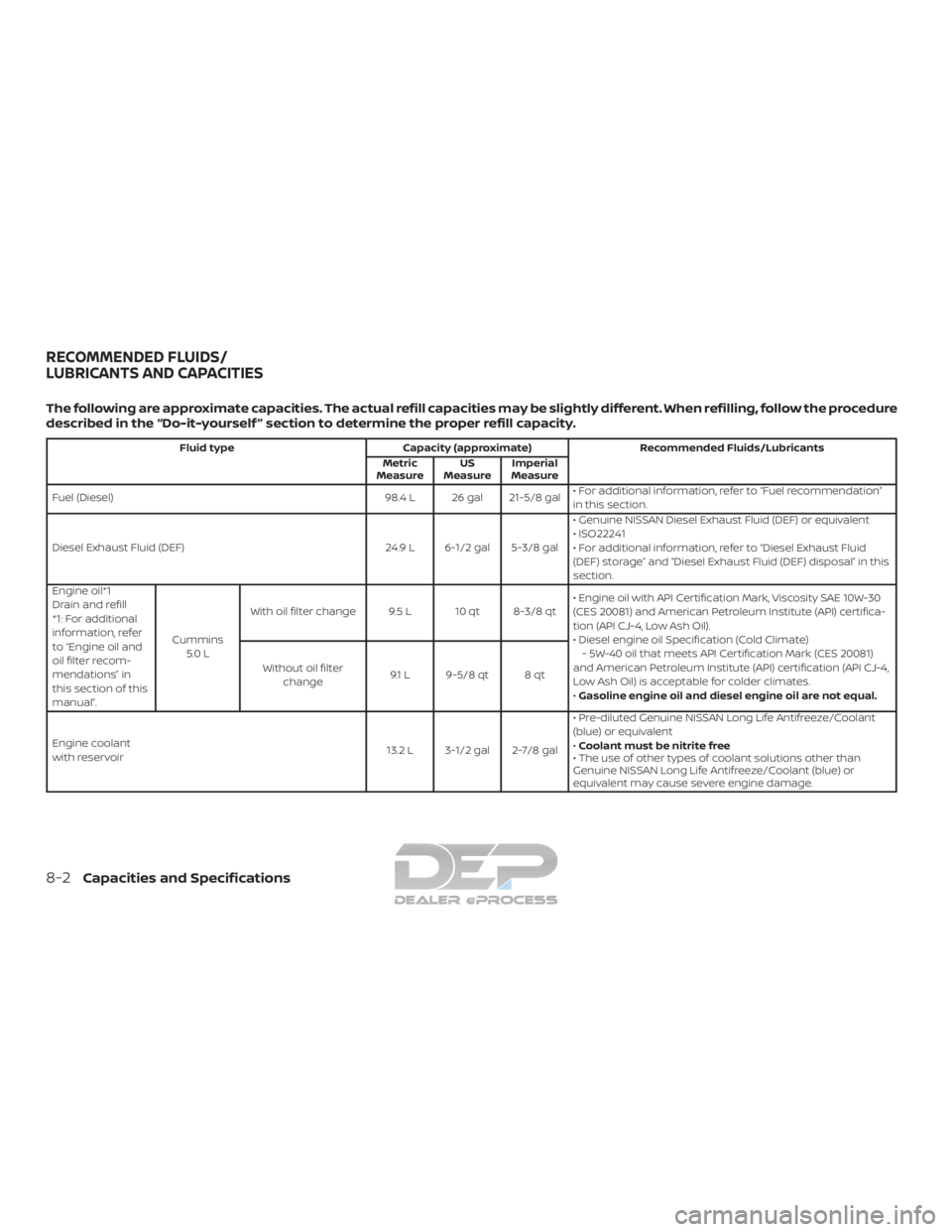
The following are approximate capacities. The actual refill capacities may be slightly different. When refilling, follow the procedure
described in the “Do-it-yourself ” section to determine the proper refill capacity.
Fluid typeCapacity (approximate) Recommended Fluids/Lubricants
Metric
Measure US
Measure Imperial
Measure
Fuel (Diesel) 98.4 L 26 gal 21-5/8 gal• For additional information, refer to “Fuel recommendation”
in this section.
Diesel Exhaust Fluid (DEF) 24.9 L 6-1/2 gal 5-3/8 gal• Genuine NISSAN Diesel Exhaust Fluid (DEF) or equivalent
• ISO22241
• For additional information, refer to “Diesel Exhaust Fluid
(DEF) storage” and “Diesel Exhaust Fluid (DEF) disposal” in this
section.
Engine oil*1
Drain and refill
*1: For additional
information, refer
to “Engine oil and
oil filter recom-
mendations” in
this section of this
manual”. Cummins
5.0 L With oil filter change 9.5 L 10 qt 8-3/8 qt
• Engine oil with API Certification Mark, Viscosity SAE 10W-30
(CES 20081) and American Petroleum Institute (API) certifica-
tion (API CJ-4, Low Ash Oil).
• Diesel engine oil Specification (Cold Climate)
- 5W-40 oil that meets API Certification Mark (CES 20081)
and American Petroleum Institute (API) certification (API CJ-4,
Low Ash Oil) is acceptable for colder climates.
• Gasoline engine oil and diesel engine oil are not equal.
Without oil filter
change 9.1 L 9-5/8 qt 8 qt
Engine coolant
with reservoir 13.2 L 3-1/2 gal 2-7/8 gal• Pre-diluted Genuine NISSAN Long Life Antifreeze/Coolant
(blue) or equivalent
•
Coolant must be nitrite free
• The use of other types of coolant solutions other than
Genuine NISSAN Long Life Antifreeze/Coolant (blue) or
equivalent may cause severe engine damage.
RECOMMENDED FLUIDS/
LUBRICANTS AND CAPACITIES
8-2Capacities and Specifications