Page 607 of 682
– Never smoke or allow sparks orflames (such as pilot lights, electri-
cal switches, or welding equip-
ment) in the work area. Never allow
diesel fuel to spill onto a hot ex-
haust manifold which can cause a
fire.
∙ Depending on the circumstance, die- sel fuel is flammable. When inspect-
ing or performing service or repairs
on the fuel system, to reduce the pos-
sibility of fire and resulting severe
personal injury, death, or property
damage, never smoke or allow sparks
or flames (such as pilot lights, electri-
cal switches, or welding equipment) in
the work area.
∙ Do not vent the fuel system on a hot engine; this can cause fuel to spill
onto a hot exhaust manifold, which
can cause a fire.
∙ Batteries can emit explosive gases. To reduce the possibility of personal in-
jury, always ventilate the compart-
ment before servicing the batteries.
To reduce the possibility of arcing, re-
move the negative (-) battery cable
first and attach the negative (-) bat-
tery cable last. ∙ When using a steam cleaner, wear
safety glasses or a face shield, as well
as protective clothing. Hot steam can
cause serious personal injury.
∙ Wear appropriate eye and face pro- tection when using compressed air.
Flying debris and dirt can cause per-
sonal injury.
CAUTION
Clean all around the filter area before
disassembly. Dirt or contaminants can
damage the fuel system.
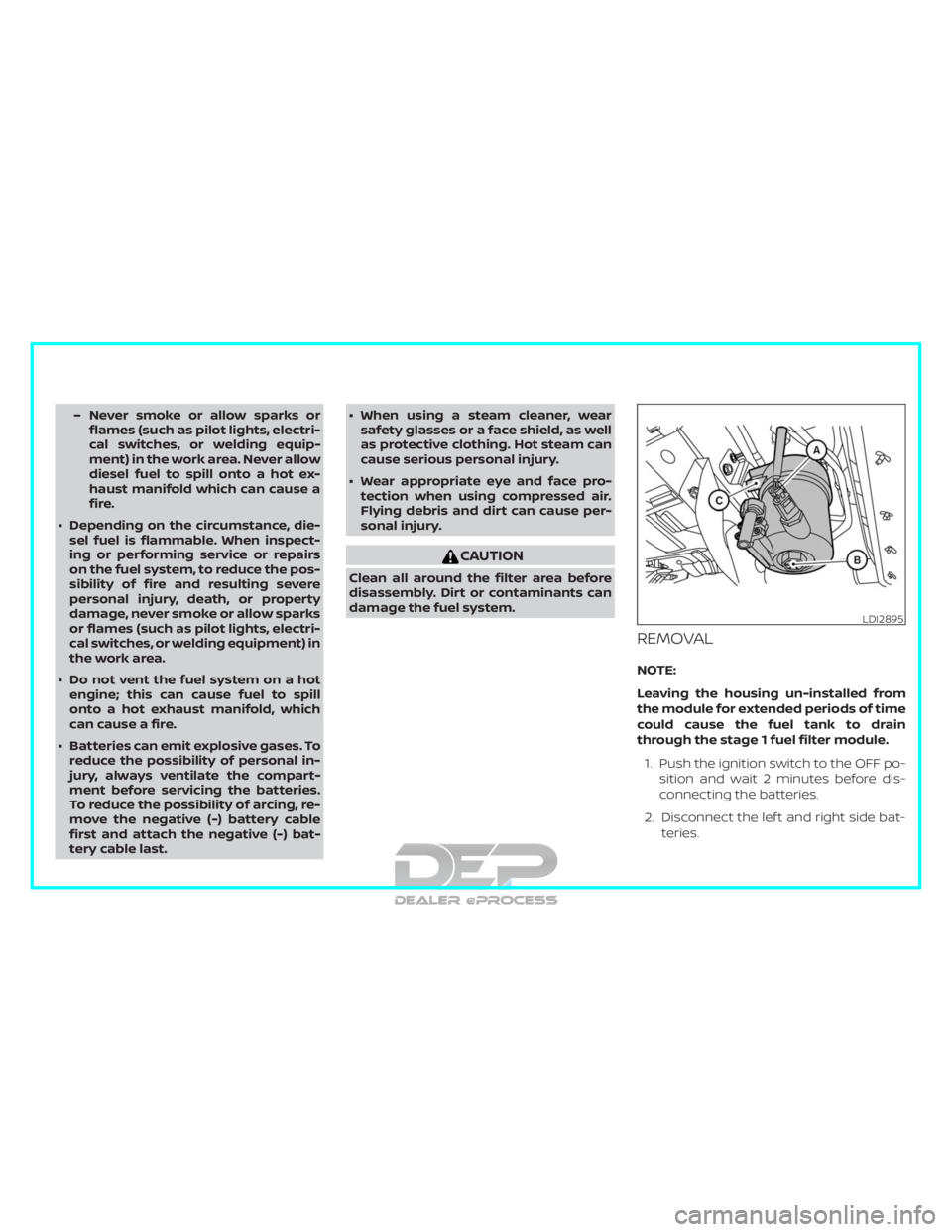
REMOVAL
NOTE:
Leaving the housing un-installed from
the module for extended periods of time
could cause the fuel tank to drain
through the stage 1 fuel filter module.
1. Push the ignition switch to the OFF po- sition and wait 2 minutes before dis-
connecting the batteries.
2. Disconnect the lef t and right side bat- teries.
LDI2895
Page 611 of 682
∙If the “Low Fuel Pressure: See Owner’s
Manual” message is displayed on the
vehicle information display with the
engine running, complete a full key
cycle (turn the vehicle off and wait
2 minutes) and restart the vehicle. If
the message is still displayed or the
Malfunction Indicator Light is illumi-
nated af ter a full key cycle , it is rec-
ommended that you visit a NISSAN
dealer for service.
∙ For additional information on the lo-
cation of the fuel filter (stage 2), refer
to the “Engine compartment check
locations” in this section.
WARNING
∙ The fuel system (fuel pump, high pres- sure fuel lines, fuel rail, injectors) con-
tain very high pressure fuel. To avoid
the risk of personal injury or fire;
– Do not loosen any fittings while the engine is running.
– Wait at least 10 minutes af ter shut- ting down the engine before loos-
ening any fittings in the high-
pressure fuel system to allow
pressure to decrease to a lower
level. – Wear appropriate eye protection
and protective equipment as high-
pressure fuel spray can penetrate
the skin.
– Never smoke or allow sparks or flames (such as pilot lights, electri-
cal switches, or welding equip-
ment) in the work area. Never allow
diesel fuel to spill onto a hot ex-
haust manifold which can cause a
fire.
∙ Batteries can emit explosive gases. To reduce the possibility of personal in-
jury, always ventilate the compart-
ment before servicing the batteries.
To reduce the possibility of arcing, re-
move the negative (-) battery cable
first and attach the negative (-) bat-
tery cable last.
∙ When using a steam cleaner, wear safety glasses or a face shield, as well
as protective clothing. Hot steam can
cause serious personal injury.
∙ Wear appropriate eye and face pro- tection when using compressed air.
Flying debris and dirt can cause per-
sonal injury.
CAUTION
Clean all around the filter area before
disassembly. Dirt or contaminants can
damage the fuel system.
REMOVAL
WARNING
∙ Depending on the circumstance, fuelis flammable. When inspecting or per-
forming service or repairs on the fuel
system, to reduce the possibility of
fire and resulting severe personal in-
jury, death, or property damage, never
smoke or allow sparks or flames (such
as pilot lights, electrical switches, or
welding equipment) in the work area.
∙ Do not bleed the fuel system of a hot engine; this can result in fuel spilling
onto a hot exhaust manifold, which
can cause a fire.
1. Push the ignition switch to the OFF po- sition and wait 2 minutes before dis-
connecting the battery.
2. Disconnect the lef t and right side bat- teries.
Page 612 of 682
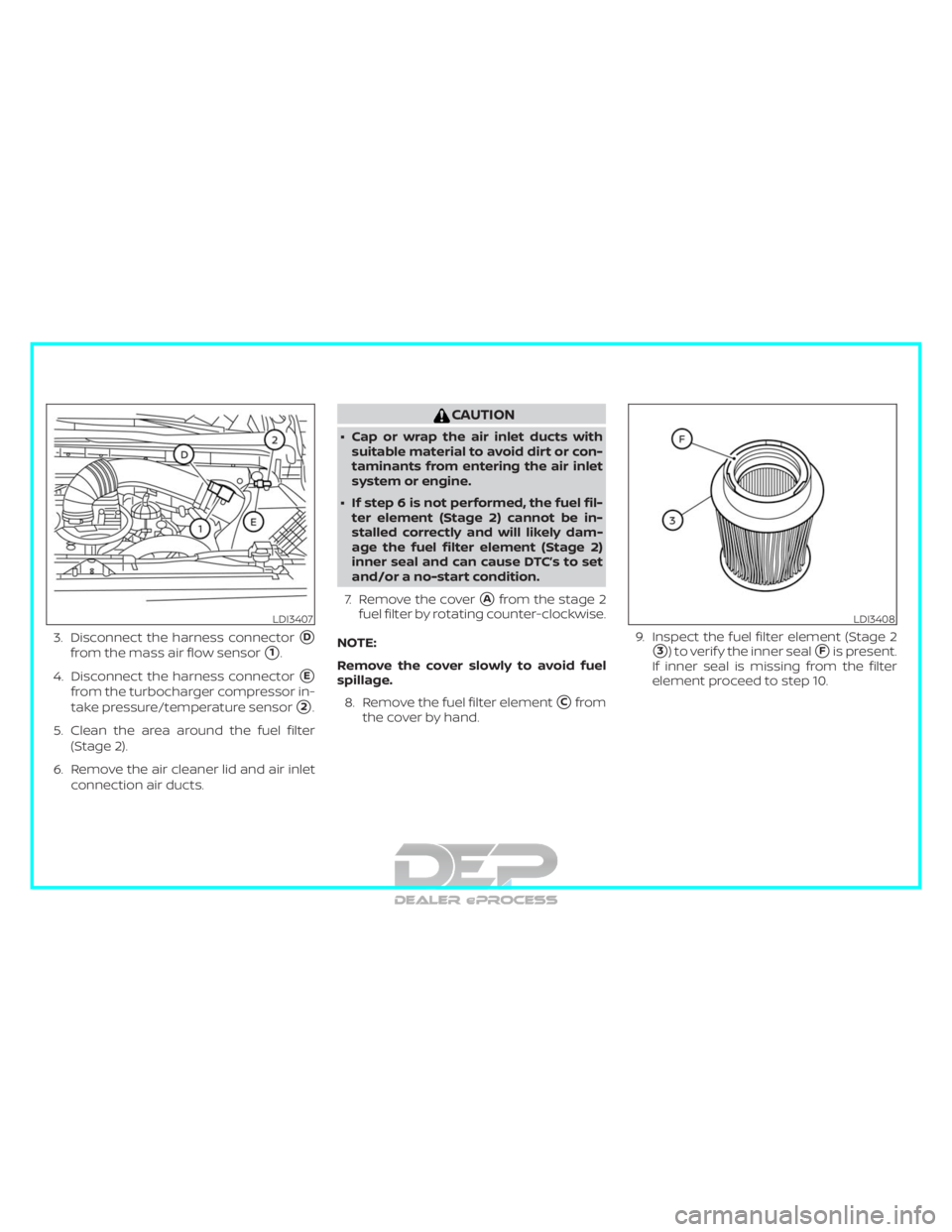
3. Disconnect the harness connector�D
from the mass air flow sensor�1.
4. Disconnect the harness connector
�E
from the turbocharger compressor in-
take pressure/temperature sensor
�2.
5. Clean the area around the fuel filter (Stage 2).
6. Remove the air cleaner lid and air inlet connection air ducts.
CAUTION
∙ Cap or wrap the air inlet ducts withsuitable material to avoid dirt or con-
taminants from entering the air inlet
system or engine.
∙ If step 6 is not performed, the fuel fil- ter element (Stage 2) cannot be in-
stalled correctly and will likely dam-
age the fuel filter element (Stage 2)
inner seal and can cause DTC’s to set
and/or a no-start condition.
7. Remove the cover
�Afrom the stage 2
fuel filter by rotating counter-clockwise.
NOTE:
Remove the cover slowly to avoid fuel
spillage. 8. Remove the fuel filter element
�Cfrom
the cover by hand. 9. Inspect the fuel filter element (Stage 2
�3) to verif y the inner seal�Fis present.
If inner seal is missing from the filter
element proceed to step 10.
LDI3407LDI3408
Page 614 of 682

13. Lubricate the inner seal on the fuel filterelement with petroleum jelly or white
lithium grease.
14. Install the fuel filter element onto the standpipe in the fuel filter housing.
CAUTION
∙ Do not install the fuel filter elementinto the fuel filter lid first or the fuel
filter element may be damaged dur-
ing installation into the housing. ∙ Be sure the fuel filter element is
seated in the housing by pushing
downward on the top of the element.
If the fuel filter element is not fully
seated in the housing af ter installa-
tion, the engine can fail to start
and/or set low fuel pressure Diagno-
sis Trouble Codes (DTCs).
NOTE:
It is possible Diagnosis Trouble Codes
(DTCs) may be stored af ter fuel filter ele-
ment replacement due to air introduced
in the system. Make sure to run the en-
gine until air is purged. If the engine fails
to start and/or set low fuel pressure
warning, illuminate it is recommended
that you visit a NISSAN dealer or other
qualified technician.
15. Install and tighten the cover.
Cover tightening torque: 18 f t-lb (25 N·m)
16. Install the air cleaner lid and air inlet connection air ducts.
17. Connect the lef t and right side batter- ies. 18. Prime the fuel system. For additional
information, refer to “Fuel system prim-
ing” in this section.
LDI2894
Page 615 of 682
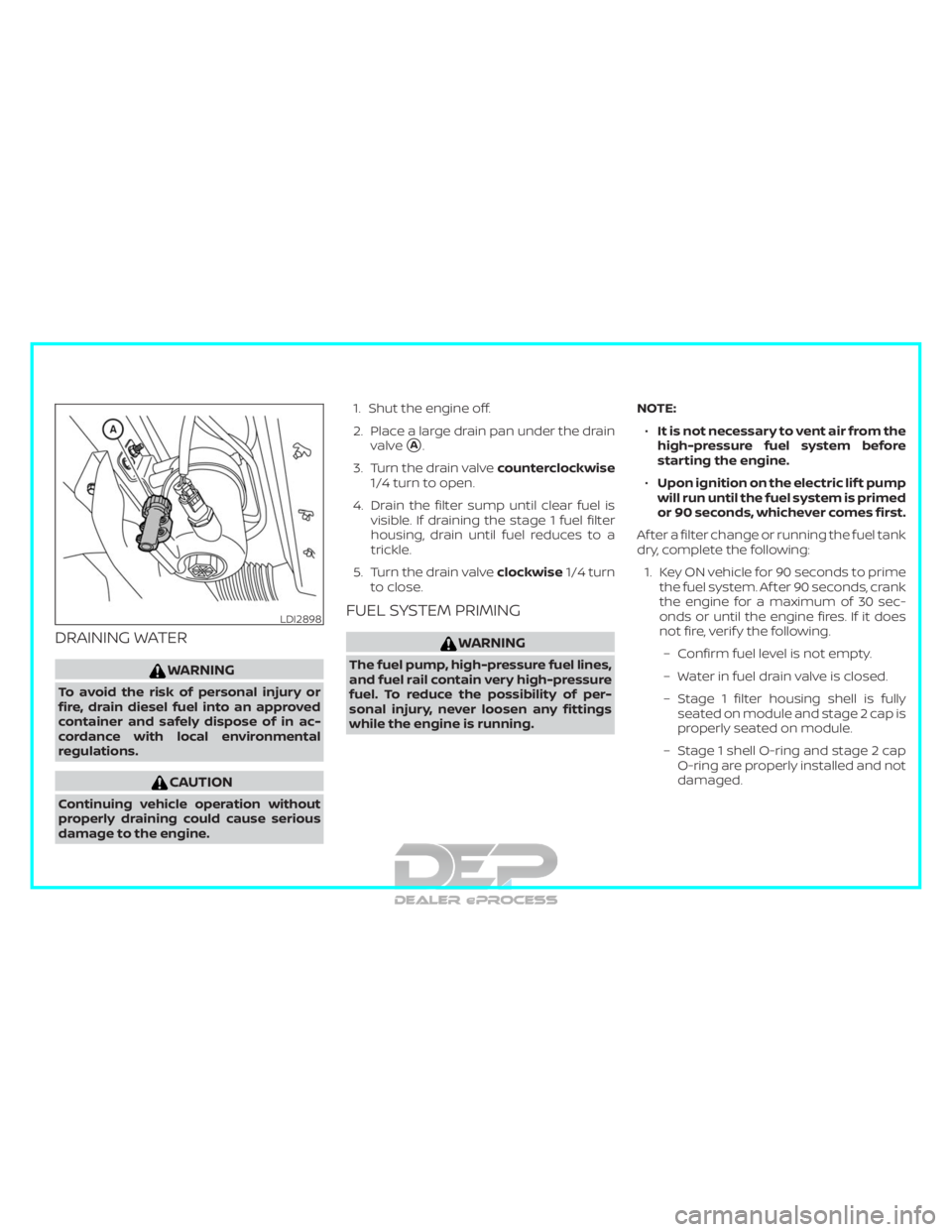
DRAINING WATER
WARNING
To avoid the risk of personal injury or
fire, drain diesel fuel into an approved
container and safely dispose of in ac-
cordance with local environmental
regulations.
CAUTION
Continuing vehicle operation without
properly draining could cause serious
damage to the engine.1. Shut the engine off.
2. Place a large drain pan under the drain
valve
�A.
3. Turn the drain valve counterclockwise
1/4 turn to open.
4. Drain the filter sump until clear fuel is visible. If draining the stage 1 fuel filter
housing, drain until fuel reduces to a
trickle.
5. Turn the drain valve clockwise1/4 turn
to close.
FUEL SYSTEM PRIMING
WARNING
The fuel pump, high-pressure fuel lines,
and fuel rail contain very high-pressure
fuel. To reduce the possibility of per-
sonal injury, never loosen any fittings
while the engine is running. NOTE:
∙ It is not necessary to vent air from the
high-pressure fuel system before
starting the engine.
∙ Upon ignition on the electric lif t pump
will run until the fuel system is primed
or 90 seconds, whichever comes first.
Af ter a filter change or running the fuel tank
dry, complete the following: 1. Key ON vehicle for 90 seconds to prime the fuel system. Af ter 90 seconds, crank
the engine for a maximum of 30 sec-
onds or until the engine fires. If it does
not fire, verif y the following.
– Confirm fuel level is not empty.
– Water in fuel drain valve is closed.
– Stage 1 filter housing shell is fully seated on module and stage 2 cap is
properly seated on module.
– Stage 1 shell O-ring and stage 2 cap O-ring are properly installed and not
damaged.
LDI2898
Page 616 of 682
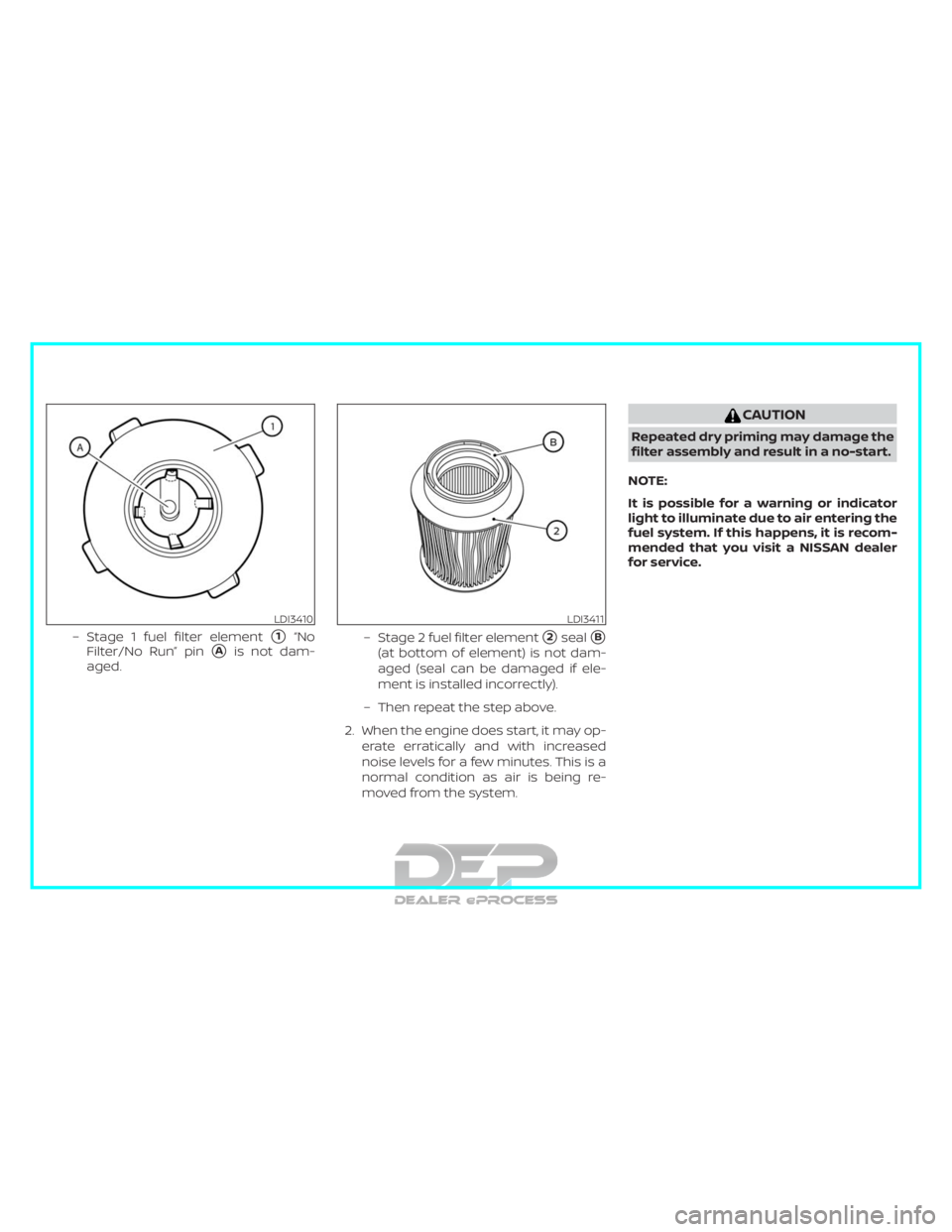
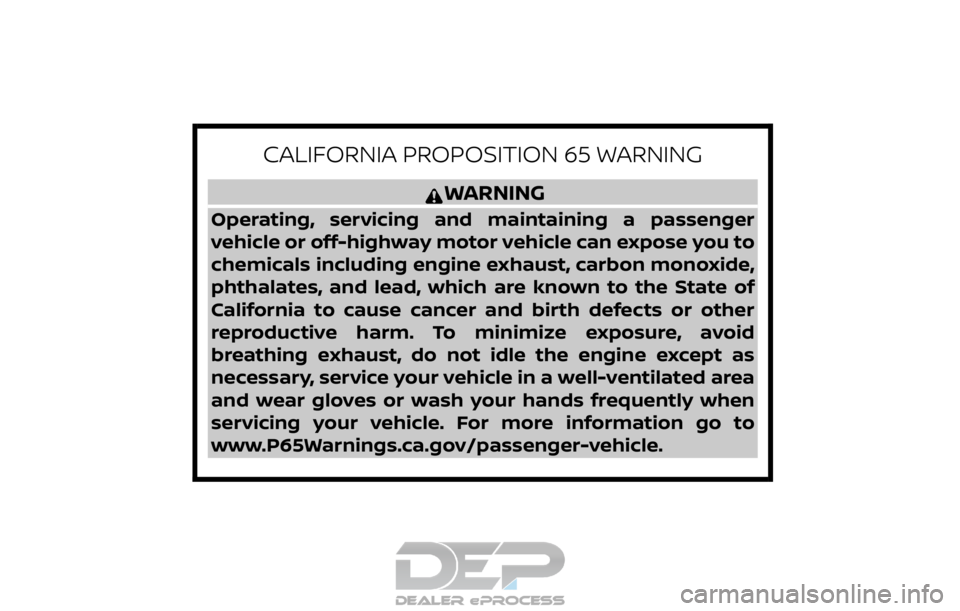
– Stage 1 fuel filter element�1“No
Filter/No Run” pin
�Ais not dam-
aged. – Stage 2 fuel filter element�2seal�B
(at bottom of element) is not dam-
aged (seal can be damaged if ele-
ment is installed incorrectly).
– Then repeat the step above.
2. When the engine does start, it may op- erate erratically and with increased
noise levels for a few minutes. This is a
normal condition as air is being re-
moved from the system.
CAUTION
Repeated dry priming may damage the
filter assembly and result in a no-start.
NOTE:
It is possible for a warning or indicator
light to illuminate due to air entering the
fuel system. If this happens, it is recom-
mended that you visit a NISSAN dealer
for service.
LDI3410LDI3411
Page 617 of 682
CALIFORNIA PROPOSITION 65 WARNING
WARNING
Operating, servicing and maintaining a passenger
vehicle or off-highway motor vehicle can expose you to
chemicals including engine exhaust, carbon monoxide,
phthalates, and lead, which are known to the State of
California to cause cancer and birth defects or other
reproductive harm. To minimize exposure, avoid
breathing exhaust, do not idle the engine except as
necessary, service your vehicle in a well-ventilated area
and wear gloves or wash your hands frequently when
servicing your vehicle. For more information go to
www.P65Warnings.ca.gov/passenger-vehicle.
Page 618 of 682
This diesel engine supplement includes in-
formation needed to correctly operate and
maintain all Cummins diesel engine sys-
tems available on this model. For addi-
tional information about vehicle specific
systems, refer to the Owner’s Manual pro-
vided with your vehicle.
All information, specifications and illustra-
tions in this manual are those in effect at
the time of printing. NISSAN reserves the
right to change specifications, perfor-
mance, design, or component suppliers
without notice and without obligation.
From time to time, NISSAN may update or
revise this manual to provide Owners with
the most accurate information currently
available. Please carefully read and retain
with this manual all revision updates sent
to you by NISSAN to ensure you have ac-
cess to accurate and up-to-date informa-
tion regarding your vehicle. Current ver-
sions of vehicle Owner’s Manuals and any
updates can also be found in the Owner
section of the NISSAN website at
https://owners.nissanusa.com/nowners/
navigation/manualsGuide.If you have questions concerning any infor-
mation in your Owner’s Manual, it is recom-
mended that you contact NISSAN Con-
sumer Affairs for this service. For additional
information, refer to the NISSAN CUS-
TOMER CARE PROGRAM page in your 2019
TITAN Owner’s Manual for contact informa-
tion.
IMPORTANT INFORMATION ABOUT
THIS MANUAL
You will see various symbols in this manual.
They are used in the following ways:
WARNING
This is used to indicate the presence of
a hazard that could cause death or seri-
ous personal injury. To avoid or reduce
the risk, the procedures must be fol-
lowed precisely.
CAUTION
This is used to indicate the presence of
a hazard that could cause minor or
moderate personal injury or damage to
your vehicle. To avoid or reduce the risk,
the procedures must be followed
carefully.
FOREWORD
WHEN READING THIS SUPPLEMENT