Page 641 of 682
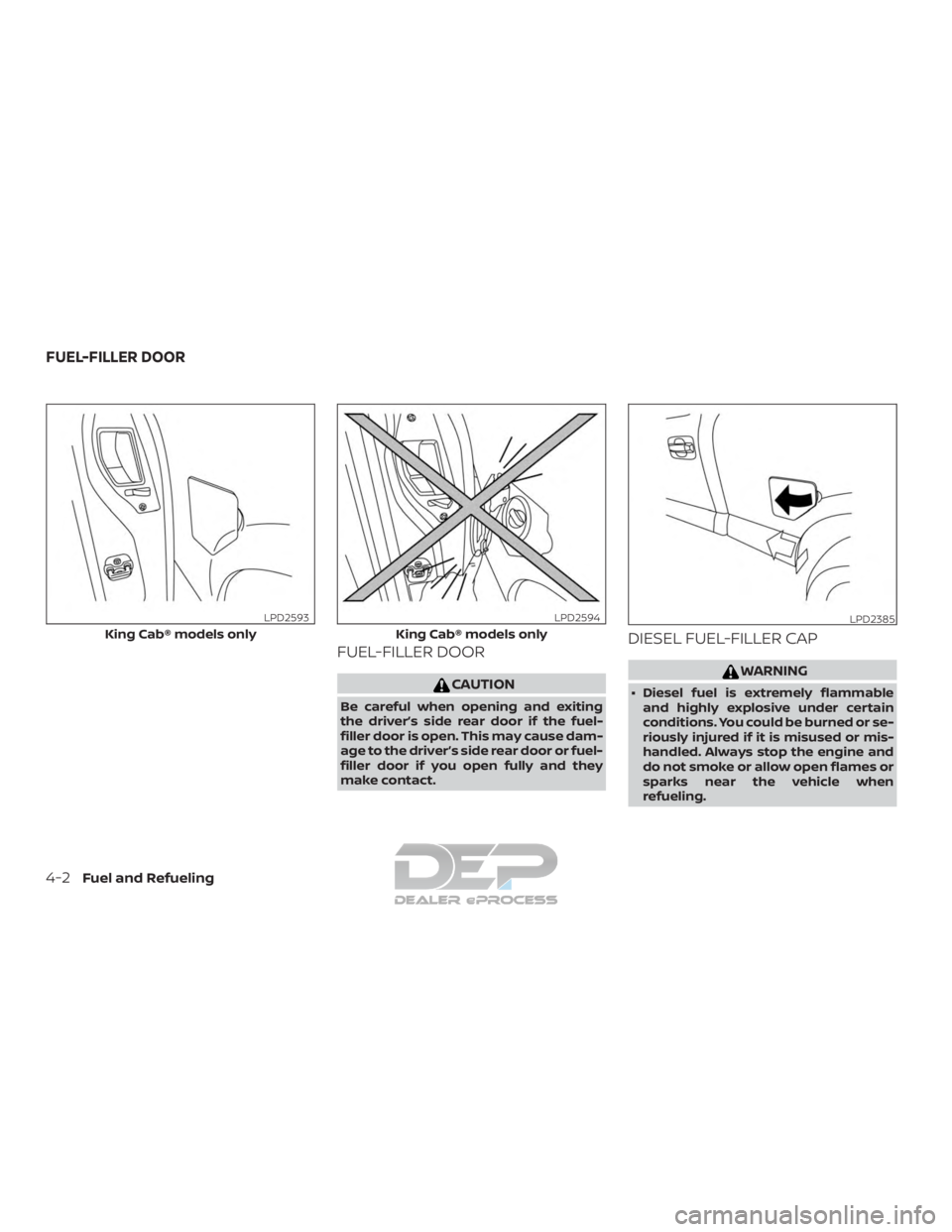
FUEL-FILLER DOOR
CAUTION
Be careful when opening and exiting
the driver’s side rear door if the fuel-
filler door is open. This may cause dam-
age to the driver’s side rear door or fuel-
filler door if you open fully and they
make contact.
DIESEL FUEL-FILLER CAP
WARNING
∙ Diesel fuel is extremely flammableand highly explosive under certain
conditions. You could be burned or se-
riously injured if it is misused or mis-
handled. Always stop the engine and
do not smoke or allow open flames or
sparks near the vehicle when
refueling.
King Cab® models only
LPD2593
King Cab® models only
LPD2594LPD2385
FUEL-FILLER DOOR
4-2Fuel and Refueling
Page 642 of 682
∙ Do not attempt to top off the fuel tankaf ter the fuel pump nozzle shuts off
automatically. Continued refueling
may cause fuel overflow, resulting in
fuel spray and possibly a fire.
∙ Use only an original equipment type fuel-filler cap as a replacement. It has
a built-in safety valve needed for
proper operation of the fuel system
and emission control system. An in-
correct cap can result in a serious mal-
function and possible injury. It could
also cause the
Malfunction Indi-
cator Light (MIL) to come on.
∙ Do not use starting fluids with this en- gine. It is equipped with an intake air
heater. The use of starting fluid could
cause an explosion, fire, personal in-
jury, system or engine damage.
∙ Do not fill a portable fuel container in the vehicle or trailer. Static electricity
can cause an explosion of flammable
liquid, vapor or gas in any vehicle or
trailer. To reduce the risk of serious
injury or death when filling portable
fuel containers:
– Always place the container on the ground when filling. – Do not use electronic devices when
filling.
– Keep the pump nozzle in contact with the container while you are
filling it.
– Use only approved portable fuel containers for flammable liquid.
CAUTION
∙ For additional information, refer tothe “Malfunction Indicator Light (MIL)”
in the “Instruments and Controls” sec-
tion of the Titan Owner’s Manual.
∙ If fuel or Diesel Exhaust Fluid (DEF) is spilled on the vehicle body, flush it
away with water to avoid paint
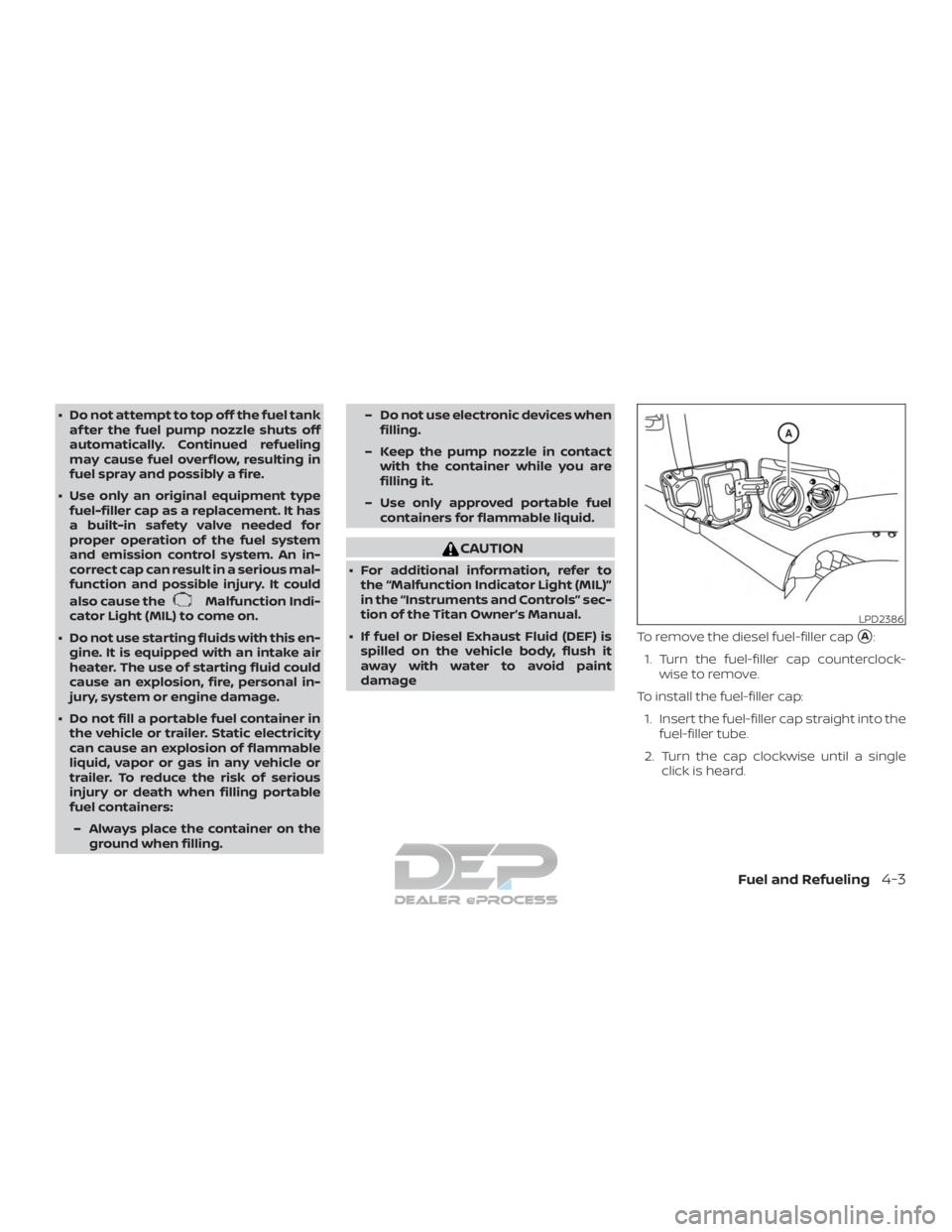
damage To remove the diesel fuel-filler cap
�A:
1. Turn the fuel-filler cap counterclock- wise to remove.
To install the fuel-filler cap: 1. Insert the fuel-filler cap straight into the fuel-filler tube.
2. Turn the cap clockwise until a single click is heard.
LPD2386
Fuel and Refueling4-3
Page 643 of 682
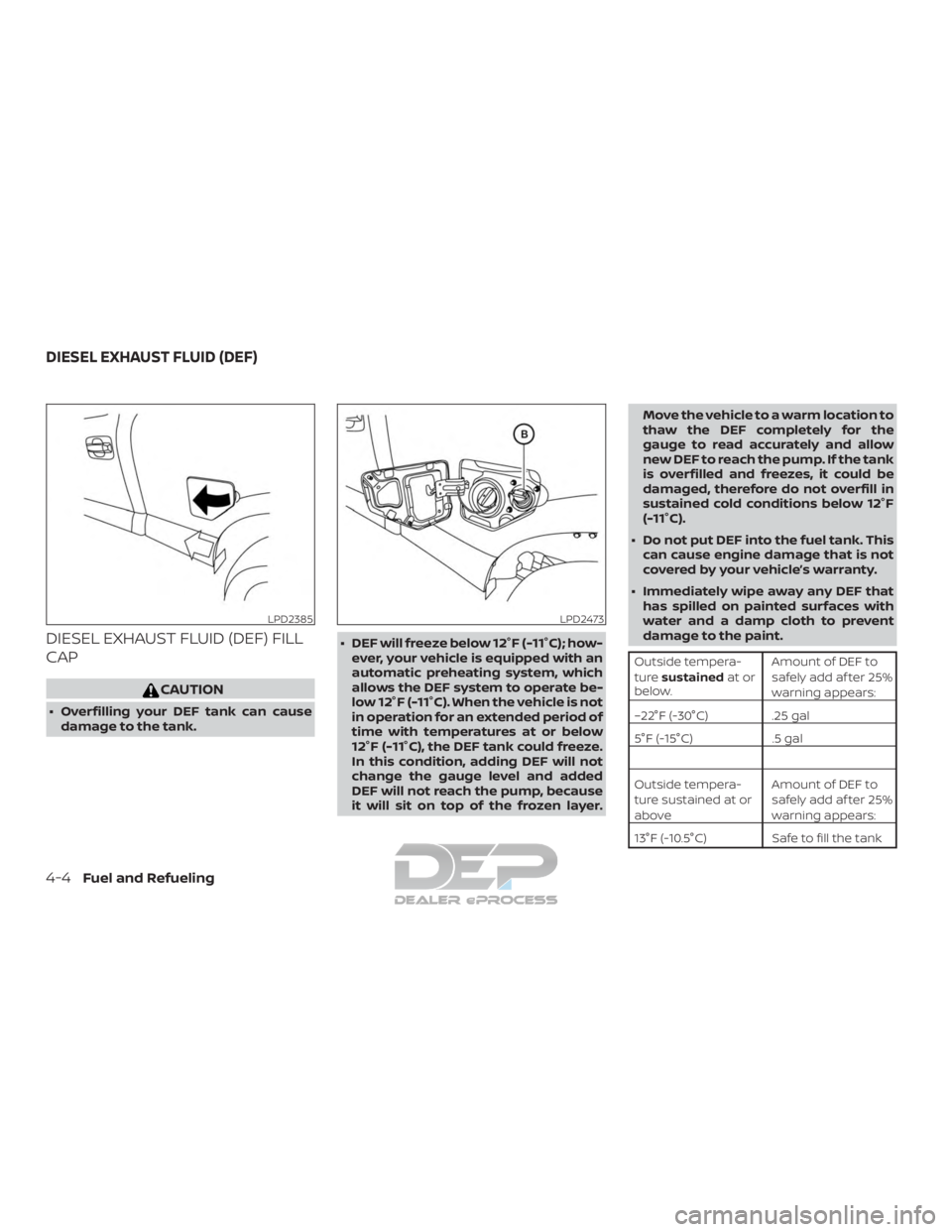
DIESEL EXHAUST FLUID (DEF) FILL
CAP
CAUTION
∙ Overfilling your DEF tank can causedamage to the tank. ∙ DEF will freeze below 12°F (-11°C); how-
ever, your vehicle is equipped with an
automatic preheating system, which
allows the DEF system to operate be-
low 12°F (-11°C). When the vehicle is not
in operation for an extended period of
time with temperatures at or below
12°F (-11°C), the DEF tank could freeze.
In this condition, adding DEF will not
change the gauge level and added
DEF will not reach the pump, because
it will sit on top of the frozen layer. Move the vehicle to a warm location to
thaw the DEF completely for the
gauge to read accurately and allow
new DEF to reach the pump. If the tank
is overfilled and freezes, it could be
damaged, therefore do not overfill in
sustained cold conditions below 12°F
(-11°C).
∙ Do not put DEF into the fuel tank. This can cause engine damage that is not
covered by your vehicle’s warranty.
∙ Immediately wipe away any DEF that has spilled on painted surfaces with
water and a damp cloth to prevent
damage to the paint.
Outside tempera-
ture sustained at or
below. Amount of DEF to
safely add af ter 25%
warning appears:
–22°F (-30°C) .25 gal
5°F (-15°C) .5 gal
Outside tempera-
ture sustained at or
above Amount of DEF to
safely add af ter 25%
warning appears:
13°F (-10.5°C) Safe to fill the tank
LPD2385LPD2473
DIESEL EXHAUST FLUID (DEF)
4-4Fuel and Refueling
Page 647 of 682
To start your engine with a booster battery,
the instructions and precautions below
must be followed.
WARNING
∙ If done incorrectly, jump starting canlead to a battery explosion, resulting
in severe injury or death. It could also
damage your vehicle.
∙ Explosive hydrogen gas is always present in the vicinity of the battery.
Keep all sparks and flames away from
the battery.
∙ Do not allow battery fluid to come into contact with eyes, skin, clothing or
painted surfaces. Battery fluid is a
corrosive sulfuric acid solution which
can cause severe burns. If the fluid
should come into contact with any-
thing, immediately flush the con-
tacted area with water.
∙ Keep battery out of the reach of children.
∙ The booster battery must be rated at 12 volts. Use of an improperly rated
battery can damage your vehicle. ∙ Whenever working on or near a bat-
tery, always wear suitable eye protec-
tors (for example, goggles or indus-
trial safety spectacles) and remove
rings, metal bands, or any other jew-
elry. Do not lean over the battery
when jump starting.
∙ Do not attempt to jump start a frozen battery. It could explode and cause
serious injury.
JUMP STARTING
5-2In Case of Emergency
Page 648 of 682
WARNING
Always follow the instructions below.
Failure to do so could result in damage
to the charging system and cause per-
sonal injury.1. If the booster battery is in another ve- hicle, position the two vehicles to bring
their batteries near each other.
Do not allow the two vehicles to
touch. 2. Apply the parking brake. Move the shif t
lever to P (Park). Switch off all unneces-
sary electrical systems (lights, heater,
air conditioner, etc.).
3. Ensure the vent caps are level and tight.
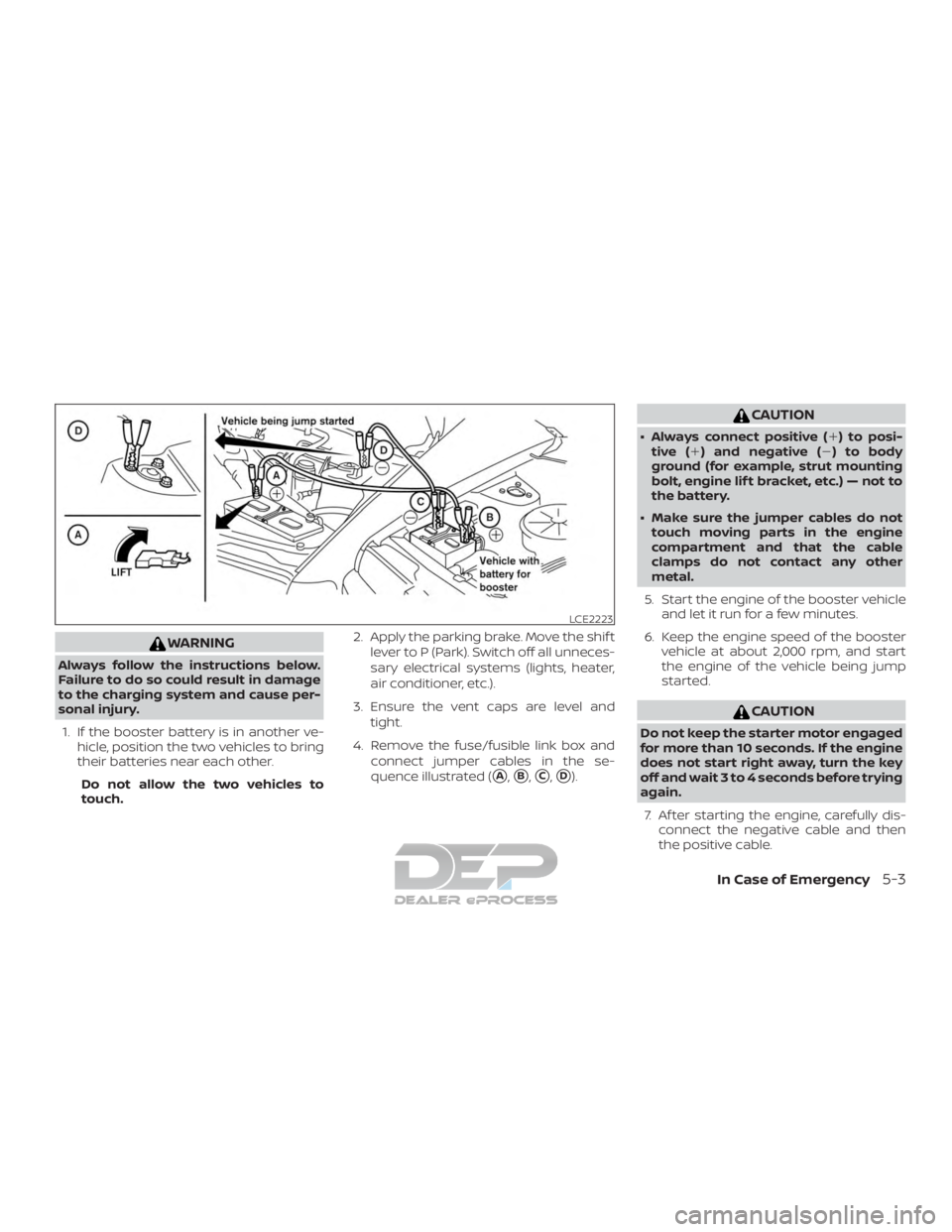
4. Remove the fuse/fusible link box and connect jumper cables in the se-
quence illustrated (
�A,�B,�C,�D).
CAUTION
∙ Always connect positive (�) to posi-tive ( �) and negative (�) to body
ground (for example, strut mounting
bolt, engine lif t bracket, etc.) — not to
the battery.
∙ Make sure the jumper cables do not touch moving parts in the engine
compartment and that the cable
clamps do not contact any other
metal.
5. Start the engine of the booster vehicle and let it run for a few minutes.
6. Keep the engine speed of the booster vehicle at about 2,000 rpm, and start
the engine of the vehicle being jump
started.
CAUTION
Do not keep the starter motor engaged
for more than 10 seconds. If the engine
does not start right away, turn the key
off and wait 3 to 4 seconds before trying
again.
7. Af ter starting the engine, carefully dis- connect the negative cable and then
the positive cable.
LCE2223
In Case of Emergency5-3
Page 650 of 682
6 Vehicle Care
Cleaning........................................6-2
Cleaning the engine ..........................6-2 Cleaning the exhaust
.........................6-2
Page 651 of 682
In order to maintain the proper operation
of a diesel engine, it is important to take
proper care of it, which includes cleaning as
indicated.
CLEANING THE ENGINE
Engines are more efficient when they are
clean because grease and dirt buildup
keep the engine warmer than normal.
When washing:∙ Take care when using a power washer to clean the engine. The high-pressure
fluid could penetrate the sealed parts
and cause damage.
∙ Do not spray a hot engine with cold wa- ter to avoid cracking the engine block or
other engine components.
∙ Spray an engine shampoo and/or degreaser on all parts that require
cleaning and pressure rinse clean.
∙ Never wash or rinse the engine while it is hot or running; water in the running
engine may cause internal damage.
∙ Never wash or rinse any control box electrical connections. ∙ Cover the battery, power distribution
box, and air filter assembly to prevent
water damage when cleaning the en-
gine.
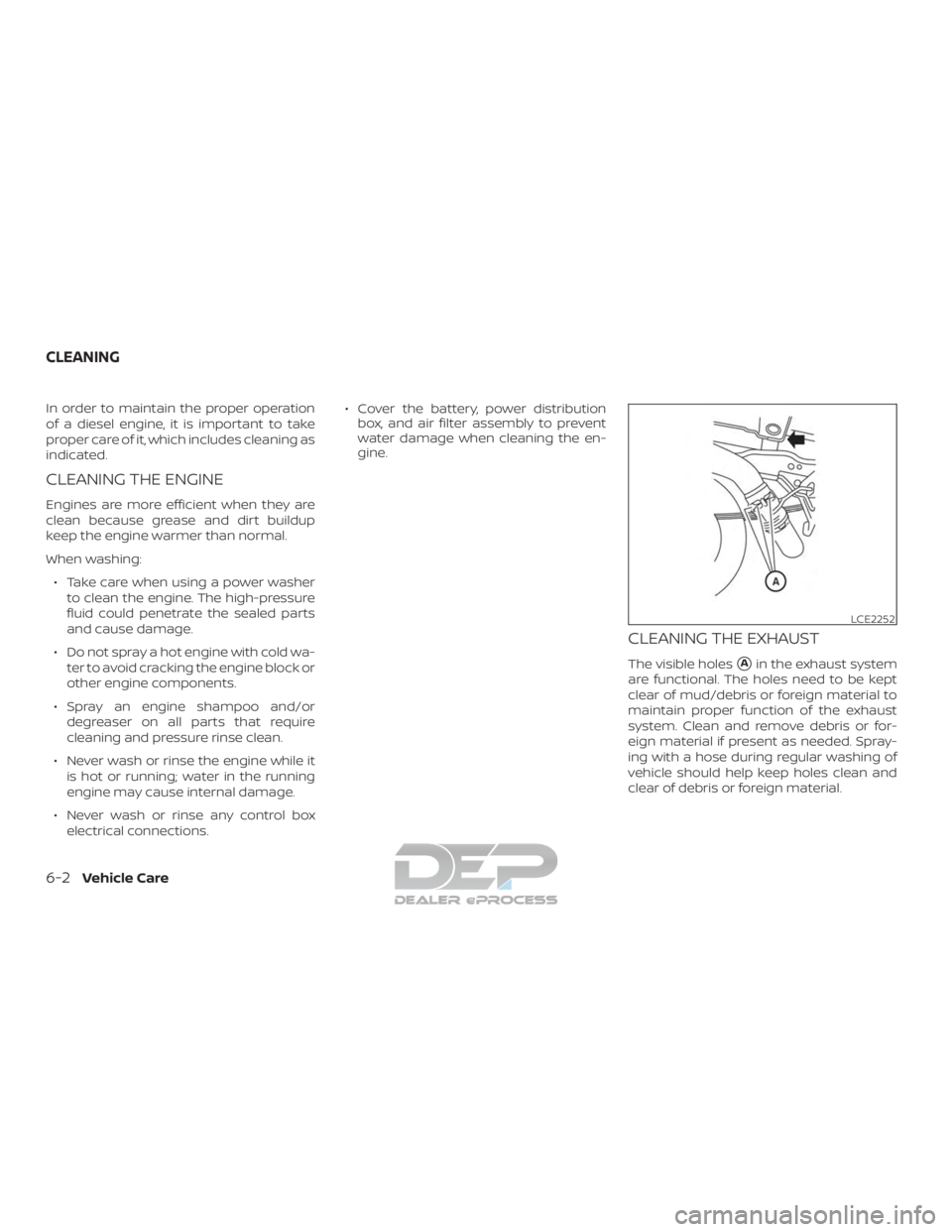
CLEANING THE EXHAUST
The visible holes�Ain the exhaust system
are functional. The holes need to be kept
clear of mud/debris or foreign material to
maintain proper function of the exhaust
system. Clean and remove debris or for-
eign material if present as needed. Spray-
ing with a hose during regular washing of
vehicle should help keep holes clean and
clear of debris or foreign material.
LCE2252
CLEANING
6-2Vehicle Care
Page 652 of 682
WARNING
∙ Failure to maintain the functionalholes in the exhaust system clean and
free of debris or foreign material may
result in the holes becoming blocked
or plugged. Do not modif y or remove
sections of the exhaust system that
contain these holes. Blocked or
plugged holesor
removal/modification of the system
could result in elevated exhaust gases
or exhaust gas temperatures which
may result in vehicle damage, per-
sonal injury or death.
∙ The normal operating temperature of the exhaust system is very high. Never
work around or attempt to repair any
part of the exhaust system until it has
cooled. Use special care when work-
ing around the diesel oxidation cata-
lytic converter and/or the diesel par-
ticulate filter (DPF). The diesel
oxidation catalytic converter and/or
the DPF heats up to a high tempera-
ture af ter only a short period of en-
gine operation and can stay hot even
af ter the engine is turned off. Failure
to follow these instructions may re-
sult in personal injury. ∙ When cleaning blocked or plugged
holes in the exhaust system, care
should be taken to minimize the
quantity of water entering the ex-
haust system. Excessive water that
enters the exhaust system could
cause damage requiring exhaust sys-
tem to be replaced.
Vehicle Care6-3