2019 MERCEDES-BENZ SPRINTER brake
[x] Cancel search: brakePage 145 of 354
DSR is in
standby mode.
R DSR is inactive:
-
as soon as youexc eed a speed of 28 mph
(45 km/h).
- DSR appears in thest atus area of the on-
board computer. In addition, theDSR Off
message appears.
- DSR - - - appears in thest atus area of the
on-board computer.
Setting the speed while driving downhill
Yo u can set the speed depending on thege ar
ra nge tobetween 2 mph (4 km/h) and 11mph
(18 km/h) using the brake and accelerator pedals
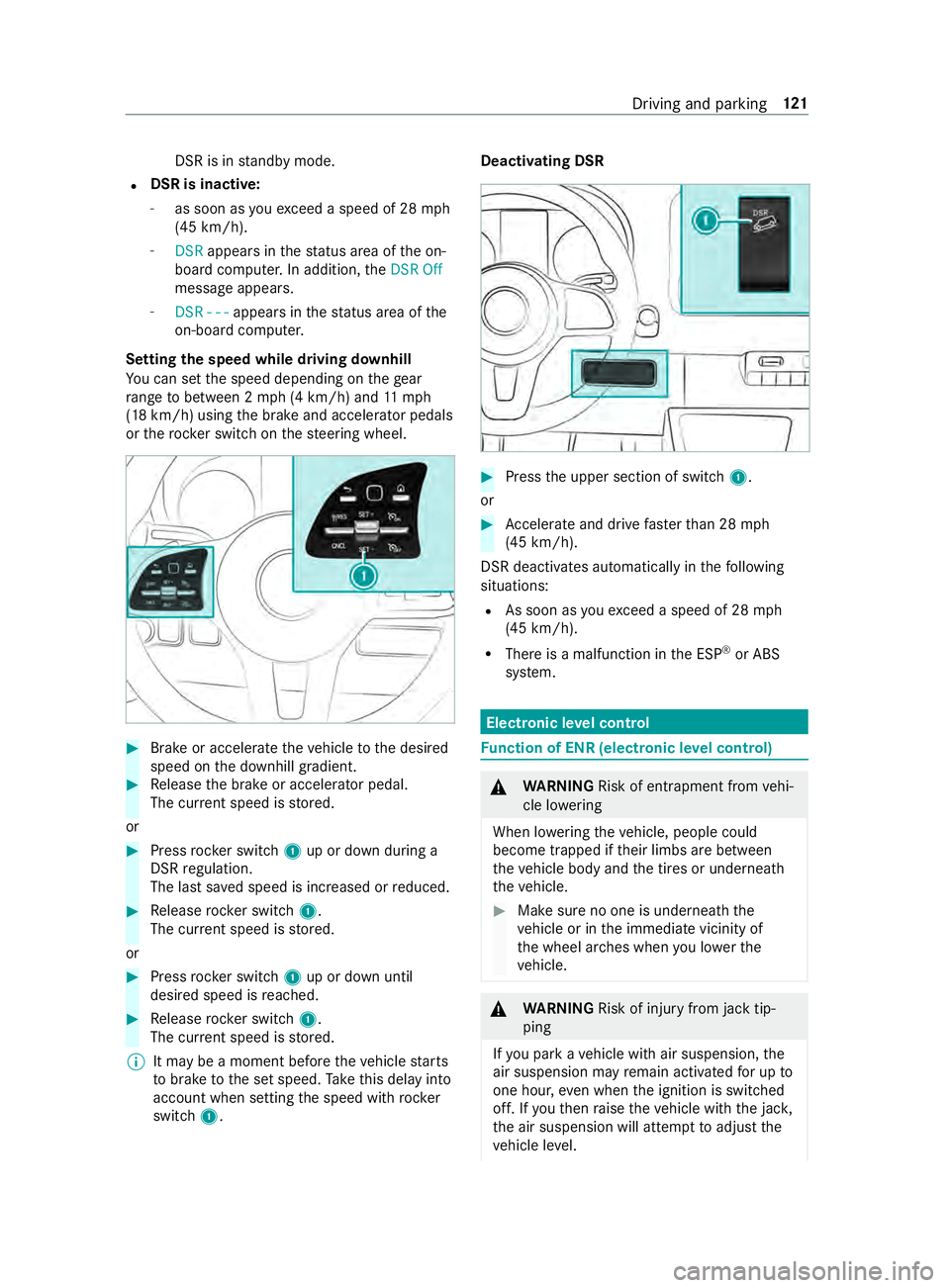
or therock er switch on thesteering wheel. #
Brake or accelerate theve hicle tothe desired
speed on the downhill gradient. #
Release the brake or accelera tor pedal.
The cur rent speed is stored.
or #
Press rocker switch 1up or down during a
DSR regulation.
The last sa ved speed is increased or reduced. #
Release rocker switch 1.
The cur rent speed is stored.
or #
Press rocker switch 1up or down until
desired speed is reached. #
Release rocker switch 1.
The cur rent speed is stored.
% It may be a moment before
theve hicle starts
to brake tothe set speed. Take this delay into
account when setting the speed with rock er
switch 1. Deactivating DSR
#
Press the upper section of switch 1.
or #
Accele rate and drive fasterthan 28 mph
(45 km/h).
DSR deactivates automatically in thefo llowing
situations:
R As soon as youexc eed a speed of 28 mph
(45 km/h).
R There is a malfunction in the ESP ®
or ABS
sy stem. Electronic le
vel control Fu
nction of ENR (electronic le vel control) &
WARNING Risk of entrapment from vehi‐
cle lo wering
When lo wering theve hicle, people could
become trapped if their limbs are between
th eve hicle body and the tires or underneath
th eve hicle. #
Make sure no one is underneath the
ve hicle or in the immediate vicinity of
th e wheel ar ches when you lo werthe
ve hicle. &
WARNING Risk of inju ryfrom jack tip‐
ping
If yo u park a vehicle with air suspension, the
air suspension may remain activated for up to
one hour, even when the ignition is switched
off. If youth en raise theve hicle with the jac k,
th e air suspension will attem pttoadjust the
ve hicle le vel. Driving and parking
121
Page 146 of 354
The jack may tip.
#
Press the Service button on the air sus‐
pension remo tecontrol before raising
th eve hicle.
This pr events au tomatic readjustment
of theve hicle le vel and pr events it from
being raised or lo wered manually. &
WARNING Risk of accident due tolow‐
ered or raised chassis
Driving with a lo wered or raised chassis may
greatly impair braking and handling charac‐
te rist ics. You may also exceed the permissible
ve hicle height when thech assis is raised. #
Set the driving le vel before pulling away. &
WARNING Risk of accident from mal‐
function of electronic le vel control
If elect ronic le vel control is malfunctioning,
th eve hicle le vel may be asymmetrical, too
high or too lo w.
The driving and steering characteristics of the
ve hicle may be noticeably dif fere nt. #
Adapt your driving style according lyand
drive carefull y. #
Stop, paying attention toroad and traf‐
fi c conditions. #
Consult a qualified specialist workshop. *
NO
TERisk of damage tothech assis from
lo we redve hicle le vel If electronic le
vel control is malfunctioning or
re adjusts while you are driving, theve hicle
le ve l may be lo wered. #
Pay attention tothero ad conditions and
ensure there is suf ficient ground clear‐
ance. #
Drive carefully. The le
vel of theve hicle depends on vehicle load
and the load distribution. Elect ronic le vel control
adjusts the le vel of there ar axle automatically on
ve hicles with an air-sprung rear axle. The vehicle
le ve l is thereby alw ays maintained at the driving
le ve l,re ga rdless of vehicle load. Driving dynamics
re main unaf fected. The height dif fere nce
between the sides of theve hicle may be up to
0.4 in (1 cm). Electronic le
vel control is not engine-dependent
and is only operational when the ignition is
switched on. The electronic le vel control com‐
pressor works audibl y.
% If
th e compressor works cons tantly or starts
up se veral times per minute, elect ronic le vel
control is malfunctioning.
Depending on theve hicle equipment, electronic
le ve l control switches between manual and auto‐
matic mode depending on either theve hicle
speed or the position of the parking brake.
If electronic le vel control switches depending on
ve hicle speed, manual operation is automatically
activated when theve hicle is stationar y.Yo u may
ra ise or lo werth eve hicle le vel. If you subse‐
qu ently drive faster than 6 mph (10 km/h), man‐
ual mode is automatically deactivated and auto‐
matic mode sets theve hicle le vel.
If elect ronic le vel control switches depending on
th e parking brake position, manual mode is auto‐
matically activated when the parking brake is
applied. You may raise or lo werth eve hicle le vel
to load and unload. If youre lease the parking
brake, manual mode is automatically deactivated
and automatic mode sets the driving le vel.
When working on theve hicle or changing a
wheel, you can deactivate electronic le vel control
(/ page 123).
If electronic le vel control is malfunctioning or the
ve hicle le vel is too high or too lo w,an audible sig‐
nal sounds.
The driving and steering characteristics of the
ve hicle will be noticeably dif fere nt. Electronic
le ve l control adjusts theve hicle le velto the nor‐
mal le vel as soon as possible. Continue driving
carefully until the audible signal stops. Only then
is theve hicle at normal le vel.
Au tomatic mode and electronic le vel control
automatically switch on again torestore theve hi‐
cle le vel, depending on the option selected:
R when the parking brake is released
R from speeds of appr oximately 6 mph
(10 km/h)
If th e electronic le vel control compressor thre at‐
ens to ov erheat, e.g. due torepeated raising or
lo we ring wi thin a short period, elect ronic le vel
control is deactivated. You can raise or lo werthe
ve hicle le vel again af ter appro ximately
one minu te. 12 2
Driving and pa rking
Page 147 of 354
Ra
ising and lo weringtheve hicle le vel Using
there mo tecontrol
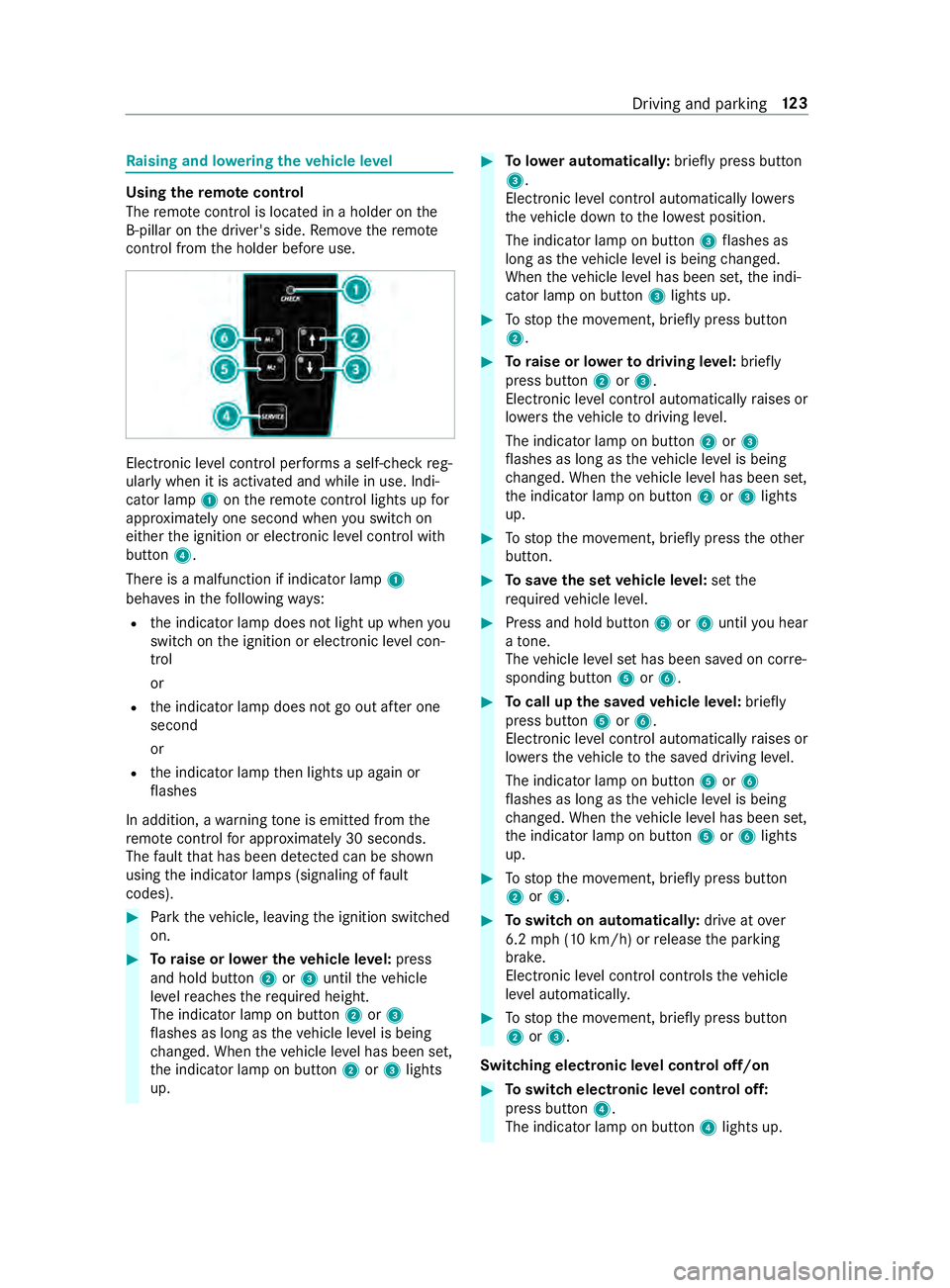
The remo tecontrol is loca ted in a holder on the
B‑pillar on the driver's side. Remo vethere mo te
control from the holder before use. Elect
ronic le vel control per form s a self-check reg‐
ularly when it is activated and while in use. Indi‐
cator lamp 1onthere mo tecontrol lights up for
appr oximately one second when you swit chon
either the ignition or electronic le vel control with
button 4.
There is a malfunction if indicator lamp 1
beha ves in thefo llowing ways:
R the indicator lamp does not light up when you
switch on the ignition or electronic le vel con‐
trol
or
R the indicator lamp does not go out af ter one
second
or
R the indicator lamp then lights up again or
fl ashes
In addition, a warning tone is emitted from the
re mo tecontrol for appro ximately 30 seconds.
The fault that has been de tected can be shown
using the indicator lamps (signaling of fault
codes). #
Park theve hicle, leaving the ignition switched
on. #
Toraise or lo wer the vehicle le vel:press
and hold button 2or3 until theve hicle
le ve lre aches therequ ired height.
The indicator lamp on button 2or3
fl ashes as long as theve hicle le vel is being
ch anged. When theve hicle le vel has been set,
th e indicator lamp on button 2or3 lights
up. #
Tolowe r automatical ly:brie fly press but ton
3 .
Electronic le vel control automatically lo wers
th eve hicle down tothe lo west position.
The indicator lamp on button 3flashes as
long as theve hicle le vel is being changed.
When theve hicle le vel has been set, the indi‐
cator lamp on button 3lights up. #
Tostop the mo vement, brief lypress button
2. #
Toraise or lo werto driving le vel:brief ly
press button 2or3.
Elect ronic le vel control automatically raises or
lo we rstheve hicle todriving le vel.
The indicator lamp on button 2or3
fl ashes as long as theve hicle le vel is being
ch anged. When theve hicle le vel has been set,
th e indicator lamp on button 2or3 lights
up. #
Tostop the mo vement, brief lypress theot her
button. #
Tosave the set vehicle le vel:set the
re qu ired vehicle le vel. #
Press and hold button 5or6 until you hear
a to ne.
The vehicle le vel set has been sa ved on cor re‐
sponding button 5or6. #
Tocall up the sa vedve hicle le vel:briefly
press button 5or6.
Electronic le vel control automatically raises or
lo we rstheve hicle tothe sa ved driving le vel.
The indicator lamp on button 5or6
fl ashes as long as theve hicle le vel is being
ch anged. When theve hicle le vel has been set,
th e indicator lamp on button 5or6 lights
up. #
Tostop the mo vement, brief lypress button
2 or3. #
Toswitch on automaticall y:drive at over
6.2 mph (10 km/h) or release the parking
brake.
Elect ronic le vel control controls theve hicle
le ve l automaticall y. #
Tostop the mo vement, brief lypress button
2 or3.
Switching electronic le vel control off/on #
Toswitch electronic le vel control off:
press button 4.
The indicator lamp on button 4lights up. Driving and parking
12 3
Page 148 of 354

#
Toswitch electronic le vel control on
again: press button 4again.
The indicator lamp on button 4goes out.
Using the but ton in the control panel #
Park theve hicle, leaving the ignition switched
on. #
Tolowe r automatical ly:brie fly press the
lo we r section of switch 2.
Electronic le vel control automatically lo wers
th eve hicle. #
Tostop the mo vement, brief lypress the upper
section of switch 1. #
Toraise todriving le vel:briefly press the
upper section of swit ch1.
Electronic le vel control automatically raises
th eve hicle tothe driving le vel. #
Tostop the mo vement, brief lypress the lo wer
section of switch 2. #
Toswitch on automaticall y:drive at over
6.2 mph (10 km/h) or release the parking
brake.
Elect ronic le vel control controls theve hicle
le ve l automaticall y. Using electronic le
vel control forch arging
with air in an emer gency Only
forve hicles with valves for electronic le vel
control emergency charging. If electronic le velcontrol is malfunctioning and
theve hicle is lean‐
ing, you can raise or lo werth eve hicle bycon‐
necting an extern al compressed-air source toone
of the emer gency valves (tire valves). If elect ronic
le ve l control is deactivated, you can drive on
carefully tothe nearest qualified specialist work‐
shop and ha vethe malfunction remedied.
* NO
TEDama gedue topressure being too
high If
th e pressure in the air suspension bello ws
is too high, the compressed-air lines or the air
suspension bello wsmay be dama ged. #
Ensure you obse rveth e maximum per‐
missible operating pressure of 600 kPa
(6 bar/87 psi). #
Apply the parking brake. #
Vehicles with automatic transmission:
shift the transmission toposition 005D. #
Switch off electronic le vel control
(/ page 123). #
Switch off the engine and open the hood
(/ page 202). #
Unscr ewtheva lve cap of the cor responding
va lve. #
Connect theex tern al compressed-air source. #
Raise or lo werth eve hicle le velby charging or
re leasing compressed air until the driving
le ve l has been reached and theve hicle is in a
horizontal position. While doing so, ensure
yo u obse rveth e maximum permissible oper‐
ating pressure of 600 kPa (6 bar/87 psi). #
Disconnect theex tern al compressed-air
source. #
Tighten theva lve caps on theva lves. #
Close the hood (/ page 202). #
Drive on carefully tothe nearest qualified
specialist workshop. 124
Driving and pa rking
Page 151 of 354

%
Ve
hicles with a diesel engine and incor‐
re ct fueling pr otector against refueling
with gasoline: thefiller neck is designed for
re fueling at diesel filling pumps for passenger
ve hicles. %
Ve
hicles with a diesel engine without
incor rect fueling pr otector: you can also
re fuel at a diesel filling pump for truc ks.
% If
th e fuel tank has been run comple tely dr y,
add at least 1.3 ga l (5 l) of fuel. Problems with
the fuel and fuel tank Problem
Possible causes/consequences and 0050 0050Solutions
Fu el is leaking from the
ve hicle. The fuel line or
the fuel tank is de fective. #
Apply the parking brake. #
Switch off the engine. #
Remo vetheke y from the ignition loc k.
Or, on vehicles with KEYLESS‑GO: #
Open the driver's door.
The on-board electronics are in position 005A. This corresponds tothe
"k ey remo ved". #
Do not restart the engine under any circums tances. #
Consult a qualified specialist workshop.
The engine does not
st art. The fuel
tank has been run comple tely dr y. #
Refuel theve hicle with at least 1.3 ga l (5 l) of fuel. #
Swit chthe ignition on for appro ximately ten seconds. #
Start the engine continuously for a maximum of ten seconds until it
ru ns smo othly.
If th e engine does not star t: #
Switch the ignition on for appro ximately ten seconds. #
Start the engine continuously for a maximum of ten seconds until it
ru ns smo othly.
If th e engine does not start af terth re e attem pts: #
Consult a qualified specialist workshop. DEF
Note
s on DEF
* NO
TEWhen you open the DEF tank,
small amounts of ammonia vapor may
escape. #
Only fill th e DEF tank in well-ventilated
areas. #
Do not let DEF come into con tact wi th
skin, eyes or clo thes. #
Keep DEF away from children. *
NO
TEDo not ingest DEF. If DEF is swallo
wed: #
Immediately rinse out your mouth thor‐
oughly. #
Drink plenty of water. #
Seek medical attention immediately. *
NO
TEDama gecaused byadditives in
DEF or bydiluting DEF The DEF
exhaust gas af tertre atment sy stem
could be destr oyed bythefo llowing:
R Additives in DEF Driving and parking
127
Page 156 of 354

Closing
the DEF filler cap on loc kable filler
caps #
Afterfilling the DEF tank, place DEF filler cap
1 onthefiller neck and tigh ten it clo ckwise. #
Remo vetool 4 from DEF filler cap 1and
st ore it in theve hicle tool kit. #
Pull co ver3 on DEF filler cap 1upover
holes 2of DEF filler cap 1, turn and
re lease. #
Turn DEF filler cap 1.
If DEF filler cap 1turns freel y,the DEF tank
is closed. Park
ing Pa
rking theve hicle &
WARNING Risk offire caused byhot
ex haust sy stem parts
Flammable material such as lea ves, grass or
twigs may ignite if they come into contact
wi th hot parts of theex haust sy stem or
ex haust gasflow. #
Park theve hicle so that no flammable
material can come into con tact wi thhot
ve hicle components. #
In particular, do not park on dry grass‐
land or har vested grain fields. &
WARNING Risk of accident and injury
due tochildren left unat tended in the
ve hicle
If ch ildren are left unat tended in theve hicle,
th ey could:
R open doo rs,th ereby endangering other
persons or road users.
R get out of theve hicle and be hit by
oncoming traf fic.
R operate ve hicle equipment and become
trapped, forex ample.
In addition, children could also set theve hicle
in motion, forex ample, by:
R releasing the parking brake.
R shifting the automatic transmission out of
park position 005D.
R starting the engine #
Never lea vechildren and animals unat‐
te nded in theve hicle. #
When leaving theve hicle, alw aysta ke
th e SmartK eywith you and lock the
ve hicle. #
Keep the SmartK eyout of there ach of
ch ildren. *
NO
TEDama getotheve hicle or the drive‐
train due torolling away #
Always park your vehicle safely and
according tolegal requirements. #
Always proper lysecure theve hicle
against rolling away. &
WARNING Risk of accident and injury if
pa rking brake is not applied
If yo u park theve hicle with the transmission
in park position 005Dand the parking brake is
not engaged, theve hicle may rollaw ay.
Engaging pa rkposition 005Dis not a fully ade‐
qu ate replacement forth e parking brake.
There is a risk of accident and injur y. #
Secu retheve hicle against rolling away
as desc ribed belo w. 13 2
Driving and pa rking
Page 157 of 354

Obser
vethefo llowing points toensure that the
ve hicle is properly secured against rolling away
unin tentionally: #
Always apply the parking brake. #
Vehicles with automatic transmission:
engage transmission position 005D.#
On uphill or downhill inclines: turnthe
front wheels towa rdsth e curb. #
On uphill or downhill inclines: securethe
re ar axle with a chock or an object without
sharp edges.
% Yo
u can operate the side windo wsforfive
minutes af teryo u ha veswitched off theve hi‐
cle. Manual parking brake
Applying/releasing
the handbrake le ver &
WARNING Risk of skidding or an acci‐
dent bybraking with the parking brake
If yo u ha vetobrake your vehicle with the
parking brake, the braking dis tance is consid‐
erab lylonger and the wheels may loc k.There
is an increased risk of skidding and/or acci‐
dent. #
Only brake theve hicle with the parking
brake if the service brake has failed. #
Inthis case, do not apply the parking
brake with too much forc e. #
Ifth e wheels loc k,immediately release
th e parking brake as much as required
fo rth e wheels toturn again. &
WARNING Risk offire and an accident if
th e parking brake is not released
If th e parking brake is not fully released when
driving, thefo llowing situations can occur:
R The parking brake can overheat and cause
a fire
R The parking brake can lose its holding
function #
Comple tely release the parking brake
before driving off. The brake lights do not light up when
you brake
th eve hicle with the parking brake.
Generally, you may only apply the parking brake
when theve hicle is stationar y. #
Toapply the pa rking brake: pull handbrake
le ve r1 up as far as the last possible de tent.
When the engine is running, the0049
and 0024 (USA) or 0024(Canada) indicator
lamps in the Instrument Display light up. If
th eve hicle is in motion, a warning tone
sounds.
% In
vehicles with a folding handbrake le ver,
yo u can then press handbrake le ver1 down
as far as it will go. #
Torelease the pa rking brake: onvehicles
with a folding handbrake le ver,firs t pull hand‐
brake le ver1 up as far as it will go. #
Pull handbrake le ver1 slightly and press
re lease knob 2. #
Guide handbrake le ver1 down toas far as it
will go.
The 0049 and0024 (USA) or 0024(Canada)
indica tor lamps in the Instrument Display go
out.
Fo lding the handbrake le ver up or down (only
in vehicles with a folding handbrake le ver)
Re quirements:
R The handbrake le ver is applied. #
Tofold down the handbrake le ver:push the
handbrake le ver down as far as it will go. #
Toraise the handbrake le ver:pull the hand‐
brake le ver up as far as it will go. Driving and parking
13 3
Page 158 of 354

Pe
rforming emer gency braking with the hand‐
brake le ver If, in
exceptional cases, the service brake fails,
yo u may use the parking brake toper form emer‐
ge ncy braking. #
Eme rgency braking: press and hold release
button 2and carefully pull brake le ver1. Electric parking brake
Note
s onthe electric pa rking brake &
WARNING Risk of accident and inju ry
due tochildren and animals left unat ten‐
ded in theve hicle
If yo u lea vechildren and animals unat tended
in theve hicle, they may be able toset the
ve hicle in motion, forex ample by:
R Releasing the parking brake.
R Shifting the automatic transmission out of
park position 005D.
R Starting the engine.
In addition, they may operate vehicle equip‐
ment and become trapped. #
Never lea vechildren and animals unat‐
te nded in theve hicle. #
When leaving theve hicle, alw aysta ke
th e SmartK eywith you and lock the
ve hicle. Fo
rth e automatic functions towo rkcor rectl y,the
driver must be seated in the cor rect seat position
(/ page 59).
The function of the electric parking brake is
dependent on the on-board electrical sy stem volt‐ age. If
the on-board electrical sy stem voltage is
low or there is a malfunction in the sy stem, it
may not be possible toapply the electric parking
brake and theye llow 0024 indicator lamp lights
up.
In this case, park theve hicle in thefo llowing way:
R Park theve hicle on le velground and secure it
to prev ent it from rolling away.
R Ve
hicles with automatic transmission:
shift the transmission toposition 005D.
% The electric parking brake is only actually
applied when
there d0049 and0024 (USA)
or 0024 (Canada) indicator lamps light up
continuousl y.
It may not be possible torelease a parking brake
if th e on-board electrical sy stem voltage is low or
if th ere is a malfunction in the sy stem. Inform a
qu alified specialist workshop. When the engine is
switched off, the electric parking brake car ries
out a function test at regular inter vals. Noises are
normal in this process.
Au tomatically applying the electric parking
brake
Ve hicles with automatic transmission:
The electric parking brake is auto matically
applied when the transmission is in position 005D.
In addition, at least one of thefo llowing condi‐
tions must be fulfilled:
R the engine is switched off
R the driver is not sitting in the driver's seat
R the belt buckle is undone To
prev ent the electric parking brake from apply‐
ing automaticall y,pull switch 1. 134
Driving and pa rking