2019 MERCEDES-BENZ SPRINTER engine overheat
[x] Cancel search: engine overheatPage 185 of 354

R
Ifth e trailer has electronically cont rolled
brakes, pull away carefully wi th theve hicle/
trailer combination. Brake manually using the
brake controller and check whe ther the
brakes are functioning cor rectly.
R Secu rethe load on the trailer in line with the
re qu irements and rules for load-securing
me thods.
R When driving with a trailer, check at regular
inter vals that the load is secure and that the
lights and brakes are functioning cor rectl y.
R Bear in mind that the handling characteristics
are more uns table when towing a trailer than
when driving without a trailer. Avoid sudden
st eering mo vements.
R The vehicle/trailer combination is heavier,
accelerates more slowl y,has a reduced
climbing ability and an increased braking dis‐
ta nce. It is more susceptible toside winds
and requ ires careful steering.
R If possible, do not brake suddenl y,but rath er
moderately at firs t so that the trailer can acti‐
va te its brakes. Then inc rease the pressure on
th e brake pedal.
R Ifth e automatic transmission shifts between
ge ars on uphill or downhill gradients, restrict
th e shift range. Select shi ftrange 4, 3, 2 or 1.
A lo werge ar and reduced speed decrease the
ri sk of engine damage.
R When driving on a downhill gradient, shift to a
lo we rge ar to use the engine's braking ef fect.
Av oid cons tant braking, as this could cause
th eve hicle brakes and possibly also the
trailer brakes toove rheat.
R Ifth e coolant temp erature increases signifi‐
cantly when the air-conditioning sy stem is
switched on, switch the air-conditioning sys‐
te m off.
Coolant heat can also be dissipated by
switching the air flow and thete mp erature of
th e heater or air conditioning tothe maximum
le ve l. Open the windo wsif necessar y.
R When overtaking, pay particular attention to
th e increased overtaking di stance of your
ve hicle/trailer combination.
Due tothe length of your vehicle/trailer com‐
bination you will requ ire a longer stre tch of
ro ad before swit ching back tothe original
lane. Pe
rm issible trailer loads and trailer dr awbar
nose weights We
ight information &
WARNING Risk of accident due to
unbraked trailer with excessively high
gross weight
If yo uto w a trailer without a separate func‐
tional braking sy stem and a gross trailer
we ight (G TW) of more than 1635 lbs (750 kg),
th en theve hicle brake sy stem may overheat.
This increases the braking dis tance and the
brake sy stem may evenfa il. #
Always use a trailer with a separate
functional braking sy stem when towing
a trailer with a gross trailerweight
(G TW ) of more than 1635 lbs (750 kg). *
NO
TEDama getothe drive train, trans‐
mission or trailer tow hit chdue toexc ess
gross combination weight The permissible
gross combinationweight is
exc eeded.
The drive train, the transmission or the trailer
to w hit chmay be dama ged. #
Comply with the permissible gross com‐
bination weight. Fo
rve hicles with a permissible gross vehicle
we ight of 11030 lbs (5003 kg),th e permissible
gross combination weight is less than the sum of
th e permissible gross vehicle weight plus the per‐
missible trailer load. If either theve hicle or the
trailer is fully laden, the permitted gross vehicle
we ight or the permitted trailer load values are
re duced accordingly. In this case, you may on ly
partially load the trailer or theve hicle.
The gross trailer weight (G TW) is calculated by
adding thewe ight of the trailer tothewe ight of
th e load and equipment. If the trailer is equipped
with a separate braking sy stem, then the maxi‐
mum gross trailer weight is 5000 lbs (2268 kg) or
75 00 lbs (3402 kg).
The maximum permissible trailer dr awbar nose‐
we ight on the ball head is 500 lbs (227 kg) or
75 0 lbs (340 kg). Ho wever,th e actual trailer
dr aw bar nose weight must not exceed theva lue
given on the trailer tow hit chor trailer identifica‐
tion plates. Where theva lues dif fer, th e lo west
va lue alw ays applies. Driving and parking
161
Page 288 of 354

Fu
el Note
s on fuel grades on vehicles with a gaso‐
line engine
Obser vethe no tes on operating fluids
(/ page 263).
* NO
TEDo not use diesel torefuel vehicles
with a gasoline engine. If
yo u acciden tally refuel with the wrong fuel:
R Do not switch on the ignition. Otherwise
fuel can enter the engine.
Even small amounts of the wrong fuel
could result in damage tothe fuel sy stem
and the engine. The repair costs are high. #
Contact a qualified specialist workshop. #
Have the fuel tank and fuel lines drained
comple tely. Only
refuel using lo w-sulfur regular fuel with at
least 87AKI/91 RON.
% E10 fuel contains an additive of up
to10%
et hanol. Your vehicle is suitable for use with
E10 fuel. You can fuel your vehicle with E10
fuel.
* NO
TEDama gecaused bythe wrong fuel Even small amounts of
the wrong fuel could
re sult in damage tothe fuel sy stem, engine
and exhaust sy stem. #
Only refuel with there commended fuel. *
NO
TEDama gecaused bythe wrong fuel Even small amounts of
the wrong fuel could
re sult in damage tothe fuel sy stem, engine
and exhaust sy stem.
Ne verre fuel with thefo llowing:
R Diesel
R Gasoline with more than 10%ethanol by
vo lume, e.g. E15, E20, E85, E100
R Gasoline with more than 3% me thanol by
vo lume, e.g. M15, M30, M85, M100
R Gasoline with additives con taining me tal #
Do not mix su chfuels with the fuel rec‐
ommended foryo ur vehicle. %
To
ensure the long evity and per form ance of
th e engine, only unleaded regular gasoline
may be used. No
tethat the higher quality premium grade
ga soline can be refueled at any time.
If yo u are using drums or canis ters to refuel the
ve hicle, you should filter the fuel before filling.
This will pr event malfunctions in the fuel sy stem
due tocontaminated fuel.
Usually you will find information about the fuel
grade on the fuel pump. If there is no identifica‐
tion on the fuel pump, consult a gasst ation
attendant.
% Fo
r fur ther information, contact a qualified
specialist workshop or visit http://
www.mbusa.com (USA only).
Note s on additives in gasoline
Obser vethe no tes on operating fluids
(/ page 263).
* NO
TEDama gefrom use of unsuitable
additives Even small amounts of
the wrong additive
may lead tomalfunctions. #
Only add cleaning additives recommen‐
ded byMercedes-Benzto the fuel. Mercedes-Benz
recommends using brand-name
fuels wi thadditives.
In some countries, theav ailable fuel may not con‐
ta in suf ficient amounts of additi ves. Deposits
could build up in the fuel injection sy stem as a
re sult.
In this case, in consultation with an authorized
Mercedes-Benz Center, the fuel should be mixed
with the cleaning additive recommended by
Mercedes-Benz.
Yo u must obse rveth e no tes and mixing ratios
indica ted on the container.
Note s on fuel grades on vehicles with diesel
engines
Gene ral no tes
Obser vethe no tes on operating fluids
(/ page 263). &
WARNING Risk offire from fuel mixture
If yo u mix diesel fuel with gasoline, theflash
point of the fuel mixture is lo werth an that of
pure diesel fuel.
While the engine is running, component pa rts
in theex haust sy stem may overheat without
wa rning. 264
Tech nical da ta
Page 294 of 354

&
WARNING ‑ Risk of fire and injury from
antifreeze
If antifreeze comes into con tact wi thhot com‐
ponent parts in the engine compartment, it
may ignite. #
Allow the engine tocool down before
adding antif reeze. #
Make sure that no antifreeze spills out
next tothefiller opening. #
Thoroughly clean off any antifreeze from
component parts before starting the
ve hicle. *
NO
TEDama gecaused byincor rect cool‐
ant #
Only add coolant that has been pre‐
mixed with therequ ired antifreeze pro‐
te ction. Information on coolant is
available at thefo llow‐
ing locations:
R inthe MB Specifications for operating fluids
31 0.1
- at http://be vo.mercedes-benz.com
- inthe BeVo app
R at a qualified specialist workshop
* NO
TEOverheating at high outside tem‐
peratures If an inapp
ropriate coolant is used, the engine
cooling sy stem is not suf ficiently pr otected
against overheating and cor rosion at high out‐
side temp eratures. #
Always use a coolant appr ovedby
Mercedes-Benz. #
Obser vethe instructions in the MB
Specifications for operating fluids3 10.1 . *
NO
TEPaint wo rkdamage due tocoolant #
Do not spill coolant on painted sur faces. Ha
ve the coolant regularly replaced at a qualified
specialist workshop.
No tethe proportion of anti-cor rosion agent/anti‐
freeze in the engine cooling sy stem within thefo l‐
lowing temp erature ranges:
R Atleast 50% (antifreeze pr otection up to
about -35 °F (-37 °C)) R
Maximum 55% (antifreeze pr otection up to
-49 °F (-45 °C))
Coolant capacities
Engine cooling sy stem Engine
Coolant
M2 74 approx. 3.0 gal
(1 1. 5 liters)
OM642 approx. 2.6 gal
(10 liters)
OM65 1a pprox. 2.5 gal
(9.5 liters) Wi
ndshield washer fluid Note
s on windshield washer fluid
Obser vethe no tes on operating fluids
(/ page 263). &
WARNING ‑ Risk of fire and injury from
windshield washer concentrate
Wi ndshield washer concentrate is highly flam‐
mable. It could ignite if it comes into con tact
wi th hot engine component parts or the
ex haust sy stem. #
Make sure that no windshield washer
concentrate spills out next tothefiller
opening. *
NO
TEDama getotheex terior lighting
due tounsuitable windshield washer fluid Uns
uitable windshield washer fluid may dam‐
age the plastic sur face of theex terior lighting. #
Only use windshield washer fluid which
is also suitable for use on plast ic surfa‐
ces, e.g. MB SummerFit or MB Winter‐
Fit. *
NO
TEBlocked spr aynozzles caused by
mixing windshield washer fluids #
Do not mix MB SummerFit and MB Win‐
te rFit with other windshield washer flu‐
ids. Do not use distilled or de-ionized
water.Other‐
wise, the le vel sensor may give a false reading. 270
Tech nical da ta
Page 312 of 354

Display messages
Possible causes/consequences and 0050 0050Solutions #
Stop in a safe location immediately and switch off the engine. #
Consult a qualified specialist workshop.
00AC
Coolant Too Hot Stop
Vehicle Turn Engine Off *T
he coolant is too hot. #
Stop in a safe location immediately and switch off the engine. &
WARNING Danger of bu rns when opening the hood
If yo u open the hood when the engine has overheated or during
a fire inthe engine compartment, you could come into con tact
wi th hot gases or other escaping operating fluids. #
Before opening the hood, allow the engine tocool down. #
Intheeve nt of a fire inthe engine compartment, keep the
hood closed and call thefire service. &
WARNING Risk of scalding from hot coolant
The engine cooling sy stem is pressurized, particularly when the
engine is warm. If you open the cap, you could be scalded byhot
coolant spr aying out. #
Let the engine cool down before opening the cap. #
When opening the cap, wear pr otective glove s and saf ety
gl asses. #
Open the cap slowly torelease pressure. #
Wait until the engine has cooled down. #
Ensure that the air supply tothe engine radiator is not obstruc‐
te d.
00AC Check Coolant Level See
Operator's Manual *T
he coolant le vel is too lo w. &
WARNING Risk of scalding from hot coolant
The engine cooling sy stem is pressurized, particularly when the
engine is warm. If you open the cap, you could be scalded byhot
coolant spr aying out. #
Let the engine cool down before opening the cap. #
When opening the cap, wear pr otective glove s and saf ety
gl asses. #
Open the cap slowly torelease pressure. *
NO
TEEngine damage due toinsuf ficient coolant #
Avoid long journe yswith insuf ficient coolant. #
Top up coolant (/ page 206).
Regeneration not possi-
ble *N
otall conditions ha vebeen met forre ge neration of the diesel par‐
ticulate filter . #
Continue driving as normal until all conditions ha vebeen met for
re ge neration of the diesel particulate filter. 288
Display messages and warning and indicator lamps
Page 314 of 354
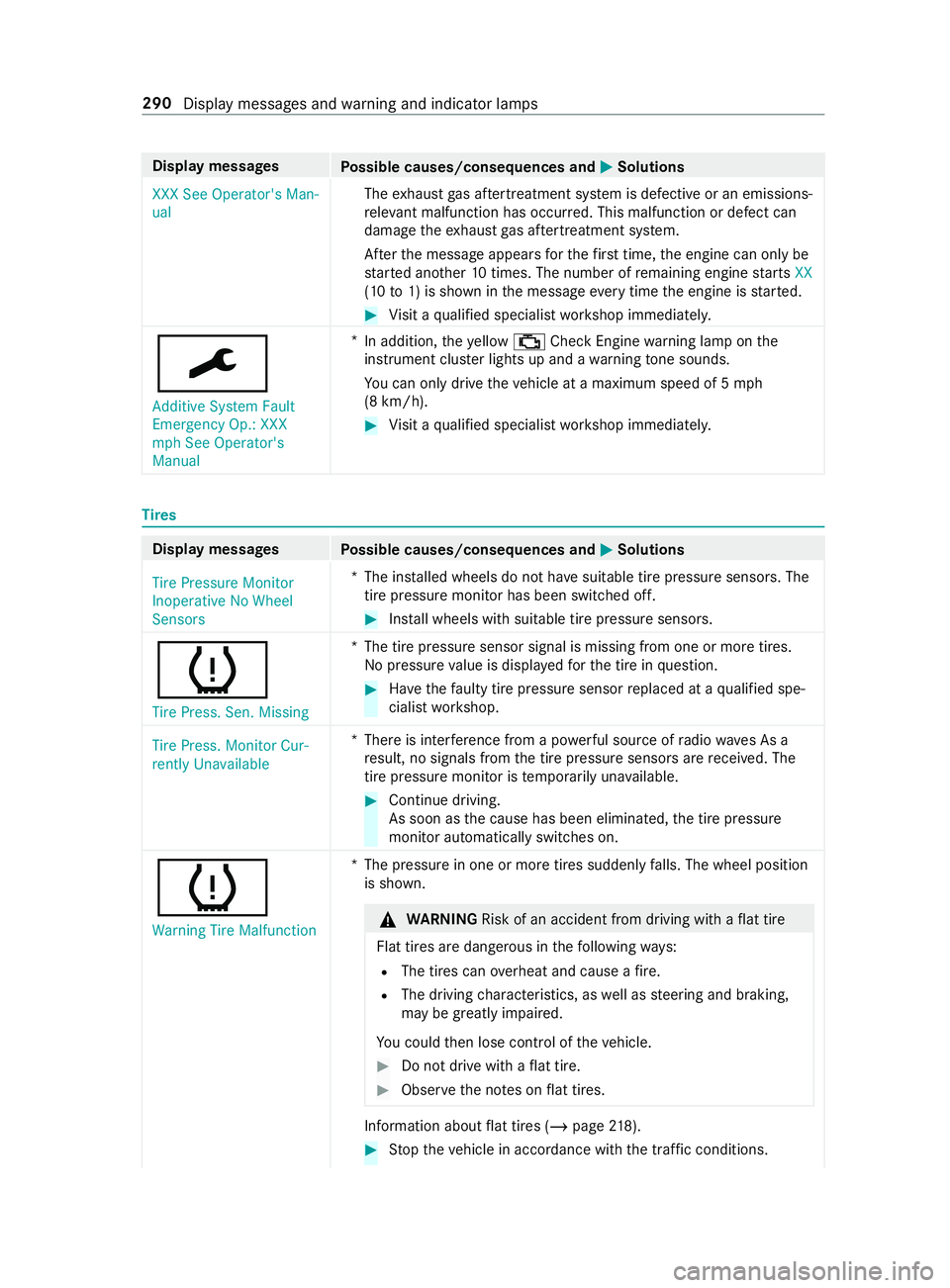
Display messages
Possible causes/consequences and 0050 0050Solutions
XXX See Operator's Man-
ual The
exhaust gas af tertre atment sy stem is defective or an emissions-
re leva nt malfunction has occu rred. This malfunction or defect can
damage theex haust gas af tertre atment sy stem.
Af terth e message appears forth efirs t time, the engine can only be
st ar ted ano ther 10 times. The number of remaining engine starts XX
(10 to1) is shown in the message everytime the engine is star ted. #
Visit a qualified specialist workshop immediately.
0099 Additive System Fault
Emergency Op.: XXX
mph See Operator's
Manual *
In addition, theye llow 00B9 Check Engine warning lamp on the
instrument clus ter lights up and a warning tone sounds.
Yo u can only drive theve hicle at a maximum speed of 5 mph
(8 km/h). #
Visit a qualified specialist workshop immediately. Ti
res Display messages
Possible causes/consequences and 0050 0050Solutions
Tire Pressure Monitor
Inoperative No Wheel
Sensors *T
he ins talled wheels do not ha vesuitable tire pressure sensors. The
tire pressure monitor has been switched off. #
Install wheels with suitable tire pressure sensors.
0077
Tire Press. Sen. Missing *T
he tire pressure sensor signal is missing from one or more tires.
No pressure value is displa yedfo rth e tire in question. #
Have thefa ulty tire pressure sensor replaced at a qualified spe‐
cialist workshop.
Tire Press. Monitor Cur-
rently Unavailable *T
here is inter fere nce from a po werful source of radio wav es As a
re sult, no signals from the tire pressure sensors are received. The
tire pressure monitor is temp orarily una vailable. #
Continue driving.
As soon as the cause has been eliminated, the tire pressure
monitor automatically switches on.
0077 Warning Tire Malfunction *T
he pressure in one or more tires suddenly falls. The wheel position
is shown. &
WARNING Risk of an accident from driving wi thaflat tire
Flat tires are dangerous in thefo llowing ways:
R The tires can overheat and cause a fire.
R The driving characteristics, as well as steering and braking,
may be greatly impaired.
Yo u could then lose cont rol of theve hicle. #
Do not drive with a flat tire. #
Obse rveth e no tes on flat tires. In
fo rm ation about flat tires (/ page218). #
Stop theve hicle in accordance with the tra ffic conditions. 290
Display messages and warning and indicator lamps
Page 327 of 354

Driving sy
stems Wa
rning/indicator
lamp Po
ssible causes/consequences and 0050 0050Solutions
00BA
Dis tance warning lamp The
red dis tance warning lamp lights up while you are driving and a
wa rning tone sounds.
Yo u are approaching an obs tacle at too high a speed. #
Beready toapply the brakes immediatel y. #
Increase the dis tance. Ve
hicle Wa
rning/indicator
lamp Po
ssible causes/consequences and 0050 0050Solutions
00CC
Po we rst eering sy stem
wa rning lamp The
red po werst eering sy stem warning lamp lights up while the engine
is running.
The po werst eering assis tance or thesteering itself is malfunctioning. &
WARNING Risk of accident if steering capability is impaired
If th esteering no longer functions as intended, theve hicle's operat‐
ing saf ety is jeopardized. #
Consult a qualified specialist workshop. #
Read the messages on the multifunction displa y.Engine
Wa
rning/indicator
lamp Po
ssible causes/consequences and 0050 0050Solutions
00AC
Coolant warning lamp The
red coolant warning lamp lights up while the engine is running.
Po ssible causes:
R temp erature sensor malfunctioning
R coolant le velto o low
R air supply tothe engine radiator obstructed
R engine radiator fanfa ulty
If a warning tone also sounds, the coolant has exceeded thete mp era‐
ture of 248 °F (120 °C). &
WARNING Danger of bu rns when opening the hood
If yo u open the hood when the engine has overheated or during a
fi re inthe engine compartment, you could come into con tact wi th
hot gases or other escaping operating fluids. #
Before opening the hood, allow the engine tocool down. #
Intheeve nt of a fire inthe engine compartment, keep the
hood closed and call thefire service. Display messages and
warning and indicator lamps 303