2019 MERCEDES-BENZ GLC tow
[x] Cancel search: towPage 62 of 370
Installing a child restraint system:
XMake sure you observe the child restraintsystem manufacturer's installation instruc-tions.
XPull the seat belt smoothly from the belt out-let.
XEngage seat belt tongue in belt buckle.
Activating the special seat belt retractor:
XPull the seat belt out fully and let the inertiareel retract it again.While the seat belt is retracting, you shouldhear a ratcheting sound. The special seat beltretractor is enabled.
XPush the child restraint system down so thatthe seat belt is tight and does not loosen.
Removing the child restraint system and deac-tivating the special seat belt retractor:
XMake sure you observe the child restraintsystem manufacturer's installation instruc-tions.
XPress the release button of the seat beltbuckle and guide the seat belt tongue backtowards the belt sash guide.The special seat belt retractor is deactivated.
Child restraint system
The use of seat belts and child restraint systemsis required by law in:
Rall 50 states
Rthe U.S. territories
Rthe District of Columbia
Rall Canadian provinces
You can obtain further information about thecorrect child restraint system from any author-ized Mercedes-Benz Center.
GWARNING
If the child restraint system is installed incor-
rectly on a suitable seat, it cannot protect as
intended. The child cannot then be restrained
in the event of an accident, heavy braking or
sudden changes of direction. There is an
increased risk of injury, possibly even fatal.
Make sure that you observe the child restraint
system manufacturer's installation instruc-
tions and the notes on use. Please ensure,
that the base of the child restraint system is
always resting completely on the seat cush-
ion. Never place objects, e.g. cushions, under
or behind the child restraint system. Only use
child restraint systems with the original cover
designed for them. Only replace damaged
covers with genuine covers.
GWARNING
If the child restraint system is installed incor-
rectly or is not secured, it can come loose in
the event of an accident, heavy braking or a
sudden change in direction. The child
restraint system could be thrown about, strik-
ing vehicle occupants. There is an increased
risk of injury, possibly even fatal.
Always install child restraint systems prop-
erly, even if they are not being used. Make
sure that you observe the child restraint sys-
tem manufacturer's installation instructions.
You will find further information on stowingobjects, luggage or loads under "Loading guide-lines" (Ypage 278).
GWARNING
Child restraint systems or their securing sys-
tems which have been damaged or subjected
to a load in an accident can no longer protect
as intended. The child cannot then be
restrained in the event of an accident, heavy
braking or sudden changes of direction. There
is an increased risk of injury, possibly even
fatal.
Replace child restraint systems which have
been damaged or subjected to a load in an
accident as soon as possible. Have the secur-
ing systems on the child restraint system
checked at a qualified specialist workshop,
before you install a child restraint system
again.
The securing systems of child restraint systemsare:
Rthe seat belt system
Rthe LATCH-type (ISOFIX) securing rings
Rthe Top Tether anchorages
If it is absolutely necessary to carry a child onthe front passenger seat, be sure to observe the
60Children in the vehicle
Safety
Page 86 of 370
The vehicle will be fully unlocked if it had previ-ously been fully unlocked. If only the driver'sdoor had been previously unlocked, only thedoor which has been opened from the inside isunlocked.
Automatic locking feature
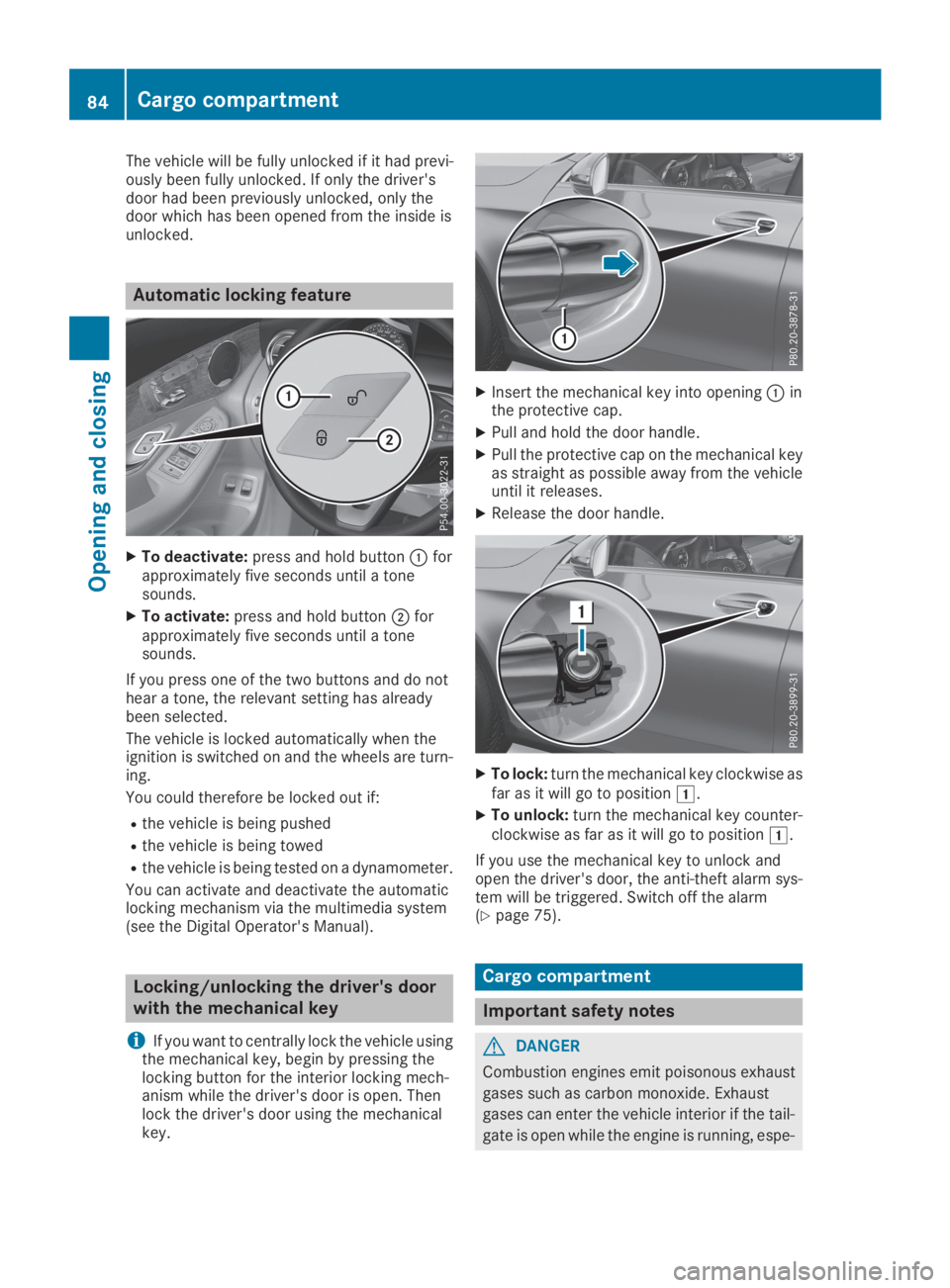
XTo deactivate:press and hold buttonCforapproximately five seconds until a tonesounds.
XTo activate:press and hold buttonDforapproximately five seconds until a tonesounds.
If you press one of the two buttons and do nothear a tone, the relevant setting has alreadybeen selected.
The vehicle is locked automatically when theignition is switched on and the wheels are turn-ing.
You could therefore be locked out if:
Rthe vehicle is being pushed
Rthe vehicle is being towed
Rthe vehicle is being tested on a dynamometer.
You can activate and deactivate the automaticlocking mechanism via the multimedia system(see the Digital Operator's Manual).
Locking/unlocking the driver's door
with the mechanical key
iIf you want to centrally lock the vehicle usingthe mechanical key, begin by pressing thelocking button for the interior locking mech-anism while the driver's door is open. Thenlock the driver's door using the mechanicalkey.
XInsert the mechanical key into openingCinthe protective cap.
XPull and hold the door handle.
XPull the protective cap on the mechanical keyas straight as possible away from the vehicleuntil it releases.
XRelease the door handle.
XTo lock:turn the mechanical key clockwise asfar as it will go to positionG.
XTo unlock:turn the mechanical key counter-clockwise as far as it will go to positionG.
If you use the mechanical key to unlock andopen the driver's door, the anti-theft alarm sys-tem will be triggered. Switch off the alarm(Ypage 75).
Cargo compartment
Important safety notes
GDANGER
Combustion engines emit poisonous exhaust
gases such as carbon monoxide. Exhaust
gases can enter the vehicle interior if the tail-
gate is open while the engine is running, espe-
84Cargo compartment
Opening and closing
Page 144 of 370
tance Assist DISTRONIC is activated. Observethe information on the HOLD function(Ypage 170) and on Active Distance AssistDISTRONIC (Ypage 165).
Engaging reverse gear
!Only move the automatic transmission to^when the vehicle is stationary.
XDepress the brake pedal.
XPush the DIRECT SELECT lever up past thefirst point of resistance.
The ECO start/stop function is not availablewhen reverse gear is engaged. Further informa-tion on the ECO start/stop function(Ypage 136).
Shifting to neutral
GWARNING
If children are left unsupervised in the vehicle,
they could:
Ropen the doors, thus endangering other
people or road users.
Rget out and disrupt traffic.
Roperate the vehicle's equipment.
Additionally, children could set the vehicle in
motion if, for example, they:
Rrelease the parking brake.
Rshifting the automatic transmission out of
park positionP
RStart the engine.
There is a risk of an accident and injury.
When leaving the vehicle, always take the
SmartKey with you and lock the vehicle. Never
leave children or animals unattended in the
vehicle. Always keep the SmartKey out of
reach of children.
XIf the transmission is in position[or^:push the DIRECT SELECT lever up or down tothe first point of resistance.
XIf the transmission is in position]: depressthe brake pedal and push the DIRECT SELECTlever up or down to the first point of resist-ance.
If you switch the engine off with the transmis-sion in position^or[, the automatic trans-mission shifts to\\automatically.
With the SmartKey:if you then open the driv-er's door or the front-passenger door or removethe SmartKey from the ignition lock, the auto-matic transmission shifts to]automatically.
With the Start/Stop button:if you then openthe driver's door or the front-passenger door,the automatic transmission shifts to]auto-matically.
If you want the automatic transmission toremain in neutral\\, e.g. when having the vehi-cle cleaned in an automatic, tow-through carwash:
XVehicles with KEYLESS-GO or KEYLESS-GO start function:remove the Start/Stopbutton from the ignition lock.
XInsert the SmartKey into the ignition lock.
XAll vehicles:switch the ignition on.
XDepress the brake pedal and keep itdepressed.
XShift to neutral\\.
XRelease the brake pedal.
XRelease the electric parking brake.
XSwitch off the ignition and leave the SmartKeyin the ignition lock.
Engaging the drive position
XIf the transmission is in position^or\\:push the DIRECT SELECT lever down past thefirst point of resistance.
XIf the transmission is in position]: depressthe brake pedal and push the DIRECT SELECTlever down past the first point of resistance.
Transmission position and drive pro-
gram display
The current transmission position and drive pro-gram appear in the multifunction display.
142Automatic transmission
Driving an d parking
Page 146 of 370
DNeutral
Do not shift the transmission to\\while driving. Otherwise, the auto-matic transmission could be dam-aged.
No power is transmitted from theengine to the drive wheels.
Releasing the brake pedal will allowyou to move the vehicle freely, e.g. topush it or tow it.
If ESP®is deactivated or faulty: shiftthe transmission to position\\if thevehicle is in danger of skidding, e.g.on icy roads.
If you switch the engine off with thetransmission in position^or[,the automatic transmission shifts to\\automatically.
!Coasting in neutral\\maycause damage to the drive train.
:Drive
The automatic transmission changesgear automatically. All forward gearsare available.
Driving tips
Changing gear
The automatic transmission shifts through theindividual gears automatically when it is in trans-mission position[. This automatic gear shift-ing behavior is determined by:
Rthe selected drive program
Rthe position of the accelerator pedal
Rthe road speed
Accelerator pedal position
Your style of driving influences how the auto-matic transmission shifts gear:
Rlittle throttle: early upshifts
Rmore throttle: late upshifts
Double-clutch function
When shifting down, the double-clutch functionis active regardless of the currently selecteddrive program. The double-clutch function
reduces load change reactions and is conduciveto a sporty driving style. The sound generated bythe double-clutch function depends on the driveprogram selected.
Kickdown
Use kickdown for maximum acceleration.
XDepress the accelerator pedal beyond thepressure point.The automatic transmission shifts to a lowergear depending on the engine speed.
XEase off the accelerator pedal once thedesired speed is reached.The automatic transmission shifts back up.
Gliding mode
Gliding mode is available depending on theequipment.
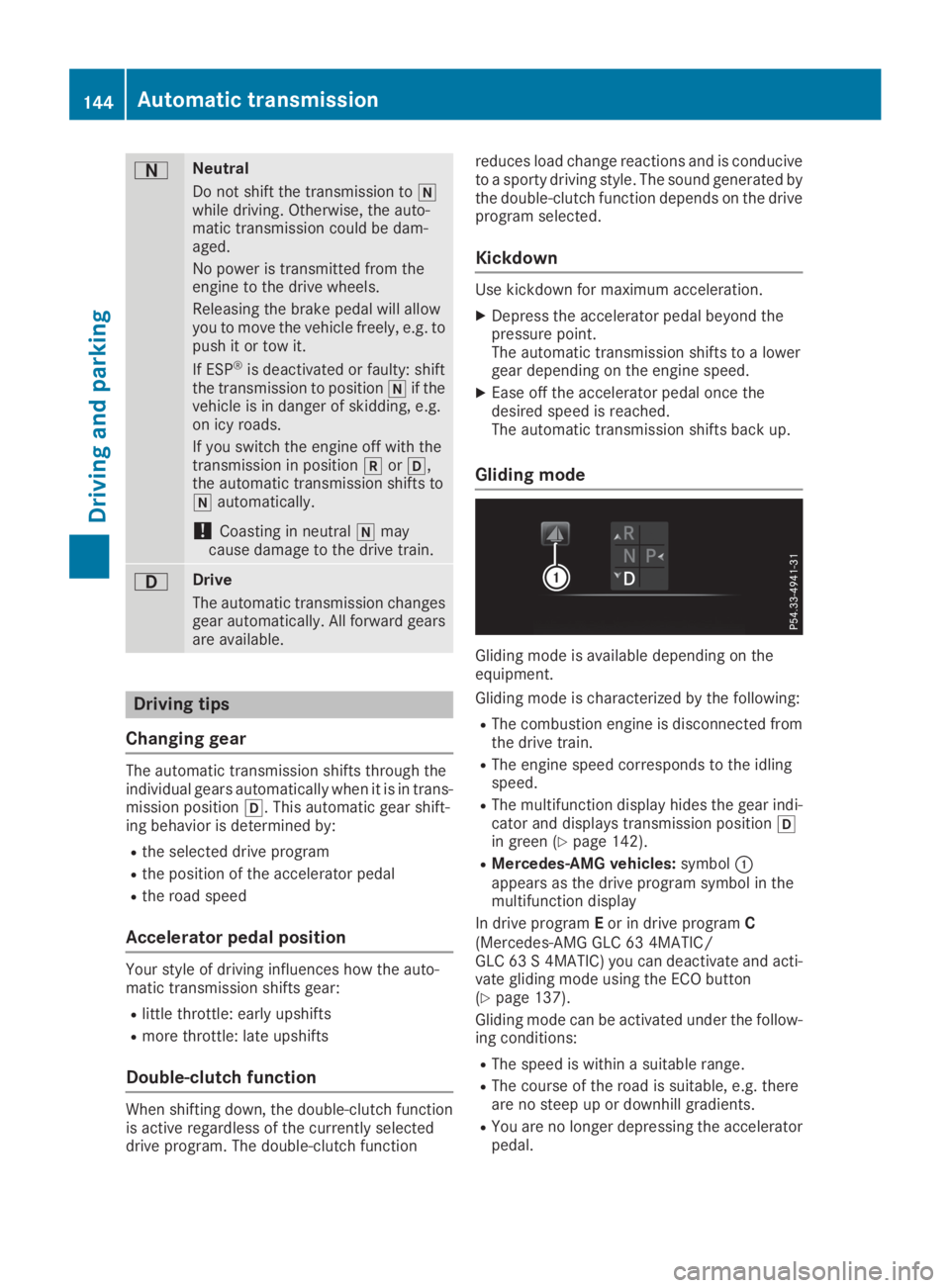
Gliding mode is characterized by the following:
RThe combustion engine is disconnected fromthe drive train.
RThe engine speed corresponds to the idlingspeed.
RThe multifunction display hides the gear indi-cator and displays transmission position[in green (Ypage 142).
RMercedes-AMG vehicles:symbolCappears as the drive program symbol in themultifunction display
In drive programEor in drive programC(Mercedes-AMG GLC 63 4MATIC/GLC 63 S 4MATIC) you can deactivate and acti-vate gliding mode using the ECO button(Ypage 137).
Gliding mode can be activated under the follow-ing conditions:
RThe speed is within a suitable range.
RThe course of the road is suitable, e.g. thereare no steep up or downhill gradients.
RYou are no longer depressing the acceleratorpedal.
144Automatic transmission
Driving an d parking
Page 147 of 370
Gliding mode is deactivated under the followingconditions:
RYou depress the accelerator pedal.
RYou depress the brake pedal.
RYou change the transmission position(Ypage 141).
RYou switch to drive programRACE(Mercedes-AMG GLC 63 S 4MATIC),S+orS(Ypage 139).
Ryou activate manual gearshifting(Ypage 147).
Ryou leave the suitable speed range.
iIf you have selected the "Eco" or "Comfort"(Mercedes-AMG GLC 63 4MATIC/GLC 63 S 4MATIC) setting for the drive(engine and transmission management) indrive programI, you can also activate glidingmode. Information on DYNAMIC SELECT andon configuring drive programIwith the mul-timedia system (see the Digital Operator'sManual).
Towing a trailer
XDrive in the middle of the engine speed rangeon uphill gradients.
XManual shifting:depending on the uphill ordownhill gradient, shift into a gear(Ypage 147), in which the engine will run themiddle of the engine speed range.
This also applies if cruise control or ActiveDistance Assist DISTRONIC is activated.
Drive programs
All vehicles except Mercedes-AMG GLC
63 4MATIC+/GLC 63 S 4MATIC+
Drive program I (Individual)
In drive programIthe following properties of thedrive program can be selected:
Rthe drive (engine and transmission manage-ment)
and therefore indirectly the availability of glid-ing mode and the properties of the driverassistance systems
Rthe suspension
Rthe steering
Rthe availability of the ECO start/stop function
Rthe climate control
Information about configuring drive programIwith the multimedia system can be found under"DYNAMIC SELECT" in the vehicle's DigitalOperator's Manual.
Drive program S+ (Sport Plus)
Drive programS+is characterized by the fol-lowing:
Rthe vehicle exhibits particularly sporty drivingcharacteristics.
Rthe vehicle pulls away in first gear.
Rthe automatic transmission shifts up later.The fuel consumption possibly being higheras a result of the later automatic transmissionshift points.
Rthe suspension exhibits particularly stiffspringing and damping settings (vehicles withAIR BODY CONTROL).
Rgliding mode is not available.
Rthe ECO start/stop function is deactivated(Ypage 136).
Drive program S (Sport)
Drive programSis characterized by the follow-ing:
Rthe vehicle exhibits sporty driving character-istics.
Rthe vehicle pulls away in first gear.
Rthe automatic transmission shifts up later.The fuel consumption possibly being higheras a result of the later automatic transmissionshift points.
Rthe suspension exhibits stiff springing anddamping settings (vehicles withAIR BODY CONTROL).
Rgliding mode is not available.
Rthe ECO start/stop function is activated(Ypage 136).
Drive program C (Comfort)
Drive programCis characterized by the follow-ing:
Rthe vehicle delivers comfortable, economicalhandling characteristics.
Rthe vehicle pulls away more gently in forwardand reverse gears, unless the acceleratorpedal is depressed fully.
Rthe vehicle has improved driving stability, forexample on slippery road surfaces.
Automatic transmission145
Driving and parking
Z
Page 152 of 370
Problems with the transmission
ProblemPossible causes/consequences andPPSolutions
The transmission hasproblems shifting gear.The transmission is losing oil.
XHave the transmission checked at a qualified specialist workshopimmediately.
The acceleration abilityis deteriorating.
The transmission no lon-ger changes gear.
The transmission is in emergency mode.
It is possible to shift to a gear and reverse gear only.
XStop the vehicle.
XShift the transmission to position].
XSwitch off the engine.
XWait at least ten seconds before restarting the engine.
XShift the transmission to position[or^.If[is selected, the transmission only shifts to one gear; if^isselected, the transmission shifts to reverse gear.
XHave the transmission checked at a qualified specialist workshopimmediately.
Transfer case
This section is only valid for vehicles with 4-wheel drive (4MATIC). Power is always trans-mitted to both axles.
!Performance tests may only be carried outon a 2-axle dynamometer. The brake systemor transfer case could otherwise be damaged.Contact a qualified specialist workshop for aperformance test.
!Since ESP®engages automatically, the igni-tion must be switched off (the SmartKey orStart/Stop button must be in positionZorG) if
Rthe electrical parking brake is being testedusing a dynamometer
Rthe vehicle is being towed with only oneaxle raised (not permitted for vehicles with4MATIC)
Otherwise, the brake system can be dam-aged.
!Vehicles with 4MATIC must not be towedwith either the front or the rear axle raised, asdoing so will damage the transmission.
Refueling
Important safety notes
GWARNING
Fuel is highly flammable. Risk of fire and
explosion by improper handling of fuel.
You must avoid fire, open flames, smoking
and creating sparks. Switch off the ignition
before refueling and, if present, switch off the
auxiliary heating.
GWARNING
Fuel is poisonous and hazardous to health.
There is a risk of injury.
You must make sure that fuel does not come
into contact with your skin, eyes or clothing
and that it is not swallowed. Do not inhale fuel
vapors. Keep fuel away from children.
If you or others come into contact with fuel,
observe the following:
RWash away fuel from skin immediately
using soap and water.
RIf fuel comes into contact with your eyes,
immediately rinse them thoroughly with
150Refueling
Driving and parking
Page 155 of 370
GWARNING
If you leave children unsupervised in the vehi-
cle, they could set it in motion by, for example:
Rrelease the parking brake.
Rshift the automatic transmission out of the
parking positionP.
Rstart the engine.
In addition, they may operate vehicle equip-
ment and become trapped. There is a risk of
an accident and injury.
When leaving the vehicle, always take the
SmartKey with you and lock the vehicle. Never
leave children unsupervised in the vehicle.
!Always secure the vehicle correctly againstrolling away. Otherwise, the vehicle or its driv-etrain could be damaged.
To ensure that the vehicle is secured againstrolling away unintentionally:
Rthe electric parking brake must be applied.
Rthe transmission must be in position]andthe SmartKey must be removed from the igni-tion lock.
Rthe front wheels must be turned towards thecurb on steep uphill or downhill gradients.
Rthe empty vehicle must be secured at thefront axle with a wheel chock or similar, forexample, on uphill or downhill gradients.
Ron uphill or downhill gradients the laden vehi-cle must also be secured at the rear axle, forexample with a wheel chock or similar object.
Switching off the engine
Important safety notes
GWARNING
The automatic transmission switches to neu-
tral positionNwhen you switch off the engine.
The vehicle may roll away. There is a risk of an
accident.
After switching off the engine, always switch
to parking positionP. Prevent the parked vehi-
cle from rolling away by applying the parking
brake.
Vehicles with automatic transmission
XApply the electric parking brake.
XShift the transmission to position].
XWith the SmartKey:turn the SmartKey toposition
Page 162 of 370
braking maneuvers. Do not use cruise control orActive Distance Assist DISTRONIC.
If the vehicle threatens to skid or cannot bestopped when moving at low speed:
XShift the transmission to position\\.
The outside temperature indicator is notdesigned to serve as an ice-warning device andis therefore unsuitable for that purpose.Changes in the outside temperature are dis-played after a short delay.
Indicated temperatures just above the freezingpoint do not guarantee that the road surface isfree of ice. The road may still be icy, especially inwooded areas or on bridges. The vehicle couldskid if you fail to adapt your driving style. Alwaysadapt your driving style and drive at a speed tosuit the prevailing weather conditions.
You should pay special attention to road condi-tions when temperatures are around freezingpoint.
For more information on driving with snowchains, see (Ypage 332).
For more information on driving with summertires, see (Ypage 332).
Observe the notes in the "Winter operation" sec-tion (Ypage 332).
Driving systems
Mercedes-Benz Intelligent Drive
Mercedes-Benz Intelligent Drive stands for inno-vative driver assistance and safety systemswhich enhance comfort and support the driver incritical situations. With these intelligent coordi-nated systems Mercedes-Benz has set a mile-stone on the path towards autonomous driving.
Mercedes-Benz Intelligent Drive embraces allelements of active and passive safety in one wellthought out system – for the safety of the vehi-cle occupants and that of other road users.
Further information on driving safety systems(Ypage 65).
Cruise control
General notes
Cruise control maintains a constant road speedfor you. It brakes automatically in order to avoidexceeding the set speed. Change into a lower
gear in good time on long and steep downhillgradients. This is especially important if thevehicle is laden or towing a trailer. By doing so,you will make use of the braking effect of theengine. This relieves the load on the brake sys-tem and prevents the brakes from overheatingand wearing too quickly.
Use cruise control only if road and traffic con-ditions make it appropriate to maintain a steadyspeed for a prolonged period. You can store anyroad speed above 20 mph (30 km/h).
Important safety notes
Cruise control can neither reduce the risk of anaccident if you fail to adapt your driving style noroverride the laws of physics. Cruise control can-not take into account the road, traffic andweather conditions. Cruise control is only anaid. You are responsible for maintaining a safedistance to the vehicle in front, for vehiclespeed, for braking in good time and for staying inlane.
Do not use cruise control:
Rin road and traffic conditions which do notallow you to maintain a constant speed, e.g. inheavy traffic or on winding roads
Ron slippery road surfaces. Braking or accel-erating could cause the drive wheels to losetraction and the vehicle could then skid
Rwhen there is poor visibility, e.g. due to fog,heavy rain or snow
If there is a change of drivers, advise the newdriver of the speed stored.
iThe speed indicated in the speedometermay differ slightly from the speed stored.
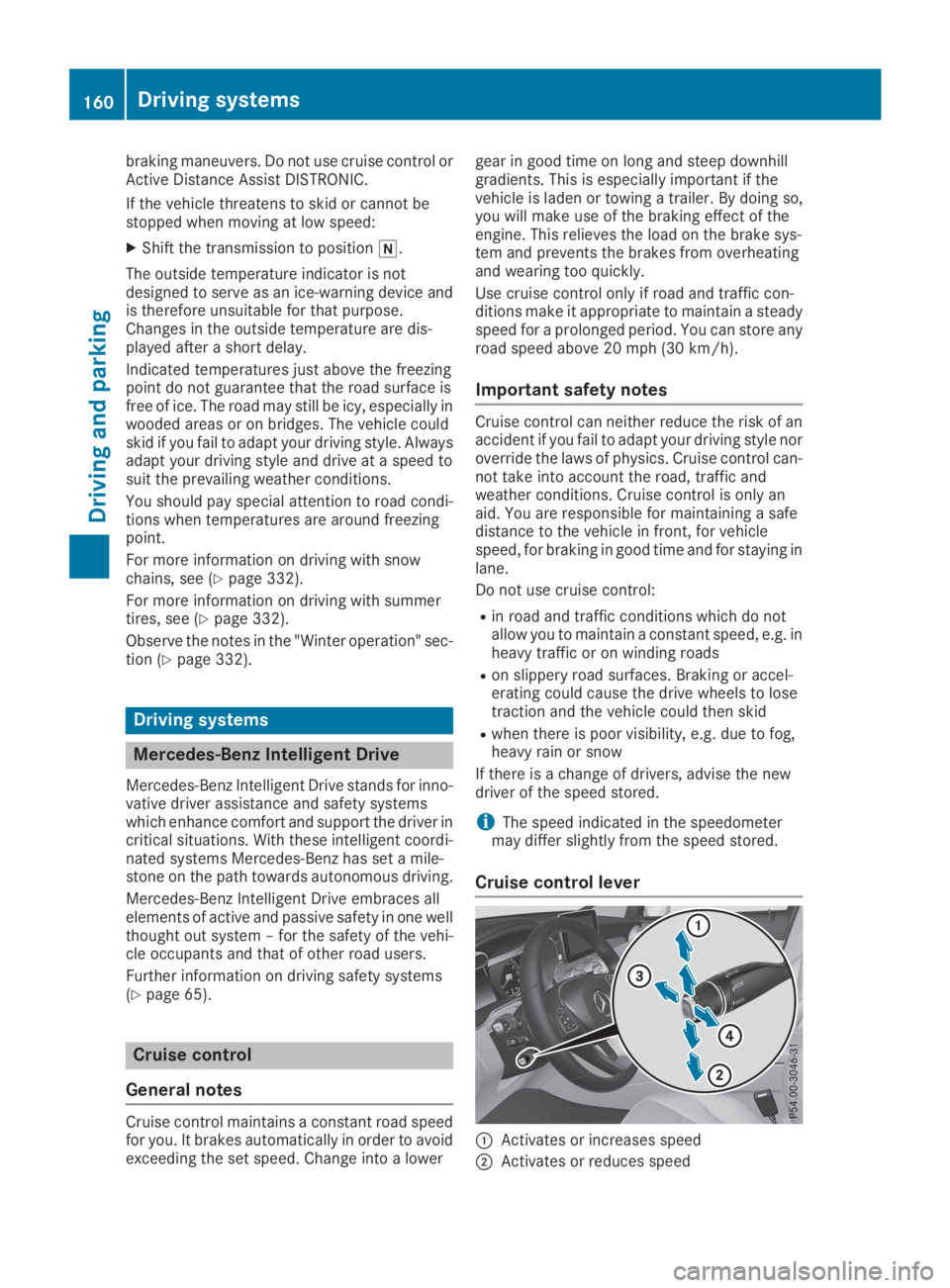
Cruise control lever
CActivates or increases speed
DActivates or reduces speed
160Driving systems
Driving and pa rking