2019 MERCEDES-BENZ GLC tow
[x] Cancel search: towPage 320 of 370
have attained a pressure of at least 200 kPa(2.0 bar/29 psi).
If a pressure of 200 kPa (2.0 bar/29 psi) hasbeen attained after five minutes, see "Tire pres-sure reached" (Ypage 318).
If a tire pressure of 200 kPa (2.0 bar/29 psi) hasnot been attained after five minutes, see "Tirepressure not reached" (Ypage 318).
If tire sealant has escaped, clean it off affectedareas as quickly as possible. It is preferable touse clean water.
If your clothes are soiled with tire sealant, havethem cleaned with perchloroethylene at a drycleaner as soon as possible.
Tire pressure not reached
If a tire pressure of 200 kPa (2.0 bar/29 psi) hasnot been attained after ten minutes:
XSwitch off the tire inflation compressor.
XUnscrew the filler hose from the valve of thefaulty tire.Tire sealant may escape when the filler hose isunscrewed.
XVery slowly drive forwards or reverse approx-imately 30 ft (10 m).
XPump up the tire again.
After a maximum of ten minutes, the tire pres-sure must be at least 200 kPa (2.0 bar/29 psi).
GWARNING
If the required tire pressure is not reached
after the specified time, the tire is too badly
damaged. The tire sealant cannot repair the
tire in this instance. Damaged tires and a tire
pressure that is too low can significantly
impair the vehicle's braking and driving char-
acteristics. There is a risk of accident.
Do not continue driving. Contact a qualified
specialist workshop.
Tire pressure reached
GWARNING
A tire temporarily sealed with tire sealant
impairs the driving characteristics and is not
suitable for higher speeds. There is a risk of
accident.
You should therefore adapt your driving style
accordingly and drive carefully. Do not exceed
the specified maximum speed with a tire that
has been repaired using tire sealant.
The maximum permissible speed for a tiresealed with tire sealant is 50 mph (80 km/h).The upper part of the TIREFIT sticker must beaffixed to the instrument cluster in the driver'sfield of vision.
If a tire pressure of 200 kPa (2.0 bar/29 psi) hasbeen attained after ten minutes:
XSwitch off the tire inflation compressor.
XUnscrew the filler hose from the valve of thefaulty tire.Tire sealant may escape when the filler hose isunscrewed.
XStow the tire sealant bottle and the tire infla-tion compressor.
XPull away immediately.
XStop after driving for approximately tenminutes and check the tire pressure with thetire inflation compressor.The tire pressure must now be at least130 kPa (1.3 bar/19 psi).
GWARNING
If the required tire pressure is not reached
after driving for a short period, the tire is too
badly damaged. The tire sealant cannot repair
the tire in this instance. Damaged tires and a
tire pressure that is too low can significantly
impair the vehicle's braking and driving char-
acteristics. There is a risk of accident.
Do not continue driving. Contact a qualified
specialist workshop.
In cases such as the one mentioned above, con-tact an authorized Mercedes-Benz Center. Orcall 1-800-FOR-MERCedes (in the USA) or1-800-387-0100 (in Canada).
XCorrect the tire pressure if it is still at least130 kPa (1.3 bar/19 psi). See the Tire andLoading Information placard on the B-pillar onthe driver's side or the tire pressure table inthe fuel filler flap for values.
XTo increase the tire pressure:switch on thetire inflation compressor.
318Flat tire
Breakdown assistance
Page 327 of 370
!Only secure the tow rope or tow bar at thetowing eyes, or the trailer tow hitch, if availa-ble. You could otherwise damage the vehicle.
!Do not use the trailer tow hitch for recoveryor towing. Do not use the towing eye forrecovery. this could damage the vehicle. If indoubt, have the vehicle recovered using acrane.
!When towing, pull away slowly andsmoothly. If the tractive power is too high, thevehicles could be damaged.
!Shift the automatic transmission to position\\and do not open the driver's or front pas-senger's door during towing. The automatictransmission may otherwise shift to position], which could damage the transmission.
!Do not tow with sling-type equipment. Thiscould damage the vehicle.
!You may tow the vehicle for a maximum dis-tance of 30 miles (50 kilometers). A towingspeed of 30 mph (50 km/h) must not beexceeded.
For towing distances over 30 miles(50 kilometers), the entire vehicle must beraised and transported.
It is better to have the vehicle transported thanto have it towed away.
If the vehicle has suffered transmission damage,have it transported on a transporter or trailer.
The automatic transmission must be in position\\when the vehicle is being towed. If the auto-matic transmission cannot be shifted to position\\, have the vehicle transported on a trans-porter or trailer.
The battery must be connected and charged.Otherwise, you:
Rcannot turn the SmartKey to positionHinthe ignition lock
Rcannot release the electric parking brake.
Rcannot shift the automatic transmission toposition\\
Disarm the automatic locking feature before thevehicle is towed (Ypage 84). You could other-wise be locked out when pushing or towing thevehicle.
Installing/removing the towing eye
Installing the towing eye
GWARNING
The exhaust tail pipe may be very hot. There is
a risk of burns when removing the rear cover.
Do not touch the exhaust pipe. Take particular
care when removing the rear cover.
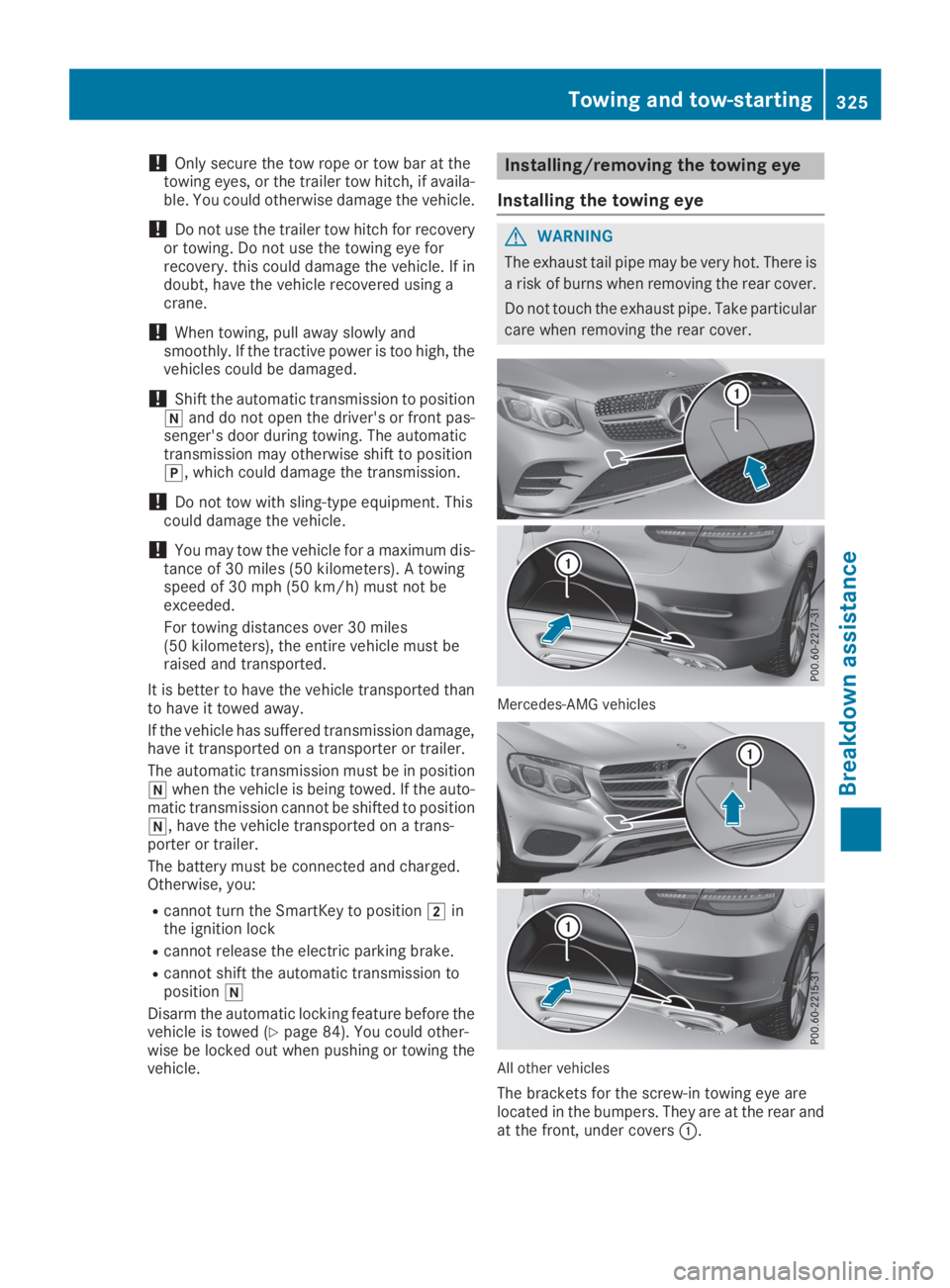
Mercedes-AMG vehicles
All other vehicles
The brackets for the screw-in towing eye arelocated in the bumpers. They are at the rear andat the front, under coversC.
Towing and tow-starting325
Breakdown assistance
Z
Page 328 of 370
XRemove the towing eye from the retainer(Ypage 314).
XMercedes-AMG vehicles:use a suitableobject, e.g. a screwdriver, to pry off coverCon the front bumper from underneath. Takethe cover from the opening, but do notremove it.
Press the mark on coverCon the rearbumper inward and remove.
XAll other vehicles:press the mark oncoverCinward and remove.
XScrew in the towing eye clockwise as far as itwill go and tighten it.
Vehicles with a trailer tow hitch do not have abracket for the screw-in towing eye at the back.Connect the towbar to the trailer tow hitch(Ypage 204).
Removing the towing eye
XUnscrew and remove the towing eye.
XAttach coverCto the bumper and press untilit engages.
Towing a vehicle with both axles on
the ground
The automatic transmission automatically shiftsto position]when you open the driver's orfront-passenger door or when you remove theSmartKey from the ignition lock. It is essential toobserve the following steps to ensure that theautomatic transmission remains in position\\during towing.
XMake sure that the vehicle is stationary.
XTurn the SmartKey to positionHin the igni-tion lock.
XDepress and hold the brake pedal.
XShift the automatic transmission to position\\.
XLeave the SmartKey in positionHin the igni-tion lock.
XRelease the brake pedal.
XRelease the electric parking brake.
XSwitch on the hazard warning lamps(Ypage 111).
In order to signal a change of direction whentowing the vehicle with the hazard warninglamps switched on, use the combination switchas usual. In this case, only the indicator lamps
for the direction of travel flash. After resettingthe combination switch, the hazard warninglamp starts flashing again.
Transporting the vehicle
General notes
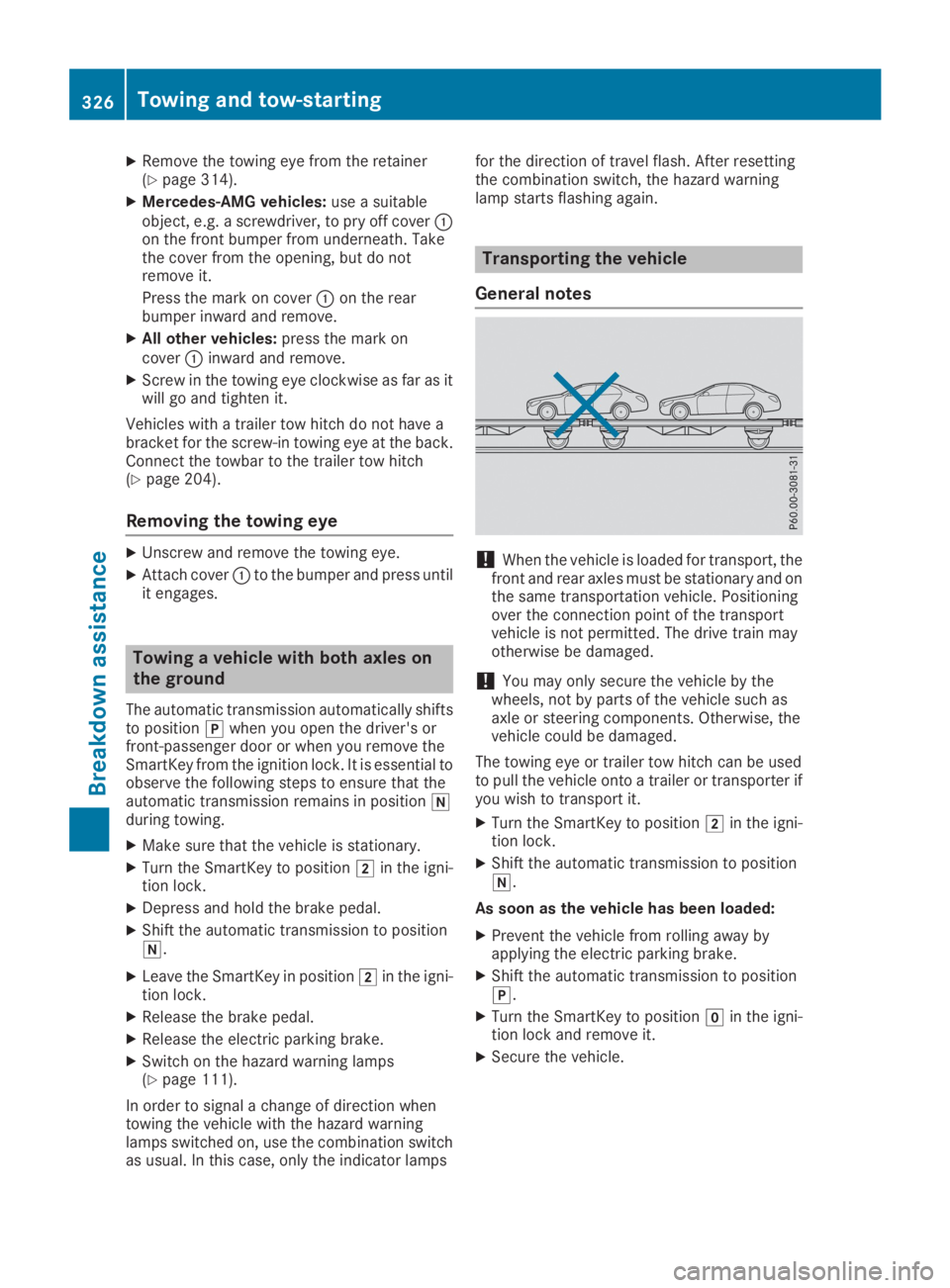
!When the vehicle is loaded for transport, thefront and rear axles must be stationary and onthe same transportation vehicle. Positioningover the connection point of the transportvehicle is not permitted. The drive train mayotherwise be damaged.
!You may only secure the vehicle by thewheels, not by parts of the vehicle such asaxle or steering components. Otherwise, thevehicle could be damaged.
The towing eye or trailer tow hitch can be usedto pull the vehicle onto a trailer or transporter ifyou wish to transport it.
XTurn the SmartKey to positionHin the igni-tion lock.
XShift the automatic transmission to position\\.
As soon as the vehicle has been loaded:
XPrevent the vehicle from rolling away byapplying the electric parking brake.
XShift the automatic transmission to position].
XTurn the SmartKey to positionZin the igni-tion lock and remove it.
XSecure the vehicle.
326Towing and tow-starting
Breakdown assistance
Page 329 of 370
Notes on 4MATIC vehicles
!Vehicles with 4MATIC must not be towedwith either the front or the rear axle raised, asdoing so will damage the transmission.
Vehicles with 4MATIC may either be towed awaywith both axles on the ground or be loaded upand transported.
If the vehicle's transmission, front, or rear axle isdamaged, have the vehicle transported on atruck or trailer.
In the event of damage to the electrical sys-tem:if the battery is defective, the automatictransmission will be locked in positionP. To shiftthe automatic transmission to positionN, youmust provide power to the vehicle's electricalsystem in the same way as when jump-starting(Ypage 322).
Have the vehicle transported on a transporter ortrailer.
Tow-starting (emergency engine
starting)
!Vehicles with automatic transmission mustnot be tow-started. You could otherwise dam-age the automatic transmission.
iYou can find information on "Jump-starting"under (Ypage 322).
Fuses
Important safety notes
GWARNING
If you manipulate or bridge a faulty fuse or if
you replace it with a fuse with a higher amper-
age, the electric cables could be overloaded.
This could result in a fire. There is a risk of an
accident and injury.
Always replace faulty fuses with the specified
new fuses having the correct amperage.
Blown fuses must be replaced with fuses of thesame rating, which you can recognize by thecolor and value. The fuse ratings are listed in thefuse allocation chart.
The fuse allocation chart is on the fuse box in thecargo compartment (Ypage 328).
If a newly inserted fuse also blows, have thecause traced and rectified at a qualified special-ist workshop, e.g. an authorized Mercedes-BenzCenter.
!Only use fuses that have been approved forMercedes-Benz vehicles and which have thecorrect fuse rating for the system concerned.Otherwise, components or systems could bedamaged.
!Make sure that no moisture can enter thefuse box when the cover is open.
!When closing the cover, make sure that it islying correctly on the fuse box. Moisture seep-ing in or dirt could otherwise impair the oper-ation of the fuses.
The fuses in your vehicle serve to close downfaulty circuits. If a fuse blows, all the compo-nents on the circuit and their functions stopoperating.
Before changing a fuse
Observe the important safety notes(Ypage 327)
XSwitch off the engine.
XSwitch off all electrical consumers.
XMake sure that the ignition is switched off(Ypage 132).
or
XWhen using the SmartKey, turn the SmartKeyto position
Page 330 of 370
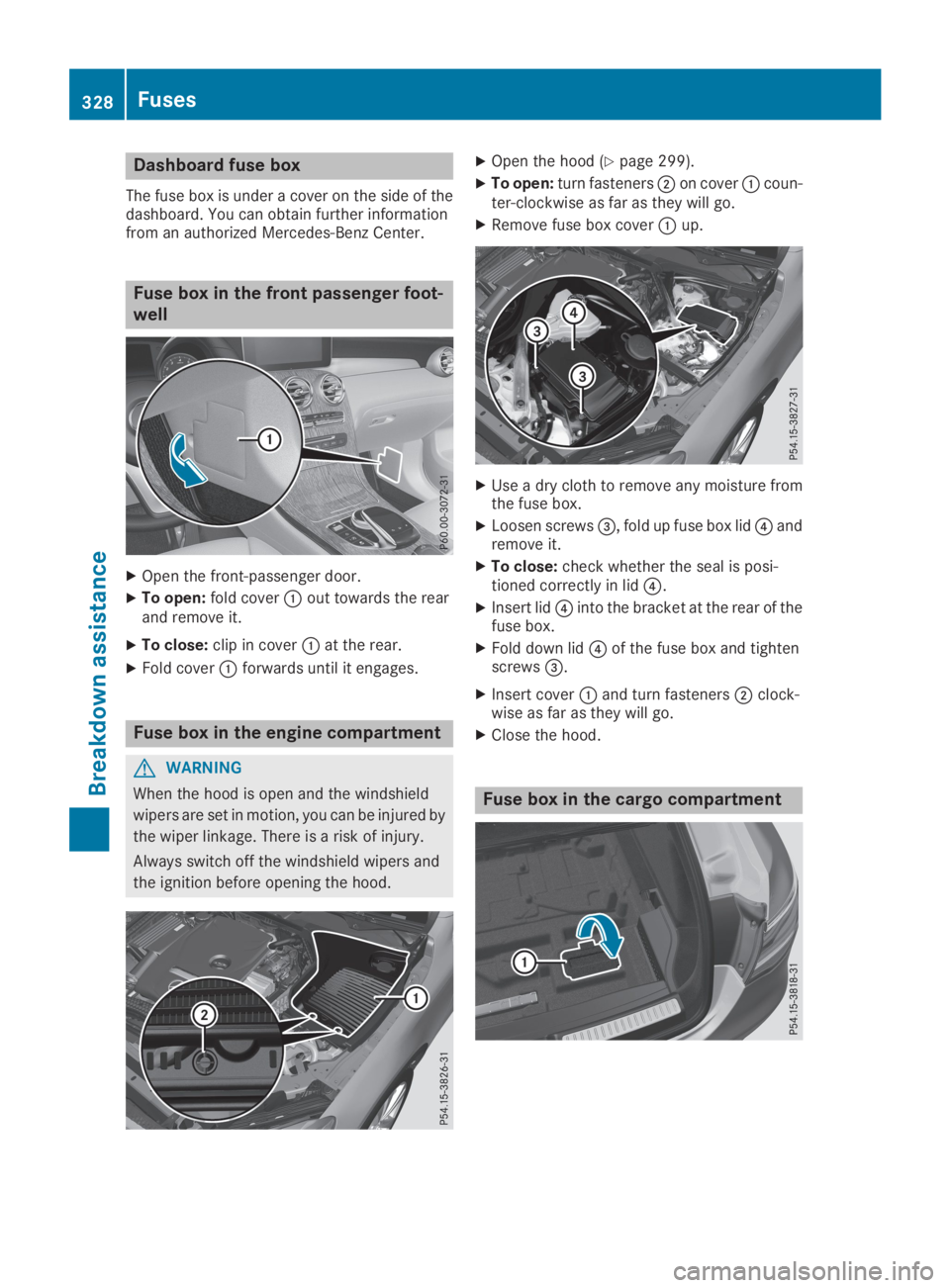
Dashboard fuse box
The fuse box is under a cover on the side of thedashboard. You can obtain further informationfrom an authorized Mercedes-Benz Center.
Fuse box in the front passenger foot-
well
XOpen the front-passenger door.
XTo open:fold coverCout towards the rearand remove it.
XTo close:clip in coverCat the rear.
XFold coverCforwards until it engages.
Fuse box in the engine compartment
GWARNING
When the hood is open and the windshield
wipers are set in motion, you can be injured by
the wiper linkage. There is a risk of injury.
Always switch off the windshield wipers and
the ignition before opening the hood.
XOpen the hood (Ypage 299).
XTo open:turn fastenersDon coverCcoun-ter-clockwise as far as they will go.
XRemove fuse box coverCup.
XUse a dry cloth to remove any moisture fromthe fuse box.
XLoosen screws
Page 339 of 370
Ryou are driving on sand or gravel.
Ryou adopt a very sporty driving style (corner-ing at high speeds or driving with high rates ofacceleration).
Ryou are towing a very heavy or large trailer.
Ryou are driving with a heavy load (in the vehi-cle or on the roof).
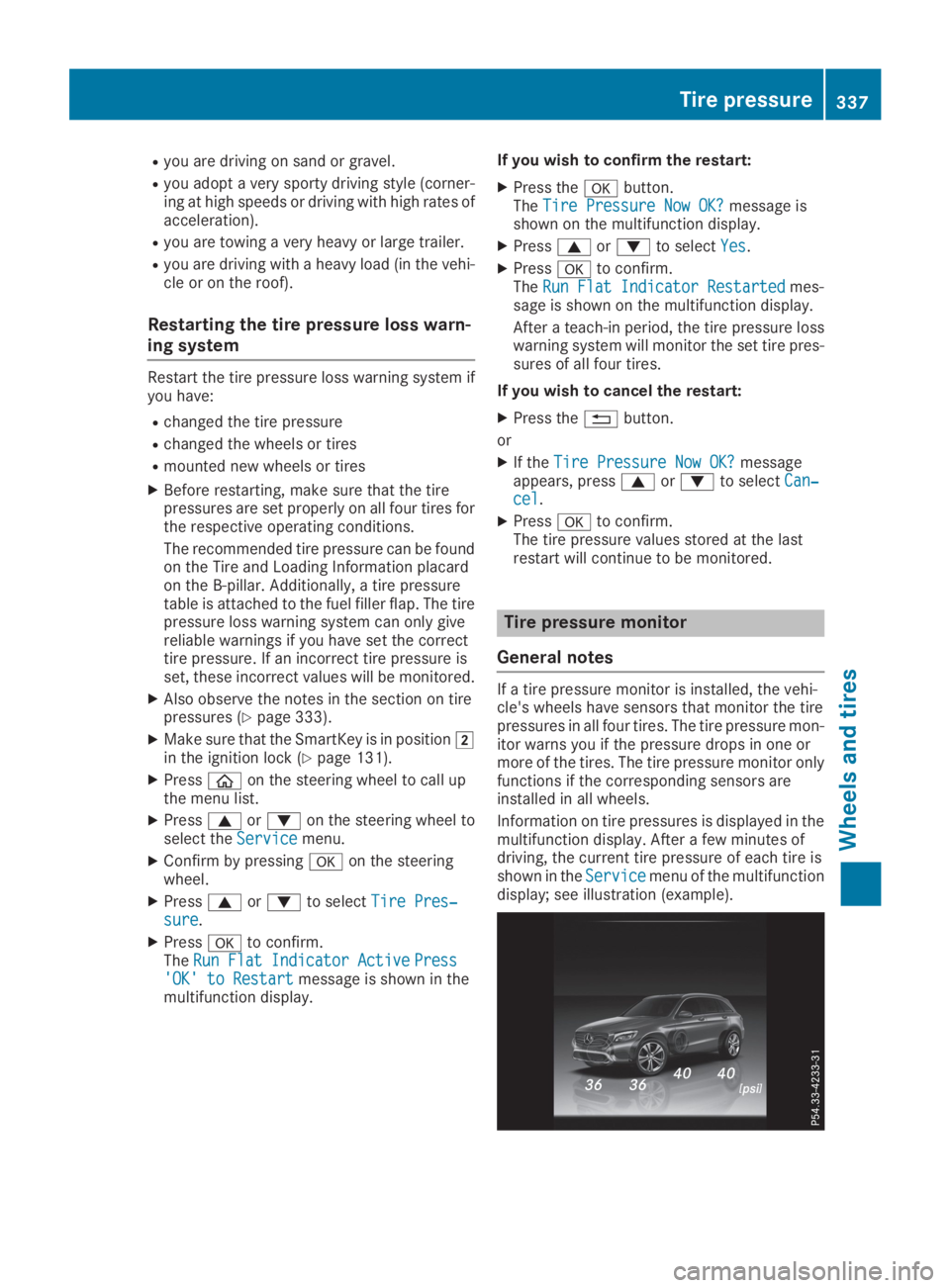
Restarting the tire pressure loss warn-
ing system
Restart the tire pressure loss warning system ifyou have:
Rchanged the tire pressure
Rchanged the wheels or tires
Rmounted new wheels or tires
XBefore restarting, make sure that the tirepressures are set properly on all four tires forthe respective operating conditions.
The recommended tire pressure can be foundon the Tire and Loading Information placardon the B-pillar. Additionally, a tire pressuretable is attached to the fuel filler flap. The tirepressure loss warning system can only givereliable warnings if you have set the correcttire pressure. If an incorrect tire pressure isset, these incorrect values will be monitored.
XAlso observe the notes in the section on tirepressures (Ypage 333).
XMake sure that the SmartKey is in positionHin the ignition lock (Ypage 131).
XPress
Page 366 of 370
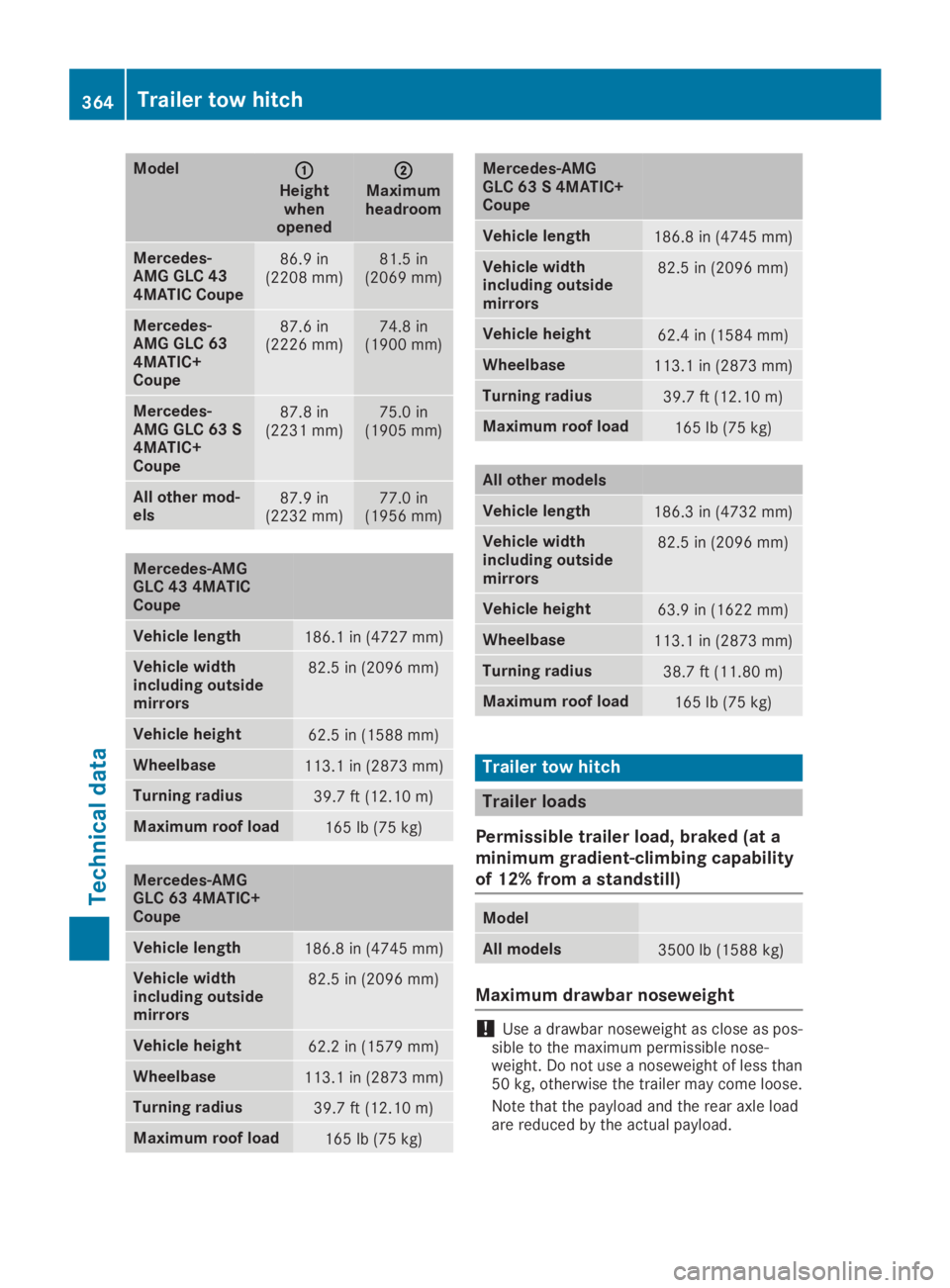
ModelCC
Heightwhenopened
DD
Maximumheadroom
Mercedes-AMG GLC 434MATIC Coupe
86.9 in(2208 mm)81.5 in(2069 mm)
Mercedes-AMG GLC 634MATIC+Coupe
87.6 in(2226 mm)74.8 in(1900 mm)
Mercedes-AMG GLC 63 S4MATIC+Coupe
87.8 in(2231 mm)75.0 in(1905 mm)
All other mod-els87.9 in(2232 mm)77.0 in(1956 mm)
Mercedes-AMGGLC 43 4MATICCoupe
Vehicle length186.1 in (4727 mm)
Vehicle widthincluding outsidemirrors
82.5 in (2096 mm)
Vehicle height62.5 in (1588 mm)
Wheelbase113.1 in (2873 mm)
Turning radius39.7 ft (12.10m)
Maximum roof load165 lb (75 kg)
Mercedes-AMGGLC 63 4MATIC+Coupe
Vehicle length186.8 in (4745 mm)
Vehicle widthincluding outsidemirrors
82.5 in (2096 mm)
Vehicle height62.2 in (1579 mm)
Wheelbase113.1 in (2873 mm)
Turning radius39.7 ft (12.10m)
Maximum roof load165 lb (75 kg)
Mercedes-AMGGLC 63 S 4MATIC+Coupe
Vehicle length186.8 in (4745 mm)
Vehicle widthincluding outsidemirrors
82.5 in (2096 mm)
Vehicle height62.4 in (1584 mm)
Wheelbase113.1 in (2873 mm)
Turning radius39.7 ft (12.10m)
Maximum roof load165 lb (75 kg)
All other models
Vehicle length186.3 in (4732 mm)
Vehicle widthincluding outsidemirrors
82.5 in (2096 mm)
Vehicle height63.9 in (1622 mm)
Wheelbase113.1 in (2873 mm)
Turning radius38.7 ft (11.80m)
Maximum roof load165 lb (75 kg)
Trailer tow hitch
Trailer loads
Permissible trailer load, braked (at a
minimum gradient-climbing capability
of 12% from a standstill)
Model
All models3500 lb (1588 kg)
Maximum drawbar noseweight
!Use a drawbar noseweight as close as pos-sible to the maximum permissible nose-weight. Do not use a noseweight of less than50 kg, otherwise the trailer may come loose.
Note that the payload and the rear axle loadare reduced by the actual payload.
364Trailer tow hitch
Technical data
Page 367 of 370
The drawbar load reduces the permissible over-all load and rear axle load.
The drawbar load acts from above onto the ballhead on the trailer tow hitch.
The drawbar noseweight is not included in thetrailer load.
ModelPermissible nose-weight
All models280 lbs (127 kg)
The actual noseweight may not be higher thanthe value which is given. The value can be foundon the trailer tow hitch or trailer identificationplates. The lowest weight applies.
The maximum permissible trailer drawbar nose-weight is the maximum weight with which thetrailer drawbar can be loaded. The permissibletrailer drawbar noseweight is the limit forMercedes-Benz-approved trailer couplings.
Permissible rear axle load when tow-
ing a trailer
ModelPermissible axleload
GLC 300 4MATIC2844 lbs (1290 kg)
Mercedes-AMGGLC 43 4MATICCoupe
2822 lbs (1280 kg)
Mercedes-AMGGLC 63 4MATIC+Coupe/GLC 63 S4MATIC+ Coupe
2932 lbs (1330 kg)
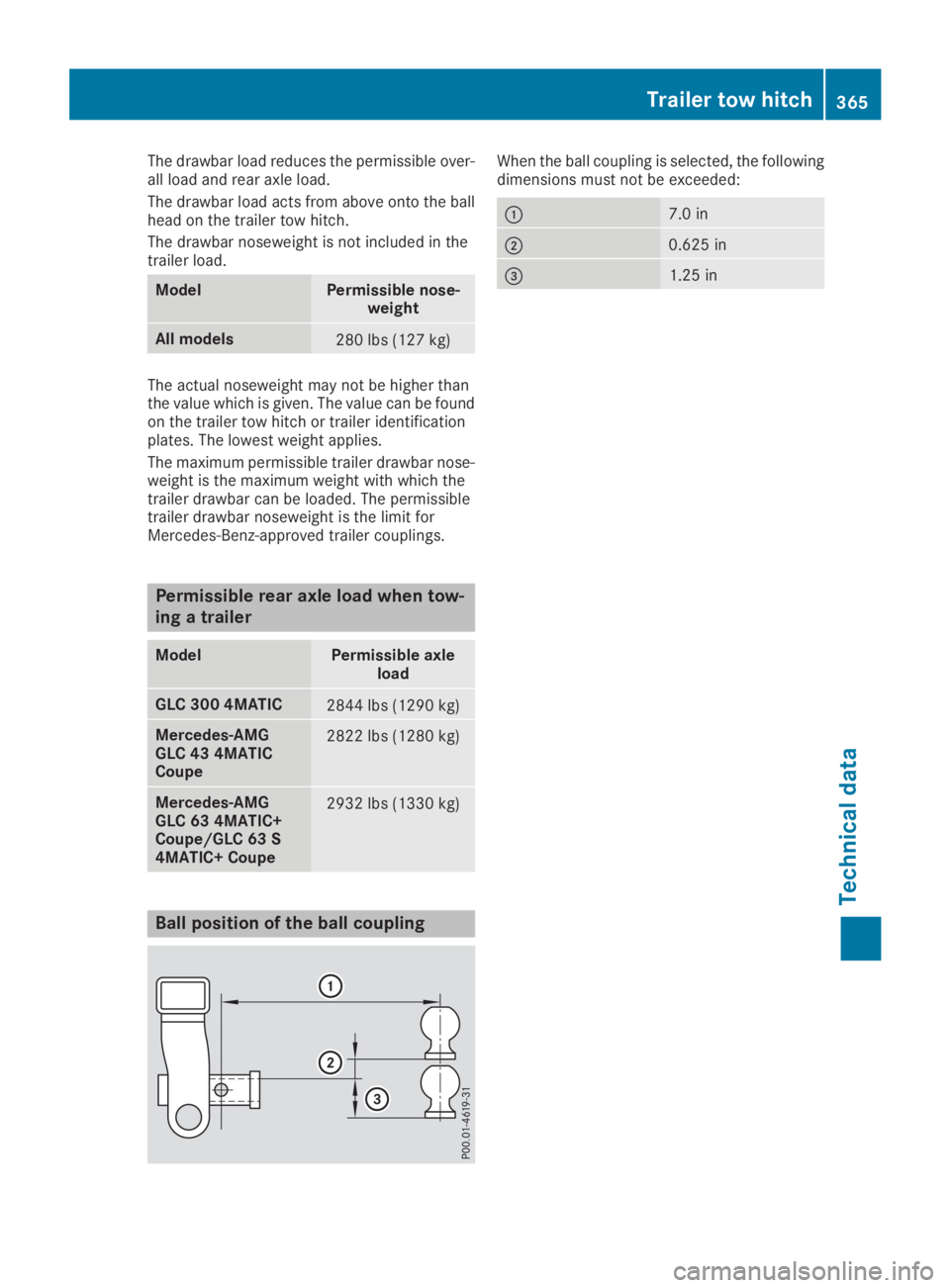
Ball position of the ball coupling
When the ball coupling is selected, the followingdimensions must not be exceeded:
C7.0 in
D0.625 in