2019 MERCEDES-BENZ GLA instrument cluster
[x] Cancel search: instrument clusterPage 42 of 346
If it is necessary to modify components of therestraint system to accommodate a personwith disabilities, contact an authorizedMercedes-Benz Center for details. USA only:for further information contact our CustomerAssistance Center at 1-800 FOR-MERCEDES(1‑800‑367‑6372).
Mercedes-Benz recommends that you only usedriving aids which have been approved specifi-cally for your vehicle by Mercedes-Benz.
Restraint system warning lamp
The functions of the restraint system arechecked after the ignition is switched on andat regular intervals while the engine is running.Therefore, malfunctions can be detected ingood time.
Theurestraint system warning lamp onthe instrument cluster lights up when the igni-tion is switched on. It goes out no later than afew seconds after the vehicle is started. Thecomponents of the restraint system are inoperational readiness.
A malfunction has occurred if theurestraint system warning lamp:
Rdoes not light up after the ignition isswitched on
Rdoes not go out after a few seconds with theengine running
Rlights up again while the engine is running
GWARNING
If the restraint system is malfunctioning,
restraint system components may be trig-
gered unintentionally or may not deploy as
intended during an accident. This can affect
for example the Emergency Tensioning
Device or the air bag. This poses an
increased risk of injury or even fatal injury.
Have the restraint system checked and
repaired in a qualified specialist workshop
as soon as possible.
PASSENGER AIR BAG indicator lamp
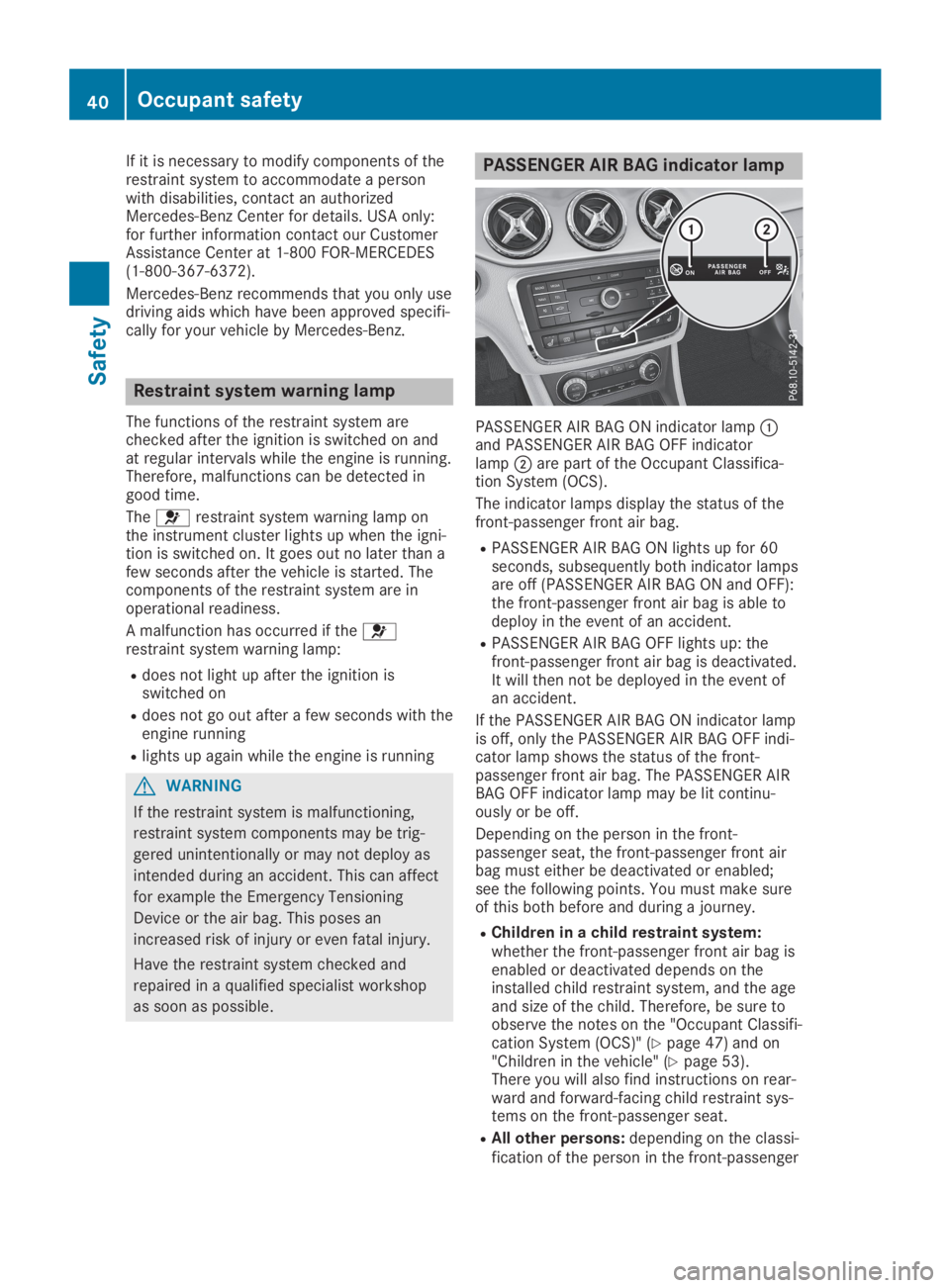
PASSENGER AIR BAG ON indicator lampCand PASSENGER AIR BAG OFF indicatorlampDare part of the Occupant Classifica-tion System (OCS).
The indicator lamps display the status of thefront-passenger front air bag.
RPASSENGER AIR BAG ON lights up for 60seconds, subsequently both indicator lampsare off (PASSENGER AIR BAG ON and OFF):the front-passenger front air bag is able todeploy in the event of an accident.
RPASSENGER AIR BAG OFF lights up: thefront-passenger front air bag is deactivated.It will then not be deployed in the event ofan accident.
If the PASSENGER AIR BAG ON indicator lampis off, only the PASSENGER AIR BAG OFF indi-cator lamp shows the status of the front-passenger front air bag. The PASSENGER AIRBAG OFF indicator lamp may be lit continu-ously or be off.
Depending on the person in the front-passenger seat, the front-passenger front airbag must either be deactivated or enabled;see the following points. You must make sureof this both before and during a journey.
RChildren in a child restraint system:whether the front-passenger front air bag isenabled or deactivated depends on theinstalled child restraint system, and the ageand size of the child. Therefore, be sure toobserve the notes on the "Occupant Classifi-cation System (OCS)" (Ypage 47) and on"Children in the vehicle" (Ypage 53).There you will also find instructions on rear-ward and forward-facing child restraint sys-tems on the front-passenger seat.
RAll other persons:depending on the classi-fication of the person in the front-passenger
40Occupant safety
Safety
Page 62 of 346
Driving safety systems
Overview of driving safety systems
In this section, you will find information aboutthe following driving safety systems:
RABS (Anti-lockBrakingSystem)(Ypage 60)
RBAS (BrakeAssistSystem) (Ypage 61)
RActive Brake Assist (Ypage 61)
RESP®(ElectronicStabilityProgram)(Ypage 63)
REBD (ElectronicBrake forceDistribution)(Ypage 67)
RADAPTIVE BRAKE (Ypage 67)
RSTEER CONTROL (Ypage 67)
Important safety notes
If you fail to adapt your driving style or if youare inattentive, the driving safety systems canneither reduce the risk of an accident noroverride the laws of physics. Driving safetysystems are merely aids designed to assistdriving.
You are responsible for maintaining the dis-tance to the vehicle in front, for vehicle speed,for braking in good time, and for staying inlane. Always adapt your driving style to suitthe prevailing road and weather conditions andmaintain a safe distance from the vehicle infront. Drive carefully.
The driving safety systems described onlywork as effectively as possible when there isadequate contact between the tires and theroad surface. Please pay special attention tothe notes on tires, recommended minimumtire tread depths, etc. (Ypage 305).
In wintry driving conditions, always use wintertires (M+S tires) and if necessary, snowchains. Only in this way will the driving safetysystems described in this section work aseffectively as possible.
ABS (Anti-lock Braking System)
General information
ABS regulates brake pressure in such a waythat the wheels do not lock when you brake.
This allows you to continue steering the vehi-cle when braking.
The%ABS warning lamp in the instrumentcluster lights up when the ignition is switchedon. It goes out when the engine is running.
ABS works from a speed of about 5 mph(8 km/h), regardless of road-surface condi-tions. ABS works on slippery surfaces, evenwhen you only brake gently.
Important safety notes
iObserve the "Important safety notes" sec-tion (Ypage 60).
GWARNING
If ABS is malfunctioning, the wheels could
lock when braking. The steerability and
braking characteristics would be severely
affected. There is an increased danger of
skidding and accidents.
Drive on carefully. Have ABS checked imme-
diately at a qualified specialist workshop.
When ABS is malfunctioning, other systems,including driving safety systems, will alsobecome inoperative. Observe the informationon the ABS warning lamp (Ypage 233) anddisplay messages which may be shown in theinstrument cluster (Ypage 204).
Braking
XIf ABS intervenes:continue to depress thebrake pedal vigorously until the braking sit-uation is over.
XTo make a full brake application:depressthe brake pedal with full force.
If ABS intervenes when braking, you will feel apulsing in the brake pedal.
The pulsating brake pedal can be an indicationof hazardous road conditions, and functions asa reminder to take extra care while driving.
Off-road ABS
An ABS system specifically suited to off-roadterrain is activated automatically once the off-road program is activated (Ypage 170).
At speeds below 20 mph (30 km/h), the frontwheels lock cyclically during braking. The dig-ging-in effect achieved in the process reduces
60Driving safety systems
Saf ety
Page 68 of 346
Deactivating/activating ESP®
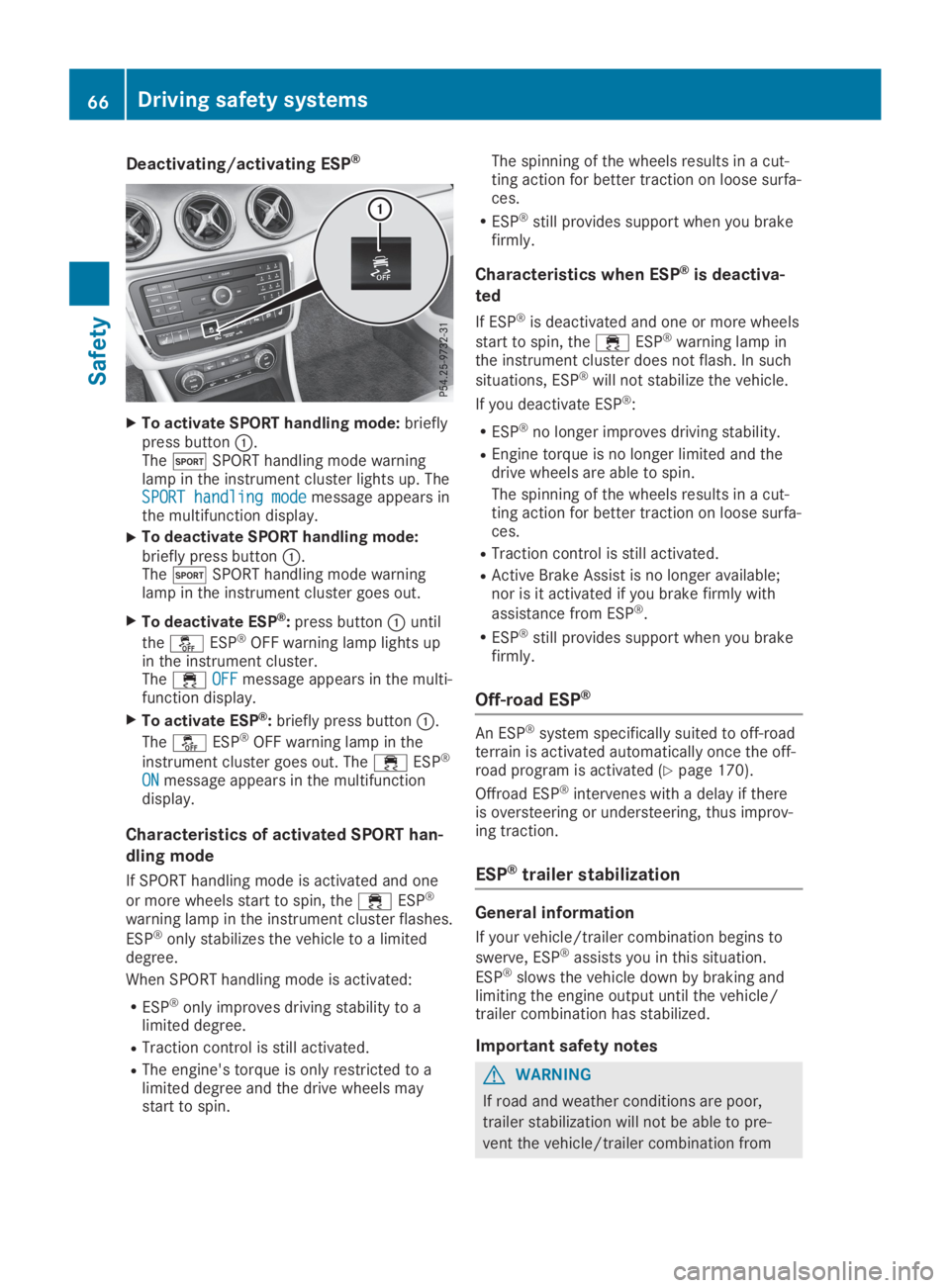
XTo activate SPORT handling mode:brieflypress buttonC.ThetSPORT handling mode warninglamp in the instrument cluster lights up. TheSPORT handling modeSPORT handling modemessage appears inthe multifunction display.
XTo deactivate SPORT handling mode:briefly press buttonC.ThetSPORT handling mode warninglamp in the instrument cluster goes out.
XTo deactivate ESP®:press buttonCuntil
the
Page 104 of 346
Exterior lighting
General notes
For reasons of safety, Mercedes-Benz recom-mends that you drive with the lights switchedon even during the daytime. In some coun-tries, operation of the headlamps varies due tolegal requirements and self-imposed obliga-tions.
Setting the exterior lighting
Setting options
Exterior lighting can be set using the:
Rlight switch
Rcombination switch (Ypage 104)
Ron-board computer (Ypage 199)
Light switch
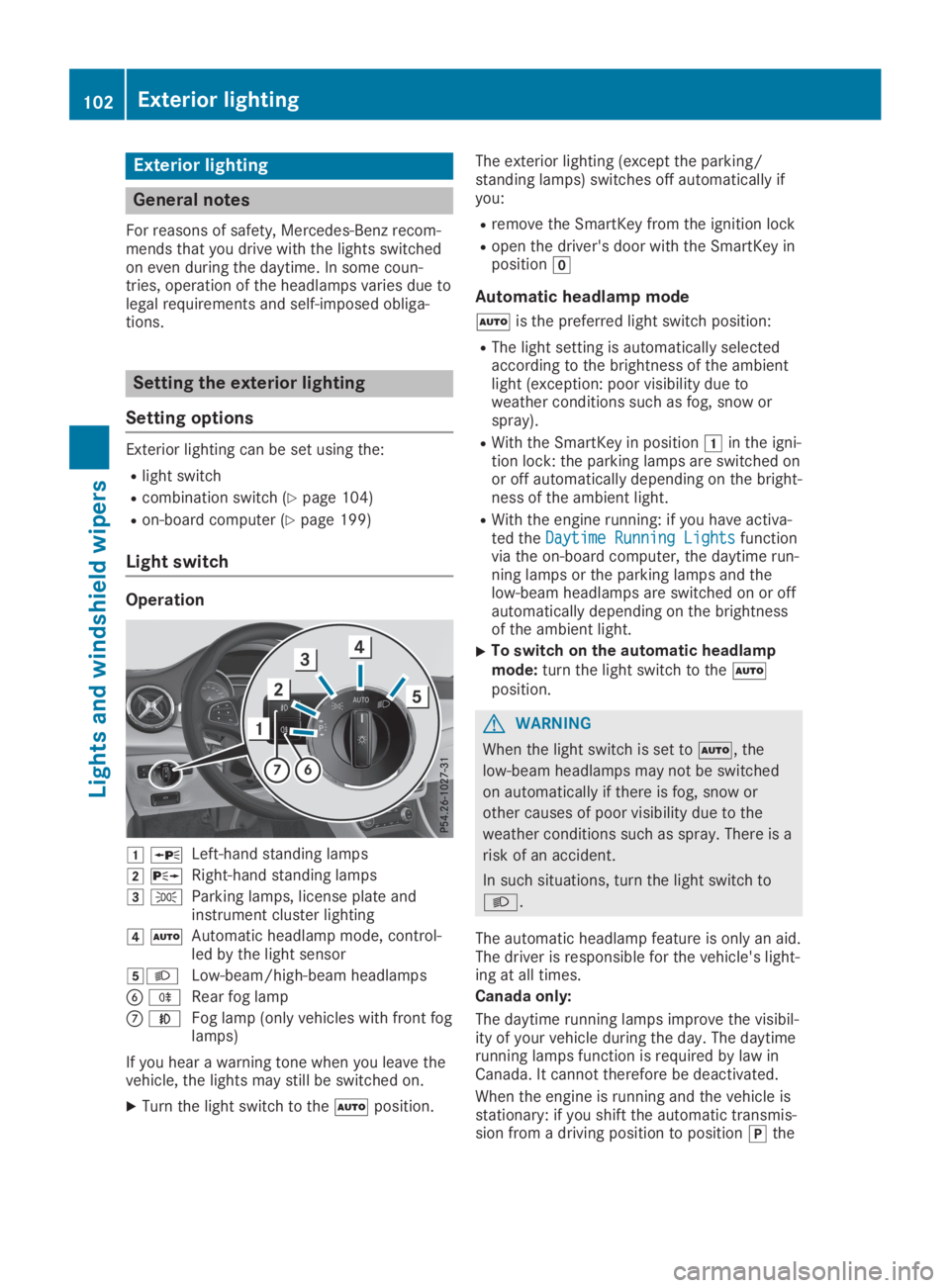
Operation
GcLeft-hand standing lamps
HdRight-hand standing lamps
I`Parking lamps, license plate andinstrument cluster lighting
JXAutomatic headlamp mode, control-led by the light sensor
KXLow-beam/high-beam headlamps
Page 128 of 346
The engine can be switched off while the vehi-cle is in motion by pressing and holding theStart/Stop button for three seconds. Thisfunction operates independently of the ECOstart/stop automatic engine switch-off func-tion.
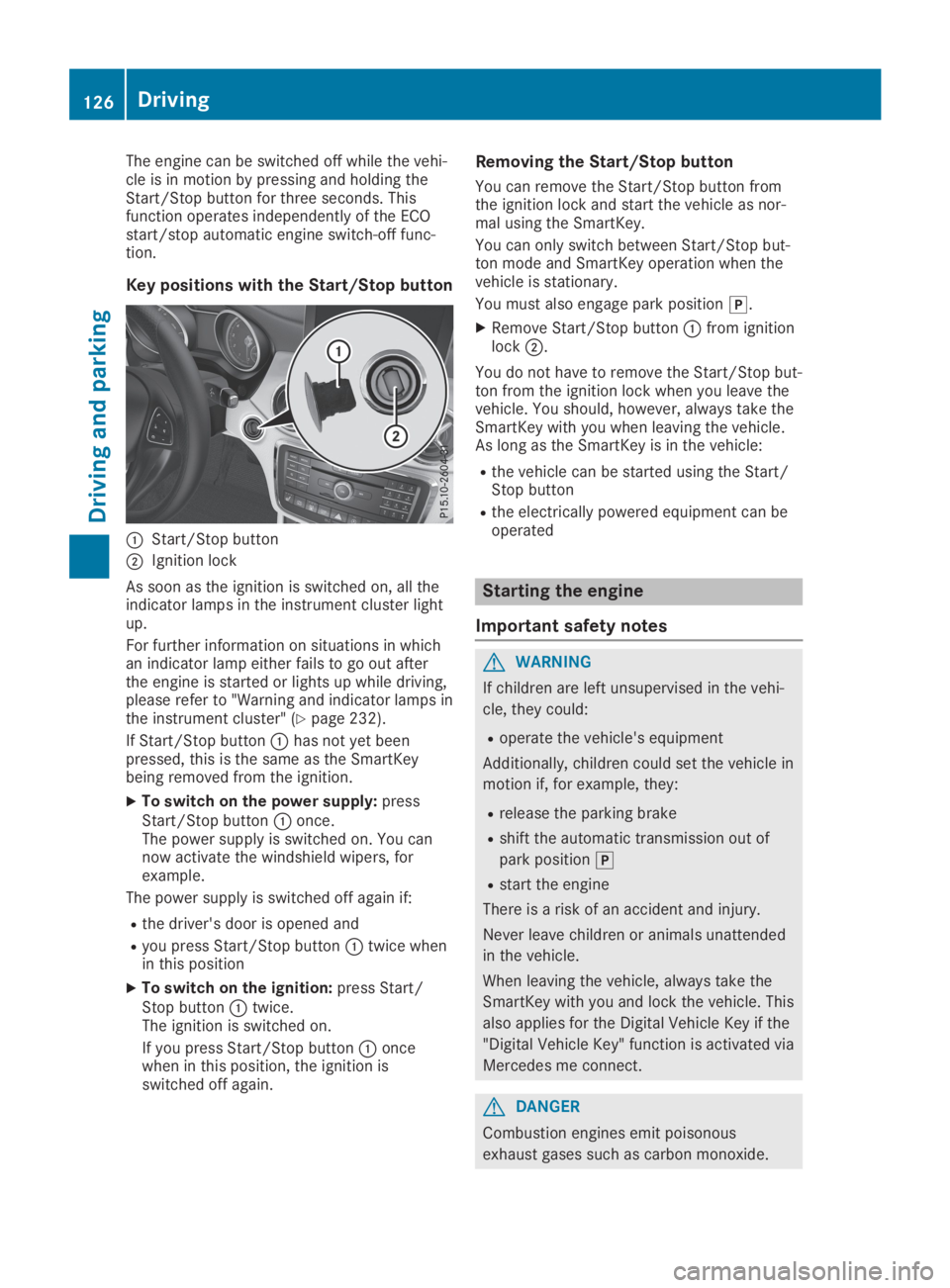
Key positions with the Start/Stop button
CStart/Stop button
DIgnition lock
As soon as the ignition is switched on, all theindicator lamps in the instrument cluster lightup.
For further information on situations in whichan indicator lamp either fails to go out afterthe engine is started or lights up while driving,please refer to "Warning and indicator lamps inthe instrument cluster" (Ypage 232).
If Start/Stop buttonChas not yet beenpressed, this is the same as the SmartKeybeing removed from the ignition.
XTo switch on the power supply:pressStart/Stop buttonConce.The power supply is switched on. You cannow activate the windshield wipers, forexample.
The power supply is switched off again if:
Rthe driver's door is opened and
Ryou press Start/Stop buttonCtwice whenin this position
XTo switch on the ignition:press Start/Stop buttonCtwice.The ignition is switched on.
If you press Start/Stop buttonConcewhen in this position, the ignition isswitched off again.
Removing the Start/Stop button
You can remove the Start/Stop button fromthe ignition lock and start the vehicle as nor-mal using the SmartKey.
You can only switch between Start/Stop but-ton mode and SmartKey operation when thevehicle is stationary.
You must also engage park position].
XRemove Start/Stop buttonCfrom ignitionlockD.
You do not have to remove the Start/Stop but-ton from the ignition lock when you leave thevehicle. You should, however, always take theSmartKey with you when leaving the vehicle.As long as the SmartKey is in the vehicle:
Rthe vehicle can be started using the Start/Stop button
Rthe electrically powered equipment can beoperated
Starting the engine
Important safety notes
GWARNING
If children are left unsupervised in the vehi-
cle, they could:
Roperate the vehicle's equipment
Additionally, children could set the vehicle in
motion if, for example, they:
Rrelease the parking brake
Rshift the automatic transmission out of
park position]
Rstart the engine
There is a risk of an accident and injury.
Never leave children or animals unattended
in the vehicle.
When leaving the vehicle, always take the
SmartKey with you and lock the vehicle. This
also applies for the Digital Vehicle Key if the
"Digital Vehicle Key" function is activated via
Mercedes me connect.
GDANGER
Combustion engines emit poisonous
exhaust gases such as carbon monoxide.
126Driving
Driving and parking
Page 133 of 346
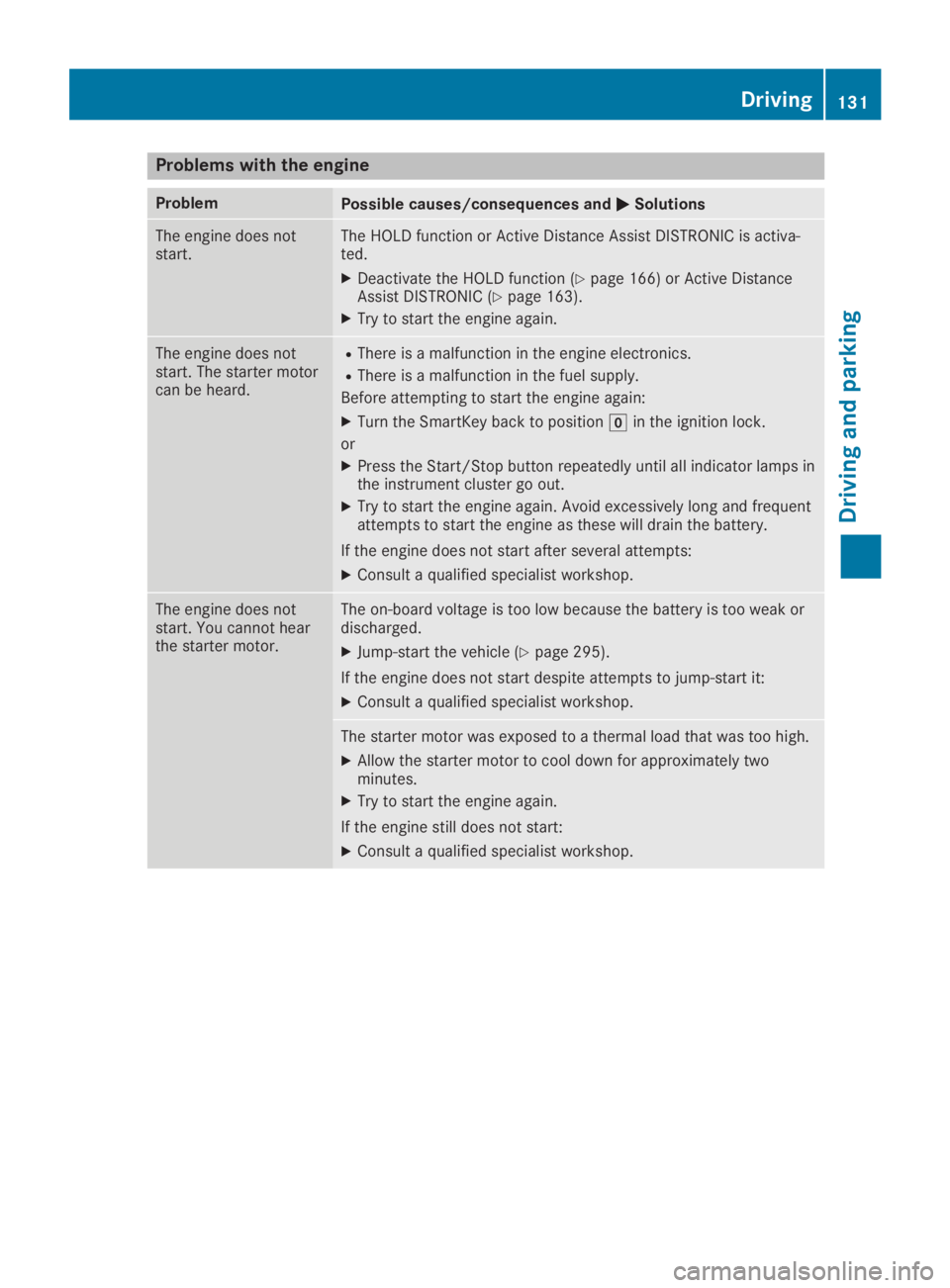
Problems with the engine
ProblemPossible causes/consequences andPPSolutions
The engine does notstart.The HOLD function or Active Distance Assist DISTRONIC is activa-ted.
XDeactivate the HOLD function (Ypage 166) or Active DistanceAssist DISTRONIC (Ypage 163).
XTry to start the engine again.
The engine does notstart. The starter motorcan be heard.
RThere is a malfunction in the engine electronics.
RThere is a malfunction in the fuel supply.
Before attempting to start the engine again:
XTurn the SmartKey back to positionZin the ignition lock.
or
XPress the Start/Stop button repeatedly until all indicator lamps inthe instrument cluster go out.
XTry to start the engine again. Avoid excessively long and frequentattempts to start the engine as these will drain the battery.
If the engine does not start after several attempts:
XConsult a qualified specialist workshop.
The engine does notstart. You cannot hearthe starter motor.
The on-board voltage is too low because the battery is too weak ordischarged.
XJump-start the vehicle (Ypage 295).
If the engine does not start despite attempts to jump-start it:
XConsult a qualified specialist workshop.
The starter motor was exposed to a thermal load that was too high.
XAllow the starter motor to cool down for approximately twominutes.
XTry to start the engine again.
If the engine still does not start:
XConsult a qualified specialist workshop.
Driving131
Driving and parking
Z
Page 148 of 346
![MERCEDES-BENZ GLA 2019 Owners Manual To ensure that the vehicle is secured againstrolling away unintentionally:
Rthe electric parking brake must be applied.
Rthe transmission must be in position]andthe transmission position display must](/manual-img/4/59079/w960_59079-147.png "MERCEDES-BENZ GLA 2019 Owners Manual To ensure that the vehicle is secured againstrolling away unintentionally:
Rthe electric parking brake must be applied.
Rthe transmission must be in position]andthe transmission position display must")
To ensure that the vehicle is secured againstrolling away unintentionally:
Rthe electric parking brake must be applied.
Rthe transmission must be in position]andthe transmission position display must show]in the multifunction display.
Rthe SmartKey must be removed from theignition lock.
Ron uphill or downhill gradients, the frontwheels must be turned towards the curb.
Switching off the engine
Important safety notes
GWARNING
The automatic transmission switches to neu-
tral positionNwhen you switch off the
engine. The vehicle may roll away. There is a
risk of an accident.
After switching off the engine, always switch
to parking positionP. Prevent the parked
vehicle from rolling away by applying the
parking brake.
Automatic transmission
XApply the electric parking brake.
XAll vehicles (except Mercedes-AMG vehi-cles):shift the transmission to position].
XMercedes-AMG vehicles:press buttonC.
XWith the SmartKey :turn the SmartKey topositionZin the ignition lock and removeit.The immobilizer is activated.
XWith the Start/Stop button:press theStart/Stop button (Ypage 125).The engine stops and all the indicator lampsin the instrument cluster go out.
If the driver's door is closed, this is thesame as key positionG. If the driver's dooris open, this is the same as key positionZ,i.e. the SmartKey having been removed.
If you switch the engine off with the transmis-sion in position^or[, the automatic trans-mission shifts to\\automatically.
With the SmartKey:if you then open the driv-er's door or the front-passenger door orremove the SmartKey from the ignition, theautomatic transmission shifts to]automati-cally.
With the Start/Stop button:if you then openthe driver's door or the front-passenger door,the automatic transmission shifts to]auto-matically.
If you want the automatic transmission toremain in neutral\\, e.g. when having thevehicle cleaned in an automatic car wash witha towing system:
XVehicles with the Start-Stop button:remove the Start-Stop button from the igni-tion lock.
XInsert the SmartKey into the ignition lock.
XAll vehicles:switch the ignition on.
XDepress the brake pedal and keep itdepressed.
XEngage neutral\\.
XRelease the brake pedal.
XRelease the electric parking brake.
XSwitch off the ignition and leave the Smart-Key in the ignition lock.
Electric parking brake
General notes
GWARNING
If children are left unsupervised in the vehi-
cle, they could:
Roperate the vehicle's equipment
146Parking
Driving and parking
Page 149 of 346
![MERCEDES-BENZ GLA 2019 Owners Manual Additionally, children could set the vehicle in
motion if, for example, they:
Rrelease the parking brake
Rshift the automatic transmission out of
park position]
Rstart the engine
There is a risk of a](/manual-img/4/59079/w960_59079-148.png "MERCEDES-BENZ GLA 2019 Owners Manual Additionally, children could set the vehicle in
motion if, for example, they:
Rrelease the parking brake
Rshift the automatic transmission out of
park position]
Rstart the engine
There is a risk of a")
Additionally, children could set the vehicle in
motion if, for example, they:
Rrelease the parking brake
Rshift the automatic transmission out of
park position]
Rstart the engine
There is a risk of an accident and injury.
Never leave children or animals unattended
in the vehicle.
When leaving the vehicle, always take the
SmartKey with you and lock the vehicle. This
also applies for the Digital Vehicle Key if the
"Digital Vehicle Key" function is activated via
Mercedes me connect.
The function of the electric parking brake isdependent on the on-board voltage. If the on-board voltage is low or there is a malfunctionin the system, it may not be possible to applythe released parking brake.
XIf this is the case, only park the vehicle onlevel ground and secure it to prevent it roll-ing away.
XShift the automatic transmission to position].
It may not be possible to release an appliedparking brake if the on-board voltage is low orthere is a malfunction in the system. Contact aqualified specialist workshop.
The electric parking brake performs a functiontest at regular intervals while the engine isswitched off. The sounds that can be heardwhile this is occurring are normal.
Applying or releasing manually
XTo apply:push handleC.When the electric parking brake is applied,the redI(USA only) or$(Canadaonly) indicator lamp lights up in the instru-ment cluster.
The electric parking brake can also beapplied when the SmartKey is removed.
XTo release:pull handleC.The redI(USA only) or$(Canadaonly) indicator lamp in the instrument clus-ter goes out.
The electric parking brake can only bereleased:
Rif the SmartKey is in positionGorHinthe ignition lock (Ypage 125) or
Rif the ignition was switched on using theStart/Stop button
Applying automatically
The electric parking brake is automaticallyapplied when the transmission is in position]and:
Rthe engine is switched off or
Rthe driver is not wearing a seat belt and thedriver's door is opened
To prevent the electric parking brake frombeing automatically applied, pull handleC.
The electric parking brake is also applied auto-matically if:
RActive Distance Assist DISTRONIC bringsthe vehicle to a standstill or
RThe HOLD function is keeping the vehiclestationary
RActive Parking Assist is keeping the vehiclestationary
In addition, at least one of the following condi-tions must be fulfilled:
RThe engine is switched off
RThe driver is not wearing a seat belt and thedriver's door is opened
RThere is a system malfunction
RThe power supply is insufficient
RThe vehicle is stationary for a long period oftime
The redI(USA only) or$(Canadaonly) indicator lamp in the instrument clustergoes out.
Parking147
Driving an d parking
Z