Page 250 of 532
250 2-4. Using other driving systems
■Reduced effectiveness of the EPS system
The effectiveness of the EPS system is reduced to prevent the s ystem from
overheating when there is frequent steering input over an exten ded period of
time. The steering wheel may feel heavy as a result. Should thi s occur,
refrain from excessive steering input or stop the vehicle and turn the engine
off. The EPS system should return to normal after a little whil e.
■ Automatic deactivatio n of “TRACK” mode
Vehicles without a smart key system
When the engine switch is turned to “LOCK” position after drivi ng in
“TRACK” mode, the mode is automatically deactivated.
Vehicles with a smart key system
When the “ENGINE START STOP” switch is turned off after driving in
“TRACK” mode, the mode is automatically deactivated.
WARNING
■ The ABS does not operate effectively when
●Tires with inadequate gripping ability are used (such as excess ively worn
tires on a snow covered road).
● The vehicle hydroplanes while driving at high speed on wet or s lick roads.
■ Stopping distance when the ABS is operating may exceed that of nor-
mal conditions
The ABS is not designed to shorten the vehicle’s stopping distance. Always
maintain a safe distance from the vehicle in front of you in the following situ-
ations:
● When driving on dirt, gravel or snow-covered roads
● When driving with tire chains
● When driving over bumps in the road
● When driving over roads with potholes or uneven surfaces
Page 251 of 532

251
2-4. Using other driving systems
2
When driving
WARNING
■
TRAC may not operate effectively when
Directional control and power may not be achievable while drivi ng on slip-
pery road surfaces, even if the TRAC system is operating.
Do not drive the vehicle in conditions where stability and powe r may be lost.
■ When the VSC and/or brake LSD function is activated
The slip indicator light flashes. Always drive carefully. Reckl ess driving may
cause an accident. Exercise particular care when the indicator light flashes.
■ When the TRAC/VSC systems are turned off
Be especially careful and drive at a speed appropriate to the r oad condi-
tions. As these are the systems to help ensure vehicle stability and driving
force, do not turn the TRAC/VSC systems off unless necessary.
■ Replacing tires
Make sure that all tires are of the specified size, brand, trea d pattern and
total load capacity. In addition, make sure that the tires are inflated to the
recommended tire inflation pressure level.
The ABS, TRAC and VSC systems will not function correctly if di fferent tires
are installed on the vehicle.
Contact your Toyota dealer for further information when replaci ng tires or
wheels.
■ Handling of tires and suspension
Using tires with any kind of problem or modifying the suspensio n will affect
the driving assist systems, and may cause a system to malfuncti on.
Page 252 of 532
252
2-4. Using other driving systems
Hill-start assist control
Hill-start assist control helps to maintain braking force to assist
starting off forward while facing uphill or starting off backward while
facing downhill. As hill-start assist control is initially disabled,
enable the system to make it operable. The enabled/disabled set ting
will be maintained the next time the engine is started.
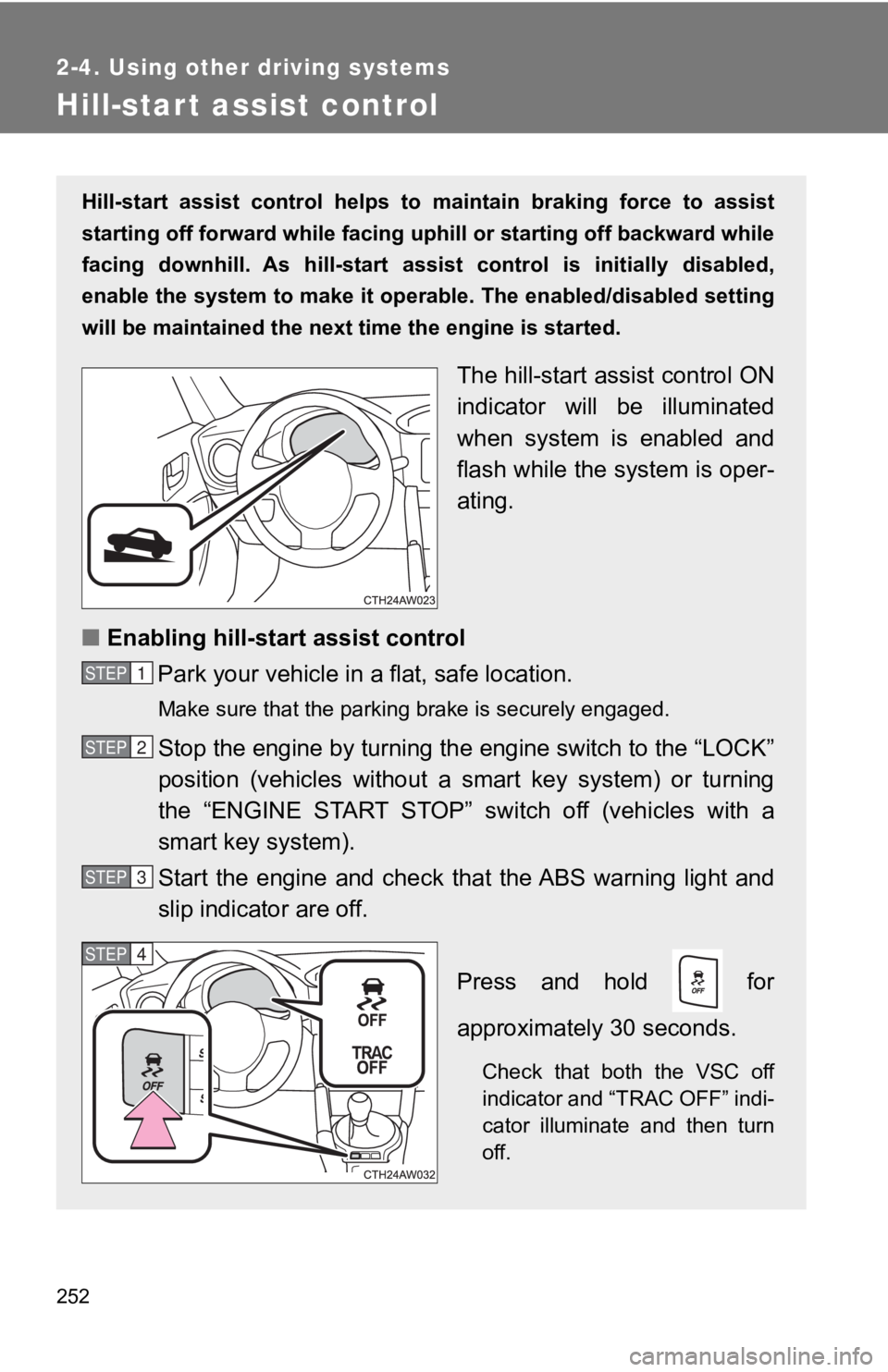
The hill-start assist control ON
indicator will be illuminated
when system is enabled and
flash while the system is oper-
ating.
■ Enabling hill-start assist control
Park your vehicle in a flat, safe location.
Make sure that the parking brake is securely engaged.
Stop the engine by turning the engine switch to the “LOCK”
position (vehicles without a smart key system) or turning
the “ENGINE START STOP” switch off (vehicles with a
smart key system).
Start the engine and check t hat the ABS warning light and
slip indicator are off.
Press and hold for
approximately 30 seconds.
Check that both the VSC off
indicator and “TRAC OFF” indi-
cator illuminate and then turn
off.
STEP 1
STEP 2
STEP 3
STEP 4
Page 255 of 532
255
2-4. Using other driving systems
2
When driving
■
Notes for hill-start assist control
●A slight jolt may be felt when starting off backward with the s hift lever in R
and then moving forward.
● If the braking power of hill-start assist control is insufficient, depress the
brake pedal.
● While the vehicle is stopped, make sure to depress the brake pe dal.
■ The system may be malfunctioning when
In the following situations, the system may be malfunctioning. Have the vehi-
cle inspected by your Toyota dealer.
● The slip indicator is illuminated.
● The hill-start assist control ON indicator turns off and a buzz er sounds.
WARNING
■Hill-start assist control precautions
●Do not overly rely on hill-start assist control. Hill-start ass ist control may
not operate effectively on steep inclines and roads covered wit h ice.
● Unlike the parking brake, hill-start assist control is not inte nded to hold the
vehicle stationary for an extended period of time. Do not attempt to use
hill-start assist control to hold the vehicle on an incline, as doing so may
lead to an accident.
● Do not stop the engine while hill-start assist control is operating, as hill-
start assist control will stop operating, possibly leading to a n accident.
Page 258 of 532
258 2-5. Driving information
As shown in the example above, if the number of occupants
increases, the cargo and luggage load will be reduced by an amount
that equals the increased weig ht due to the additional occupant s. In
other words, if an increase in t he number of occupants causes a n
excess of the total load capacity (combined weight of occupants plus
cargo and luggage load), you must reduce the cargo and luggage on
your vehicle.
WARNING
■Things that must not be carried in the trunk
The following things may cause a fire if loaded in the trunk:
●Receptacles containing gasoline
●Aerosol cans
Page 259 of 532

259
2-5. Driving information
2
When driving
WARNING
■Storage precautions
Observe the following precautions.
Failure to do so may result i
n death or serious injury.
●Stow cargo and luggage in the trunk whenever possible.
●To prevent cargo and luggage from sliding forward during brakin g, do
not stack anything in the enlarged trunk. Keep cargo and luggag e low,
as close to the floor as possible.
●When you fold down the rear seats, long items should not be pla ced
directly behind the front seats.
●Never allow anyone to ride in the enlarged trunk. It is not des igned for
passengers. They should ride in their seats with their seat belts prop-
erly fastened. Otherwise, they are much more likely to suffer d eath or
serious bodily injury, in the event of sudden braking, sudden s werving
or an accident.
●Do not place cargo or luggage in or on the following locations as the
item may get under the clutch, brake or accelerator pedal and p revent
the pedals from being depressed properly, block the driver’s vi sion, or
hit the driver or passengers, causing an accident:
• At the feet of the driver
• On the front passenger or rear seats (when stacking items)
• On the package tray
• On the instrument panel
• On the dashboard
●Secure all items in the occupant compartment, as they may shift and
injure someone during sudden braking, sudden swerving or an acc i-
dent.
■Capacity and distribution
●Do not exceed the maximum axle weight rating or the total vehic le
weight rating.
●Even if the total load of occupant's weight and the cargo load is less
than the total load capacity, do not apply the load unevenly. I mproper
loading may cause deterioration of steering or braking control which
may cause death or serious injury.
Page 260 of 532
260
2-5. Driving information
Vehicle load limits
■Total load capacity and seating capacity
These details are described on the tire and loading information label.
( P. 3 5 3 )
WARNING
■Overloading the vehicle
Do not overload the vehicle.
It may not only cause damage to t he tires, but also degrade steering and
braking ability, resulting in an accident.
Vehicle load limits include total load capacity, seating capaci ty,
towing capacity and cargo capacity.
■ Total load capacity (veh icle capacity weight): ( P. 458)
Total load capacity means the combined weight of occupants, car go
and luggage.
■ Seating capacity
Seating capacity means the max imum number of occupants whose
estimated average weight is 150 lb. (68 kg) per person.
■Towing capacity
Toyota does not recommend towing a trailer with your vehicle.
■Cargo capacity
Cargo capacity may increase or decrease depending on the weight
and the number of occupants.
Page 264 of 532
264 2-5. Driving information
WARNING
■Driving with snow tires
Observe the following precautions to reduce the risk of accidents.
Failure to do so may result in a loss of vehicle control and ca use death or
serious injury.
●Use tires of the specified size, and that are the same size, sa me
maker, same brand and tread pattern.
●Maintain the recommended level of air pressure.
●Do not drive in excess of 75 mph (120 km/h), regardless of the type of
snow tires being used.
●Use snow tires on all, not just some wheels.
NOTICE
■Repairing or replacing snow tires
Request repairs or replacement of snow tires from Toyota dealers or
legitimate tire retailers.
This is because the removal and a ttachment of snow tires affects the
operation of the tire pressure wa rning valves and transmitters.
■Fitting tire chains
The tire pressure warning valves and transmitters may not funct ion cor-
rectly when tire chains are fitted.