Page 347 of 532

347
4-3. Do-it-yourself maintenance
4
Maintenance and care
■When to replace your vehicle’s tires
Tires should be replaced if:
●The treadwear indicators are showing on a tire.
●You have tire damage such as c
uts, splits, cracks deep enough to
expose the fabric or bulges indicating internal damage
●A tire goes flat repeatedly or cannot be properly repaired due to the
size or location of a cut or other damage
If you are not sure, consul t with your Toyota dealer.
■Replacing tires and wheels
If the ID code of the tire pressure warning valve and transmitt er is not
registered, the tire pressure w arning system will not work prop erly. After
driving for about 20 minutes, t he tire pressure warning light c omes on
after blinking for 1 minute to indicate a system malfunction.
■Tire life
Any tire over 6 years old must be checked by a qualified techni cian even
if they have seldom or never b een used or damage is not obvious.
■If the tread wears down below 0.16 in. (4 mm) on snow tires
The effectiveness of snow tires is lost.
■Low profile tires
Generally, low profile tires will wear more rapidly and tire gr ip perfor-
mance will be reduced on snowy and /or icy roads when compared to
standard tires. Be sure to use snow tires or tire chains on sno wy and/or
icy roads and drive carefully at a speed appropriate for road a nd weather
conditions.
Page 349 of 532

349
4-3. Do-it-yourself maintenance
4
Maintenance and care
■Initializing the tire p
ressure warning system
Initialize the system with the ti re inflation pressure adjusted to the speci-
fied level.
■Routine tire infla tion pressure checks
The tire pressure warning system does not replace routine tire inflation
pressure checks. Make sure to check tire inflation pressure as part of
your routine of daily vehicle checks.
■Tire pressure warning system certification (vehicles without a
smart key system)
MODEL/FCC IDs:
Transmitter: PAXPMVC010
Receiver: HYQ23AAC
For vehicles sold in the U.S.A.
This device complies with part 15 of the FCC Rules. Operation is subject
to the following two conditions: (1) This device may not cause harmful
interference, and (2) this device must accept any interference received,
including interference that may cause undesired operation.
FCC WARNING:
Changes or modifications not expressly approved by the party re sponsi-
ble for compliance could void the user's authority to operate t he equip-
ment.
For vehicles sold in Canada
NOTE:
This device complies with Industr y Canada’s licence-exempt RSSs.
Operation is subject to the following two conditions: (1) This device may
not cause interference; and (2) This device must accept any int erfer-
ence, including interference that may cause undesired operation of the
device.
NOTE:
Le présent appareil est conforme aux CNR d’Industrie Canada applica-
bles aux appareils radio exempts de licence. L’exploitation est autorisée
aux deux conditions suivantes: (1) l’appareil ne doit pas produ ire de
brouillage; (2) l’utilisateur de l’appareil doit accepter tout brouillage
radioélectrique subi, même si le brouillage est susceptible d’en compro-
mettre le fonctionnement.
Page 350 of 532

350 4-3. Do-it-yourself maintenance
■Tire pressure warning system certification (vehicles with a smart
key system)
MODEL/FCC IDs:
Transmitter: PAXPMVC010
Receiver: HYQ23AAE
For vehicles sold in the U.S.A.
This device complies with part 15 of the FCC Rules. Operation is subject
to the following two conditions: (1) This device may not cause harmful
interference, and (2) this device must accept any interference received,
including interference that may cause undesired operation.
FCC WARNING:
Changes or modifications not expressly approved by the party re sponsi-
ble for compliance could void the user's authority to operate t he equip-
ment.
For vehicles sold in Canada
NOTE:
This device complies with Industry Canada’s licence-exempt RSSs .
Operation is subject to the following two conditions: (1) This device may
not cause interference; and (2) This device must accept any int erfer-
ence, including interference that may cause undesired operation of the
device.
NOTE:
Le présent appareil est conforme aux CNR d’Industrie Canada app lica-
bles aux appareils radio exempts de licence. L’exploitation est autorisée
aux deux conditions suivantes: (1) l’appareil ne doit pas produ ire de
brouillage; (2) l’utilisateur de l’appareil doit accepter tout brouillage
radioélectrique subi, même si le brouillage est susceptible d’en compro-
mettre le fonctionnement.
Page 351 of 532
351
4-3. Do-it-yourself maintenance
4
Maintenance and care
WARNING
■Tire pressure warning system operation
The tire pressure warning system may not provide warning immedi
ately
if a tire bursts or if sudden air leakage occurs.
■When inspecting or replacing tires
Observe the following precautions to prevent accidents.
Failure to do so may cause damage to parts of the drive train, as well as
dangerous handling characteristics, which may lead to an accide nt
resulting in death or serious injury.
●Make sure to install 4 tires that are of the specified size, and that all 4
tires are the same size, same ma ker, same brand and tread pattern.
●Do not use tire sizes other than those recommended by Toyota.
●Only use radial tires.
●Do not mix summer, all season and snow tires.
●Do not use tires that have be en used on another vehicle.
Do not use tires if you do not kno w how they were used previously.
NOTICE
■Repairing or replacing tires, wheels, tire pressure warning val ves,
transmitters and tire valve caps
●When removing or fitting the wheels, tires or the tire pressure warning
valves and transmitters, contact your Toyota dealer as the tire pres-
sure warning valves and transmitters may be damaged if not hand led
correctly.
●Make sure to install the tire valve caps. If the tire valve cap s are not
installed, water could enter the tire pressure warning valves a nd the
tire pressure warning valves could be bound.
●When replacing tire valve caps, do not use tire valve caps othe r than
those specified. The c ap may become stuck.
Page 356 of 532
356 4-3. Do-it-yourself maintenance
WARNING
■Proper inflation is critical to save tire performance
Keep your tires properly inflated.
If the tires are not properly inflated, the following conditions may occur
which could lead to an accident resulting in death or serious injury:
●Excessive wear
●Uneven wear
●Poor handling
●Possibility of blowouts resulting from overheated tires
●Air leaking from between tire and wheel
●Wheel deformation and/or tire damage
●Greater possibility of tire damage while driving (due to road hazards,
expansion joints, sharp edges in the road, etc.)
NOTICE
■When inspecting and adjust ing tire inflation pressure
Be sure to reinstall the tire valve caps.
If a valve cap is not installed, dirt or moisture may get into the valve and
cause an air leak, resulting in decreased tire inflation pressu re.
Page 358 of 532
358 4-3. Do-it-yourself maintenance
■When replacing wheels
The wheels of your Toyota are equipped with tire pressure warning
valves and transmitters that allow the tire pressure warning sy stem to
provide advanced warning in the event of a loss in tire inflati on pressure.
Whenever wheels are replaced, the tire pressure warning valves and
transmitters mus t be installed. (P. 3 4 6 )
WARNING
■When replacing wheels
●Do not use wheels that are a different size from those recommen ded in
the Owner’s Manual, as this may result in loss of handling cont rol.
●Never use an inner tube in a leaking wheel which is designed fo r a
tubeless tire. Doing so may result in an accident, causing deat h or seri-
ous injury.
■When installing the wheel nuts
●Never use oil or grease on the wheel bolts or wheel nuts.
Oil and grease may cause the wheel nuts to be excessively tight ened,
leading to bolt or disc wheel damage. In addition, the oil or g rease can
cause the wheel nuts to loosen and the wheel may fall off, caus ing an
accident and resulting in death or serious injury. Remove any o il or
grease from the wheel bolts or wheel nuts.
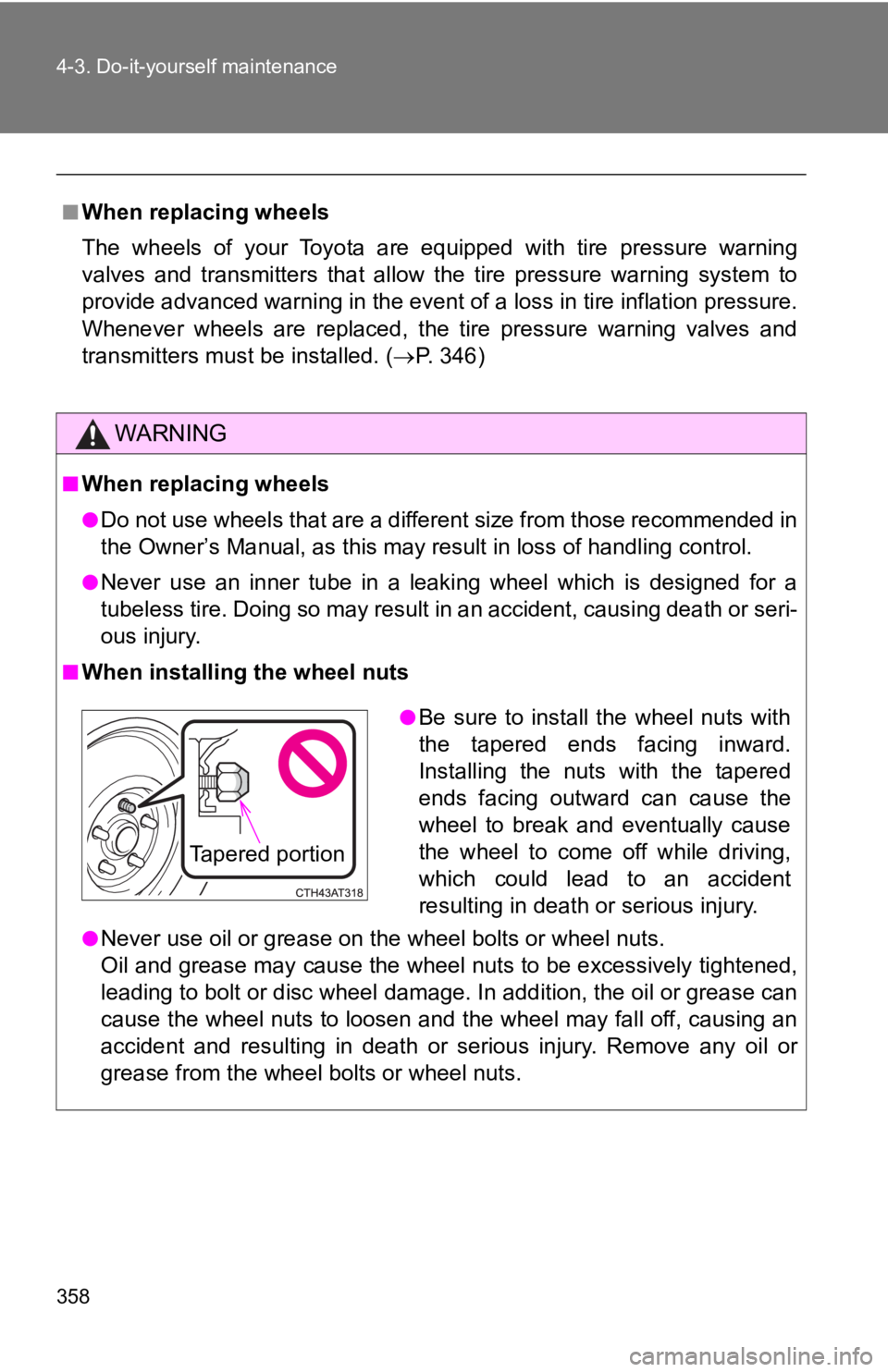
●Be sure to install the wheel nuts with
the tapered ends facing inward.
Installing the nuts with the tapered
ends facing outward can cause the
wheel to break and eventually cause
the wheel to come off while driving,
which could lead to an accident
resulting in death or serious injury.
Tapered portion
Page 359 of 532
359
4-3. Do-it-yourself maintenance
4
Maintenance and care
NOTICE
■Replacing tire inflation pressu
re warning valves and transmitte rs
●Because tire repair or replacement may affect the tire pressure warn-
ing valves and transmitters, make sure to have tires serviced b y your
Toyota dealer or other qualifie d service shop. In addition, make sure to
purchase your tire pressure warning valves and transmitters at your
Toyota dealer.
●Ensure that only genuine Toyota w heels are used on your vehicle.
Tire pressure warning valves and transmitters may not work prop erly
with non-genuine wheels.
Page 365 of 532
365
4-3. Do-it-yourself maintenance
4
Maintenance and care
■
Use a CR2016 (vehicles without a smart key system) or CR2032 (v ehi-
cles with a smart key system) lithium battery
● Batteries can be purchased at your Toyota dealer, local electri cal appli-
ance shops or camera stores.
● Replace only with the same or equivalent type recommended by th e
manufacturer.
● Dispose of used batteries according to local laws.
■ If the key battery is depleted
The following symptoms may occur:
●The smart key system (if equipped) and wireless remote control will not
function properly.
● The operational range will be reduced.
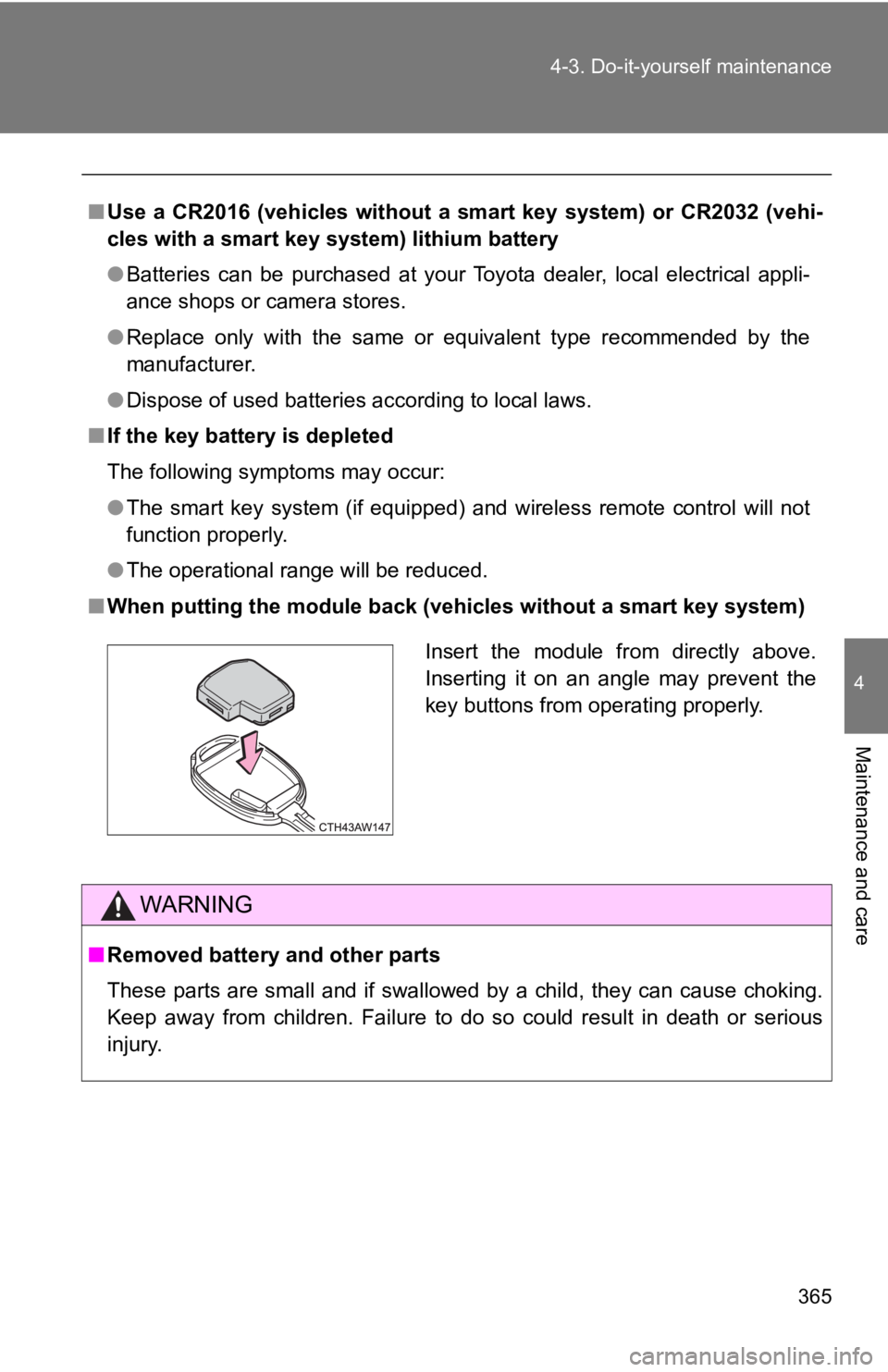
■ When putting the module back ( vehicles without a smart key syst em)
WARNING
■Removed battery and other parts
These parts are small and if swallowed by a child, they can cau se choking.
Keep away from children. Failure to do so could result in death or serious
injury.
Insert the module from directly above.
Inserting it on an angle may prevent the
key buttons from operating properly.