Page 374 of 532
374 4-3. Do-it-yourself maintenance
■After a fuse is replaced
●If the lights do not turn on even after the fuse has been repla ced, a bulb
may need replacement. ( P. 375)
● If the replaced fuse blows again, have the vehicle inspected by your
Toyota dealer.
■ If there is an overload in the circuits
The fuses are designed to blow, protecting the wiring harness from damage.
WARNING
■To prevent system breakdow ns and vehicle fire
Observe the following precautions.
Failing to do so may cause damage to the vehicle, and possibly a fire or
injury.
● Never use a fuse of a higher amperage rating than indicated, or use any
other object in place of a fuse.
● Always use a genuine Toyota fuse or equivalent.
● Do not modify the fuse or the fuse box.
NOTICE
■Before replacing fuses
Have the cause of electrical overload determined and repaired b y your
Toyota dealer.
Page 381 of 532
381
4-3. Do-it-yourself maintenance
4
Maintenance and care
WARNING
■
Replacing light bulbs
●Turn off the lights. Do not attempt to replace the bulb immedia tely after
turning off the lights.
The bulbs become very hot and may cause burns.
● Do not touch the glass portion of the light bulb with bare hand s. When it is
unavoidable to hold the glass portion, use and hold with a clea n dry cloth
to avoid getting moisture and oils on the bulb.
Also, if the bulb is scratched or dropped, it may blow out or c rack.
● Fully install the light bulbs and any parts used to secure them . Failure to
do so may result in heat damage, fire, or water entering a light unit. This
may damage the light or cause condensation to build up on the i nner side
of the lens.
■ When changing the back-up lights
Stop the engine and wait until the exhaust pipes have cooled do wn suffi-
ciently. The lights are located near the exhaust pipe and touching a hot
exhaust pipe can cause burns.
■ To prevent damage or fire
Make sure bulbs are fully seated and locked.
Page 383 of 532
When trouble arises5
383
5-1. Essential informationEmergency flashers ......... 384
If your vehicle needs to be towed ........................ 385
If you think something is wrong ......................... 393
Fuel pump shut off system ........................... 394
5-2. Steps to take in an emergency
If a warning light turns on or a warning buzzer
sounds... ........................ 395
If a warning message is displayed........................ 407
If you have a flat tire......... 424 If the engine will
not start .......................... 435
If the shift lever cannot be shifted from P................. 438
If you lose your keys ........ 439
If the electronic key does not operate properly....... 440
If the battery is discharged ..................... 444
If your vehicle overheats ....................... 449
If the vehicle becomes stuck .............................. 452
If your vehicle has to be stopped in an
emergency ..................... 454
Page 386 of 532
386 5-1. Essential information
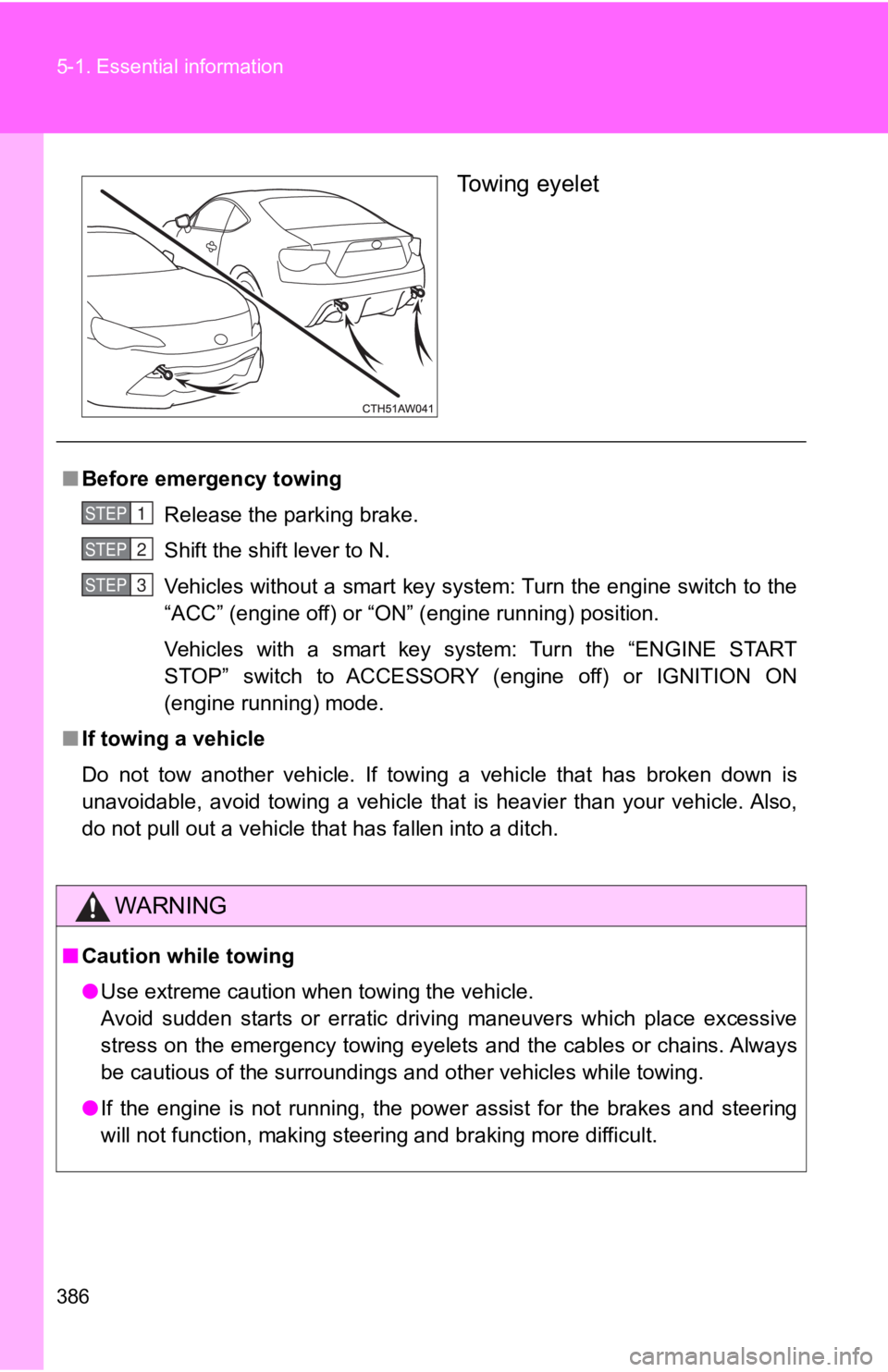
To w i n g e y e l e t
■Before emergency towing
Release the parking brake.
Shift the shift lever to N.
Vehicles without a smart key system: Turn the engine switch to the
“ACC” (engine off) or “ON” (engine running) position.
Vehicles with a smart key system: Turn the “ENGINE START
STOP” switch to ACCESSORY (engine off) or IGNITION ON
(engine running) mode.
■ If towing a vehicle
Do not tow another vehicle. If towing a vehicle that has broken down is
unavoidable, avoid towing a vehicle that is heavier than your v ehicle. Also,
do not pull out a vehicle that has fallen into a ditch.
WARNING
■ Caution while towing
●Use extreme caution when towing the vehicle.
Avoid sudden starts or erratic driving maneuvers which place excessive
stress on the emergency towing eyelets and the cables or chains. Always
be cautious of the surroundings and other vehicles while towing .
● If the engine is not running, the power assist for the brakes a nd steering
will not function, making steering and braking more difficult.
STEP 1
STEP 2
STEP 3
Page 389 of 532
5
When trouble arises
389
5-1. Essential
information
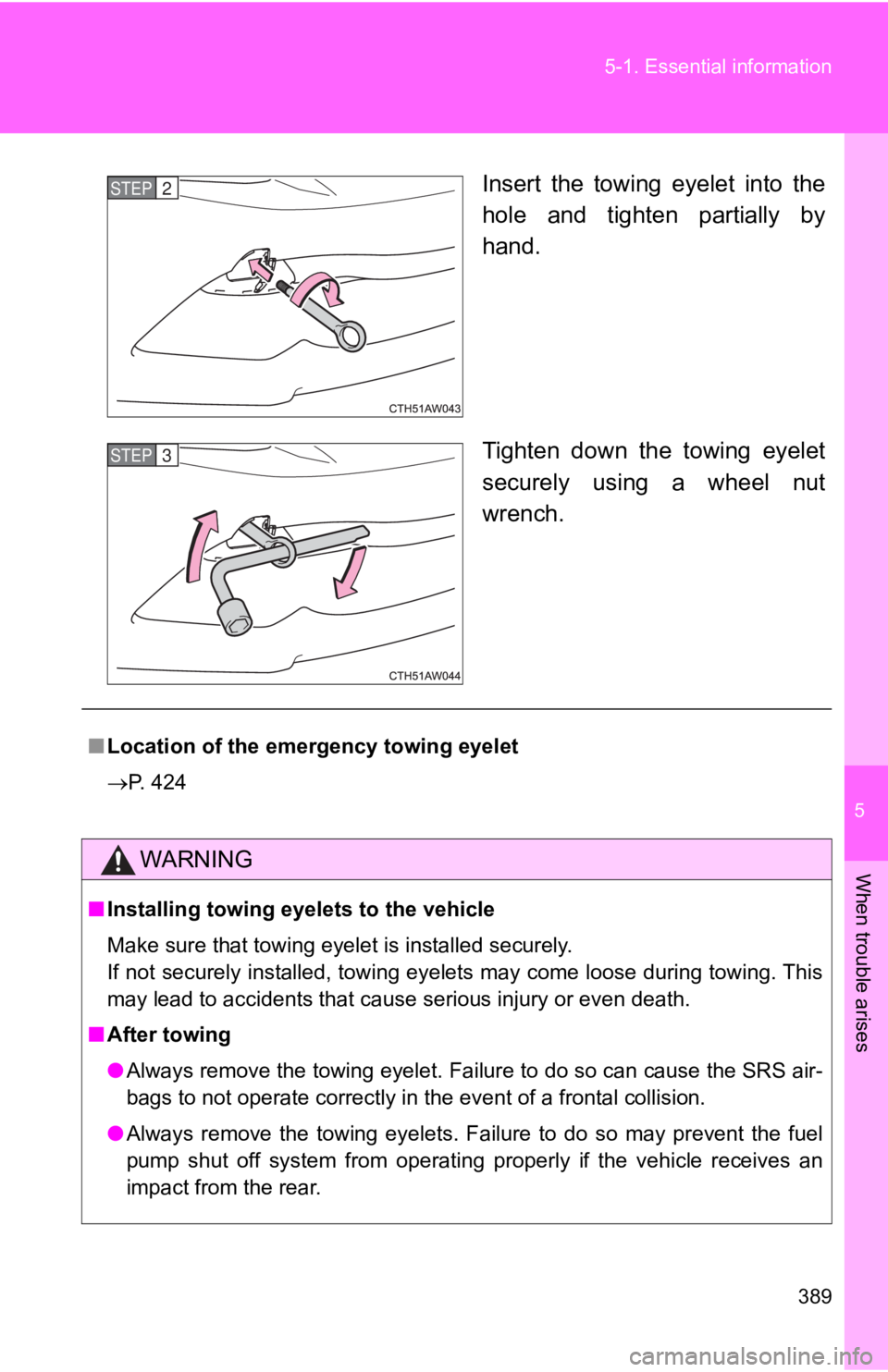
Insert the towing eyelet into the
hole and tighten partially by
hand.
Tighten down the towing eyelet
securely using a wheel nut
wrench.STEP 2
STEP 3
■Location of the eme rgency towing eyelet
P. 424
WARNING
■ Installing towing eyelets to the vehicle
Make sure that towing eyelet is installed securely.
If not securely installed, towing eyelets may come loose during towing. This
may lead to accidents that cause serious injury or even death.
■ After towing
●Always remove the towing eyelet. Failure to do so can cause the SRS air-
bags to not operate correctly in the event of a frontal collisi on.
● Always remove the towing eyelets. Failure to do so may prevent the fuel
pump shut off system from operating properly if the vehicle receives an
impact from the rear.
Page 395 of 532
5
When trouble arises
395
5-2. Steps to take in an emergency
If a warning light tur ns on or a war ning buzzer sounds...
Stop the vehicle immediately. Continuing to drive the vehicle
may be dangerous.
The following warning indicates a possible problem in the brake sys-
tem. Immediately stop the vehicle in a safe place and contact y our
Toyota dealer.
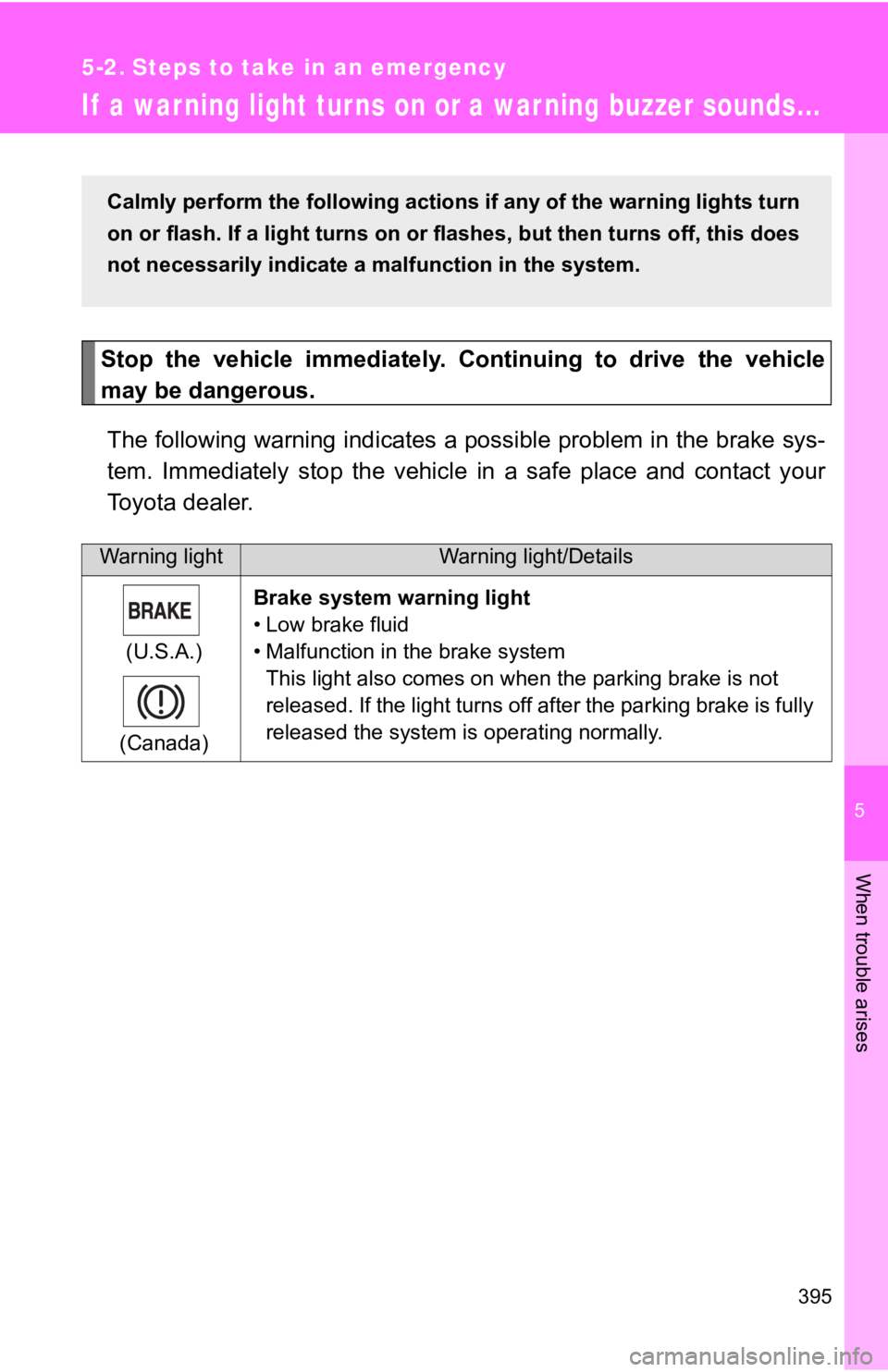
Warning lightWarning light/Details
(U.S.A.)
(Canada) Brake system warning light
• Low brake fluid
• Malfunction in the brake system
This light also comes on when the parking brake is not
released. If the light turns off after the parking brake is ful ly
released the system is operating normally.
Calmly perform the following acti ons if any of the warning lights turn
on or flash. If a light turns on or flashes, but then turns off , this does
not necessarily indicate a malfunction in the system.
Page 396 of 532
396 5-2. Steps to take in an emergency
Stop the vehicle immediately.The following warning indicates the possibility of damage to th e vehi-
cle that may lead to an acciden t. Immediately stop the vehicle in a
safe place and contact your Toyota dealer.
Warning lightWarning light/Details
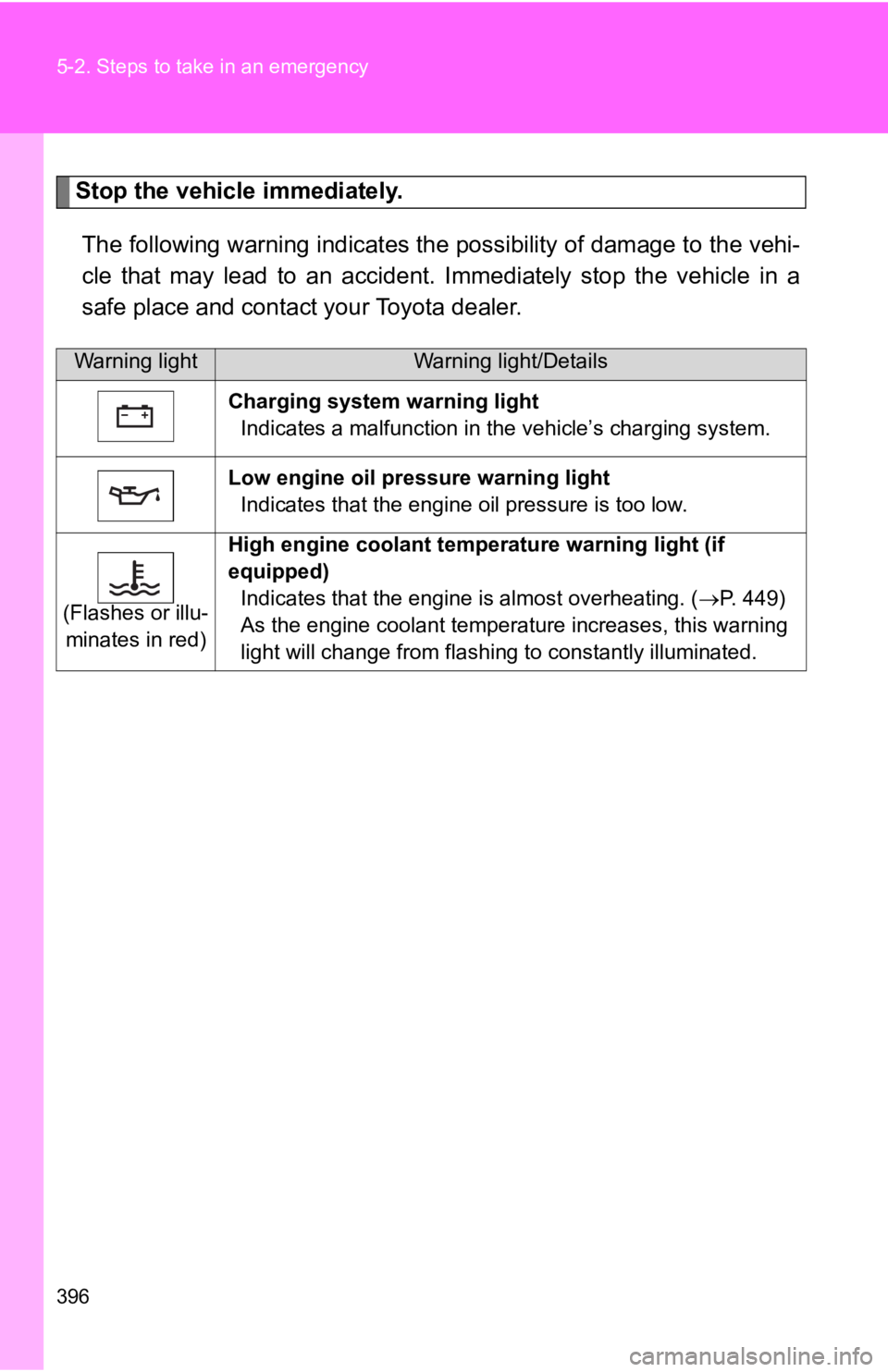
Charging system warning light Indicates a malfunction in the vehicle’s charging system.
Low engine oil pressure warning light Indicates that the engine oil pressure is too low.
(Flashes or illu- minates in red) High engine coolant temper
ature warning light (if
equipped) Indicates that the engine is almost overheating. ( P. 449)
As the engine coolant temperature increases, this warning
light will change from flashing to constantly illuminated.
Page 397 of 532
5
When trouble arises
397
5-2. Steps to take in an emergency
Have the vehicle ins
pected immediately.
Failing to investigate the cause of the following warnings may lead to
the system operating abnormally and possibly cause an accident.
Have the vehicle ins pected by your Toyota dealer immediately.
Warning lightWarning light/Details
(U.S.A.)
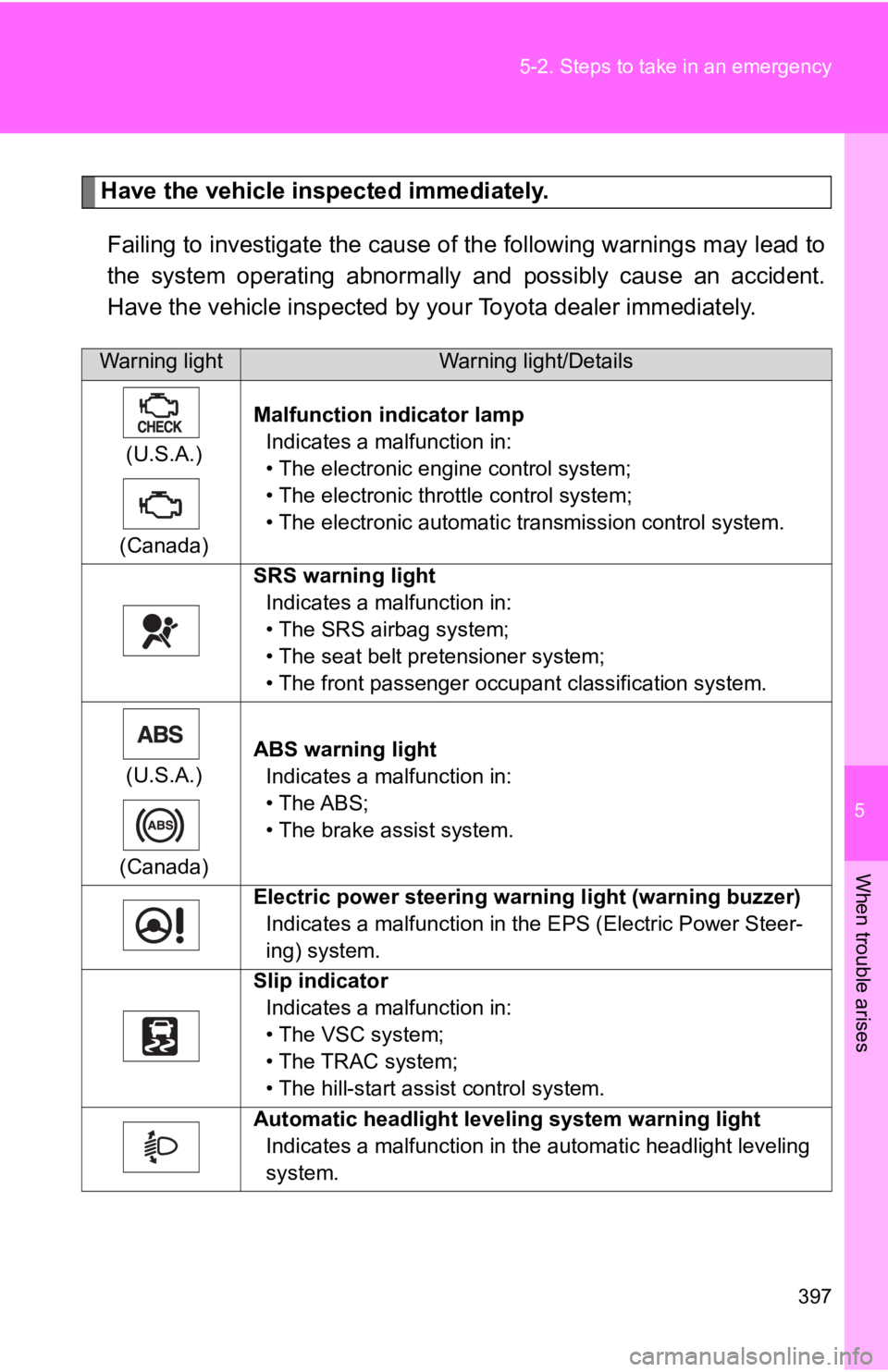
(Canada) Malfunction indicator lamp
Indicates a malfunction in:
• The electronic engine control system;
• The electronic throttle control system;
• The electronic automatic transmission control system.
SRS warning light Indicates a malfunction in:
• The SRS airbag system;
• The seat belt pretensioner system;
• The front passenger occupant classification system.
(U.S.A.)
(Canada) ABS warning light
Indicates a malfunction in:
• The ABS;
• The brake assist system.
Electric power steering warning light (warning buzzer) Indicates a malfunction in the EPS (Electric Power Steer-
ing) system.
Slip indicator Indicates a malfunction in:
• The VSC system;
• The TRAC system;
• The hill-start assist control system.
Automatic headlight leveling system warning light Indicates a malfunction in the automatic headlight leveling
system.