Page 423 of 532
5
When trouble arises
423
5-2. Steps to take in an emergency
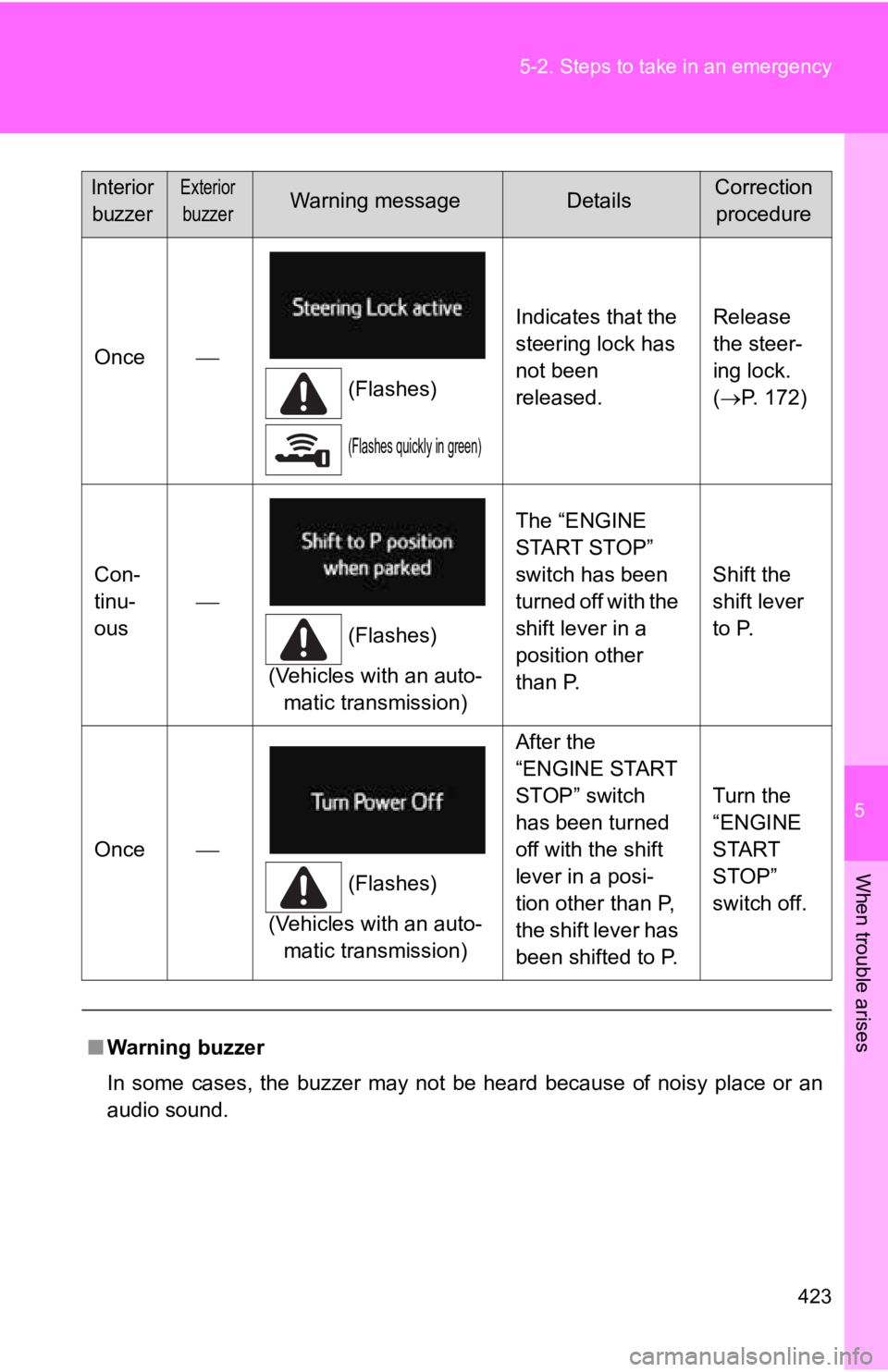
Once
(Flashes)
(Flashes quickly in green)
Indicates that the
steering lock has
not been
released. Release
the steer-
ing lock.
(
P. 172)
Con-
tinu-
ous
(Flashes)
(Vehicles with an auto- matic transmission) The “ENGINE
START STOP”
switch has been
turned off with the
shift lever in a
position other
than P.
Shift the
shift lever
to P.
Once
(Flashes)
(Vehicles with an auto- matic transmission) After the
“ENGINE START
STOP” switch
has been turned
off with the shift
lever in a posi-
tion other than P,
the shift lever has
been shifted to P.
Turn the
“ENGINE
START
STOP”
switch off.
■ Warning buzzer
In some cases, the buzzer may not be heard because of noisy pla ce or an
audio sound.
Interior buzzerExterior
buzzerWarning messageDetailsCorrection procedure
Page 429 of 532
5
When trouble arises
429
5-2. Steps to take in an emergency
Stow the flat tire, tire jack and all tools.
■The compact spare tire
●The compact spare tire is identified by the label “TEMPORARY US
E
ONLY” on the tire sidewall.
Use the compact spare tire tem porarily only in an emergency.
●Make sure to check the tire pressure of the compact spare tire.
( P. 468)
■When using the compact spare tire
As the compact spare tire is not equipped with the tire pressure warning
valve and transmitter, low infla tion pressure of the spare tire will not be
warned. Also, if you replace the compact spare tire after the t ire pressure
warning light comes on, the light remains on.
■If you have a flat rear tire
Install the compact spare tire on the front of the vehicle. Per form the fol-
lowing steps.
Replace a front tire with the compact spare tire.
Replace the flat rear tire with the tire removed from the front of
the vehicle.
■After completing the tire change
The tire pressure warning system must be reset. (P. 3 4 6 )
STEP 5
STEP 1
STEP 2
Page 431 of 532

5
When trouble arises
431
5-2. Steps to take in an emergency
WARNING
■Using the tire jack
Improper use of the tire jack may lead to death or serious inju
ries due to
the vehicle suddenly falling off the jack.
●Do not use the tire jack for any purpose other than replacing t ires or
installing and removing tire chains.
●Only use the tire jack that comes with this vehicle for replacing a flat
tire.
Do not use it on other vehicles, and do not use other tire jack s for
replacing tires on this vehicle.
●Always check that the tire jack is securely set to the jack point.
●Do not put any part of your body under the vehicle supported by a jack.
●Do not start or run the engine while your vehicle is supported by the
jack.
●Do not raise the vehicle while someone is in it.
●When raising the vehicle, do not put an object on or under the jack.
●Do not raise the vehicle to a height greater than that required to
replace the tire.
●Use a jack stand if it is necessary to get under the vehicle.
Take particular care when lowering the vehicle to ensure that n o one
working on or near the vehicle may be injured.
Page 432 of 532

432 5-2. Steps to take in an emergency
WARNING
■Replacing a flat tire
●Do not touch the disc wheels or the area around the brakes immedi-
ately after the vehicl e has been driven.
After the vehicle has been driven the disc wheels and the area around
the brakes will be extremely hot . Touching these areas with han ds, feet
or other body parts w hile changing a tire, e tc. may result in burns.
●Do not attach a heavily damaged wheel ornament, as it may fly o ff the
wheel while the ve hicle is moving.
●Failure to follow these precautions could cause the wheel nuts to
loosen and the tire to fall off, resulting in death or serious injury.
• Have the wheel nuts tightened with a torque wrench to 89 ft•lb f (120
N•m, 12.2 kgf•m) as soon as possible after changing wheels.
• When installing a tire, only use wheel nuts that have been spe cifi-
cally designed for that wheel.
• If there are any cracks or deformations in the bolt screws, nu t
threads or bolt holes of the wheel, have the vehicle inspected by
your Toyota dealer.
• When installing the wheel nuts, be sure to install them with t he
tapered ends facing inward. ( P. 358)
Page 433 of 532

5
When trouble arises
433
5-2. Steps to take in an emergency
WARNING
■When using the compact spare tire
●Remember that your compact spare tire is specifically designed
for
use with your vehicle. Do not use your compact spare tire on an other
vehicle.
●Do not use two compact spa re tires simultaneously.
●Replace the compact spare tire with a standard tire as soon as possi-
ble.
●Avoid sudden acceleration, abrupt steering, sudden braking and shift-
ing operations that cause sudden engine braking.
●Install the compact spar e tire on a front wheel.
■When storing the compact spare tire
Be careful not to catch fingers or other body parts between the compact
spare tire and the body of the vehicle.
■Speed limit when using the compact spare tire
Do not drive at speeds in excess of 50 mph (80 km/h) when a compact
spare tire is installed on the vehicle.
The compact spare tire is not designed for driving at high spee ds. Failing
to observe this precaution may lead to an accident causing deat h or seri-
ous injury.
■When the compact spare tire is attached
The vehicle speed may not be corr ectly detected, and the following sys-
tems may not ope rate correctly:
●ABS & brake assist
●VSC
●TRAC
●EPS
●Cruise control
Page 434 of 532

434 5-2. Steps to take in an emergency
NOTICE
■Do not drive the vehicle with a flat tire.
Do not continue drivi ng with a flat tire.
Driving even a short distance wi th a flat tire can damage the tire and the
wheel beyond repair.
■Be careful when driving over bumps with the compact spare tire
installed on the vehicle.
The vehicle becomes lower when d riving with the compact spare tire
compared to when driving with standard tires. Be careful when d riving
over uneven road surfaces.
■Driving with tire chains and the compact spare tire
Do not fit tire chains to t he compact spare tire.
Tire chains may damage the vehicle body and adversely affect dr iving
performance.
■When replacing the tires
When removing or fitting the wheels, tires or the tire pressure warning
valve and transmitter, contact yo ur Toyota dealer as the tire pressure
warning valve and transmitter ma y be damaged if not handled correctly.
■To avoid damage to the tire pressure warning valves and transmi t-
ters
When a tire is repaired with liquid sealants, the tire pressure warning
valve and transmitter may not operate properly. If a liquid sea lant is
used, contact your Toyota dealer or other qualified service shop as soon
as possible. Make sure to replace the tire pressure warning val ve and
transmitter when replacing the tire. ( P. 3 4 6 )
■Stowing the jack
When stowing the jack in the jack holder, make sure that the pa rt that the
jack handle attaches to is pointing towards the inside of the t runk. Failure
to do so may damage the vehicle body.
Page 447 of 532

5
When trouble arises
447
5-2. Steps to take in an emergency
WARNING
■
Avoiding battery fires or explosions
Observe the following precautions to prevent accidentally ignit ing the flam-
mable gas that may be emitted from the battery.
● Make sure the jumper cable is connected to the correct terminal and that it
is not unintentionally in contact with any part other than the intended termi-
nal.
● Do not allow the jumper cables to come into contact with the “+ ” and “-” ter-
minals.
● Do not allow open flame or use matches, cigarette lighters or s moke near
the battery.
■ Battery precautions
The battery contains poisonous and corrosive acidic electrolyte , while
related parts contain lead and lead compounds. Observe the following pre-
cautions when handling the battery.
● When working with the battery, always wear safety glasses and t ake care
not to allow any battery fluids (acid) to come into contact wit h skin, clothing
or the vehicle body.
● Do not lean over the battery.
● In the event that battery fluid comes into contact with the ski n or eyes,
immediately wash the affected area with water and seek medical attention.
Place a wet sponge or cloth over the affected area until medica l attention
can be received.
● Always wash your hands after handling the battery support, term inals, and
other battery-related parts.
● Do not allow children near the battery.
■ To prevent damage to the vehicle
Do not pull- or push-start the vehicle as the three-way catalytic converter
may overheat and become a fire hazard.
Page 449 of 532
5
When trouble arises
449
5-2. Steps to take in an emergency
If your vehicle overheats
Correction proceduresStop the vehicle in a safe place and turn off the air condition -
ing system, and then stop the engine.
If you see steam:
Carefully lift the hood after the steam subsides.
If you do not see steam:
Carefully lift the hood.
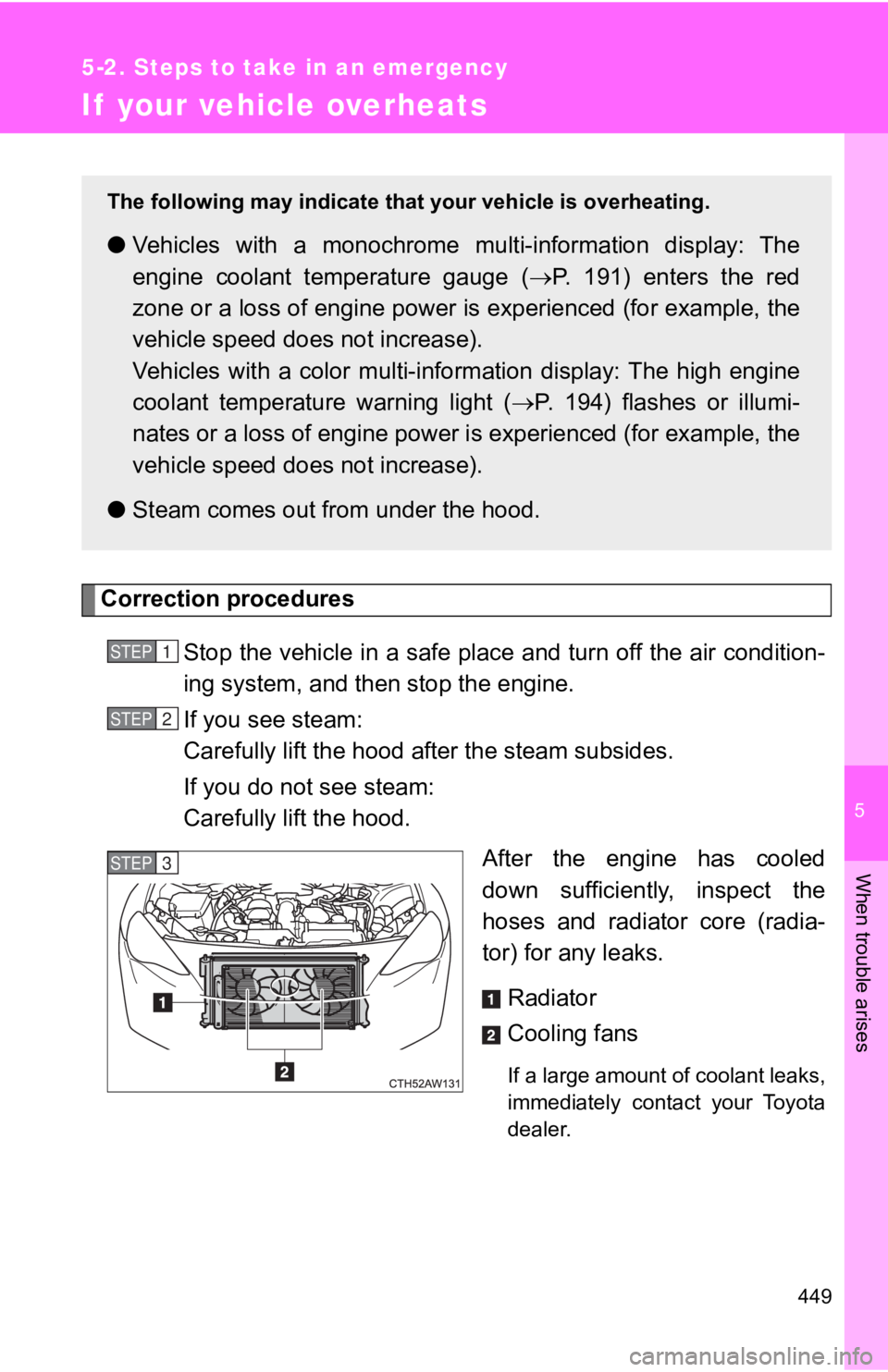
After the engine has cooled
down sufficiently, inspect the
hoses and radiator core (radia-
tor) for any leaks.
Radiator
Cooling fans
If a large amount of coolant leaks,
immediately contact your Toyota
dealer.
The following may indicate that your vehicle is overheating.
●Vehicles with a monochrome mu lti-information display: The
engine coolant temperature gauge ( P. 191) enters the red
zone or a loss of engine power is experienced (for example, the
vehicle speed does not increase).
Vehicles with a color multi-information display: The high engin e
coolant temperature warning light ( P. 194) flashes or illumi-
nates or a loss of engine power i s experienced (for example, the
vehicle speed does not increase).
● Steam comes out from under the hood.
STEP 1
STEP 2
STEP 3