2018 TOYOTA 86 warning
[x] Cancel search: warningPage 451 of 532

5
When trouble arises
451
5-2. Steps to take in an emergency
WARNING
■
To prevent an accident or injury when inspecting under the hood of
your vehicle
● If steam is seen coming from under the hood, do not open the ho od until
the steam has subsided. The engine compartment may be very hot, caus-
ing serious injuries such as burns.
● Keep hands and clothing (especially a tie, a scarf or a muffler ) away from
the fans and belts. Failure to do so may cause the hands or clothing to be
caught, resulting in serious injury.
● Do not loosen the radiator cap and the coolant reservoir cap wh ile the
engine and radiator are hot.
Serious injury, such as burns, may result from hot coolant and steam
released under pressure.
NOTICE
■ When adding engine coolant
Wait until the engine has cooled down before adding engine cool ant.
When adding coolant, do so slowly. Adding cool coolant to a hot engine too
quickly can cause damage to the engine.
■ To prevent damage t o the cooling system
Observe the following precautions:
● Avoid contaminating the coolant with foreign matter (such as sa nd or dust
etc.).
● Do not use any coolant additives.
Page 453 of 532

5
When trouble arises
453
5-2. Steps to take in an emergency
WARNING
■
When attempting to free a stuck vehicle
If you choose to push the vehicle back and forth to free it, ma ke sure the sur-
rounding area is clear to avoid striking other vehicles, object s or people. The
vehicle may also lunge forward or lunge back suddenly as it bec omes free.
Use extreme caution.
■ When shifting the shift lever
For vehicles with an automatic transmission, be careful not to shift the shift
lever with the accelerator pedal depressed.
This may lead to unexpected rapid acceleration of the vehicle t hat may
cause an accident resulting in death or serious injury.
NOTICE
■ To avoid damage to the trans mission and other components
● Avoid spinning the rear wheels and depressing the accelerator p edal more
than necessary.
● If the vehicle remains stuck even after these procedures are performed,
the vehicle may require towing to be freed.
Page 455 of 532
5
When trouble arises
455
5-2. Steps to take in an emergency
WARNING
■
If the engine has to be turned off while driving
● Power assist for the brakes and steering wheel will be lost, ma king the
brake pedal harder to depress and the steering wheel heavier to turn.
Decelerate as much as possible before turning off the engine.
● Vehicles without a smart key system: Never attempt to remove the key, as
doing so will lock the steering wheel.
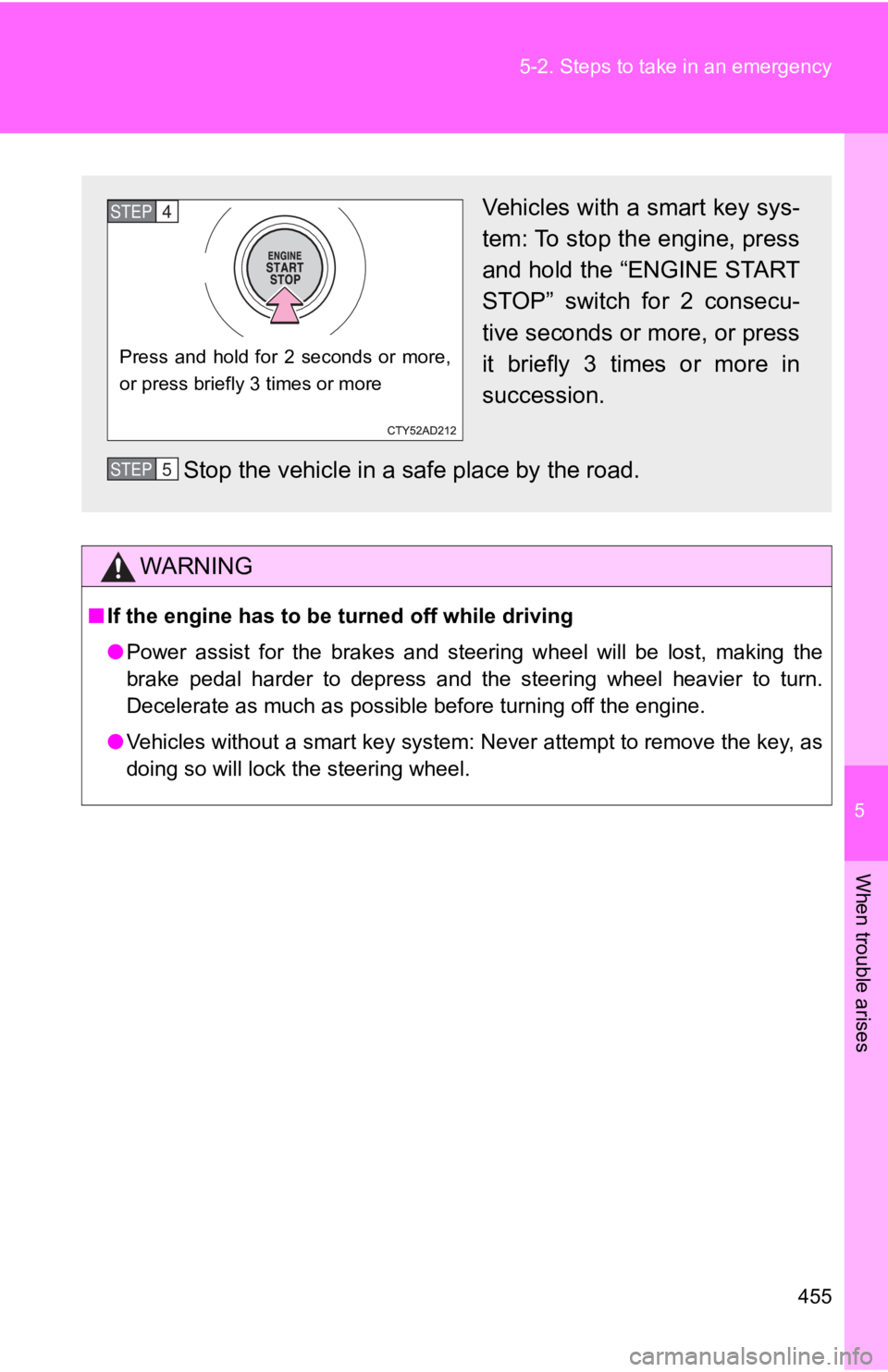
Vehicles with a smart key sys-
tem: To stop the engine, press
and hold the “ENGINE START
STOP” switch for 2 consecu-
tive seconds or more, or press
it briefly 3 times or more in
succession.
Stop the vehicle in a s afe place by the road.
Press and hold for 2 seconds or more,
or press briefly 3 times or more
STEP 4
STEP 5
Page 479 of 532

479
6-1. Specifications
6
Vehicle specifications
■
Treadwear
The treadwear grade is a comparative rating based on the wear
rate of the tire when tested under controlled conditions on a speci-
fied government test course.
For example, a tire graded 150 would wear one and a half (1 - 1 /2)
times as well on the governmen t course as a tire graded 100.
The relative performance of tires depends upon the actual condi tions
of their use. Performance may differ significantly from the nor m due
to variations in driving habits, service practices and differen ces in
road characterist ics and climate.
■Traction AA, A, B, C
The traction grades, from highest to lowest, are AA, A, B and C ,
and they represent the tire’s ability to stop on wet pavement a s
measured under controlled cond itions on specified government
test surfaces of asphalt and concrete.
A tire marked C may have p oor traction performance.
Warning: The traction grade assigned to this tire is based on b raking
(straight ahead) traction tests and does not include cornering (turn-
ing) traction.
■ Temperature A, B, C
The temperature grades are A (the highest), B, and C, represent -
ing the tire’s resistance to the generation of heat and its abi lity to
dissipate heat when tested under controlled conditions on a speci-
fied indoor laboratory test wheel.
Sustained high temperature can c ause the material of the tire to
degenerate and reduce tire life, and excessive temperature can lead
to sudden tire failure.
Grade C corresponds to a level of performance which all passeng er
car tires must meet under the Fe deral Motor Vehicle Safety Standard
No. 109.
Grades B and A represent higher levels of performance on the la bo-
ratory test wheel than the minimum required by law.
Page 480 of 532

480 6-1. Specifications
Warning: The temperature grades of a tire assume that it is properly
inflated and not overloaded.
Excessive speed, underinflation, or excessive loading, either s epa-
rately or in combination, can cause heat buildup and possible t ire fail-
ure.
Glossary of tire terminology
Tire related termMeaning
Cold tire inflation
pressure Tire pressure when the vehicle has been
parked for three hours or more, or has not
been driven more than 1
mile or 1.5 km under
that condition
Maximum inflation
pressure The maximum cold inflated pressure to which a
tire may be inflated, shown on the sidewall of
the tire
Recommended
inflation pressure Cold tire inflation pressure recommended by a
manufacturer.
Accessory weight The combined weight (i
n excess of those stan-
dard items which may be replaced) of auto-
matic transmission, po wer steering, power
brakes, power windows, power seats, radio
and heater, to the exten t that these items are
available as factory-installed equipment
(whether installed or not)
Curb weight The weight of a
motor vehicle with standard
equipment, including th e maximum capacity of
fuel, oil and coolant, and if so equipped, air
conditioning and additional weight optional
engine
Maximum loaded
vehicle weight The sum of:
(a) Curb weight
(b) Accessory weight
(c) Vehicle capacity weight
(d) Production options weight
Page 520 of 532

520
Abbreviation list
Abbreviation/Acronym list
ABBREVIATIONSMEANING
ABS Anti-lock Brake System
ACC Accessory
AI-SHIFT Artificial Intelligence Shift
ALR Automatic Locking Retractor
CRS Child Restraint System
DISP Display
ECU Electronic Control Unit
EDR Event Data Recorder
ELR Emergency Locking Retractor
EPS Electric Power Steering
GAWR Gross Axle Weight Ratings
GVWR Gross Vehicle Weight Rating
I/M Emission inspection and maintenance
LATCH Lower Anchors and Tethers for Children
LED Light Emitting Diode
LSD Limited Slip Differential
M + S Mud and Snow
MMT Methylcyclopentadienyl Manganese Tricarbonyl
OBD On Board Diagnostics
SRS Supplemental Restraint System
TIN Tire Identification Number
TPMS Tire Pressure Warning System
TRAC Traction Control
VIN Vehicle Identification Number
VSC Vehicle Stability Control
Page 521 of 532

521
Alphabetical index
Alphabetical index
A/C .................................... 268, 275
ABS........................................... 245
Air conditioning filter .............. 360
Air conditioning systemAir conditioning filter ............. 360
Automatic air conditioning system................................ 275
Manual air conditioning system................................ 268
Airbags
Airbag operating conditions ................... 103, 111
Airbag precautions for
your child............................ 120
Airbag warning light .............. 397
Curtain shield airbag operating conditions ........... 111
Curtain shield airbag precautions ........................ 120
Front passenger occupant classification system .......... 128
General airbag
precautions ........................ 120
Locations of airbags ............... 89
Modification and disposal of airbags ............. 124
Proper driving posture ......................... 87, 120
Side airbag operating conditions ........................... 111
Side airbag
precautions ........................ 120
Side and curtain shield airbags operating
conditions ........................... 111
Side and curtain shield airbags precautions............ 120
SRS airbag instructions for
Canadian owners ............... 496
SRS airbags ........................... 89 Alarm ...........................................82
Anti-lock brake system............245
Audio input ...............................286
Audio system
Audio input ............................286
AUX port................................286
iPod .......................................286
Portable music player............286
Steering wheel audio switches ..............................287
USB memory .........................286
USB port................................286
Automatic air conditioning
system ....................................275
Automatic headlight leveling system ....................................226
Automatic light control system ....................................222
Automatic transmission
Automatic transmission .........178
If the shift lever cannot be shifted from P......................438
Manual mode ........................181
Mode select switch ................180
Paddle shift switches.............181
AUX port ...................................286
Back-up lights Replacing light bulbs .............375
Wattage .................................469
Battery Checking ...............................339
If the vehicle has a discharged battery ..............444
Preparing and checking before winter .......................261
Bottle holders ...........................293
Brake
Fluid ......................................337
Parking brake ........................189A
B
Page 523 of 532

523
Alphabetical index
Dimension ................................ 458
Dinghy towing ......................... 266
Display
Drive information .................. 210
Multi-information display ........................ 200, 207
Trip information ............ 202, 208
Warning messages............... 407
Do-it-yourself maintenance .... 324
Door courtesy lights Door courtesy lights.............. 289
Wattage ................................ 469
Doors Door lock .................... 25, 38, 43
Door windows ......................... 72
Side mirrors ............................ 69
Driver's seat belt
reminder light ........................ 399
Driving Break-in tips ......................... 155
Correct posture....................... 87
Procedures ........................... 152
Winter drive tips.................... 261
Electric power steering........... 245
Electronic key If the electronic key does not operate properly ........... 440
Emergency flashers Switch ................................... 384
Emergency, in case of
If the electronic key does not operate properly ........... 440
If the engine will not start...... 435
If the shift lever cannot
be shifted from P ................ 438
If the vehicle has a
discharged battery ............. 444
If the warning buzzer sounds ............................... 395
If the warning light turns on .............................. 395 If the warning message
is displayed .........................407
If you have a flat tire .............424
If you lose your keys .............439
If you think something is wrong ..................................393
If your vehicle becomes stuck ...................................452
If your vehicle has to be stopped in an
emergency ..........................454
If your vehicle needs to be towed .............................385
If your vehicle overheats .......449
Engine Compartment ........................331
Engine switch ................166, 175
Hood......................................327
How to start the engine .........................166, 175
Identification number .............459
If the engine will not start ......435
Ignition switch................166, 175
Overheating...........................449
Engine coolant Capacity ................................464
Checking ...............................335
Engine coolant temperature gauge ......................................191
Engine immobilizer system.......79
Engine oil Capacity ................................462
Checking ...............................332
Preparing and checking before winter .......................261
Engine switch ...................166, 175
Engine switch light ..................289
EPS ............................................245
Event data recorder ...................18
E