2018 SUBARU WRX warning
[x] Cancel search: warningPage 433 of 578

(448,1)
北米Model "A1700BE-B" EDITED: 2017/ 10/ 11
–When the vehicle has been left
parked during a snowstorm
Check for snow or ice buildup on
the suspension, disc brakes and
brake hoses underneath the ve-
hicle. If there is caked snow or
ice, remove it, being careful not
to damage the disc brakes and
brake hoses and ABS harness.
When parking for long periods in cold
weather, you should observe the following
tips.
1. For MT models, place the shift lever in
the“1”or“R”position. For CVT models,
place the select lever in the“P”position.
2. Use tire stops under the tires to prevent
the vehicle from moving.
!Refueling in cold weather
To help prevent moisture from forming in
the fuel system and the risk of its freezing,
use of an antifreeze additive in the fuel
tank is recommended during cold weather.
Use only additives that are specifically
designed for this purpose. When an anti-
freeze additive is used, its effect lasts
longer if the tank is refilled whenever the
fuel level reaches half empty.
If your SUBARU is not going to be used for
an extended period, it is best to have thefuel tank filled to capacity.
&Driving on snowy and icy
roadsTo prevent skidding and slipping, avoid
sudden braking, abrupt acceleration, high-
speed driving, and sharp turning when
driving on snowy or icy roads.
Always maintain ample distance between
your vehicle and the vehicle ahead of you
to avoid the need for sudden braking.
To supplement the foot brake, use the
engine brake effectively to control the
vehicle speed. (Shift into a lower gear
when necessary.)
Avoid shifting down abruptly. Such beha-
vior can cause the wheels to lock, possibly
leading to loss of vehicle control.
An anti-lock brake system (ABS) en-
hances your vehicle’s braking perfor-
mance on snowy and icy roads. For
information on braking on slippery sur-
faces, refer to“ABS (Anti-lock Brake
System)”F7-35 and“Vehicle Dynamics
Control system”F7-37.
WARNING
Do not use the cruise control on
slippery roads such as snowy or icy
roads. This may cause loss of vehi-
cle control.
CAUTION
Avoid prolonged continuous driving
in snowstorms. Snow will enter the
engine’sintakesystemandmay
hinder the airflow, which could re-
sult in engine shutdown or even
breakdown.
!Wiper operation when snowing
Before driving in cold weather, make sure
the wiper blade rubbers are not frozen to
the windshield.
If the wiper blade rubbers are frozen to the
windshield, use the defroster and the
temperature set for maximum warmth until
the wiper blade rubbers are completely
thawed. Refer to“Climate control”F4-1.
If your vehicle is equipped with a wiper
deicer, use it. It is helpful to thaw the
windshield wiper blade rubbers. Refer to
“Defogger and deicer”F3-84.
When driving in snow, if frozen snow starts
Driving tips/Winter driving
8-8
Page 434 of 578

(449,1)
北米Model "A1700BE-B" EDITED: 2017/ 10/ 11
to stick on the surface of the windshield
despite wiper operation, use the defroster
and the temperature set for maximum
warmth. After the windshield gets warmed
enough to melt the frozen snow on it, wash
it away using the windshield washer. Refer
to“Windshield washer”F3-74.
Snow stuck on the wiper arm prevents the
wiper from working effectively. If snow is
stuck on the wiper arm, pull off the road to
a safe place, then remove it. If you stop the
vehicle at road side, use the hazard
warning flasher to alert other drivers. Refer
to“Hazard warning flasher”F3-8.
We recommend use of non-freezing type
wiper blades (winter blades) during the
seasons you could have snow and freez-
ing temperatures. Blades of this type give
superior wiping performance in snowy
conditions. Be sure to use blades that are
suitable for your vehicle.
CAUTION
During high-speed driving, non-
freezing type wiper blades may not
perform as well as standard wiper
blades. If this happens, reduce the
vehicle speed.
NOTEWhen the season requiring non-freez-
ing type wiper blades is over, replace
them with standard wiper blades.&Corrosion protectionRefer to“Corrosion protection”F10-5.&Snow tires
WARNING
.When you replacing or installing
winter tire(s), all four tires must
be the same for following items.
(a) Size
(b) Circumference
(c) Speed symbol
(d) Load index
(e) Construction
(f) Manufacturer
(g) Brand (tread pattern)
(h) Degrees of wear
For the items (a) to (d), you must
obey the specification that is
printed on the tire placard. The
tire placard is located on the
bottom of driver’s door pillar.If all of four winter tires are not
the same for items (a) to (h), there
is a possibility that serious me-
chanical damage could occur to
the drive train of your car, and
affect the following.
—Ride
—Handling
—Braking
—Speedometer/Odometer
calibration
—Clearance between the body
and tires
It also may be dangerous and
lead to loss of vehicle control,
and it can lead to an accident.
.Do not use a combination of
radial, belted bias or bias tires
since it may cause dangerous
handling characteristics and lead
to an accident.
Your vehicle is equipped with“summer
tires”as original equipment, which are
inadequate for driving on slippery roads
such as on snow-covered or icy roads.
When you choose to install winter tires on
your vehicle, be sure to use the correct tire
size and type. You must install four winter
tires that are of the same size, construc-
–CONTINUED–
Driving tips/Winter driving
8-9
8
Page 436 of 578

(451,1)
北米Model "A1700BE-B" EDITED: 2017/ 10/ 11
Loading your vehicle
WARNING
.Never allow passengers to ride
on a folded rear seatback or in the
trunk. Doing so may result in
serious injury.
.Never stack luggage or other
cargo higher than the top of the
seatback because it could tumble
forward and injure passengers in
the event of a sudden stop or
accident. Keep luggage or cargo
low, as close to the floor as
possible.
.Stow cargo and luggage in the
trunk whenever possible..To prevent cargo and luggage
from sliding forward during brak-
ing, do not stack anything in the
enlarged trunk. Keep cargo and
luggage low, as close to the floor
as possible.
.When you carry something inside
the vehicle, secure it whenever
you can to prevent it from being
thrown around inside the vehicle
during sudden stops, sharp turns
or in an accident.
.Do not pile heavy loads on the
roof. These loads raise the vehi-
cle’s center of gravity and make it
more prone to tip over.
.Secure lengthy items properly to
prevent them from shooting for-
ward and causing serious injury
during a sudden stop.
.Never exceed the maximum load
limit. If you do, some parts on
your vehicle can break, or it can
change the way your vehicle
handles. This could result in loss
of control and cause personal
injury. Also, overloading can
shorten the life of your vehicle.
.Do not place cargo or luggage in
or on the following locations as
the item may get under theclutch, brake, or accelerator ped-
al and prevent the pedals from
being depressed properly, block
the driver’s vision, or hit the
driver or passengers, causing
an accident:
–At the feet of the driver
–On the front passenger or rear
seats (when stacking items)
–On the rear shelf
–On the instrument panel
–On the dashboard
CAUTION
Do not carry spray cans, containers
with flammable or corrosive liquids
or any other dangerous items inside
the vehicle.NOTEFor better fuel economy, do not carry
unneeded cargo.
–CONTINUED–
Driving tips/Loading your vehicle
8-11
8
Page 438 of 578

(453,1)
北米Model "A1700BE-B" EDITED: 2017/ 10/ 11
&Precautions for TYPE RAThe roof carrier and other equipment
cannot be attached on the carbon roof
because of the design.
WARNING
Do not place a roof carrier or any
other equipment on the roof of the
vehicle. Due to the design of the
roof, the cargo may fall off and cause
an accident.&Roof molding and crossbar (if
equipped)
CAUTION
.For cargo carrying purposes, the
roof molding must be used to-
gether with a roof crossbar kit
and the appropriate carrying at-
tachment. Otherwise, damage tothe roof or paint or a dangerous
road hazard due to loss of cargo
could result.
.When using the roof crossbar kit,
make sure that the total weight of
the crossbars, carrying attach-
ment and cargo does not exceed
the maximum load limit. Over-
loading may cause damage to
the vehicle and create a safety
hazard.
Cargo can be carried after securing the
roof crossbar kit to the roof molding and
installing the appropriate carrying attach-
ment. When installing the roof crossbar kit,
follow the manufacturer’s instructions.
When carrying cargo on the roof using the
roof crossbar kit and carrying attachments,
never exceed the maximum load limit as
explained below. You should also be
careful that the vehicle does not exceed
the Gross Vehicle Weight Rating (GVWR)
and front and rear Gross Axle Weight
Rating (GAWR). For information about
loading cargo into or onto your vehicle,
refer to“Loading your vehicle”F8-11. The
maximum total load on the roof (including
crossbars, carrying attachments and car-
go) must not exceed88 lbs (40 kg). Refer
to the crossbar installation instructions for
the maximum crossbar capacity. Place the
–CONTINUED–
Driving tips/Loading your vehicle
8-13
8
Page 441 of 578
(456,1)
北米Model "A1700BE-B" EDITED: 2017/ 10/ 11
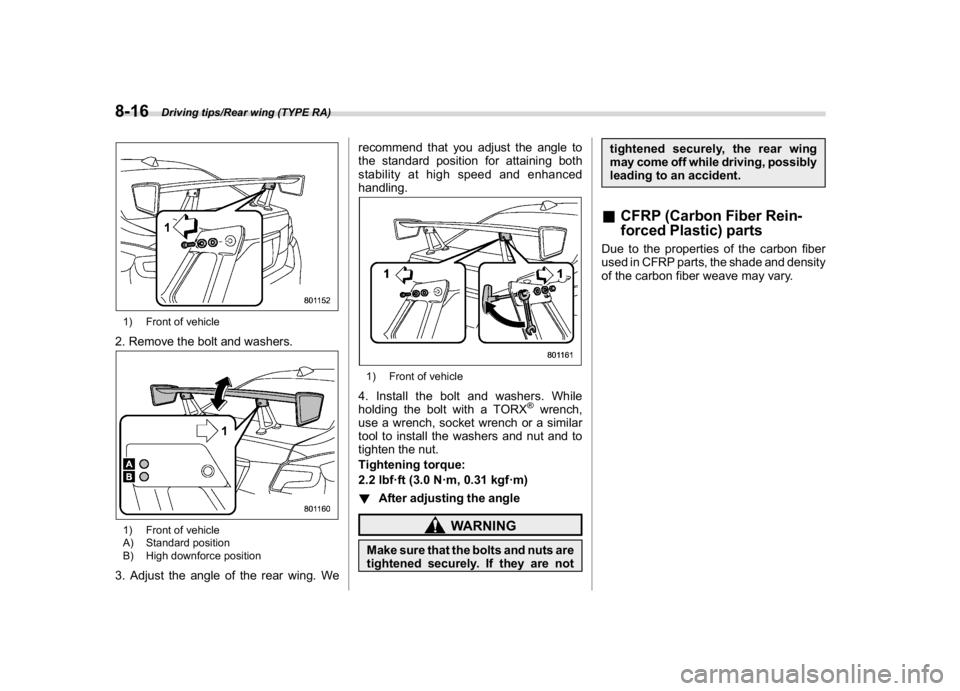
1) Front of vehicle2. Remove the bolt and washers.1) Front of vehicle
A) Standard position
B) High downforce position3. Adjust the angle of the rear wing. Werecommend that you adjust the angle to
the standard position for attaining both
stability at high speed and enhanced
handling.
1) Front of vehicle4. Install the bolt and washers. While
holding the bolt with a TORX
®wrench,
use a wrench, socket wrench or a similar
tool to install the washers and nut and to
tighten the nut.
Tightening torque:
2.2 lbf·ft (3.0 N·m, 0.31 kgf·m)
!After adjusting the angle
WARNING
Make sure that the bolts and nuts are
tightened securely. If they are nottightened securely, the rear wing
may come off while driving, possibly
leading to an accident.
&CFRP (Carbon Fiber Rein-
forced Plastic) partsDue to the properties of the carbon fiber
used in CFRP parts, the shade and density
of the carbon fiber weave may vary.
Driving tips/Rear wing (TYPE RA)
8-16
Page 443 of 578

(460,1)
北米Model "A1700BE-B" EDITED: 2017/ 10/ 11
If you park your vehicle in
case of an emergencyUse the hazard warning flasher in day or
night to warn other drivers when you have
to park your vehicle under emergency
conditions.
Avoid stopping on the road. It is best to
safely pull off the road if a problem occurs.
You can activate the hazard warning
flasher regardless of the ignition switch
position.
Turn on the hazard warning by pushing the
hazard warning flasher switch. Turn it off
by pushing the switch again.
NOTEWhen the hazard warning flasher is on,
the turn signals do not work.
Temporary spare tire (if
equipped)
WARNING
When a spare tire is mounted or a
wheel rim is replaced without the
original pressure sensor/transmitter
being transferred, the low tire pres-
sure warning light will illuminate
steadily after blinking for approxi-
mately one minute. This indicates
the tire pressure monitoring system
(TPMS) is unable to monitor all four
road wheels. Contact your SUBARU
dealer as soon as possible for tire
and sensor replacement and/or sys-
tem resetting.
CAUTION
.Never use any temporary spare
tire other than the original. Using
other sizes may result in severe
mechanical damage to the drive
train of your vehicle.
.Always conform to the following
instructions when using the tem-
porary spare tire. Otherwise, a
seriously dangerous situation
In case of emergency/If you park your vehicle in case of an emergency
9-2
Page 446 of 578

(463,1)
北米Model "A1700BE-B" EDITED: 2017/ 10/ 11
1) Wheel nut wrench
2) Screwdriver
3) Jack
4) Towing hook (eye bolt)A jack handle is stored under the floor of
the trunk. A jack and a towing hook are
stored in the tool bucket that is located in
the recess of the spare tire wheel. A
screwdriver and a wheel nut wrench are
stored in the vinyl bag. You can also store
these tools in the tool bucket.NOTEFor how to use the jack, refer to“Flat
tires”F9-5.
Flat tiresIf you have a flat tire while driving, never
brake suddenly; keep driving straight
ahead while gradually reducing speed.
Then slowly pull off the road to a safe
place.&Changing a flat tire!Models with flat tire repair kit
It may be difficult to change a flat tire.
However, it may be possible to seal the
tire. For details, refer to“Sealing flat tire
(models with flat tire repair kit)”F9-8.
!Models without flat tire repair kit
WARNING
.Do not jack up the vehicle on an
incline or a loose road surface.
The jack can come out of the
jacking point or sink into the
ground and this can result in a
severe accident.
.Use only the jack provided with
your vehicle. The jack supplied
with the vehicle is designed only
for changing a tire. Never get
under the vehicle while support-
ing the vehicle with this jack..Before using the jack, be sure
that there are no occupants or
cargo in the vehicle.
.Always turn off the engine before
raising the flat tire off the ground
using the jack. Never swing or
push the vehicle supported with
the jack. The jack can come out of
the jacking point due to a jolt and
this can result in a severe acci-
dent.
1. Park on a hard, level surface, when-
ever possible, then stop the engine.
2. Set the parking brake securely and
shift the shift lever in reverse (MT models)
or the select lever to the“P”(Park) position
(CVT models).
3. Turn on the hazard warning flasher and
have everyone get out of the vehicle.
–CONTINUED–
In case of emergency/Flat tires
9-5
9
Page 448 of 578

(465,1)
北米Model "A1700BE-B" EDITED: 2017/ 10/ 11
Turn the jackscrew by hand until the jack
head engages firmly into the jack-up point.9. Insert the jack handle into the jack-
screw, and turn the handle until the tire
clears the ground. Do not raise the vehicle
higher than necessary.10. Remove the wheel nuts and the flat
tire.
11. Before putting the spare tire on, per-
form the following steps.
.Clean the mounting surface of the
wheel and hub with a cloth..Clean the threaded parts with a cloth
and check the conditions there.
CAUTION
If the threaded part was damaged,
you should immediately contact
your SUBARU dealer.
12. Put on the spare tire. Replace the
wheel nuts. Tighten them by hand.
WARNING
Do not use oil or grease on the wheel
studs or nuts when the spare tire is
installed. This could cause the nuts
to become loose and lead to an
accident.
13. Turn the jack handle counterclockwise
to lower the vehicle.
–CONTINUED–
In case of emergency/Flat tires
9-7
9