2018 SUBARU WRX warning
[x] Cancel search: warningPage 449 of 578
(466,1)
北米Model "A1700BE-B" EDITED: 2017/ 10/ 11
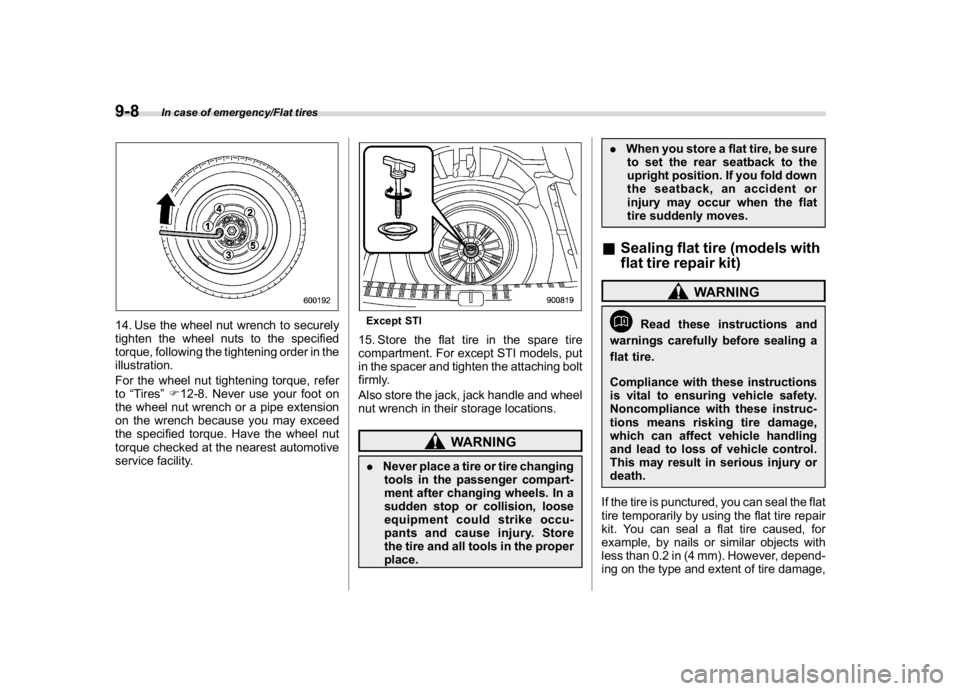
14. Use the wheel nut wrench to securely
tighten the wheel nuts to the specified
torque, following the tightening order in the
illustration.
For the wheel nut tightening torque, refer
to“Tires”F12-8. Never use your foot on
the wheel nut wrench or a pipe extension
on the wrench because you may exceed
the specified torque. Have the wheel nut
torque checked at the nearest automotive
service facility.
Except STI15. Store the flat tire in the spare tire
compartment. For except STI models, put
in the spacer and tighten the attaching bolt
firmly.
Also store the jack, jack handle and wheel
nut wrench in their storage locations.
WARNING
.Never place a tire or tire changing
tools in the passenger compart-
ment after changing wheels. In a
sudden stop or collision, loose
equipment could strike occu-
pants and cause injury. Store
the tire and all tools in the proper
place..When you store a flat tire, be sure
to set the rear seatback to the
upright position. If you fold down
the seatback, an accident or
injury may occur when the flat
tire suddenly moves.
&Sealing flat tire (models with
flat tire repair kit)
WARNING
Read these instructions and
warnings carefully before sealing a
flat tire.
Compliance with these instructions
is vital to ensuring vehicle safety.
Noncompliance with these instruc-
tions means risking tire damage,
which can affect vehicle handling
and lead to loss of vehicle control.
This may result in serious injury or
death.
If the tire is punctured, you can seal the flat
tire temporarily by using the flat tire repair
kit. You can seal a flat tire caused, for
example, by nails or similar objects with
less than 0.2 in (4 mm). However, depend-
ing on the type and extent of tire damage,
In case of emergency/Flat tires
9-8
Page 450 of 578
(467,1)
北米Model "A1700BE-B" EDITED: 2017/ 10/ 11
some tires can only be partially sealed or
not sealed at all, and this condition may
cause a loss of tire pressure. A loss of tire
pressure can affect vehicle handling,
leading to the loss of vehicle control.
After sealing the flat tire temporarily,
change the tires with new ones as soon
as possible. We recommend that you have
the sealed tire changed by your nearest
SUBARU dealer. You may reuse the wheel
if the attached sealant is wiped off, but the
valve of the wheel must be replaced with a
new one. If you reuse the wheel without
replacing the valve, air may leak from the
valve.
For tire replacement, refer to“Tire replace-
ment”F11-36.!Safety precautions when sealing flat
tire
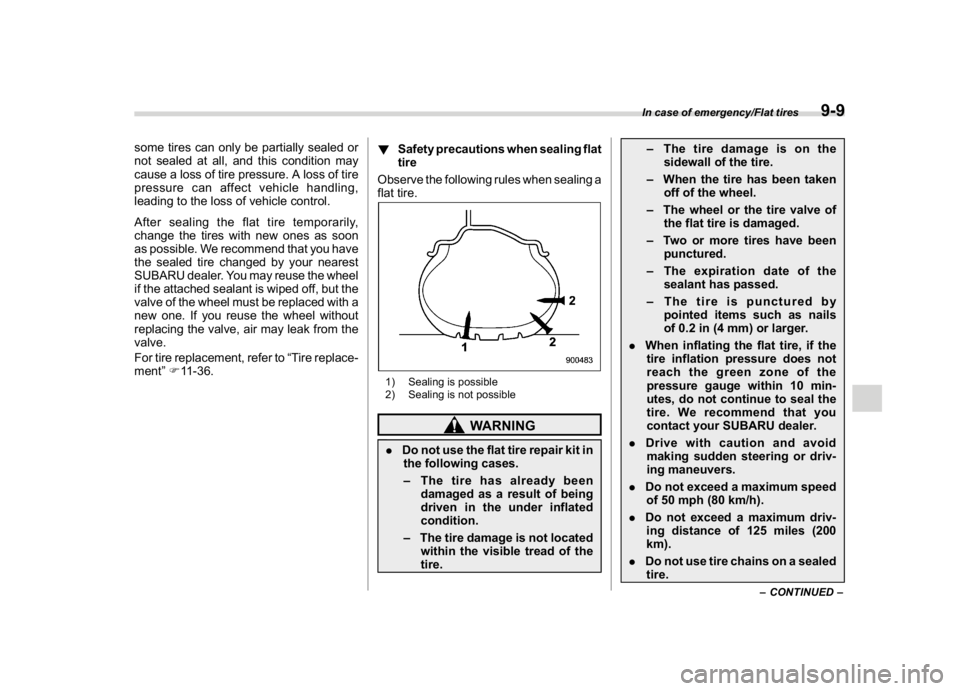
Observe the following rules when sealing a
flat tire.
1) Sealing is possible
2) Sealing is not possible
WARNING
.Do not use the flat tire repair kit in
the following cases.
–The tire has already been
damaged as a result of being
driven in the under inflated
condition.
–The tire damage is not located
within the visible tread of the
tire.–The tire damage is on the
sidewall of the tire.
–When the tire has been taken
off of the wheel.
–The wheel or the tire valve of
the flat tire is damaged.
–Two or more tires have been
punctured.
–The expiration date of the
sealant has passed.
–The tire is punctured by
pointed items such as nails
of 0.2 in (4 mm) or larger.
.When inflating the flat tire, if the
tire inflation pressure does not
reach the green zone of the
pressure gauge within 10 min-
utes, do not continue to seal the
tire. We recommend that you
contact your SUBARU dealer.
.Drive with caution and avoid
making sudden steering or driv-
ing maneuvers.
.Do not exceed a maximum speed
of 50 mph (80 km/h).
.Do not exceed a maximum driv-
ing distance of 125 miles (200
km).
.Do not use tire chains on a sealed
tire.
–CONTINUED–
In case of emergency/Flat tires
9-9
9
Page 451 of 578
(468,1)
北米Model "A1700BE-B" EDITED: 2017/ 10/ 11
.Do not tow a trailer.
.If used for a purpose other than
sealing a flat tire, the flat tire
repair kit may cause a severe
accident or injury due to the fact
that compressed air can act as an
explosive or propellant.
.Safely park your vehicle on the
roadside so that you do not
obstruct the flow of traffic and
so that you are able to seal the flat
tire without being in danger.
.Apply the parking brake, even if
the vehicle is parked on a level
road, to make sure that the vehi-
cle will not move.
.Stop the engine before sealing
the flat tire.
.Turn on the hazard warning
flasher while sealing the flat tire.
.Do not attempt to remove foreign
objects like nails or screws that
have penetrated the tire. Leave
them as they are.
.Never leave the flat tire repair kit
unattended while in use.
.Only one tire can be repaired with
one bottle of sealant.
.The tires can be repaired when
the ambient temperature is228F(308C) or higher.
CAUTION
.Remember that the flat tire repair
kit only provides temporary mo-
bility. Regulations concerning
tire repair after usage of flat tire
repair kit may differ from country
to country. We recommend that
you consult your SUBARU dealer
or tire dealer for advice.
.Store the flat tire repair kit safely
and secure it in the cargo area.
Storing it anywhere in the pas-
senger compartment is not advi-
sable because it could strike an
occupant in the event of a sudden
stop or collision and cause injury.
.Use the flat tire repair kit with
original vehicle tires only.
.Do not keep the air compressor
operating for more than 10 min-
utes, otherwise there is a risk of
overheating.
.The temperature of the air com-
pressor may become high. Be
careful not to burn yourself.
.When raining, take measures to
prevent the air compressor frombeing exposed directly to the
rain. Exposing to rain may cause
a malfunction.
.Do not use air compressors other
than the one in the repair kit.
Using an air compressor other
than the one in the repair kit may
damage the tires.
.Do not disassemble or modify the
air compressor to enable the use
of a power supply or a battery
other than DC12V.
.If a temporary puncture repair is
performed with the repair kit, the
Tire Pressure Monitoring System
(TPMS) may not operate nor-
mally.
In case of emergency/Flat tires
9-10
Page 453 of 578
(470,1)
北米Model "A1700BE-B" EDITED: 2017/ 10/ 11
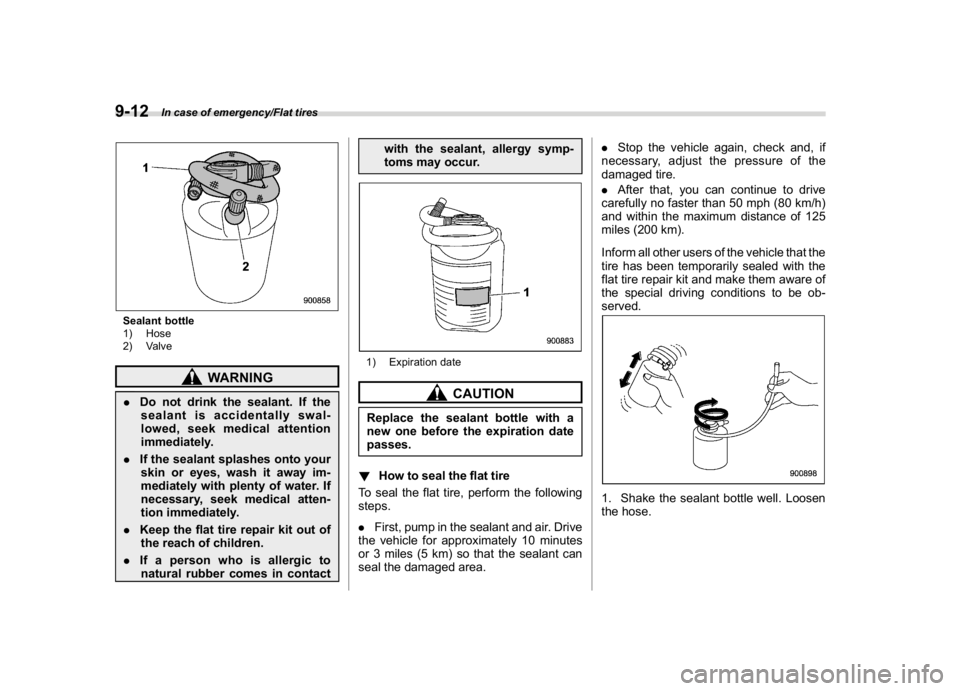
Sealant bottle
1) Hose
2) Valve
WARNING
.Do not drink the sealant. If the
sealant is accidentally swal-
lowed, seek medical attention
immediately.
.If the sealant splashes onto your
skin or eyes, wash it away im-
mediately with plenty of water. If
necessary, seek medical atten-
tion immediately.
.Keep the flat tire repair kit out of
the reach of children.
.If a person who is allergic to
natural rubber comes in contactwith the sealant, allergy symp-
toms may occur.
1) Expiration date
CAUTION
Replace the sealant bottle with a
new one before the expiration date
passes.
!How to seal the flat tire
To seal the flat tire, perform the following
steps.
.First, pump in the sealant and air. Drive
the vehicle for approximately 10 minutes
or 3 miles (5 km) so that the sealant can
seal the damaged area..Stop the vehicle again, check and, if
necessary, adjust the pressure of the
damaged tire.
.After that, you can continue to drive
carefully no faster than 50 mph (80 km/h)
and within the maximum distance of 125
miles (200 km).
Inform all other users of the vehicle that the
tire has been temporarily sealed with the
flat tire repair kit and make them aware of
the special driving conditions to be ob-
served.
1. Shake the sealant bottle well. Loosen
the hose.
In case of emergency/Flat tires
9-12
Page 455 of 578
(472,1)
北米Model "A1700BE-B" EDITED: 2017/ 10/ 11
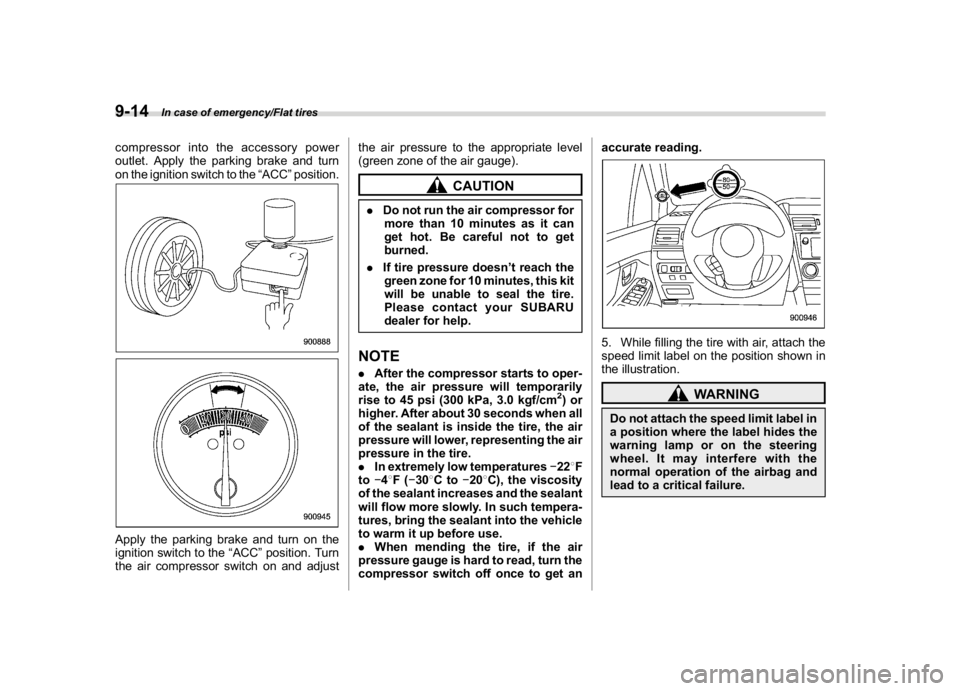
compressor into the accessory power
outlet. Apply the parking brake and turn
on the ignition switch to the“ACC”position.Apply the parking brake and turn on the
ignition switch to the“ACC”position. Turn
the air compressor switch on and adjustthe air pressure to the appropriate level
(green zone of the air gauge).
CAUTION
.Do not run the air compressor for
more than 10 minutes as it can
get hot. Be careful not to get
burned.
.If tire pressure doesn’t reach the
green zone for 10 minutes, this kit
will be unable to seal the tire.
Please contact your SUBARU
dealer for help.NOTE.After the compressor starts to oper-
ate, the air pressure will temporarily
rise to 45 psi (300 kPa, 3.0 kgf/cm
2)or
higher. After about 30 seconds when all
of the sealant is inside the tire, the air
pressure will lower, representing the air
pressure in the tire.
.In extremely low temperatures228F
to48F(308Cto208C), the viscosity
of the sealant increases and the sealant
will flow more slowly. In such tempera-
tures, bring the sealant into the vehicle
to warm it up before use.
.When mending the tire, if the air
pressure gauge is hard to read, turn the
compressor switch off once to get anaccurate reading.
5. While filling the tire with air, attach the
speed limit label on the position shown in
the illustration.
WARNING
Do not attach the speed limit label in
a position where the label hides the
warning lamp or on the steering
wheel. It may interfere with the
normal operation of the airbag and
lead to a critical failure.
In case of emergency/Flat tires
9-14
Page 456 of 578
(473,1)
北米Model "A1700BE-B" EDITED: 2017/ 10/ 11
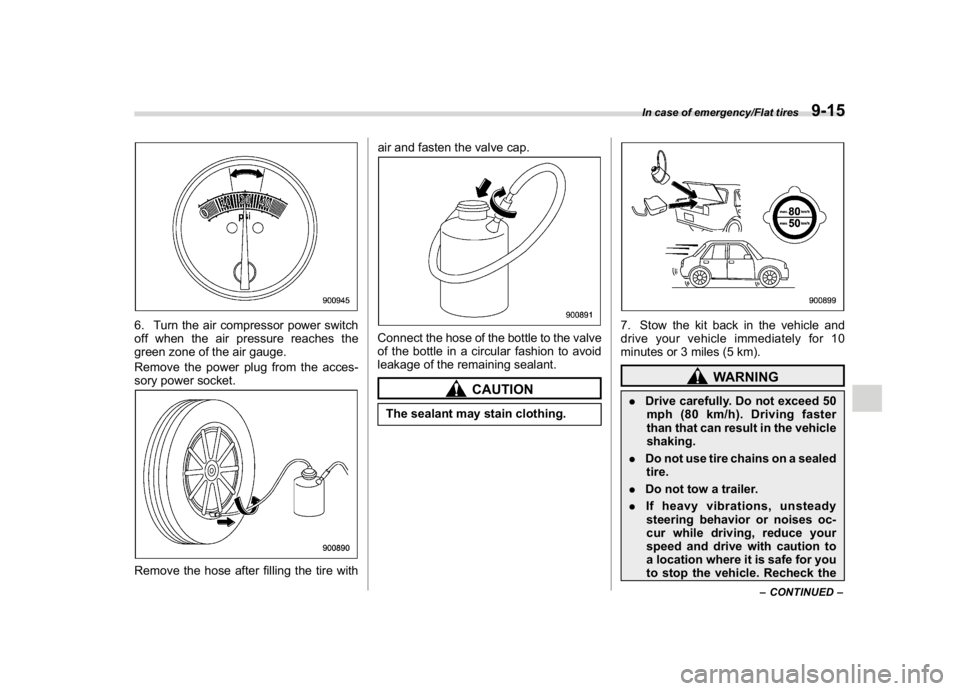
6. Turn the air compressor power switch
off when the air pressure reaches the
green zone of the air gauge.
Remove the power plug from the acces-
sory power socket.Remove the hose after filling the tire withair and fasten the valve cap.
Connect the hose of the bottle to the valve
of the bottle in a circular fashion to avoid
leakage of the remaining sealant.
CAUTION
The sealant may stain clothing.
7. Stow the kit back in the vehicle and
drive your vehicle immediately for 10
minutes or 3 miles (5 km).
WARNING
.Drive carefully. Do not exceed 50
mph (80 km/h). Driving faster
than that can result in the vehicle
shaking.
.Do not use tire chains on a sealed
tire.
.Do not tow a trailer.
.If heavy vibrations, unsteady
steering behavior or noises oc-
cur while driving, reduce your
speed and drive with caution to
a location where it is safe for you
to stop the vehicle. Recheck the
–CONTINUED–
In case of emergency/Flat tires
9-15
9
Page 458 of 578

(475,1)
北米Model "A1700BE-B" EDITED: 2017/ 10/ 11
&Tire pressure monitoring
system (TPMS) (U.S.-spec.
models)Low tire pressure warning lightThe tire pressure monitoring system pro-
vides the driver with the warning message
indicated by sending a signal from a
sensor that is installed in each wheel when
tire pressure is severely low.
The tire pressure monitoring system will
activate only when the vehicle is driven.
Also, this system may not react immedi-
ately to a sudden drop in tire pressure (for
example, a blow-out caused by running
over a sharp object).
WARNING
.If the low tire pressure warning
light illuminates while driving,
never brake suddenly. Instead,
perform the following procedure.
(1) Keep driving straight ahead
while gradually reducing
speed.
(2) Slowly pull off the road to a
safe place. Otherwise an acci-
dent involving serious vehicle
damage and serious personal
injury could occur.
(3) Check the pressure for all four
tires and adjust the pressure
to the COLD tire pressure
shown on the vehicle placard
on the door pillar on the
driver’s side.
If this light still illuminates while
driving after adjusting the tire
pressure, a tire may have signifi-
cant damage and a fast leak that
causes the tire to lose air rapidly.
If you have a flat tire, refer to“Flat
tires”F9-5.
.When a spare tire is mounted or a
wheel rim is replaced without the
original pressure sensor/trans-
mitter being transferred, the lowtire pressure warning light will
illuminate steadily after blinking
for approximately one minute.
This indicates the TPMS is unable
to monitor all four road wheels.
Contact your SUBARU dealer as
soon as possible for tire and
sensor replacement and/or sys-
tem resetting.
.When a tire is repaired with liquid
sealant, the tire pressure warning
valve and transmitter may not
operate properly. If a liquid sea-
lant is used, contact your nearest
SUBARU dealer or other qualified
service shop as soon as possi-
ble. Make sure to replace the tire
pressure warning valve and
transmitter when replacing the
tire. You may reuse the wheel if
there is no damage to it and if the
sealant residue is properly
cleaned off.
If the light illuminates steadily
after blinking for approximately
one minute, promptly contact a
SUBARU dealer to have the sys-
tem inspected.
In case of emergency/Flat tires
9-17
9
Page 459 of 578
(476,1)
北米Model "A1700BE-B" EDITED: 2017/ 10/ 11
Jump starting
WARNING
.Battery fluid is SULFURIC ACID.
Do not let it come in contact with
the eyes, skin, clothing or the
vehicle.
If battery fluid gets on you, thor-
oughly flush the exposed area
with water immediately. Get med-
ical help if the fluid has entered
your eyes.
If battery fluid is accidentally
swallowed, immediately drink a
large amount of milk or water,
and obtain immediate medical
help.
Keep everyone including chil-
dren away from the battery.
.The gas generated by a battery
explodes if a flame or spark is
brought near it. Do not smoke or
light a match while jump starting.
.Never attempt jump starting if the
discharged battery is frozen. It
could cause the battery to burst
or explode.
.Whenever working on or around a
battery, always wear suitable eyeprotectors, and remove metal
objects such as rings, bands or
other metal jewelry.
.Be sure the jumper cables and
clamps on them do not have
loose or missing insulation.
Do not jump start unless cables
in suitable condition are avail-
able.
.A running engine can be danger-
ous. Keep your fingers, hands,
clothing, hair and tools away
from the cooling fan, belts and
any other moving engine parts.
Removing rings, watches and
ties is advisable.
.Jump starting is dangerous if it
done incorrectly. If you are un-
sure about the proper procedure
for jump starting, consult a com-
petent mechanic.
When your vehicle does not start due to a
run down (discharged) battery, the vehicle
may be jump started by connecting your
battery to another battery (called the
booster battery) with jumper cables.
&How to jump start1. Make sure the booster battery is 12
volts and the negative terminal is
grounded.
2. If the booster battery is in another
vehicle, do not let the two vehicles touch.
3. Turn off all unnecessary lights and
accessories.
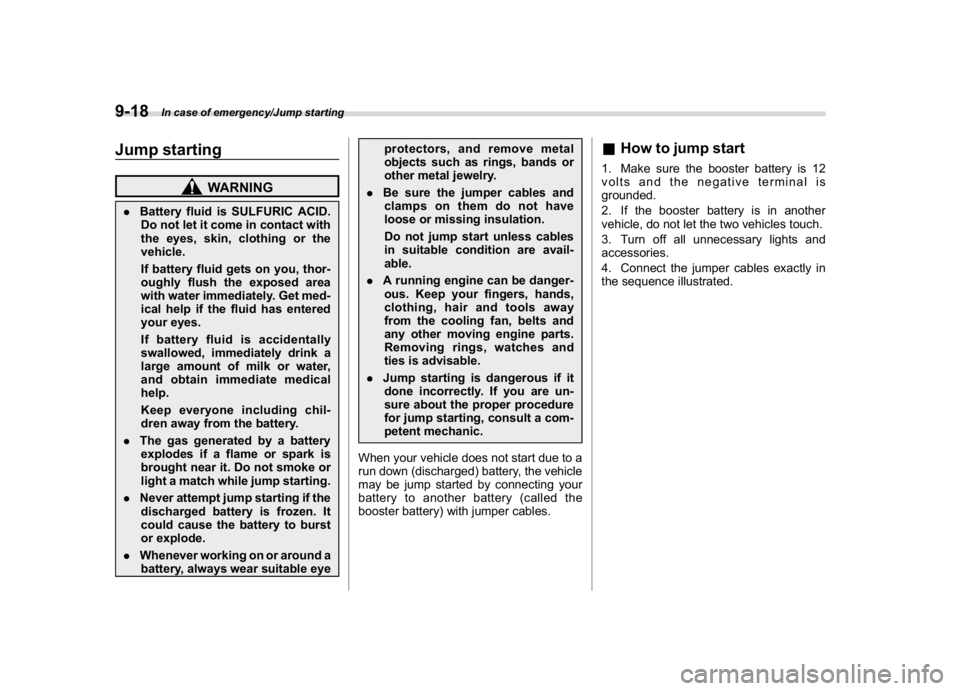
4. Connect the jumper cables exactly in
the sequence illustrated.
In case of emergency/Jump starting
9-18