2018 SUBARU WRX engine
[x] Cancel search: enginePage 435 of 578

(450,1)
北米Model "A1700BE-B" EDITED: 2017/ 10/ 11
tion, brand and load range and you should
never mix radial, belted bias or bias tires
since this may result in dangerous hand-
ling characteristics. When you choose a
tire, make sure that there is enough
clearance between the tire and vehicle
body.
Remember to drive with care at all times
regardless of the type of tires on your
vehicle.&Tire chains
CAUTION
You cannot use tire chains on your
vehicle because of the lack of clear-
ance between the tires and vehicle
body.NOTEEven though you cannot use tire
chains, use of another type of traction
device (such as spring chains) may be
acceptable if use on your vehicle is
recommended by the device manufac-
turer, taking into account tire size and
road conditions. Follow the device
manufacturer’s instructions, especially
regarding maximum vehicle speed.
To help avoid damage to your vehicle,drive slowly, readjust or remove the
device if it is contacting your vehicle,
and do not spin your wheels. Damage
caused to your vehicle by use of a
traction device is not covered under
warranty.
Make certain that any traction device
you use is an SAE class S device, and
use it on the front wheels only. Always
use the utmost care when driving with a
traction device. Overconfidence be-
cause you are using a traction device
could easily lead to a serious accident.
&Rocking the vehicleIf you must rock the vehicle to free it from
snow, sand, or mud, depress the accel-
erator pedal slightly and move the shift
lever/select lever back and forth between
“1”/“D”and“R”repeatedly. Do not race the
engine. For the best possible traction,
avoid spinning the wheels when trying to
free the vehicle.
When the road surface is extremely
slippery, you can obtain better traction by
starting the vehicle with the transmission in
2nd than in 1st (MT models and CVT
models).
If your vehicle is a CVT model, for
information about holding the transmissionin the 2nd position, refer to“Selection of
manual mode”F7-25.
Driving tips/Winter driving
8-10
Page 440 of 578
(455,1)
北米Model "A1700BE-B" EDITED: 2017/ 10/ 11
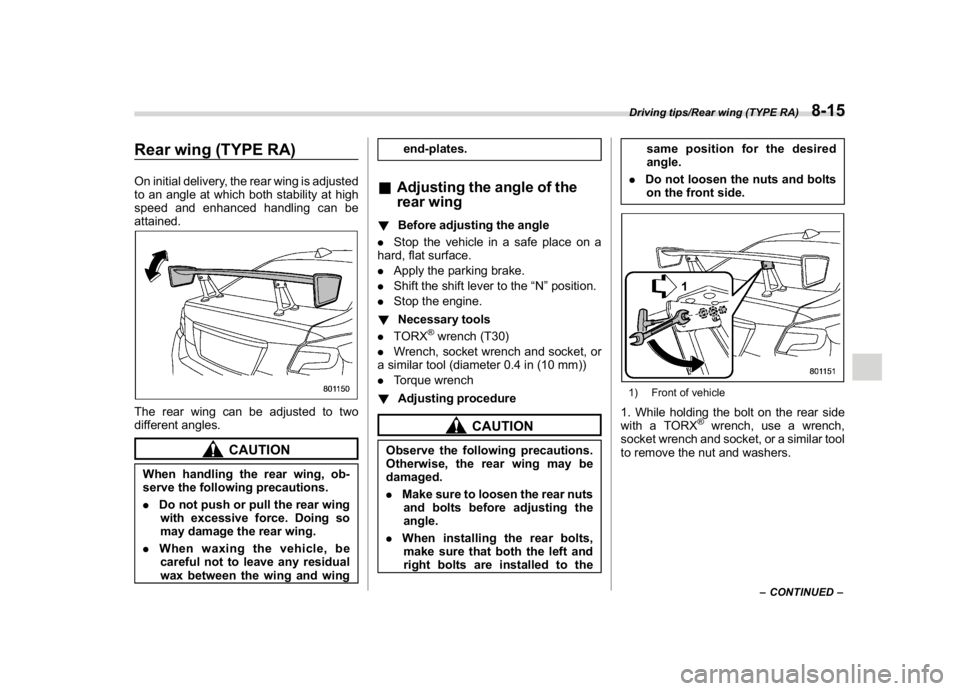
Rear wing (TYPE RA)On initial delivery, the rear wing is adjusted
to an angle at which both stability at high
speed and enhanced handling can be
attained.The rear wing can be adjusted to two
different angles.
CAUTION
When handling the rear wing, ob-
serve the following precautions.
.Do not push or pull the rear wing
with excessive force. Doing so
may damage the rear wing.
.When waxing the vehicle, be
careful not to leave any residual
wax between the wing and wingend-plates.
&Adjusting the angle of the
rear wing!Before adjusting the angle
.Stop the vehicle in a safe place on a
hard, flat surface.
.Apply the parking brake.
.Shift the shift lever to the“N”position.
.Stop the engine.
!Necessary tools
.TORX
®wrench (T30)
.Wrench, socket wrench and socket, or
a similar tool (diameter 0.4 in (10 mm))
.Torque wrench
!Adjusting procedure
CAUTION
Observe the following precautions.
Otherwise, the rear wing may be
damaged.
.Make sure to loosen the rear nuts
and bolts before adjusting the
angle.
.When installing the rear bolts,
make sure that both the left and
right bolts are installed to thesame position for the desired
angle.
.Do not loosen the nuts and bolts
on the front side.
1) Front of vehicle1. While holding the bolt on the rear side
with a TORX
®
wrench, use a wrench,
socket wrench and socket, or a similar tool
to remove the nut and washers.
–CONTINUED–
Driving tips/Rear wing (TYPE RA)
8-15
8
Page 442 of 578

(459,1)
北米Model "A1700BE-B" EDITED: 2017/ 10/ 11
If you park your vehicle in case of an
emergency............................................................9-2
Temporary spare tire(if equipped)........................9-2
Maintenance tools...................................................9-3
Models with flat tire repair kit................................. 9-4
Models without flat tire repair kit............................ 9-4
Flat tires...................................................................9-5
Changing a flat tire................................................ 9-5
Sealing flat tire (models with flat tire repair kit)...... 9-8
Tire pressure monitoring system (TPMS)
(U.S.-spec. models).............................................9-17
Jump starting........................................................9-18
How to jump start.................................................9-18
Engine overheating...............................................9-20
If steam is coming from the engine
compartment......................................................9-20
If no steam is coming from the engine
compartment......................................................9-20
Towing...................................................................9-21
Towing and tie-down hooks/holes.........................9-21
Using a flat-bed truck...........................................9-24
Towing with all wheels on the ground...................9-25
Electronic parking brake–if the electronic
parking brake cannot be released (models
with electronic parking brakesystem)............9-25
Access key fob–if access key fob does not
operate properly................................................9-26
Locking and unlocking.........................................9-26
Switching power status........................................9-26
Starting engine.....................................................9-27
Moonroof (if equipped)–if the moonroof
does not close...................................................9-28
If your vehicle is involvedin an accident...........9-28
In case of emergency
9
Page 446 of 578

(463,1)
北米Model "A1700BE-B" EDITED: 2017/ 10/ 11
1) Wheel nut wrench
2) Screwdriver
3) Jack
4) Towing hook (eye bolt)A jack handle is stored under the floor of
the trunk. A jack and a towing hook are
stored in the tool bucket that is located in
the recess of the spare tire wheel. A
screwdriver and a wheel nut wrench are
stored in the vinyl bag. You can also store
these tools in the tool bucket.NOTEFor how to use the jack, refer to“Flat
tires”F9-5.
Flat tiresIf you have a flat tire while driving, never
brake suddenly; keep driving straight
ahead while gradually reducing speed.
Then slowly pull off the road to a safe
place.&Changing a flat tire!Models with flat tire repair kit
It may be difficult to change a flat tire.
However, it may be possible to seal the
tire. For details, refer to“Sealing flat tire
(models with flat tire repair kit)”F9-8.
!Models without flat tire repair kit
WARNING
.Do not jack up the vehicle on an
incline or a loose road surface.
The jack can come out of the
jacking point or sink into the
ground and this can result in a
severe accident.
.Use only the jack provided with
your vehicle. The jack supplied
with the vehicle is designed only
for changing a tire. Never get
under the vehicle while support-
ing the vehicle with this jack..Before using the jack, be sure
that there are no occupants or
cargo in the vehicle.
.Always turn off the engine before
raising the flat tire off the ground
using the jack. Never swing or
push the vehicle supported with
the jack. The jack can come out of
the jacking point due to a jolt and
this can result in a severe acci-
dent.
1. Park on a hard, level surface, when-
ever possible, then stop the engine.
2. Set the parking brake securely and
shift the shift lever in reverse (MT models)
or the select lever to the“P”(Park) position
(CVT models).
3. Turn on the hazard warning flasher and
have everyone get out of the vehicle.
–CONTINUED–
In case of emergency/Flat tires
9-5
9
Page 451 of 578
(468,1)
北米Model "A1700BE-B" EDITED: 2017/ 10/ 11
.Do not tow a trailer.
.If used for a purpose other than
sealing a flat tire, the flat tire
repair kit may cause a severe
accident or injury due to the fact
that compressed air can act as an
explosive or propellant.
.Safely park your vehicle on the
roadside so that you do not
obstruct the flow of traffic and
so that you are able to seal the flat
tire without being in danger.
.Apply the parking brake, even if
the vehicle is parked on a level
road, to make sure that the vehi-
cle will not move.
.Stop the engine before sealing
the flat tire.
.Turn on the hazard warning
flasher while sealing the flat tire.
.Do not attempt to remove foreign
objects like nails or screws that
have penetrated the tire. Leave
them as they are.
.Never leave the flat tire repair kit
unattended while in use.
.Only one tire can be repaired with
one bottle of sealant.
.The tires can be repaired when
the ambient temperature is228F(308C) or higher.
CAUTION
.Remember that the flat tire repair
kit only provides temporary mo-
bility. Regulations concerning
tire repair after usage of flat tire
repair kit may differ from country
to country. We recommend that
you consult your SUBARU dealer
or tire dealer for advice.
.Store the flat tire repair kit safely
and secure it in the cargo area.
Storing it anywhere in the pas-
senger compartment is not advi-
sable because it could strike an
occupant in the event of a sudden
stop or collision and cause injury.
.Use the flat tire repair kit with
original vehicle tires only.
.Do not keep the air compressor
operating for more than 10 min-
utes, otherwise there is a risk of
overheating.
.The temperature of the air com-
pressor may become high. Be
careful not to burn yourself.
.When raining, take measures to
prevent the air compressor frombeing exposed directly to the
rain. Exposing to rain may cause
a malfunction.
.Do not use air compressors other
than the one in the repair kit.
Using an air compressor other
than the one in the repair kit may
damage the tires.
.Do not disassemble or modify the
air compressor to enable the use
of a power supply or a battery
other than DC12V.
.If a temporary puncture repair is
performed with the repair kit, the
Tire Pressure Monitoring System
(TPMS) may not operate nor-
mally.
In case of emergency/Flat tires
9-10
Page 459 of 578
(476,1)
北米Model "A1700BE-B" EDITED: 2017/ 10/ 11
Jump starting
WARNING
.Battery fluid is SULFURIC ACID.
Do not let it come in contact with
the eyes, skin, clothing or the
vehicle.
If battery fluid gets on you, thor-
oughly flush the exposed area
with water immediately. Get med-
ical help if the fluid has entered
your eyes.
If battery fluid is accidentally
swallowed, immediately drink a
large amount of milk or water,
and obtain immediate medical
help.
Keep everyone including chil-
dren away from the battery.
.The gas generated by a battery
explodes if a flame or spark is
brought near it. Do not smoke or
light a match while jump starting.
.Never attempt jump starting if the
discharged battery is frozen. It
could cause the battery to burst
or explode.
.Whenever working on or around a
battery, always wear suitable eyeprotectors, and remove metal
objects such as rings, bands or
other metal jewelry.
.Be sure the jumper cables and
clamps on them do not have
loose or missing insulation.
Do not jump start unless cables
in suitable condition are avail-
able.
.A running engine can be danger-
ous. Keep your fingers, hands,
clothing, hair and tools away
from the cooling fan, belts and
any other moving engine parts.
Removing rings, watches and
ties is advisable.
.Jump starting is dangerous if it
done incorrectly. If you are un-
sure about the proper procedure
for jump starting, consult a com-
petent mechanic.
When your vehicle does not start due to a
run down (discharged) battery, the vehicle
may be jump started by connecting your
battery to another battery (called the
booster battery) with jumper cables.
&How to jump start1. Make sure the booster battery is 12
volts and the negative terminal is
grounded.
2. If the booster battery is in another
vehicle, do not let the two vehicles touch.
3. Turn off all unnecessary lights and
accessories.
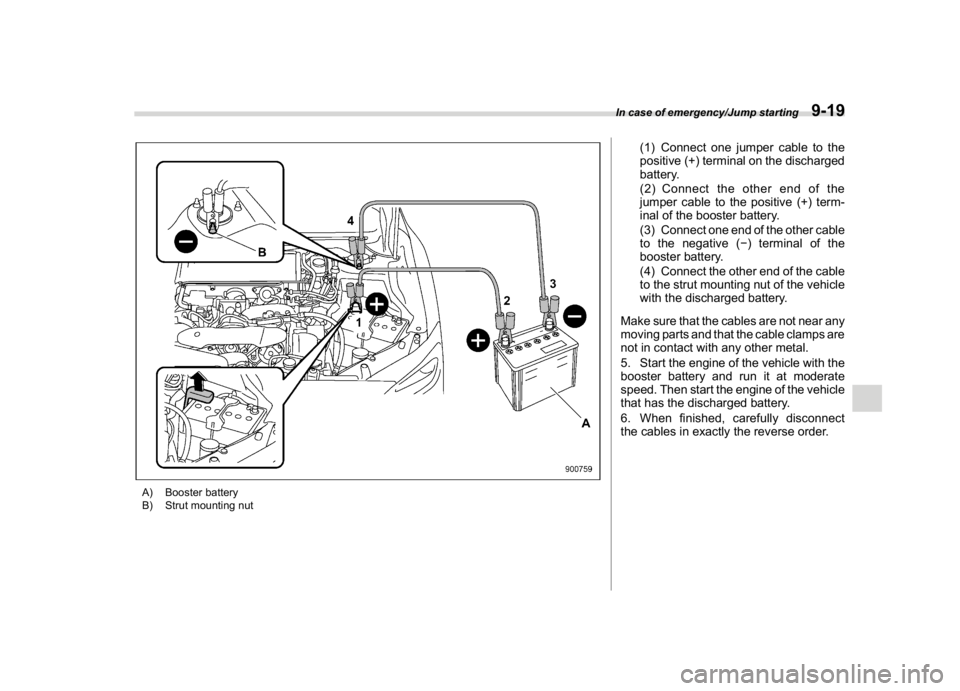
4. Connect the jumper cables exactly in
the sequence illustrated.
In case of emergency/Jump starting
9-18
Page 460 of 578
(477,1)
北米Model "A1700BE-B" EDITED: 2017/ 10/ 11
A) Booster battery
B) Strut mounting nut
(1) Connect one jumper cable to the
positive (+) terminal on the discharged
battery.
(2) Connect the other end of the
jumper cable to the positive (+) term-
inal of the booster battery.
(3) Connect one end of the other cable
to the negative () terminal of the
booster battery.
(4) Connect the other end of the cable
to the strut mounting nut of the vehicle
with the discharged battery.
Make sure that the cables are not near any
moving parts and that the cable clamps are
not in contact with any other metal.
5. Start the engine of the vehicle with the
booster battery and run it at moderate
speed. Then start the engine of the vehicle
that has the discharged battery.
6. When finished, carefully disconnect
the cables in exactly the reverse order.
In case of emergency/Jump starting
9-19
9
Page 461 of 578

(478,1)
北米Model "A1700BE-B" EDITED: 2017/ 10/ 11
Engine overheating
WARNING
Never attempt to remove the radiator
cap until the engine has been shut
off and has fully cooled down. When
the engine is hot, the coolant is
under pressure. Removing the cap
while the engine is still hot could
release a spray of boiling hot cool-
ant, which could burn you very
seriously.
If the engine overheats, safely pull off the
road and stop the vehicle in a safe
location.&If steam is coming from the
engine compartment.Turn off the engine and get everyone
away from the vehicle until it cools down.
.Contact an authorized SUBARU deal-
er.
&If no steam is coming from the
engine compartment1. Keep the engine running at idling
speed.
2. Open the engine hood to ventilate the
engine compartment. Refer to“Engine
hood”F11-9.
Confirm that the cooling fan is turning. If
the fan is not turning, immediately turn off
the engine and contact an authorized
SUBARU dealer for repair.
3. After the engine coolant temperature
has dropped, turn off the engine.Temperature gauge
1) Normal operating rangeIf temperature gauge stays in the over-
heated zone, turn off the engine. Refer to
“Temperature gauge”F3-11.4. After the engine has fully cooled down,
check the coolant level in the reserve tank.
If the coolant level is below the“LOW”
mark, add coolant up to the“FULL”mark.
NOTEFor details about how to check the
coolant level or how to add coolant,
refer to“Engine coolant”F11-17.
5. If there is no coolant in the reserve
tank, add coolant to the reserve tank. Then
remove the radiator cap and fill the radiator
with coolant.
If you remove the radiator cap from a hot
radiator, first wrap a thick cloth around the
radiator cap, then turn the cap counter-
clockwise slowly without pressing down
until it stops. Release the pressure from
the radiator. After the pressure has been
fully released, remove the cap by pressing
down and turning it.
In case of emergency/Engine overheating
9-20