2018 SUBARU WRX engine
[x] Cancel search: enginePage 466 of 578
(483,1)
北米Model "A1700BE-B" EDITED: 2017/ 10/ 11
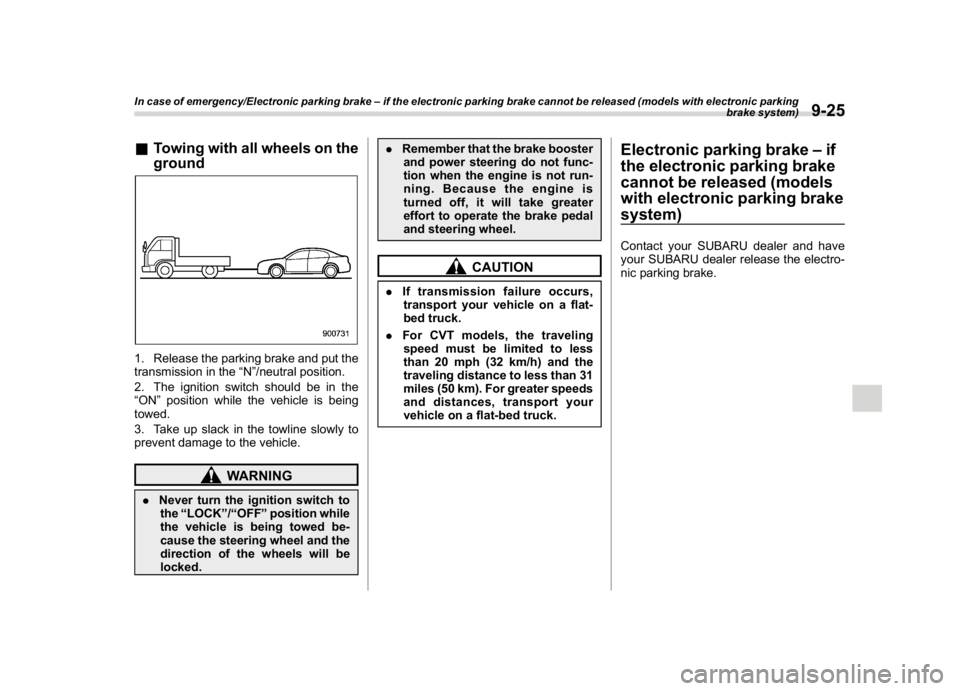
&Towing with all wheels on the
ground1. Release the parking brake and put the
transmission in the“N”/neutral position.
2. The ignition switch should be in the
“ON”position while the vehicle is being
towed.
3. Take up slack in the towline slowly to
prevent damage to the vehicle.
WARNING
.Never turn the ignition switch to
the“LOCK”/“OFF”position while
the vehicle is being towed be-
cause the steering wheel and the
direction of the wheels will be
locked..Remember that the brake booster
and power steering do not func-
tion when the engine is not run-
ning. Because the engine is
turned off, it will take greater
effort to operate the brake pedal
and steering wheel.
CAUTION
.If transmission failure occurs,
transport your vehicle on a flat-
bed truck.
.For CVT models, the traveling
speed must be limited to less
than 20 mph (32 km/h) and the
traveling distance to less than 31
miles (50 km). For greater speeds
and distances, transport your
vehicle on a flat-bed truck.
Electronic parking brake–if
the electronic parking brake
cannot be released (models
with electronic parking brake
system)Contact your SUBARU dealer and have
your SUBARU dealer release the electro-
nic parking brake.
In case of emergency/Electronic parking brake–if the electronic parking brake cannot be released (models with electronic parking
brake system)
9-25
9
Page 467 of 578
(484,1)
北米Model "A1700BE-B" EDITED: 2017/ 10/ 11
Access key fob–if access key
fob does not operate properly
CAUTION
Keep metallic objects, magnetic
sources and signal transmitters
away from the area between the
access key fob and the push-button
ignition switch. They may interfere
with the communication between
the access key fob and the push-
button ignition switch.
The following functions may be inoperable
because of strong radio signals in the
surrounding area or a low battery condition
of the access key fob.
.Locking/unlocking doors
.Switching power status
.Starting the engine
In such cases, perform the following
procedure. When the battery of the access
key fob is discharged, replace it with a new
one. Refer to“Replacing battery of access
key fob”F11-52.
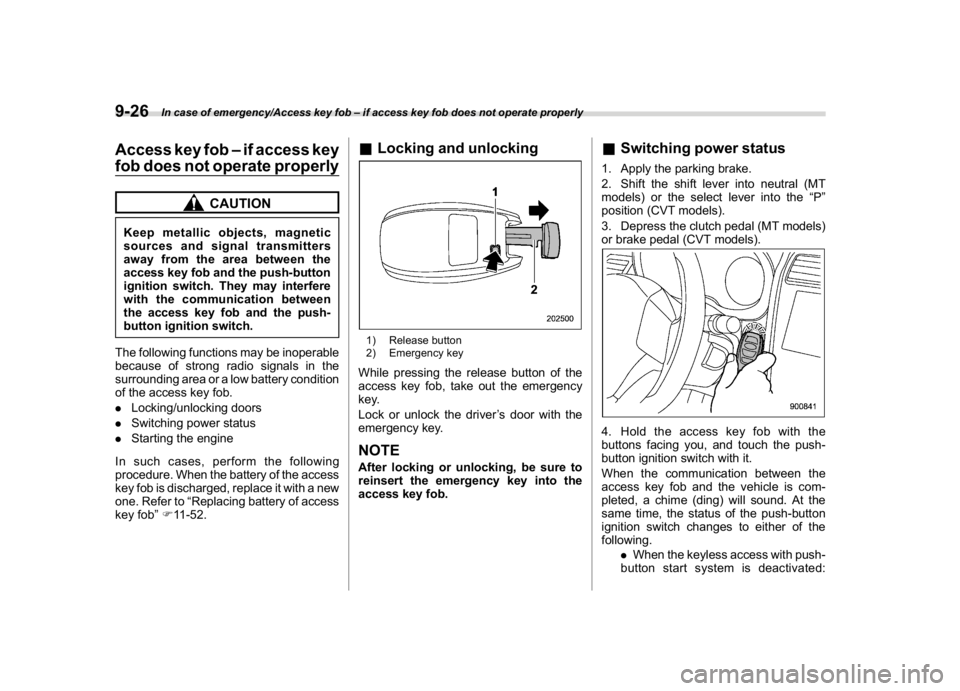
&Locking and unlocking1) Release button
2) Emergency keyWhile pressing the release button of the
access key fob, take out the emergency
key.
Lock or unlock the driver’s door with the
emergency key.NOTEAfter locking or unlocking, be sure to
reinsert the emergency key into the
access key fob.
&Switching power status1. Apply the parking brake.
2. Shift the shift lever into neutral (MT
models) or the select lever into the“P”
position (CVT models).
3. Depress the clutch pedal (MT models)
or brake pedal (CVT models).4. Hold the access key fob with the
buttons facing you, and touch the push-
button ignition switch with it.
When the communication between the
access key fob and the vehicle is com-
pleted, a chime (ding) will sound. At the
same time, the status of the push-button
ignition switch changes to either of the
following.
.When the keyless access with push-
button start system is deactivated:
In case of emergency/Access key fob–if access key fob does not operate properly
9-26
Page 468 of 578
(485,1)
北米Model "A1700BE-B" EDITED: 2017/ 10/ 11
“ACC”
.Under other conditions:“ON”
5. When the keyless access with push-
button start system is deactivated, press
the push-button ignition switch with the
clutch pedal (MT models) or brake pedal
(CVT models) released. The status of the
push-button ignition switch then changes
to“ON”.
NOTEIf the power does not switch even
though the above procedure was fol-
lowed precisely, contact your SUBARU
dealer.
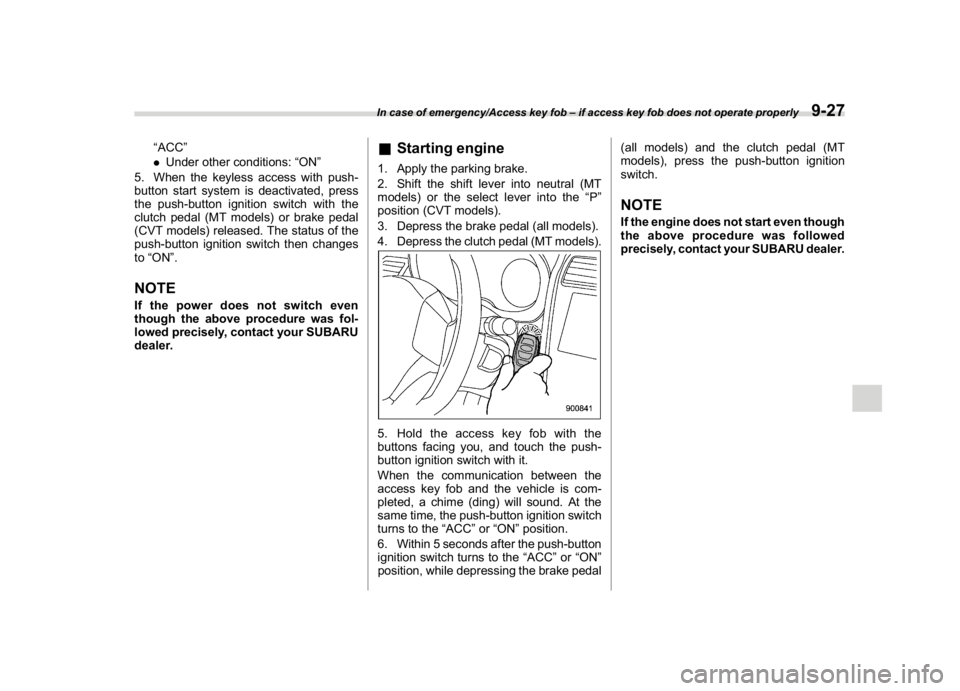
&Starting engine1. Apply the parking brake.
2. Shift the shift lever into neutral (MT
models) or the select lever into the“P”
position (CVT models).
3. Depress the brake pedal (all models).
4. Depress the clutch pedal (MT models).5. Holdtheaccesskeyfobwiththe
buttons facing you, and touch the push-
button ignition switch with it.
When the communication between the
access key fob and the vehicle is com-
pleted, a chime (ding) will sound. At the
same time, the push-button ignition switch
turns to the“ACC”or“ON”position.
6. Within 5 seconds after the push-button
ignition switch turns to the“ACC”or“ON”
position, while depressing the brake pedal(all models) and the clutch pedal (MT
models), press the push-button ignition
switch.
NOTEIf the engine does not start even though
the above procedure was followed
precisely, contact your SUBARU dealer.
In case of emergency/Access key fob–if access key fob does not operate properly
9-27
9
Page 469 of 578

(486,1)
北米Model "A1700BE-B" EDITED: 2017/ 10/ 11
Moonroof (if equipped)–if the
moonroof does not closeIf the moonroof does not close, we
recommend that you have the system
checked by a SUBARU dealer.
If your vehicle is involved in
an accident
CAUTION
If your vehicle is involved in an
accident, be sure to inspect the
ground under the vehicle before
restarting the engine. If you find that
fuel has leaked on the ground, do
not try to restart the engine. The fuel
system has been damaged and is in
need of repair. Immediately contact
the nearest automotive service facil-
ity. We recommend that you consult
your SUBARU dealer.
Your vehicle has a fuel pump shut off
system. To minimize the risk of fire due to
fuel leakage when your vehicle is subject
to impact from an accident or another
factor, the system stops supplying fuel.
However, depending on the impact condi-
tions at the time of collision, the fuel pump
shut-off system may not operate.
Perform the following procedures to restart
the engine after the system is activated.Models without“keyless access with
push-button start system”:
1. Turn the ignition switch to the“LOCK”
or“ACC”position.
2. Restart the engine.
Models with“keyless access with
push-button start system”:
1. Turn the push-button ignition switch to
the“ACC”or“OFF”position.
2. Restart the engine.
In case of emergency/Moonroof–if the moonroof does not close
9-28
Page 471 of 578
(490,1)
北米Model "A1700BE-B" EDITED: 2017/ 10/ 11
Exterior care&Washing
CAUTION
TYPE RA: Do not use automatic car
washes. Doing so may damage the
rear wing or its finish.
CAUTION
.When washing the vehicle, the
brakes may get wet. As a result,
the brake stopping distance will
be longer. To dry the brakes, drive
the vehicle at a safe speed while
lightly depressing the brake ped-
al to heat up the brakes.
.Do not wash the engine compart-
ment and area adjacent to it. If
water enters the engine air intake
or electrical parts, it will cause
engine trouble or a malfunction
of electrical equipment.
.When washing the inner fenders,
underbody, bumpers and pro-
truding objects such as exhaust
pipes and exhaust finishers, be
careful to prevent injuries from
contacting sharp ends..Do not use any organic solvents
when washing the surface of the
bulb assembly cover. However, if
a detergent with organic solvents
is used to wash the cover sur-
face, completely rinse off the
detergent with water. Otherwise,
the cover surface may be da-
maged.
NOTEWhen having your vehicle washed in an
automatic car wash, make sure before-
hand that the car wash is of suitable
type.
The best way to preserve your vehicle’s
beauty is frequent washing. Wash the
vehicle at least once a month to avoid
contamination by road grime.
Wash dirt off with a wet sponge and plenty
of lukewarm or cold water. Do not wash the
vehicle with hot water and in direct sun-
light.
Salt, chemicals, insects, tar, soot, tree sap,
and bird droppings should be washed off
by using a light detergent, as required. If
you use a light detergent, make certain
that it is a neutral detergent. Do not use
strong soap or chemical detergents. All
cleaning agents should be promptly rinsedoff the surface and not allowed to dry there.
Rinse the vehicle thoroughly with plenty of
lukewarm water. Wipe the remaining water
off with a chamois or soft cloth. Wear
rubber gloves and use a hand brush when
washing down underbody, inner fenders
and suspension to effectively remove mud
and dirt off.
!Washing the underbody
Chemicals, salts and gravel used for
deicing road surfaces are extremely cor-
rosive, accelerating the corrosion of un-
derbody components, such as the exhaust
system, fuel and brake lines, brake cables,
floor pan and fenders, and suspension.
Thoroughly flush the underbody and inside
of the fenders with lukewarm or cold water
at frequent intervals to reduce the harmful
effects of such agents.
Mud and sand adhering to the underbody
components may accelerate their corro-
sion.
After driving off-road or on muddy or sandy
roads, wash the mud and sand off the
underbody. Carefully flush the suspension
and axle parts, as they are particularly
prone to mud and sand buildup. Do not use
a sharp-edged tool to remove caked mud.
Appearance care/Exterior care
10-2
Page 472 of 578

(491,1)
北米Model "A1700BE-B" EDITED: 2017/ 10/ 11
CAUTION
.Be careful not to damage brake
hoses, sensor harnesses, and
other parts when washing sus-
pension components.
.Be careful not to flush the engine
bottom for a long time. It may
cause damage of some electrical
parts.
!Using a warm water washer
.Keep a good distance of 12 in (30 cm)
or more between the washer nozzle and
the vehicle.
.Do not wash the same area continu-
ously.
.If a stain will not come out easily, wash
by hand. Some warm water washers are of
the high temperature, high pressure type,
and they can damage or deform the resin
parts such as moldings, or cause water to
leak into the vehicle.!Precautions for TYPE RA
!Precautions when cleaning the
carbon roof and rear wing
CAUTION
.When cleaning, take care that you
do not apply strong force to a
single point. Depending on the
degree of force and the location,
there is the risk of denting the
carbon roof or rear wing.
.After acid rain falls, it is recom-
mended that the vehicle be
washed before the water on the
paint evaporates.
.Promptly wash off any bird drop-
pings, insects, pollen, tree sap, or
similar substance that adheres to
the paint. If it is not promptly
washed off, it may penetrate the
paint.
.Remove any dirt using a neutral deter-
gent. Do not use hard brushes or abrasive
cleaners. Do not use strong or harsh
chemical cleaners.
.As the CFRP parts may change color if
they are exposed to ultraviolet rays for
extended periods of time, we recommend
that your vehicle be stored in a placewhere it will not be exposed to direct
sunlight.
.Do not use wax that contains abrasives.
NOTEDue to the characteristics of the carbon
roof, white cloudy areas may occur in
spots on the roof, however these do not
affect performance in any way.
!Precautions when cleaning
around the rear bumper cherry
red stripeRear bumper cherry red stripePrecautions when using a high-pres-
sure washer:
.Keep a distance of 12 in (30 cm) or
more between the washer nozzle and the
stripe.
–CONTINUED–
Appearance care/Exterior care
10-3
10
Page 478 of 578

(499,1)
北米Model "A1700BE-B" EDITED: 2017/ 10/ 11
Maintenance schedule.......................................... 11-3
Maintenance precautions..................................... 11-3
Before checking or servicing in the engine
compartment...................................................... 11-4
When checking or servicing in the engine
compartment...................................................... 11-5
When checking or servicing in the engine
compartment while the engine is running............ 11-5
Maintenance tips................................................... 11-6
Removing and reinstalling clips............................ 11-6
Engine hood.......................................................... 11-9
Engine compartment overview.......................... 11-11
STI...................................................................... 11-11
Except STI.......................................................... 11-12
Engine oil............................................................. 11-13
Engine oil consumption...................................... 11-13
Checking the oil level.......................................... 11-13
Changing the oil and oil filter.............................. 11-15
Recommended grade and viscosity..................... 11-15
Synthetic oil........................................................ 11-16
Cooling system................................................... 11-16
Cooling fan, hose and connections..................... 11-17
Engine coolant.................................................... 11-17
Air cleaner element............................................. 11-18
Replacing the air cleaner element........................ 11-19
Spark plugs......................................................... 11-21
Recommended spark plugs................................. 11-21
Drive belts........................................................... 11-21Manual transmission oil......................................11-22
Recommended grade and viscosity..................... 11-22
Continuously variable transmission fluid..........11-22
Front differential gear oil (CVT models) and
rear differential gear oil....................................11-23
Recommended grade and viscosity..................... 11-23
Power steering fluid (STI)...................................11-23
Checking the fluid level...................................... 11-23
Recommended fluid............................................ 11-24
Brake fluid............................................................11-24
Checking the fluid level...................................... 11-24
Recommended brake fluid.................................. 11-25
Clutch fluid (MT models).....................................11-25
Checking the fluid level...................................... 11-25
Recommended clutch fluid................................. 11-26
Brake booster......................................................11-26
Brake pedal..........................................................11-27
Checking the brake pedal free play..................... 11-27
Checking the brake pedal reserve distance ......... 11-27
Clutch pedal (MT models)...................................11-27
Checking the clutch function .............................. 11-27
Checking the clutch pedal free play.................... 11-28
Hill start assist system.......................................11-28
Replacement of brake pad andlining................11-28
Breaking-in of new brake pads (models with
electronic parking brake system)..................... 11-29
Breaking-in of new brake pads and linings
(models without electronic parking brake
system)........................................................... 11-29
Maintenance and service
11
Page 480 of 578

(501,1)
北米Model "A1700BE-B" EDITED: 2017/ 10/ 11
Maintenance scheduleU.S. models
The scheduled maintenance items re-
quired to be serviced at regular intervals
are shown in the“Warranty and Mainte-
nance Booklet”. For details, read the
separate“Warranty and Maintenance
Booklet”.
Canada models
The scheduled maintenance items re-
quired to be serviced at regular intervals
are shown in the“Warranty and Service
Booklet”. For details, read the separate
“Warranty and Service Booklet”.
Other models
Some items of your vehicle are required to
be serviced at scheduled intervals. For
details about your maintenance schedule,
read the separate“Warranty and Main-
tenance Booklet”.NOTEYou can set a reminder to be displayed
when a scheduled maintenance item is
almost due. For details, refer to“Main-
tenance settings”F3-59.
Maintenance precautionsWhen maintenance and service are re-
quired, it is recommended that all work be
done by an authorized SUBARU dealer.
If you perform maintenance and service by
yourself, you should familiarize yourself
with the information provided in this sec-
tion on general maintenance and service
for your SUBARU.
Incorrect or incomplete service could
cause improper or unsafe vehicle opera-
tion. Any problems caused by improper
maintenance and service performed by
you are not eligible for warranty coverage.
WARNING
.Testing of an All-Wheel Drive
model must NEVER be performed
on a single two-wheel dynam-
ometer or similar apparatus. At-
tempting to do so will result in
transmission damage and in un-
controlled vehicle movement and
may cause an accident or injuries
to persons nearby.
.Always select a safe area when
performing maintenance on your
vehicle.
.Always be very careful to avoidinjury when working on the vehi-
cle. Remember that some of the
materials in the vehicle may be
hazardous if improperly used or
handled, for example, battery
acid.
.Your vehicle should only be ser-
viced by persons fully competent
to do so. Serious personal injury
may result to persons not experi-
enced in servicing vehicles.
.Always use the proper tools and
make certain that they are well
maintained.
.Never get under the vehicle sup-
ported only by a jack. Always use
safety stands to support the
vehicle.
.Never keep the engine running in
a poorly ventilated area, such as
a garage or other closed areas.
.Do not smoke or allow open
flames around the fuel or battery.
This will cause a fire.
.Because the fuel system is under
pressure, replacement of the fuel
filter should be performed only
by your SUBARU dealer.
.Wear adequate eye protection to
guard against getting oil or fluids
–CONTINUED–
Maintenance and service/Maintenance schedule
11-3
11