2018 SUBARU WRX engine
[x] Cancel search: enginePage 375 of 578

(388,1)
北米Model "A1700BE-B" EDITED: 2017/ 10/ 11
1) Upshift indicator
2) Downshift indicator
3) Gear position indicatorWhen the manual mode is selected, the
gear position indicator and upshift indica-
tor and/or downshift indicator on the
combination meter appear.
The gear position indicator shows the
currently selected gear in the following
range.
.1st-to-8th-gear range (when the Sport
Sharp (S#) mode is selected)
.1st-to-6th-gear range (in other situa-
tions)
The upshift and downshift indicators show
when a gear shift is possible. When the
upshift indicator“
”appears, upshifting is
possible. When the downshift indicator“
”appears, downshifting is possible.
When both indicators appear, upshifting
and downshifting are both possible. When
the vehicle stops (for example, at traffic
signals), the downshift indicator turns off.
Gearshifts can be performed using the
shift paddle behind the steering wheel.
To upshift to the next higher gear position,
pull the shift paddle that has“+”indicated
on it. To downshift to the next lower gear
position, pull the shift paddle that has“–”
indicated on it.
CAUTION
Do not place or hang anything on the
shift paddles. Doing so may result in
accidental gear shifting.
NOTEPlease read the following points care-
fully and bear them in mind when using
the manual mode.
.If you attempt to shift down when the
engine speed is too high, i.e., when a
downshift would push the tachometer
needle beyond the red zone, beeps will
be emitted to warn you that the down-
shift is not possible.
.If you attempt to shift up when the
vehicle speed is too low, the transmis-
sion will not respond.
.You can perform a skip-shift (for
example, from 4th to 2nd) by operating
the shift paddle twice in rapid succes-
sion.
.The transmission automatically se-
lects 1st gear when the vehicle stops
moving.
.If the temperature of the transmis-
sion fluid becomes too high, the“AT
OIL TEMP”warning light on the combi-
nation meter will illuminate. Immedi-
ately stop the vehicle in a safe location
and let the engine idle until the warning
light turns off.
.By selecting the Sport Sharp (S#)
mode, upshifting will not occur auto-
matically. According to the road condi-
tions, shift change manually so that the
tachometer needle does not enter the
Starting and operating/Continuously variable transmission
7-26
Page 376 of 578

(389,1)
北米Model "A1700BE-B" EDITED: 2017/ 10/ 11
red zone. Also, if the engine revolutions
reach the specified number, the fuel
supply will be cut. In this case, perform
shift up operation.
!To deselect the manual mode
To deselect the manual mode, return the
select lever to the“D”position from the“M”
position.&Shift lock functionThe shift lock function helps prevent the
improper operation of the select lever.
.You cannot move the select lever with
the ignition switch in the“ON”position and
the brake pedal depressed.
.You cannot move the select lever from
the“P”position to any other position
unless the brake pedal is depressed.
Depress the brake pedal first, and then
operate the select lever.
.Only the“P”position allows you to turn
the ignition switch from the“ACC”position
to the“LOCK”/“OFF”position and remove
the key from the ignition switch.
.If you turn the ignition switch to the
“LOCK”/“OFF”position while the select
lever is in the“N”position, the select lever
may not be moved to the“P”position after
a period of time. Therefore, move the
select lever to the“P”position with the
brake pedal depressed soon after turningthe ignition switch to the“LOCK”/“OFF”
position.
!Shift lock release
If you cannot move the select lever, turn
theignitionswitchbacktothe“ON”
position then move the select lever to the
“P”position with the select lever button
pressed and brake pedal depressed.
If the select lever does not move after
performing the above procedure, perform
the following steps.
.When you cannot shift the select
lever from“P”to“N”:
Refer to“
Shift lock release using the shift
lock release button”F7-27.
.When you cannot shift the select
lever from“N”to“R”,“P”:
Within 60 seconds after placing the ignition
switch in the“ACC”position, move the
select lever to the“P”position with the
select lever button pressed and brake
pedal depressed.
If you must perform the above procedure,
the shift lock system (or the vehicle control
system) may be malfunctioning. Contact a
SUBARU dealer for an inspection as soon
as possible.
If the select lever does not move after
performing the above procedure, refer to“Shift lock release using the shift lock
release button”F7-27.
!Shift lock release using the shift
lock release button
Perform the following procedure to release
the shift lock.
1. Apply the parking brake and stop the
engine.
2. Wrap the tip of a flat-head screwdriver
with vinyl tape or a cloth and use it to
remove the shift lock cover. The shift lock
release button is located under the shift
lock cover.
–CONTINUED–
Starting and operating/Continuously variable transmission
7-27
7
Page 377 of 578

(390,1)
北米Model "A1700BE-B" EDITED: 2017/ 10/ 11
3. Remove the grip portion of the screw-
driver.4. While depressing the brake pedal,
insert a screwdriver into the hole, press
the shift lock release button using a
screwdriver, and then move the selectlever.
If the select lever does not move after
performing the above procedure, the shift
lock system may be malfunctioning. Con-
tact a SUBARU dealer for an inspection as
soon as possible.
&Driving tips
NOTEIf the accelerator and brake pedals are
depressed at the same time, driving
torque may be restrained. This is not a
malfunction.
.Always apply the foot or parking brake
when the vehicle is stopped in the“D”or
“R”position.
.Make sure to apply the parking brake
when parking your vehicle. Do not hold the
vehicle with only the mechanical friction of
the transmission.
.Do not keep the vehicle in a stationary
position on an uphill grade by using the“D”
position. Use the brake instead.
.The engine may, on rare occasions,
knock when the vehicle rapidly acceler-
ates or rapidly pulls away from a standstill.
This phenomenon does not indicate a
malfunction.
SI-DRIVE (if equipped)SI-DRIVE (SUBARU Intelligent Drive)
works to maximize engine performance,
control and efficiency.
This system consists of three modes:
.Intelligent (I) mode
.Sport (S) mode
.Sport Sharp (S#) mode
By adjusting the SI-DRIVE selector, the
character of the power unit changes.&Intelligent (I) mode!For smooth, efficient performance
drivingThe Intelligent (I) mode provides well-
balanced performance with greater fuel
Starting and operating/SI-DRIVE
7-28
Page 378 of 578
(391,1)
北米Model "A1700BE-B" EDITED: 2017/ 10/ 11
efficiency and smooth driveability without
stress. Power delivery is moderate during
acceleration for maximum fuel efficiency.
This is ideal for around-town driving and
situations that do not require full power
output. It provides better control in difficult
driving conditions, such as slippery roads
or loose surfaces, due to gentler throttle
response.
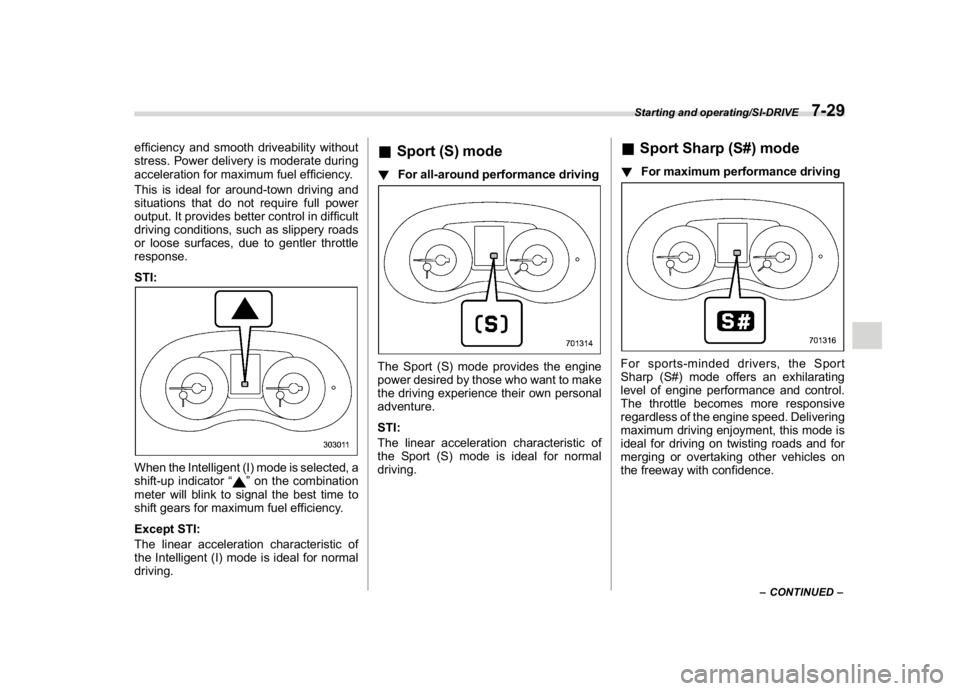
STI:When the Intelligent (I) mode is selected, a
shift-up indicator“
”on the combination
meter will blink to signal the best time to
shift gears for maximum fuel efficiency.
Except STI:
The linear acceleration characteristic of
the Intelligent (I) mode is ideal for normal
driving.
&Sport (S) mode!For all-around performance drivingThe Sport (S) mode provides the engine
power desired by those who want to make
the driving experience their own personal
adventure.
STI:
The linear acceleration characteristic of
the Sport (S) mode is ideal for normal
driving.
&Sport Sharp (S#) mode!For maximum performance drivingFor sports-minded drivers, the Sport
Sharp (S#) mode offers an exhilarating
level of engine performance and control.
The throttle becomes more responsive
regardless of the engine speed. Delivering
maximum driving enjoyment, this mode is
ideal for driving on twisting roads and for
merging or overtaking other vehicles on
the freeway with confidence.
–CONTINUED–
Starting and operating/SI-DRIVE
7-29
7
Page 379 of 578

(392,1)
北米Model "A1700BE-B" EDITED: 2017/ 10/ 11
!Except STI
When you select the Sport Sharp (S#)
mode with the select lever in the“D”
position, the transmission gear ratio will
shift from variable speed to eight-speed.
The select lever/gear position indicator
display will change from“D”to the gear
position.
When selecting Sport Sharp (S#) mode,
the following controls will be applied.
.Uphill control
Prevents unnecessary shift-up/shift-down
during ascent.
.Cornering control
While turning, if there is a large centrifugal
force, shift-up will not occur: during re-
acceleration.
.Braking control
At the beginning of corners etc., heavy
application of the brake pedal will cause
automatic downshift and gently re-accel-
erate.
.Sudden acceleration return control
During acceleration, if acceleration pedal
is returned suddenly (for example, at
corners etc.), shift-up will not be applied.
&SI-DRIVE switch
NOTE.The next time you turn on the engine,
the following SI-DRIVE mode will be
selected.
–Intelligent (I) mode if you have
turned off the engine in the Intelli-
gent (I) mode
–Sport (S) mode if you have turned
off the engine in the Sport (S) mode
or Sport Sharp (S#) mode
.If the CHECK ENGINE warning light/
malfunction indicator light illuminates
during engine operation, the SI-DRIVE
mode changes to the Sport (S) mode. In
this case, it is not possible to change to
the Sport Sharp (S#) mode or Intelligent
(I) mode.
.If the engine coolant temperature
becomes so high that the engine could
overheat, it is not possible to change to
the Sport Sharp (S#) mode. While the
vehicle is in the Sport Sharp (S#) mode,
it changes to the Sport (S) mode when
the engine coolant temperature in-
creases.
.If any of the SI-DRIVE indicators
blink, the SI-DRIVE system may be
malfunctioning. Contact your SUBARU
dealer.!STI
SI-DRIVE switchTo select the Intelligent (I) mode:
Push the SI-DRIVE switch.
To select the Sport (S) mode:
Rotate the SI-DRIVE switch to the left.
To select the Sport Sharp (S#) mode:
Rotate the SI-DRIVE switch to the right.
After operating the SI-DRIVE switch, the
switch returns to its original position.
Starting and operating/SI-DRIVE
7-30
Page 380 of 578

(393,1)
北米Model "A1700BE-B" EDITED: 2017/ 10/ 11
!Except STISI-DRIVE switchesTo select the Intelligent (I) mode:
.Press the“S/I”switch when the Sport
(S) mode is selected
.Press the“S#/I”switch when the Sport
Sharp (S#) mode is selected
To select the Sport (S) mode:
Press the“S/I”switch when any mode
other than Sport (S) mode is selected.
To select the Sport Sharp (S#) mode:
Press the“S#/I”switch when any mode
other than Sport Sharp (S#) mode is
selected.
Limited slip differential (LSD)
(STI)The LSD provides optimum distribution of
power according to the difference in
revolutions between the right and left
wheels that may be caused by certain
driving conditions, thereby improving driv-
ing stability on snow-covered, muddy or
other slippery roads or when high speed
driving.
CAUTION
.Never start the engine while a tire
on one side is jacked up, as the
vehicle may move.
.If one tire is spinning in mud,
avoid continued spinning at high
speed as this could adversely
affect the LSD.
.If you use a temporary spare tire
to replace a flat tire, be sure to
use the original temporary spare
tire stored in the vehicle. Using
other sizes will adversely affect
the LSD.
Power steering&STIThe vehicle is equipped with a hydraulic
power steering system. The power steer-
ing system operates only when the engine
is running.
If you lose power steering assist because
the engine stops or the system fails to
function, you can steer but it will take much
more effort.
CAUTION
Do not hold the steering wheel at the
fully locked position left or right for
more than 5 seconds. This may
damage the power steering pump.NOTERight after the engine has been started
and before it has warmed up, you may
hear a noise coming from areas adja-
cent to the power steering pump which
is located at the right-front area of the
engine compartment. This noise is
normal. It does not indicate power
steering system trouble.
–CONTINUED–
Starting and operating/Limited slip differential (LSD) (STI)
7-31
7
Page 381 of 578
(394,1)
北米Model "A1700BE-B" EDITED: 2017/ 10/ 11
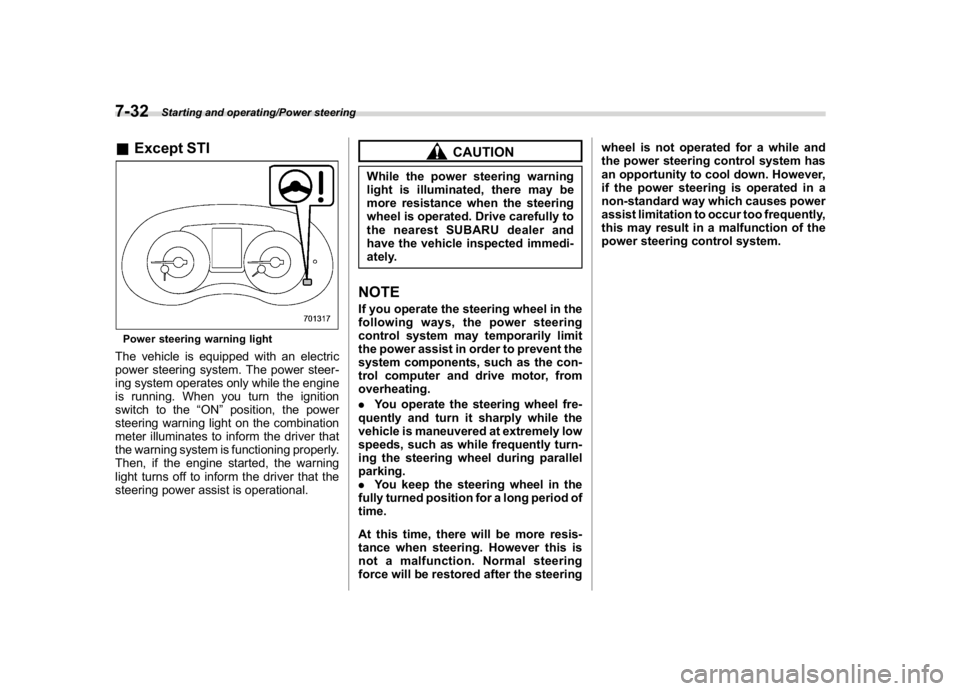
&Except STIPower steering warning lightThe vehicle is equipped with an electric
power steering system. The power steer-
ing system operates only while the engine
is running. When you turn the ignition
switch to the“ON”position, the power
steering warning light on the combination
meter illuminates to inform the driver that
the warning system is functioning properly.
Then, if the engine started, the warning
light turns off to inform the driver that the
steering power assist is operational.
CAUTION
While the power steering warning
light is illuminated, there may be
more resistance when the steering
wheel is operated. Drive carefully to
the nearest SUBARU dealer and
have the vehicle inspected immedi-
ately.NOTEIf you operate the steering wheel in the
following ways, the power steering
control system may temporarily limit
the power assist in order to prevent the
system components, such as the con-
trol computer and drive motor, from
overheating.
.You operate the steering wheel fre-
quently and turn it sharply while the
vehicle is maneuvered at extremely low
speeds, such as while frequently turn-
ing the steering wheel during parallel
parking.
.You keep the steering wheel in the
fully turned position for a long period of
time.
At this time, there will be more resis-
tance when steering. However this is
not a malfunction. Normal steering
force will be restored after the steeringwheel is not operated for a while and
the power steering control system has
an opportunity to cool down. However,
if the power steering is operated in a
non-standard way which causes power
assist limitation to occur too frequently,
this may result in a malfunction of the
power steering control system.
Starting and operating/Power steering
7-32
Page 382 of 578

(395,1)
北米Model "A1700BE-B" EDITED: 2017/ 10/ 11
Braking&Braking tips
WARNING
Never rest your foot on the brake
pedal while driving. This can cause
dangerous overheating of the
brakes and needless wear on the
brake pads and linings.
!When the brakes get wet
When driving in rain or after washing the
vehicle, the brakes may get wet. As a
result, brake stopping distance will be
longer. To dry the brakes, drive the vehicle
at a safe speed while lightly depressing the
brake pedal to heat up the brakes.
!Use of engine braking
Remember to make use of engine braking
in addition to foot braking. When descend-
ing a grade, if only the foot brake is used,
the brakes may start working improperly
because of brake fluid overheating,
caused by overheated brake pads. To help
prevent this, shift into a lower gear to get
stronger engine braking.
!Braking when a tire is punctured
Do not depress the brake pedal suddenly
when a tire is punctured. This could causea loss of control of the vehicle. Keep
driving straight ahead while gradually
reducing speed. Then slowly pull off the
road to a safe place.
&Brake system!Two separate circuits
Your vehicle has two separate circuit brake
systems. Each circuit works diagonally
across the vehicle. If one circuit of the
brake system should fail, the other half of
the system still works. If one circuit fails,
the brake pedal will go down much closer
to the floor than usual and you will need to
press it down much harder. And a much
longer distance will be needed to stop the
vehicle.
!Brake booster
The brake booster uses engine manifold
vacuum to assist braking force. Do not turn
off the engine while driving because that
will turn off the brake booster, resulting in
poor braking power.
The brakes will continue to work even
when the brake booster completely stops
functioning. If this happens, however, you
will have to depress the pedal much harder
than normal and the braking distance will
increase.!Brake assist system
WARNING
Do not be overconfident about the
brake assist. It is not a system that
brings more braking ability to the
vehicle beyond its braking capabil-
ity. Always use the utmost care
when driving regarding vehicle
speed and safe distance.
CAUTION
When you need to brake suddenly,
continue depressing the brake pedal
strongly to obtain the effect of the
brake assist.
Brake assist is a driver assistance system.
It assists the brake power when the driver
cannot depress the brake pedal strongly
and the brake power is insufficient.
Brake assist generates the brake power
according to the speed at which the driver
depresses the brake pedal.NOTEWhen you depress the brake pedal
strongly or suddenly, the following
phenomena occur. However, even
though these occur, they do not indi-
–CONTINUED–
Starting and operating/Braking
7-33
7