2018 SUBARU CROSSTREK fuel
[x] Cancel search: fuelPage 404 of 474
(417,1)
北米Model "A1320BE-C" EDITED: 2017/ 10/ 10
that cannot be seen with the naked eye.
This type of damage does not become
evident until time has passed. Try not to
drive over curbs, potholes or on other
rough surfaces. If doing so is unavoid-
able, keep the vehicle’s speed down to
a walking pace or less, and approach
the curbs as squarely as possible. Also,
make sure the tires are not pressed
against the curb when you park the
vehicle.
.If you feel unusual vibration while
driving or find it difficult to steer the
vehicle in a straight line, one of the tires
and/or wheels may be damaged. Drive
slowly to the nearest authorized
SUBARU dealer and have the vehicle
inspected.&Tire pressures and wearMaintaining the correct tire pressures
helps to maximize the tires’service lives
and is essential for good running perfor-
mance. Check and, if necessary, adjust
the pressure of each tire (including the
spare - if equipped) at least once a month
(for example, during a fuel stop) and
before any long journey.
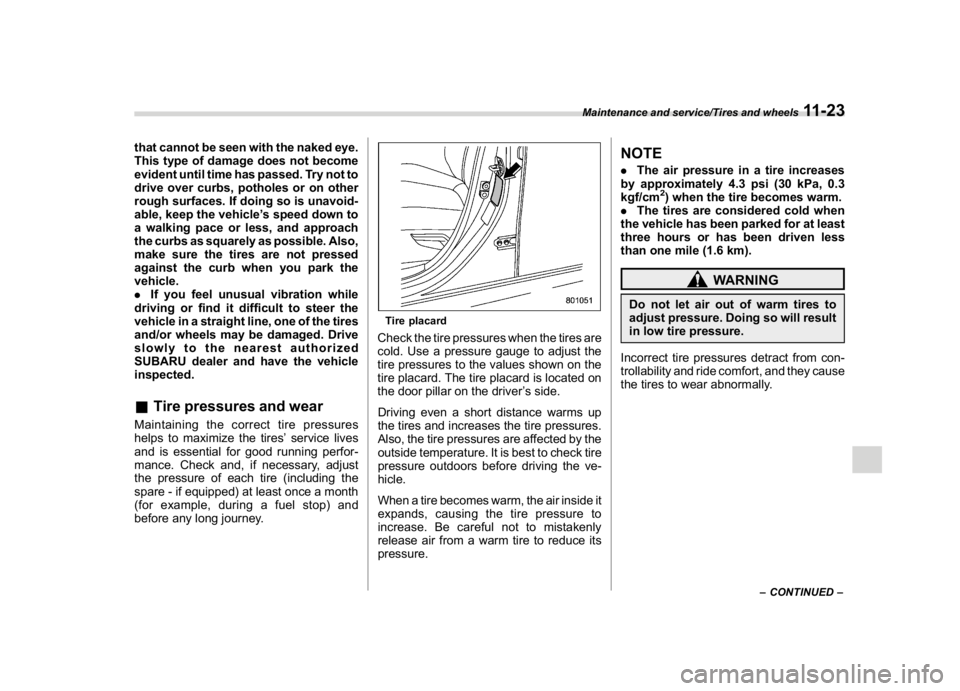
Tire placardCheck the tire pressures when the tires are
cold. Use a pressure gauge to adjust the
tire pressures to the values shown on the
tire placard. The tire placard is located on
the door pillar on the driver’s side.
Driving even a short distance warms up
the tires and increases the tire pressures.
Also, the tire pressures are affected by the
outside temperature. It is best to check tire
pressure outdoors before driving the ve-
hicle.
When a tire becomes warm, the air inside it
expands, causing the tire pressure to
increase. Be careful not to mistakenly
release air from a warm tire to reduce its
pressure.
NOTE.The air pressure in a tire increases
by approximately 4.3 psi (30 kPa, 0.3
kgf/cm
2) when the tire becomes warm.
.The tires are considered cold when
the vehicle has been parked for at least
three hours or has been driven less
than one mile (1.6 km).
WARNING
Do not let air out of warm tires to
adjust pressure. Doing so will result
in low tire pressure.
Incorrect tire pressures detract from con-
trollability and ride comfort, and they cause
the tires to wear abnormally.
–CONTINUED–
Maintenance and service/Tires and wheels
11-23
11
Page 405 of 474

(418,1)
北米Model "A1320BE-C" EDITED: 2017/ 10/ 10
1) Correct tire pressure (tread worn evenly)
Roadholding is good, and steering is
responsive. Rolling resistance is low, so
fuel consumption is also lower.
2) Under inflated tire (tread worn on
shoulders)
Rolling resistance is high, so fuel con-
sumption is also higher.3) Over inflated (tread worn in the center)
Ride comfort is poor. Also, the tire
magnifies the effects of road-surface
bumps and dips, possibly resulting in
vehicle damage.
If the tire placard shows tire pressures for
the vehicle when fully loaded, adjust the
tire pressures to the values that match the
loading conditions.
WARNING
Driving at high speeds with exces-
sively low tire pressures can cause
the tires to deform severely and to
rapidly heat up. A sharp increase in
temperature could cause tread se-
paration, and destruction of the
tires. The resulting loss of vehicle
control could lead to an accident.&Wheel balanceEach wheel was correctly balanced when
your vehicle was new, but the wheels will
become unbalanced as the tires become
worn during use. Wheel imbalance causes
the steering wheel to vibrate slightly at
certain vehicle speeds and detracts from
the vehicle’s straight-line stability. It can
also cause steering and suspension sys-
tem problems and abnormal tire wear. If
you suspect that the wheels are notcorrectly balanced, have them checked
and adjusted by your SUBARU dealer.
Also have them adjusted after tire repairs
and after tire rotation.
CAUTION
Loss of correct wheel alignment
causes the tires to wear on one side
and reduces the vehicle’s running
stability. Contact your SUBARU
dealer if you notice abnormal tire
wear.NOTEThe suspension system is designed to
hold each wheel at a certain alignment
(relative to the other wheels and to the
road) for optimum straight-line stability
and cornering performance.
Maintenance and service/Tires and wheels
11-24
Page 426 of 474

(441,1)
北米Model "A1320BE-C" EDITED: 2017/ 10/ 10
Specifications........................................................12-2
Dimensions...........................................................12-2
Engine..................................................................12-3
Fuel......................................................................12-3
Engine oil.............................................................12-4
Manual transmission, front differential and rear
differential gear oil..............................................12-6
Fluids...................................................................12-7
Engine coolant......................................................12-7
Electrical system..................................................12-8
Tires .....................................................................12-8Temporary spare tires...........................................12-9
Brake disc............................................................12-9
Fuses and circuits..............................................12-10
Fuse panel located in the passenger
compartment...................................................12-10
Fuse panel located in the engine compartment ... 12-12
Bulb chart............................................................12-14
Safety precautions..............................................12-14
Bulb chart..........................................................12-15
Vehicle identification..........................................12-18
Specifications
12
Page 428 of 474

(443,1)
北米Model "A1320BE-C" EDITED: 2017/ 10/ 10
&EngineEngine model
FB20
(2.0 L, DOHC, non-turbo)
Engine type Horizontally opposed, liquid cooled 4 cylinder, 4-stroke direct injection gasoline engine
Displacement cu-in (cc) 121.7 (1,995)
Bore6Stroke in (mm) 3.3163.54 (84.0690.0)
Compression ratio12.5 : 1
Firing order1–3–2–4&Fuel
Fuel requirement Fuel tank capacity
Unleaded gasoline with 87 AKI (90 RON) or higher16.6 US gal (63 liters, 13.9 Imp gal)
For more details, refer to“Fuel”F7-3.
–CONTINUED–
Specifications/Specifications
12-3
12
Page 431 of 474

(446,1)
北米Model "A1320BE-C" EDITED: 2017/ 10/ 10
&Manual transmission, front differential and rear differential gear oilOil Manual transmission oilFront differential gear oil
(CVT models)Rear differential gear
oil (CVT models)Rear differential gear oil (MT models)
Oil grade.SUBARU Extra MT*
3
.API classification
GL-5 (75W-90)*
4
.SUBARU Extra MT*
3
.API classification GL-5
(75W-90)API classification GL-5
SAE viscosity
No. and ap-
plicable tem-
perature—.75W-90*
.90
*: Recommended
Oil capacity*
1
3.5 US qt (3.3 liters, 2.9
Imp qt)1.4 US qt (1.3 liters, 1.1
Imp qt)0.8 US qt (0.8 liters, 0.7 Imp qt)
Remarks*
2
“Manual transmission oil”
F11-14
“Front differential gear oil (CVT models) and rear differential gear oil”F11-15
*1: The indicated oil quantity is only a guideline. The necessary quantity for replacement may differ slightly depending on the temperature and other
factors. After refilling the gearbox with oil, the oil level should be checked.
*2: For more details about maintenance and service, refer to the indicated section.
*3: The vehicle is filled at the factory with this type of oil.
*4: You may use this type of manual transmission oil. However, using this type of oil will detract from driveability and fuel efficiency.
Specifications/Specifications
12-6
Page 437 of 474

(452,1)
北米Model "A1320BE-C" EDITED: 2017/ 10/ 10
&Fuse panel located in the engine compartmentA) Main fuseFuse
panelFuse
ratingCircuit
1 7.5A
HORN 2
2 7.5A
HORN 1
3 15A
H/L LO RH
4
15A H/L LO LH
5
7.5A ACTGS
6 10A
H/L HI RH
7 10A
H/L HI LH
8 10A
TAIL
9 10A
ODS
10 7.5A
OBD
11 7.5A
PU B/UP
12 30A
JB-B
13 15A
HAZARD
14 20A
FUEL
15 7.5A
D-OP+B
16 10A
MB-B
17 15A
D/L
18 10A
DCM
19 20A
TCU
20 7.5A
CVT SSR
21 15A
IG COIL
22 10A
AVCS
Specifications/Fuses and circuits
12-12
Page 443 of 474
(458,1)
北米Model "A1320BE-C" EDITED: 2017/ 10/ 10
Vehicle identification
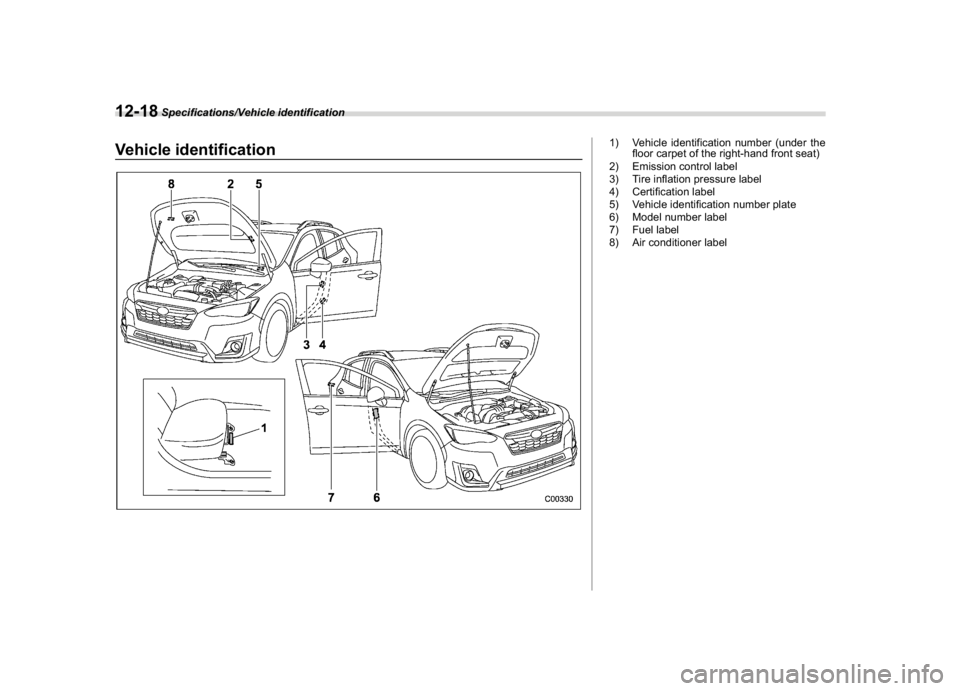
1) Vehicle identification number (under the
floor carpet of the right-hand front seat)
2) Emission control label
3) Tire inflation pressure label
4) Certification label
5) Vehicle identification number plate
6) Model number label
7) Fuel label
8) Air conditioner label
Specifications/Vehicle identification
12-18
Page 448 of 474

(465,1)
北米Model "A1320BE-C" EDITED: 2017/ 10/ 10
crease in temperature could cause
tread separation, and failure of the
tire(s). Possible resulting loss of
vehicle control could lead to an
accident.!Measuring and adjusting air
pressure to achieve proper in-
flationCheck and, if necessary, adjust the
pressure of each tire (including the
spare) at least once a month and
before any long journey. Check the
tire pressures when the tires are
cold. Use a pressure gauge to
adjust the tire pressures to the
specific values. Driving even a short
distance warms up the tires and
increases the tire pressures. Also,
the tire pressures are affected by
the outside temperature. It is best to
check tire pressure outdoors before
driving the vehicle. When a tire
becomes warm, the air inside it
expands, causing the tire pressure
to increase. Be careful not to mis-
takenly release air from a warm tire
to reduce its pressure.
&Glossary of tire terminology.
Accessory weight
The combined weight (in excess of
those standard items which may be
replaced) of automatic transmis-
sion, power steering, power brakes,
power windows, power seats, radio,
and heater, to the extent that these
items are available as factory-in-
stalled equipment (whether in-
stalled or not)..
Bead
The part of the tire that is made of
steel wires, wrapped or reinforced
by ply cords and that is shaped to fit
the rim..
Bead separation
A breakdown of the bond between
components in the bead..
Bias ply tire
A pneumatic tire in which the ply
cords that extend to the beads are
laid at alternate angles substantially
less than 90 degrees to the center-
line of the tread..
Carcass
The tire structure, except tread andsidewall rubber which, when in-
flated, bears the load.
.
Chunking
The breaking away of pieces of the
tread or sidewall..
Cold tire pressure
The pressure in a tire that has been
driven less than 1 mile or has been
standing for three hours or more..
Cord
The strands forming the plies in the
tire..
Cord separation
The parting of cords from adjacent
rubber compounds..
Cracking
Any parting within the tread, side-
wall, or inner liner of the tire
extending to cord material..
Curb weight
The weight of a motor vehicle with
standard equipment including the
maximum capacity of fuel, oil and
coolant, and if so equipped, air
conditioning and additional weight
optional engine.
–CONTINUED–
Consumer information and Reporting safety defects/Tire information
13-5
13