2018 SUBARU CROSSTREK front arm
[x] Cancel search: front armPage 7 of 474

(6,1)
北米Model "A1320BE-C" EDITED: 2017/ 10/ 10
Vehicle symbolsThere are some of the symbols you may
see on your vehicle.
For warning and indicator lights, refer to
“Warning and indicator lights”F23.
Mark Name
WARNINGCAUTIONRead these instructions care-
fullyWear eye protectionBattery fluid contains sulfuric
acidKeep children awayKeep flames awayPrevent explosions
Safety precautions when
driving&Seatbelt and SRS airbag
WARNING
.All persons in the vehicle must
fasten their seatbelts BEFORE
the vehicle starts to move. Other-
wise, the possibility of serious
injury becomes greater in the
event of a sudden stop or acci-
dent.
.To obtain maximum protection in
the event of an accident, the
driver and all passengers must
always wear seatbelts when in
the vehicle. The SRS (Supple-
mental Restraint System) airbag
does not do away with the need to
fasten seatbelts. In combination
with the seatbelts, it offers the
best combined protection in case
of a serious accident.
Not wearing a seatbelt increases
the chance of severe injury or
death in a crash even when the
vehicle has the SRS airbag..The SRS airbags deploy with
considerable speed and force.
Occupants who are out of proper
position when the SRS airbag
deploys could suffer very serious
injuries. Because the SRS airbag
needs enough space for deploy-
ment, the driver should always sit
upright and well back in the seat
as far from the steering wheel as
practical while still maintaining
full vehicle control and the front
passenger should move the seat
as far back as possible and sit
upright and well back in the seat.
For instructions and precautions, carefully
read the following sections.
.For the seatbelt system, refer to“Seat-
belts”F1-12.
.For the SRS airbag system, refer to
“SRS airbag (Supplemental Restraint Sys-
tem airbag)”F1-37.
&Child safety
WARNING
.Never hold a child on your lap or
in your arms while the vehicle is
moving. The passenger cannot
protect the child from injury in a
4
Page 9 of 474

(8,1)
北米Model "A1320BE-C" EDITED: 2017/ 10/ 10
&Engine exhaust gas (carbon
monoxide)
WARNING
.Never inhale engine exhaust gas.
Engine exhaust gas contains
carbon monoxide, a colorless
and odorless gas which is dan-
gerous, or even lethal, if inhaled.
.Always properly maintain the en-
gine exhaust system to prevent
engine exhaust gas from entering
the vehicle.
.Never run the engine in a closed
space, such as a garage, except
for the brief time needed to drive
the vehicle in or out of it.
.Avoid remaining in a parked ve-
hicle for a lengthy time while the
engine is running. If that is un-
avoidable, then use the ventila-
tion fan to force fresh air into the
vehicle.
.Always keep the front ventilator
inlet grille free from snow, leaves
or other obstructions to ensure
that the ventilation system al-
ways works properly.
.If at any time you suspect that
exhaust fumes are entering thevehicle, have the problem
checked and corrected as soon
as possible. If you must drive
under these conditions, drive
only with all windows fully open.
.Keep the rear gate closed while
driving to prevent exhaust gas
from entering the vehicle.
&Drinking and driving
WARNING
Drinking and then driving is very
dangerous. Alcohol in the blood-
stream delays your reaction time
and impairs your perception, judg-
ment and attentiveness. If you drive
after drinking–even if you drink just
a little–it will increase the risk of
being involved in a serious or fatal
accident, injuring or killing yourself,
your passengers and others. In
addition, if you are injured in the
accident, alcohol may increase the
severity of that injury.
Please don’t drink and drive.
Drunken driving is one of the most frequent
causes of accidents. Since alcohol affects
all people differently, you may have con-sumed too much alcohol to drive safely
even if the level of alcohol in your blood is
below the legal limit. The safest thing you
can do is never drink and drive. However if
you have no choice but to drive, stop
drinking and sober up completely before
getting behind the wheel.
&Drugs and driving
WARNING
There are some drugs (over the
counter and prescription) that can
delay your reaction time and impair
your perception, judgment and at-
tentiveness. If you drive after taking
them, it may increase your, your
passengers’and other persons’risk
of being involved in a serious or fatal
accident.
If you are taking any drugs, check with
your doctor or pharmacist or read the
literature that accompanies the medication
to determine if the drug you are taking can
impair your driving ability. Do not drive
after taking any medications that can make
you drowsy or otherwise affect your ability
to safely operate a motor vehicle. If you
have a medical condition that requires you
to take drugs, please consult with your
doctor.
6
Page 11 of 474

(10,1)
北米Model "A1320BE-C" EDITED: 2017/ 10/ 10
Never restrain pets or pet carriers in the
front passenger’s seat. For further infor-
mation, consult your veterinarian, local
animal protection society or pet shop.&Tire pressuresCheck and, if necessary, adjust the pres-
sure of each tire (including the spare) at
least once a month and before any long
journey.
Check the tire pressure when the tires are
cold. Use a pressure gauge to adjust the
tire pressures to the values shown on the
tire placard. For detailed information, refer
to“Tires and wheels”F11-21.
WARNING
Driving at high speeds with exces-
sively low tire pressures can cause
the tires to deform severely and to
rapidly become hot. A sharp in-
crease in temperature could cause
tread separation, and destruction of
the tires. The resulting loss of vehi-
cle control could lead to an accident.
&Attaching accessories
WARNING
.Do not attach any accessories,
labels or stickers (other than
properly placed inspection stick-
ers) to the windshield. Such
items may obstruct your view.
.If it is necessary to attach an
accessory (such as an electronic
toll collection (ETC) device or
security pass) to the windshield,
consult your SUBARU dealer for
details on the proper location.
General information&California proposition 65
warning
WARNING
Engine exhaust, some of its consti-
tuents, and certain vehicle compo-
nents contain or emit chemicals
known to the State of California to
cause cancer and birth defects or
other reproductive harm. In addi-
tion, certain fluids in vehicles and
certain components of product wear
contain or emit chemicals known to
the State of California to cause
cancer and birth defects or other
reproductive harm.&California Perchlorate Advi-
soryCertain vehicle components such as air-
bag modules, seatbelt pretensioners and
keyless entry transmitter batteries may
contain perchlorate material. Special
handling may apply for service or vehicle
end of life disposal. See www.dtsc.ca.gov/
hazardouswaste/perchlorate.
8
Page 39 of 474
(40,1)
北米Model "A1320BE-C" EDITED: 2017/ 10/ 10
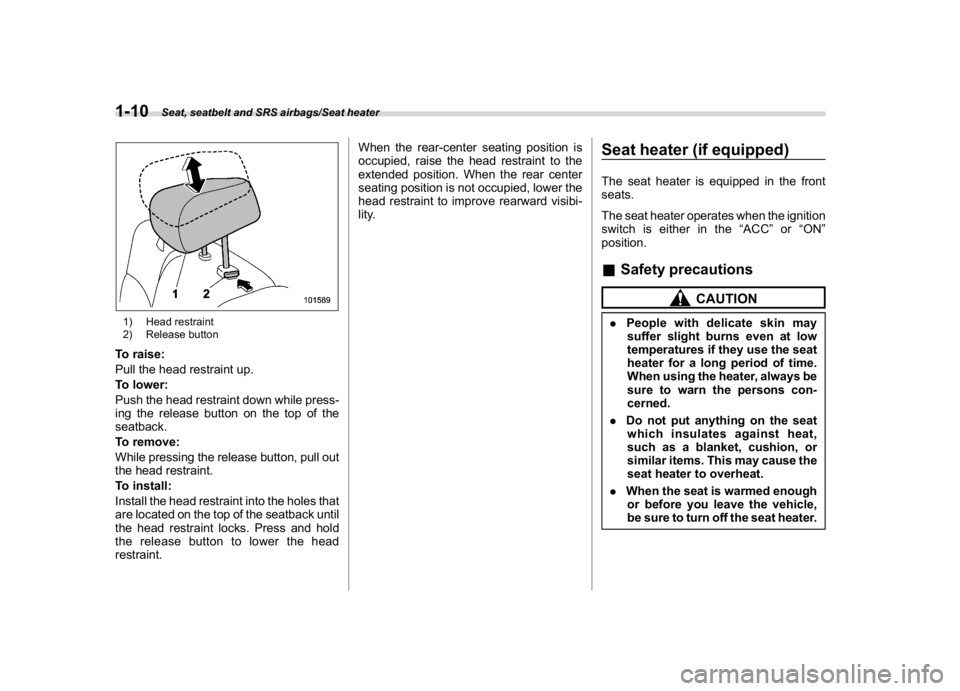
1) Head restraint
2) Release buttonTo raise:
Pull the head restraint up.
To lower:
Push the head restraint down while press-
ing the release button on the top of the
seatback.
To remove:
While pressing the release button, pull out
the head restraint.
To install:
Install the head restraint into the holes that
are located on the top of the seatback until
the head restraint locks. Press and hold
the release button to lower the head
restraint.When the rear-center seating position is
occupied, raise the head restraint to the
extended position. When the rear center
seating position is not occupied, lower the
head restraint to improve rearward visibi-
lity.
Seat heater (if equipped)The seat heater is equipped in the front
seats.
The seat heater operates when the ignition
switch is either in the“ACC”or“ON”
position.&Safety precautions
CAUTION
.People with delicate skin may
suffer slight burns even at low
temperatures if they use the seat
heater for a long period of time.
When using the heater, always be
sure to warn the persons con-
cerned.
.Do not put anything on the seat
which insulates against heat,
such as a blanket, cushion, or
similar items. This may cause the
seat heater to overheat.
.When the seat is warmed enough
or before you leave the vehicle,
be sure to turn off the seat heater.
Seat, seatbelt and SRS airbags/Seat heater
1-10
Page 41 of 474

(42,1)
北米Model "A1320BE-C" EDITED: 2017/ 10/ 10
Seatbelts&Seatbelt safety tips
WARNING
.All persons in the vehicle should
fasten their seatbelts BEFORE
the vehicle starts to move. Other-
wise, the possibility of serious
injury becomes greater in the
event of a sudden stop or acci-
dent.
.All belts should fit snugly in order
to provide full restraint. Loose
fitting belts are not as effective in
preventing or reducing injury.
.Each seatbelt is designed to sup-
port only one person. Never use a
single belt for two or more per-
sons–even children. Otherwise,
in an accident, serious injury or
death could result.
.Replace all seatbelt assemblies
including retractors and attach-
ing hardware worn by occupants
of a vehicle that has been in a
serious accident. The entire as-
sembly should be replaced even
if damage is not obvious.
.Never use a belt that is twisted orreversed. In an accident, this can
increase the risk or severity of
injury.
.Keep the lap belt as low as
possible on your hips. In a colli-
sion, this spreads the force of the
lap belt over stronger hip bones
instead of across the weaker
abdomen.
.Seatbelts provide maximum re-
straint when the occupant sits
well back and upright in the seat.
To reduce the risk of sliding
under the seatbelt in a collision,
the front seatbacks should be
always used in the upright posi-
tion while the vehicle is running.
If the front seatbacks are not
used in the upright position in a
collision, the risk of sliding under
the lap belt and of the lap belt
sliding up over the abdomen will
increase, and both can result in
serious internal injury or death.
.Do not put cushions or any other
materials between occupants
and seatbacks or seat cushions.
If you do so, the risk of sliding
under the lap belt and of the lap
belt sliding up over the abdomen
will increase, and both can result
in serious internal injury or death.
WARNING
Never place the shoulder belt under
the arm or behind the back. If an
accident occurs, this can increase
the risk or severity of injury.
CAUTION
Metallic parts of the seatbelt can
become very hot in a vehicle that has
been closed up in sunny weather;
they could burn an occupant. Do not
touch such hot parts until they cool.
Your vehicle is equipped with a crash
sensing and diagnostic module, which will
record the use of the seatbelt by the front
Seat, seatbelt and SRS airbags/Seatbelts
1-12
Page 42 of 474
(43,1)
北米Model "A1320BE-C" EDITED: 2017/ 10/ 10
passenger when any of the SRS frontal,
side and curtain airbags deploy.
!Infants or small children
Use a child restraint system that is suitable
for your vehicle. Refer to“Child restraint
systems”F1-25.
!Children
WARNING
Place children in the rear seat prop-
erly restrained at all times. The SRS
airbag deploys with considerable
speed and force and can injure or
even kill children, especially if they
are not restrained or improperly
restrained. Because children are
lighter and weaker than adults, their
risk of being injured from deploy-
ment is greater. For that reason, we
strongly recommend that ALL chil-
dren (including those in child seats
and those that have outgrown child
restraint devices) sit in the REAR
seat properly restrained at all times
in a child restraint device or in a
seatbelt, whichever is appropriate
for the child’s height and weight.
Secure ALL types of child restraint
devices (including forward facing
child seats) in the REAR seats at alltimes.
NEVER INSTALL A FORWARD OR
REARWARD FACING CHILD SEAT IN
THE FRONT SEAT. DOING SO RISKS
SERIOUS INJURY OR DEATH TO
THE CHILD BY PLACING THE
CHILD’SHEADTOOCLOSETO
THE SRS AIRBAG.
According to accident statistics,
children are safer when properly
restrained in the rear seating posi-
tions than in the front seating posi-
tions. For instructions and precau-
tions concerning the child restraint
system, refer to“Child restraint
systems”F1-25.
If a child is too big for a child restraint
system, the child should sit in the rear seat
and be restrained using the seatbelts.
According to accident statistics, children
are safer when properly restrained in the
rear seating positions than in the front
seating positions. Never allow a child to
stand up or kneel on the seat.
If the shoulder portion of the belt crosses
the face or neck, move the child closer to
the belt buckle to help provide a good
shoulder belt fit. Care must be taken to
securely place the lap belt as low as
possible on the hips and not on the child’swaist. If the shoulder portion of the belt
cannot be properly positioned, a child
restraint system should be used. Never
place the shoulder belt under the child’s
arm or behind the child’s back.
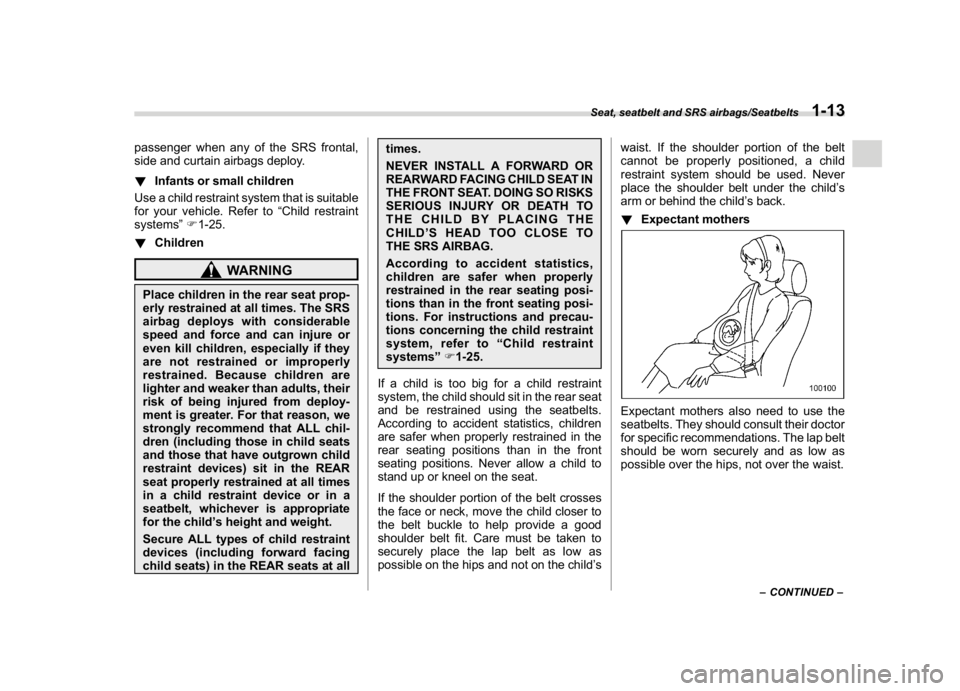
!Expectant mothers
Expectant mothers also need to use the
seatbelts. They should consult their doctor
for specific recommendations. The lap belt
should be worn securely and as low as
possible over the hips, not over the waist.
–CONTINUED–
Seat, seatbelt and SRS airbags/Seatbelts
1-13
1
Page 51 of 474

(52,1)
北米Model "A1320BE-C" EDITED: 2017/ 10/ 10
.Side impact sensor
.Front door impact sensor
.Rollover sensor
If the sensor detects a certain predeter-
mined amount of force during frontal or
side collisions or rollover accidents, any
seatbelt that has a seatbelt pretensioner is
quickly drawn back in by the retractor to
take up the slack so that the belt more
effectively restrains the seat occupant.
The driver’s seatbelt pretensioner includes
a tension reducing device which limits the
peak forces exerted by the seatbelt on the
occupant in the event of a collision.
When a seatbelt pretensioner is activated,
an operating noise will be heard and a
small amount of smoke will be released.
These occurrences are normal and not
harmful. This smoke does not indicate a
fire in the vehicle.
Once the seatbelt pretensioner has been
activated, the seatbelt retractor remains
locked. Consequently, the seatbelt can not
be pulled out and retracted and therefore
must be replaced.!In cases of rollover accident, frontal
collisions or side collisions, the
following components will operate
simultaneously
For details, refer to“In cases of rollover
accident, frontal collisions or side colli-
sions, the following components will oper-
ate simultaneously”F1-23.
&Seatbelt with shoulder belt
and lap belt pretensioners
NOTEThis section is applicable to the front
passenger’s side seatbelt.1) Seatbelt retractor assembly (shoulder
belt pretensioner and adaptive force
limiter)
2) Lap belt pretensioner
On the front passenger’sside,the
shoulder belt pretensioner is supplemen-
ted by a lap belt pretensioner, which is
located at the base of the center pillar. Like
the shoulder belt pretensioner, the lap belt
pretensioner instantaneously pulls in the
belt to eliminate slack if a certain level of
frontal collision force is detected. As a
result, the seatbelt restrains the front seat
occupant more effectively.
The front passenger’s seatbelt preten-
sioner includes a tension reducing device
which limits the peak forces exerted by the
seatbelt on the occupant in the event of a
collision.
The adaptive force limiter will select a
reducing load to the suit body size of
occupant as detected by the occupant
detection sensor.
When a seatbelt pretensioner is activated,
an operating noise will be heard and a
small amount of smoke will be released.
These occurrences are normal and not
harmful. This smoke does not indicate a
fire in the vehicle.
Once the seatbelt pretensioner has been
activated, the seatbelt pretensioner re-
mains locked. Consequently, the seatbelt
cannot be pulled out and retracted and
therefore must be replaced.
Seat, seatbelt and SRS airbags/Seatbelt pretensioners
1-22
Page 54 of 474

(55,1)
北米Model "A1320BE-C" EDITED: 2017/ 10/ 10
Child restraint systemsInfants and small children should always
be placed in an infant or child restraint
system in the rear seat while riding in the
vehicle.
You should use an infant or child restraint
system that meets Federal Motor Vehicle
Safety Standards or Canada Motor Vehi-
cle Safety Standards, is compatible with
your vehicle and is appropriate for the
child’s age and size.
All child restraint systems are designed to
be secured in vehicle seats by lap belts or
the lap belt portion of a lap/shoulder belt
(except those described in“Installation of
child restraint systems by use of lower and
tether anchorages (LATCH)”F1-33).Children could be endangered in an
accident if their child restraints are not
properly secured in the vehicle. When
installing the child restraint system, care-
fully follow the manufacturer’s instructions.
According to accident statistics, children
are safer when properly restrained in the
rear seating positions than in the front
seating positions.
All U.S. states and Canadian provinces
require that infants and small children be
restrained in an approved child restraint
system at all times while the vehicle is
moving.
WARNING
Never let a passenger hold a child on
his or her lap or in his or her armswhile the vehicle is moving. The
passenger cannot protect the child
from injury in a collision, because
the child will be caught between the
passenger and objects inside the
vehicle.
Additionally, holding a child in your
lap or arms in the front seat exposes
that child to another serious danger.
Since the SRS airbag deploys with
considerable speed and force, the
child could be injured or even killed.
WARNING
Children should be properly re-
strained at all times. Never allow a
child to stand up, or to kneel on any
–CONTINUED–
Seat, seatbelt and SRS airbags/Child restraint systems
1-25
1