2018 SUBARU CROSSTREK fuel
[x] Cancel search: fuelPage 330 of 474

(341,1)
北米Model "A1320BE-C" EDITED: 2017/ 10/ 10
exhaust fumes are entering the
vehicle, have the problem
checked and corrected as soon
as possible. If you must drive
under these conditions, drive
only with all windows fully open.
.Keep the rear gate closed while
driving to prevent exhaust gas
from entering the vehicle.
NOTEDue to the expansion and contraction
of the metals used in the manufacture
of the exhaust system, you may hear a
crackling sound coming from the ex-
haust system for a short time after the
engine has been shut off. This sound is
normal.
Catalytic converterThe catalytic converter is installed in the
exhaust system. It serves as a catalyst to
reduce HC, CO and NOx in exhaust gases,
thus providing cleaner exhaust.
To avoid damage to the catalytic converter:
.Use only unleaded fuel. Even a small
amount of leaded fuel will damage the
catalytic converter.
.Never start the engine by pushing or
pulling the vehicle.
.Avoid racing the engine.
.Never turn the ignition switch to the
“OFF”position while the vehicle is moving.
.Keep your engine tuned-up. If you feel
the engine running rough (misfiring, back-
firing or incomplete combustion), haveyour vehicle checked and repaired by an
authorized SUBARU dealer.
.Do not apply undercoating or rust
prevention treatment to the heat shield of
catalytic converter and the exhaust sys-
tem.
.Do not drive with an extremely low fuel
level.
WARNING
.Avoid fire hazards. Do not drive
or park the vehicle anywhere
near flammable materials (e.g.,
grass, paper, rags or leaves),
because the catalytic converter
operates at very high tempera-
tures.
.Keep everyone and flammable
materials away from the exhaust
pipe while the engine is running.
The exhaust gas is very hot.Driving tips/Catalytic converter
8-3
8
Page 331 of 474

(342,1)
北米Model "A1320BE-C" EDITED: 2017/ 10/ 10
Periodic inspectionsTo keep your vehicle in the best condition
at all times, always have the recom-
mended maintenance services listed in
the maintenance schedule in the“War-
ranty and Maintenance Booklet”per-
formed at the specified time or mileage
intervals.
Driving in foreign countriesWhen planning to use your vehicle in
another country:
.Confirm the availability of the correct
fuel. Refer to“Fuel requirements”F7-3.
.Comply with all regulations and require-
ments of each country.
Driving tips for AWD models
WARNING
.Always maintain a safe driving
speed according to the road and
weather conditions in order to
avoid having an accident on a
sharp turn, during sudden brak-
ing or under other similar condi-
tions.
.Always use the utmost care in
driving–overconfidence be-
cause you are driving an All-
Wheel Drive vehicle could easily
lead to a serious accident.
.When replacing or installing tire
(s), all four tires must be the same
for following items.
(a) Size
(b) Circumference
(c) Speed symbol
(d) Load index
(e) Construction
(f) Manufacturer
(g) Brand (tread pattern)
(h) Degrees of wear
For the items (a) to (d), you must
obey the specification that is
Driving tips/Periodic inspections
8-4
Page 336 of 474
(347,1)
北米Model "A1320BE-C" EDITED: 2017/ 10/ 10
icing may develop on the brake
system, which could cause poor
braking action. Check for snow or
ice buildup on the suspension,
disc brakes and brake hoses
underneath the vehicle. If there
is caked snow or ice, remove it,
being careful not to damage the
disc brakes and brake hoses and
ABS harness.
When parking for long periods in cold
weather, you should observe the following
tips.
1. For MT models, place the shift lever in
the“1”or“R”position. For CVT models,
place the select lever in the“P”position.
2. Use tire stops under the tires to prevent
the vehicle from moving.
!Refueling in cold weather
To help prevent moisture from forming in
the fuel system and the risk of its freezing,
use of an antifreeze additive in the fuel
tank is recommended during cold weather.
Use only additives that are specifically
designed for this purpose. When an anti-
freeze additive is used, its effect lasts
longer if the tank is refilled whenever the
fuel level reaches half empty.
If your SUBARU is not going to be used foran extended period, it is best to have the
fuel tank filled to capacity.
&Driving on snowy and icy
roadsTo prevent skidding and slipping, avoid
sudden braking, abrupt acceleration, high-
speed driving, and sharp turning when
driving on snowy or icy roads.
Always maintain ample distance between
your vehicle and the vehicle ahead of you
to avoid the need for sudden braking.
To supplement the foot brake, use the
engine brake effectively to control the
vehicle speed. (Shift into a lower gear
when necessary.)
Avoid shifting down abruptly. Such beha-
vior can cause the wheels to lock, possibly
leading to loss of vehicle control.
An anti-lock brake system (ABS) en-
hances your vehicle’s braking perfor-
mance on snowy and icy roads. For
information on braking on slippery sur-
faces, refer to“ABS (Anti-lock Brake
System)”F7-33 and“Vehicle Dynamics
Control system”F7-35.
WARNING
For models with cruise control:
Do not use the cruise control on
slippery roads such as snowy or icyroads. This may cause loss of vehi-
cle control.
CAUTION
Avoid prolonged continuous driving
in snowstorms. Snow will enter the
engine’s intake system and may
hinder the airflow, which could re-
sult in engine shutdown or even
breakdown.
!Wiper operation when snowing
Before driving in cold weather, make sure
the wiper blade rubbers are not frozen to
the windshield or rear window.
If the wiper blade rubbers are frozen to the
windshield or rear window, perform the
following procedure.
.To thaw the windshield wiper blade
rubbers, use the defroster with the airflow
selection in“
”and the temperature set
for maximum warmth until the wiper blade
rubbers are completely thawed. Refer to
“Climate control”F4-1.
.If your vehicle is equipped with a wiper
deicer, use it. It is helpful to thaw the
windshield wiper blade rubbers. Refer to
“Defogger and deicer”F3-89.
.To thaw the rear wiper blade rubbers,
–CONTINUED–
Driving tips/Winter driving
8-9
8
Page 339 of 474
(350,1)
北米Model "A1320BE-C" EDITED: 2017/ 10/ 10
WARNING
.When you carry something inside
the vehicle, secure it whenever
you can to prevent it from being
thrown around inside the vehicle
during sudden stops, sharp turns
or in an accident.
.Do not pile heavy loads on the
roof. These loads raise the vehi-
cle’s center of gravity and make it
more prone to tip over.
.Secure lengthy items properly to
prevent them from shooting for-
ward and causing serious injury
during a sudden stop.
.Never exceed the maximum load
limit. If you do, some parts on
your vehicle can break, or it can
change the way your vehicle
handles. This could result in loss
of control and cause personal
injury. Also, overloading can
shorten the life of your vehicle.
.Do not place anything on the
extended cargo area cover. Such
items could tumble forward in the
event of a sudden stop or a
collision. This could cause ser-
ious injury.
CAUTION
Do not carry spray cans, containers
with flammable or corrosive liquids
or any other dangerous items inside
the vehicle.NOTEFor better fuel economy, do not carry
unneeded cargo.&Vehicle capacity weight
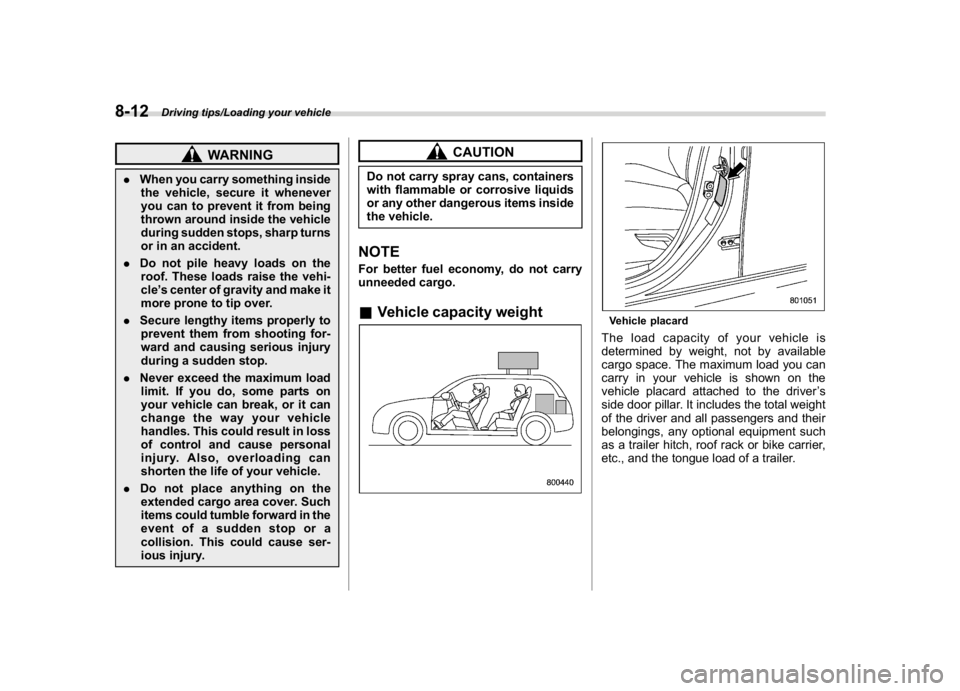
Vehicle placardThe load capacity of your vehicle is
determined by weight, not by available
cargo space. The maximum load you can
carry in your vehicle is shown on the
vehicle placard attached to the driver’s
side door pillar. It includes the total weight
of the driver and all passengers and their
belongings, any optional equipment such
as a trailer hitch, roof rack or bike carrier,
etc., and the tongue load of a trailer.
Driving tips/Loading your vehicle
8-12
Page 340 of 474
(351,1)
北米Model "A1320BE-C" EDITED: 2017/ 10/ 10
&GVWR and GAWR (Gross Ve-
hicle Weight Rating and
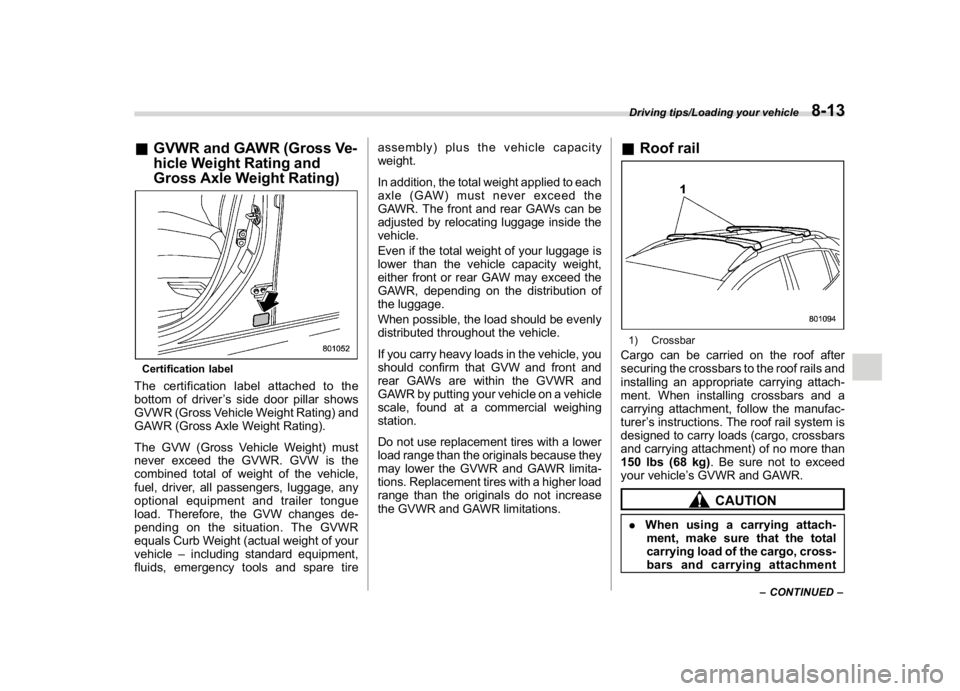
Gross Axle Weight Rating)Certification labelThe certification label attached to the
bottom of driver’s side door pillar shows
GVWR (Gross Vehicle Weight Rating) and
GAWR (Gross Axle Weight Rating).
The GVW (Gross Vehicle Weight) must
never exceed the GVWR. GVW is the
combined total of weight of the vehicle,
fuel, driver, all passengers, luggage, any
optional equipment and trailer tongue
load. Therefore, the GVW changes de-
pending on the situation. The GVWR
equals Curb Weight (actual weight of your
vehicle–including standard equipment,
fluids, emergency tools and spare tireassembly) plus the vehicle capacity
weight.
In addition, the total weight applied to each
axle (GAW) must never exceed the
GAWR. The front and rear GAWs can be
adjusted by relocating luggage inside the
vehicle.
Even if the total weight of your luggage is
lower than the vehicle capacity weight,
either front or rear GAW may exceed the
GAWR, depending on the distribution of
the luggage.
When possible, the load should be evenly
distributed throughout the vehicle.
If you carry heavy loads in the vehicle, you
should confirm that GVW and front and
rear GAWs are within the GVWR and
GAWR by putting your vehicle on a vehicle
scale, found at a commercial weighing
station.
Do not use replacement tires with a lower
load range than the originals because they
may lower the GVWR and GAWR limita-
tions. Replacement tires with a higher load
range than the originals do not increase
the GVWR and GAWR limitations.
&Roof rail1) CrossbarCargo can be carried on the roof after
securing the crossbars to the roof rails and
installing an appropriate carrying attach-
ment. When installing crossbars and a
carrying attachment, follow the manufac-
turer’s instructions. The roof rail system is
designed to carry loads (cargo, crossbars
and carrying attachment) of no more than
150 lbs (68 kg). Be sure not to exceed
your vehicle’s GVWR and GAWR.
CAUTION
.When using a carrying attach-
ment, make sure that the total
carrying load of the cargo, cross-
barsandcarryingattachment
–CONTINUED–
Driving tips/Loading your vehicle
8-13
8
Page 343 of 474
(354,1)
北米Model "A1320BE-C" EDITED: 2017/ 10/ 10
maximum gross weight. The chains should
cross under the trailer tongue to prevent
the tongue from dropping onto the ground
in case it should disconnect from the hitch
ball. Allow sufficient slack in the chains
taking tight turn situations into account;
however, be careful not to let them drag on
the ground.
WARNING
Do not connect safety chains to any
part of the vehicle other than the
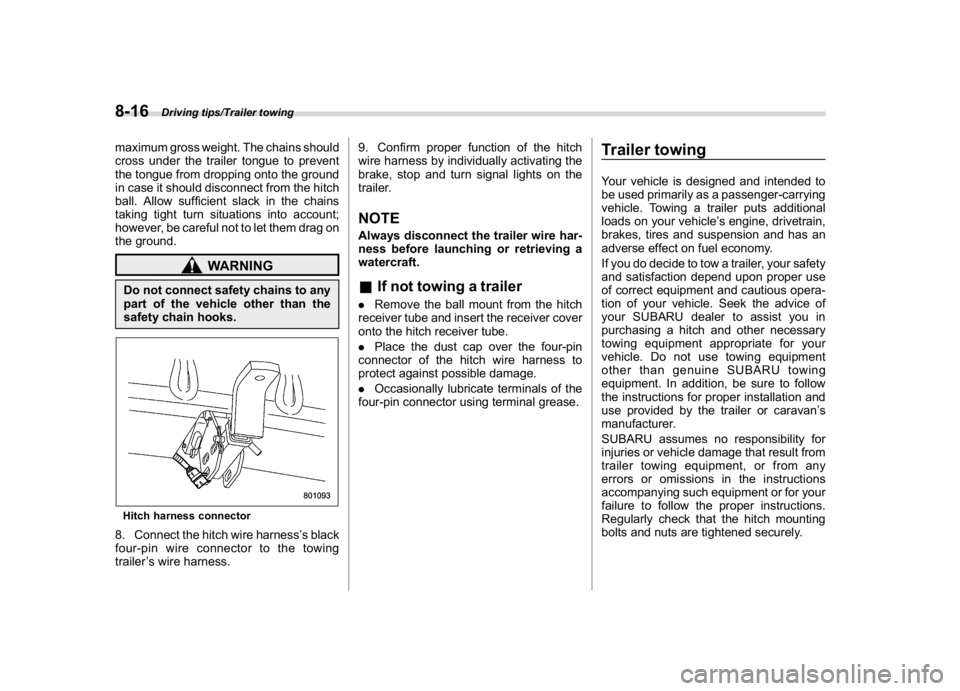
safety chain hooks.Hitch harness connector8. Connect the hitch wire harness’s black
four-pin wire connector to the towing
trailer’s wire harness.9. Confirm proper function of the hitch
wire harness by individually activating the
brake, stop and turn signal lights on the
trailer.
NOTEAlways disconnect the trailer wire har-
ness before launching or retrieving a
watercraft.&If not towing a trailer.Remove the ball mount from the hitch
receiver tube and insert the receiver cover
onto the hitch receiver tube.
.Place the dust cap over the four-pin
connector of the hitch wire harness to
protect against possible damage.
.Occasionally lubricate terminals of the
four-pin connector using terminal grease.
Trailer towingYour vehicle is designed and intended to
be used primarily as a passenger-carrying
vehicle. Towing a trailer puts additional
loads on your vehicle’s engine, drivetrain,
brakes, tires and suspension and has an
adverse effect on fuel economy.
If you do decide to tow a trailer, your safety
and satisfaction depend upon proper use
of correct equipment and cautious opera-
tion of your vehicle. Seek the advice of
your SUBARU dealer to assist you in
purchasing a hitch and other necessary
towing equipment appropriate for your
vehicle. Do not use towing equipment
other than genuine SUBARU towing
equipment. In addition, be sure to follow
the instructions for proper installation and
use provided by the trailer or caravan’s
manufacturer.
SUBARU assumes no responsibility for
injuries or vehicle damage that result from
trailer towing equipment, or from any
errors or omissions in the instructions
accompanying such equipment or for your
failure to follow the proper instructions.
Regularly check that the hitch mounting
bolts and nuts are tightened securely.
Driving tips/Trailer towing
8-16
Page 368 of 474
(379,1)
北米Model "A1320BE-C" EDITED: 2017/ 10/ 10
the vehicle and stow it in the tool bucket.
Fit the towing hook cover on the bumper.
WARNING
.Do not use the towing hook
except when towing your vehicle.
.Be sure to remove the towing
hook after towing. Leaving the
towing hook mounted on the
vehicle could interfere with prop-
er operation of the fuel pump
shut off function when the vehi-
cle is struck from behind.
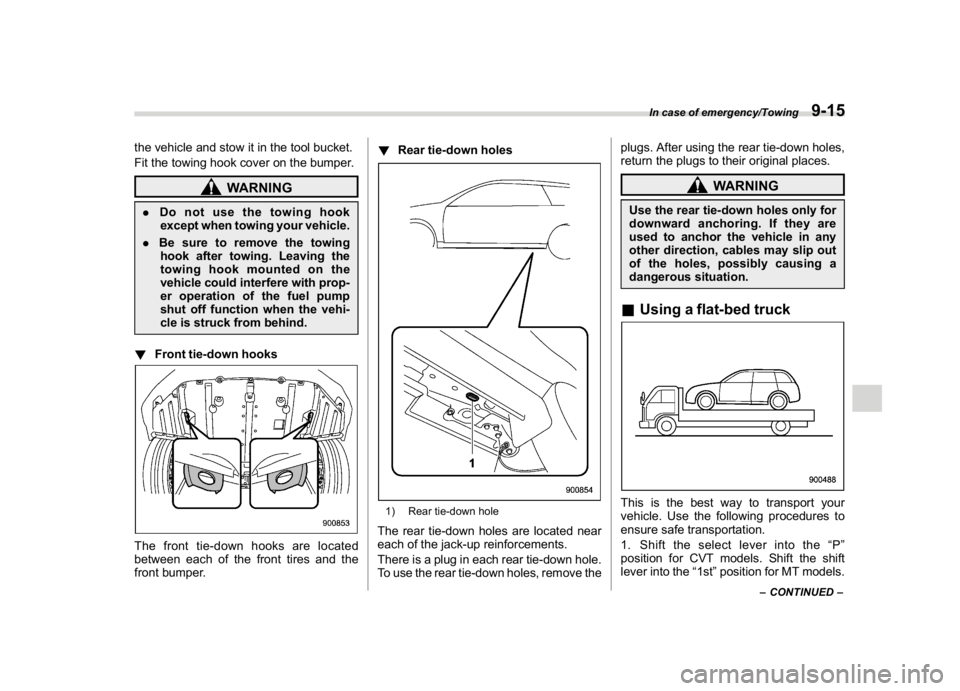
!Front tie-down hooksThe front tie-down hooks are located
between each of the front tires and the
front bumper.!Rear tie-down holes
1) Rear tie-down holeThe rear tie-down holes are located near
each of the jack-up reinforcements.
There is a plug in each rear tie-down hole.
To use the rear tie-down holes, remove theplugs. After using the rear tie-down holes,
return the plugs to their original places.
WARNING
Use the rear tie-down holes only for
downward anchoring. If they are
used to anchor the vehicle in any
other direction, cables may slip out
of the holes, possibly causing a
dangerous situation.&Using a flat-bed truckThis is the best way to transport your
vehicle. Use the following procedures to
ensure safe transportation.
1. Shift the select lever into the“P”
position for CVT models. Shift the shift
lever into the“1st”position for MT models.
–CONTINUED–
In case of emergency/Towing
9-15
9
Page 373 of 474
(384,1)
北米Model "A1320BE-C" EDITED: 2017/ 10/ 10
If your vehicle is involved in
an accident
CAUTION
If your vehicle is involved in an
accident, be sure to inspect the
ground under the vehicle before
restarting the engine. If you find that
fuel has leaked on the ground, do
not try to restart the engine. The fuel
system has been damaged and is in
need of repair. Immediately contact
the nearest automotive service facil-
ity. We recommend that you consult
your SUBARU dealer.
Your vehicle has a fuel pump shut off
system. When the vehicle sustains an
impact in an accident, etc., the fuel pump
shut off system stops supplying the fuel in
order to minimize fuel leakage. However,
depending on the impact conditions at the
time of collision, the fuel pump shut-off
system may not operate.
Perform the following procedures to restart
the engine after the system is activated.Models without“keyless access with
push-button start system”:
1. Turn the ignition switch to the“LOCK”
or“ACC”position.
2. Restart the engine.
Models with“keyless access with
push-button start system”:
1. Turn the push-button ignition switch to
the“ACC”or“OFF”position.
2. Restart the engine.
In case of emergency/If your vehicle is involved in an accident
9-20