2018 SUBARU CROSSTREK wheels
[x] Cancel search: wheelsPage 366 of 474

(377,1)
北米Model "A1320BE-C" EDITED: 2017/ 10/ 10
TowingIf towing is necessary, it is best done by
your SUBARU dealer or a commercial
towing service. Observe the following
procedures for safety.
WARNING
Never tow AWD models with the
front wheels raised off the ground
while the rear wheels are on the
ground, or with the rear wheels
raised off the ground while the front
wheels are on the ground. This will
cause the vehicle to spin away due
to the operation or deterioration of
the center differential.
&Towing hooks and tie-down
hooks/holesThe towing hooks should be used only in
an emergency (e.g., to free a stuck vehicle
from mud, sand or snow).
CAUTION
.Use only the specified towing
hooks and tie-down hooks/holes.
Never use suspension parts or
other parts of the body for towing
or tie-down purposes.
.To prevent deformation to the
front bumper and the towing
hook, do not apply excessive
lateral load to the towing hooks.
!Front towing hook
1. Take the towing hook and screwdriver
out of the tool bucket. Take the jack handle
out of the cargo area.
2. Cover the tip of a flat-head screwdriver
with vinyl tape or cloth so that it will not
scratch the bumper. Insert the flat-head
screwdriver into the cutout of the cover and
pry open the cover.3. Screw the towing hook into the thread
–CONTINUED–
In case of emergency/Towing
9-13
9
Page 369 of 474

(380,1)
北米Model "A1320BE-C" EDITED: 2017/ 10/ 10
2. Pull up the parking brake lever firmly.
3. Secure the vehicle onto the carrier
properly with safety chains. Each safety
chain should be equally tightened and care
must be taken not to pull the chains so
tightly that the suspension bottoms out.
CAUTION
If your vehicle has a bumper under
guard (optional), be careful not to
scrape it when placing the vehicle
on the carrier and when removing
the vehicle from the carrier.
&Towing with all wheels on the
ground1. Release the parking brake and put the
transmission in the neutral position (CVT
and MT).
2. The ignition switch should be in the
“ON”position while the vehicle is being
towed.
3. Take up slack in the towline slowly to
prevent damage to the vehicle.
WARNING
.Never turn the ignition switch to
the“LOCK”/“OFF”position while
the vehicle is being towed be-
cause the steering wheel and the
direction of the wheels will belocked.
.Remember that the brake booster
and power steering do not func-
tion when the engine is not run-
ning. Because the engine is
turned off, it will take greater
effort to operate the brake pedal
and steering wheel.
CAUTION
.If transmission failure occurs,
transport your vehicle on a flat-
bed truck.
.For CVT models, the traveling
speed must be limited to less
than 20 mph (30 km/h) and the
traveling distance to less than 31
miles (50 km). For greater speeds
and distances, transport your
vehicle on a flat-bed truck.
In case of emergency/Towing
9-16
Page 374 of 474

(387,1)
北米Model "A1320BE-C" EDITED: 2017/ 10/ 10
Exterior care..........................................................10-2
Washing...............................................................10-2
Waxing and polishing............................................10-3
Cleaning alloy wheels...........................................10-4
Corrosion protection............................................10-4
Most common causes of corrosion.......................10-4
To help prevent corrosion.....................................10-5
Cleaning the interior.............................................10-5
Seat fabric............................................................10-5
Leather seat materials..........................................10-6
Synthetic leather upholstery.................................10-6
Seatbelt................................................................10-6
Climate control panel, audio panel, instrument
panel, console panel, and switches....................10-6
Monitor.................................................................10-7
Appearance care
10
Page 377 of 474

(390,1)
北米Model "A1320BE-C" EDITED: 2017/ 10/ 10
coat. When in doubt, it is always best to
contact your SUBARU dealer or an auto
paint specialist.
CAUTION
Do not use any agents with organic
solvents on the surface of the bulb
assembly cover. However, if a polish
or wax with organic solvents is
applied to the cover surface, com-
pletely wipe off the polish or wax.
Otherwise, the cover surface may be
damaged.NOTE.Be careful not to block the wind-
shield washer nozzles with wax when
waxing the vehicle.
.Do not wipe the rear view camera
with alcohol, benzine or paint thinner.
Otherwise, discoloration may occur. To
remove contamination, wipe the cam-
era with a cloth moistened with diluted
neutral detergent and then wipe it with a
soft, dry cloth.
.When waxing the vehicle, be careful
not to apply the wax to the rear view
camera. If it comes in contact with the
camera, moisten a clean cloth with
diluted neutral detergent to remove
the wax.
&Cleaning alloy wheels.Promptly wipe the alloy wheels clean of
any kind of grime or agent. If dirt is left on
too long, it may be difficult to clean off.
.Do not use soap containing grit to clean
the wheels. Be sure to use a neutral
cleaning agent, and later rinse thoroughly
with water. Do not clean the wheels with a
stiff brush or expose them to a high-speed
washing device.
.Clean the vehicle (including the alloy
wheels) with water as soon as possible
when it has been splashed with sea water,
exposed to sea breezes, or driven on
roads treated with salt or other agents.
Corrosion protectionYour SUBARU has been designed and
built to resist corrosion. Special materials
and protective finishes have been used on
most parts of the vehicle to help maintain
fine appearance, strength, and reliable
operation.&Most common causes of cor-
rosionThe most common causes of corrosion
are:
.The accumulation of moisture retaining
dirt and debris in body panel sections,
cavities, and other areas.
.Damage to paint and other protective
coatings caused by gravel and stone chips
or minor accidents.
Corrosion is accelerated on the vehicle
when:
.It is exposed to road salt or dust control
chemicals, or used in coastal areas where
there is more salt in the air, or in areas
where there is considerable industrial
pollution.
.It is driven in areas of high humidity,
especially when temperatures range just
above freezing.
.Dampness in certain parts of the
Appearance care/Corrosion protection
10-4
Page 382 of 474

(395,1)
北米Model "A1320BE-C" EDITED: 2017/ 10/ 10
Maintenance schedule.......................................... 11-3
Maintenance precautions..................................... 11-3
Before checking or servicing in the engine
compartment...................................................... 11-4
When checking or servicing in the engine
compartment...................................................... 11-4
When checking or servicing in the engine
compartment while the engine is running............ 11-5
Engine hood.......................................................... 11-5
Engine compartment overview............................ 11-7
Engine oil............................................................... 11-8
Engine oil consumption........................................ 11-8
Locations of the oil level gauge, oil filler cap
and oil filter........................................................ 11-8
Checking the oil level............................................ 11-8
Changing the oil and oil filter................................ 11-9
Recommended grade and viscosity..................... 11-10
Synthetic oil........................................................ 11-10
Cooling system................................................... 11-10
Safety precautions.............................................. 11-10
Cooling fan, hose and connections..................... 11-11
Engine coolant.................................................... 11-11
Air cleaner element............................................. 11-12
Replacing the air cleaner element........................ 11-13
Spark plugs......................................................... 11-14
Recommended spark plugs................................. 11-14
Drive belts........................................................... 11-14
Manual transmission oil..................................... 11-14
Recommended grade and viscosity..................... 11-14
Continuously variable transmission fluid..........11-15
Front differential gear oil (CVT models) and
rear differential gear oil....................................11-15
Recommended grade and viscosity..................... 11-15
Brake fluid............................................................11-15
Checking the fluid level...................................... 11-15
Recommended brake fluid.................................. 11-16
Clutch fluid (MT models).....................................11-16
Checking the fluid level...................................... 11-16
Recommended clutch fluid................................. 11-17
Brake booster......................................................11-17
Brake pedal..........................................................11-18
Checking the brake pedal free play..................... 11-18
Checking the brake pedal reserve distance ......... 11-18
Clutch pedal (MT models)...................................11-18
Checking the clutch function .............................. 11-18
Checking the clutch pedal free play.................... 11-19
Hill start assist system.......................................11-19
Replacement of brake pad andlining................11-19
Breaking-in of new brake pads and linings .......... 11-20
Parking brake stroke...........................................11-20
Tires and wheels.................................................11-21
Types of tires..................................................... 11-21
Tire pressure monitoring system (TPMS)
(if equipped).................................................... 11-21
Tire inspection.................................................... 11-22
Tire pressures and wear..................................... 11-23
Wheel balance.................................................... 11-24
Wear indicators.................................................. 11-25
Maintenance and service
11
Page 383 of 474

(396,1)
北米Model "A1320BE-C" EDITED: 2017/ 10/ 10
Rotational direction of tires................................. 11-25
Tire rotation........................................................ 11-25
Tire replacement................................................. 11-26
Wheel replacement............................................. 11-27
Alloy wheels........................................................ 11-27
Windshield washer fluid..................................... 11-28
Adding the windshield washer fluid..................... 11-28
Windshield washer fluid...................................... 11-28
Replacement of wiper blades............................ 11-29
Windshield wiper blade assembly........................ 11-29
Window wiper blade rubber................................. 11-30
Rear window wiper blade assembly..................... 11-31
Rear window wiper blade rubber......................... 11-32
Battery................................................................. 11-33
Fuses................................................................... 11-34
Installation of accessories................................. 11-35Replacing bulbs...................................................11-36
Headlights (models with LED headlights)............ 11-36
Headlights (models with halogen headlights) ...... 11-36
Front turn signal light......................................... 11-38
Parking light....................................................... 11-38
Front fog light (if equipped)................................ 11-38
Rear combination lights...................................... 11-38
Backup light....................................................... 11-40
License plate light.............................................. 11-40
Map light............................................................ 11-41
Vanity mirror light (if equipped)........................... 11-41
Dome light and cargo area light.......................... 11-41
Other bulbs........................................................ 11-42
Replacing key battery.........................................11-42
Safety precautions.............................................. 11-42
Replacing battery of access key fob................... 11-43
Replacing transmitter battery.............................. 11-44
Maintenance and service
Page 401 of 474
(414,1)
北米Model "A1320BE-C" EDITED: 2017/ 10/ 10
result in the need for costly brake
rotor repair or replacement.&Breaking-in of new brake
pads and liningsWhen replacing the brake pad or lining,
use only genuine SUBARU parts. After
replacement, the new parts must be
broken in as follows.
!Brake pad and lining
While maintaining a speed of 30 to 40 mph
(50 to 65 km/h), step on the brake pedal
lightly. Repeat this five or more times.
!Parking brake lining
1. Drive the vehicle at a speed of approxi-
mately 22 mph (35 km/h).
2. With the parking brake release button
pushed in, pull the parking brake lever
SLOWLY and GENTLY (pulling with a
force of approximately 33.7 lbf [150 N,
15.3 kgf]).
3. Drive the vehicle for approximately 220
yards (200 meters) in this condition.
4. Wait 5 to 10 minutes for the parking
brake to cool down. Repeat this proce-
dure.
5. Check the parking brake stroke. If the
parking brake stroke is out of the specified
range, adjust it by turning the adjusting nutlocated on the parking brake lever.
Parking brake stroke:
7–8 notches / 45 lbf (200 N, 20.4 kgf)
WARNING
A safe location and situation should
be selected for break-in driving.
CAUTION
Pulling the parking brake lever too
forcefully may cause the rear wheels
to lock. To avoid this, be certain to
pull the lever up slowly and gently.
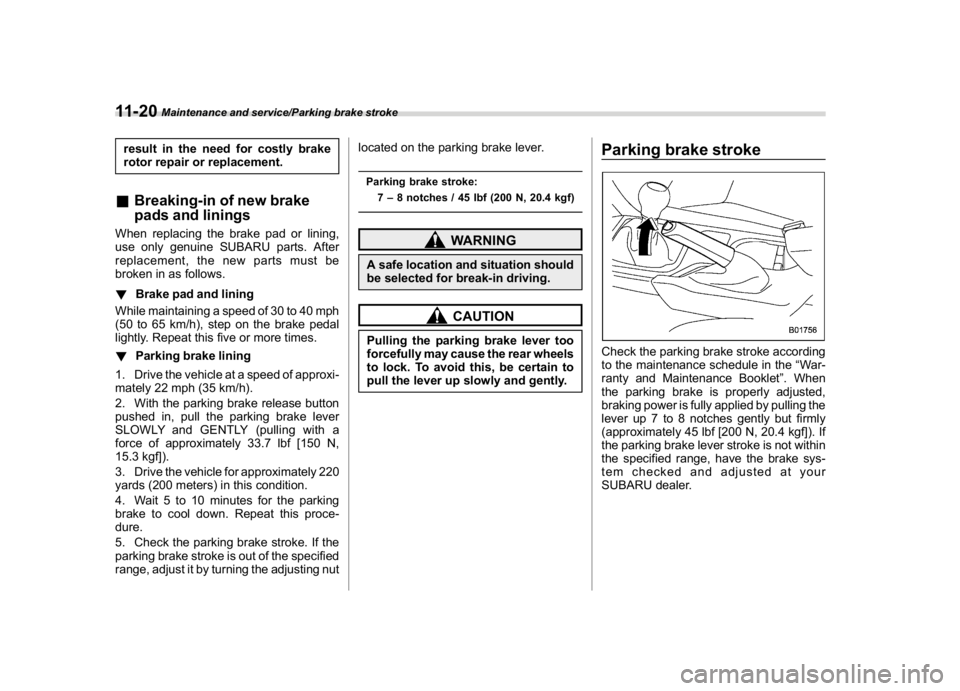
Parking brake strokeCheck the parking brake stroke according
to the maintenance schedule in the“War-
ranty and Maintenance Booklet”. When
the parking brake is properly adjusted,
braking power is fully applied by pulling the
lever up 7 to 8 notches gently but firmly
(approximately 45 lbf [200 N, 20.4 kgf]). If
the parking brake lever stroke is not within
the specified range, have the brake sys-
tem checked and adjusted at your
SUBARU dealer.
Maintenance and service/Parking brake stroke
11-20
Page 402 of 474

(415,1)
北米Model "A1320BE-C" EDITED: 2017/ 10/ 10
Tires and wheels&Types of tiresYou should be familiar with type of tires
present on your vehicle.
!All season tires
All season tires are designed to provide an
adequate measure of traction, handling
and braking performance in year-round
driving including snowy and icy road
conditions. However all season tires do
not offer as much traction performance as
winter (snow) tires in heavy or loose snow
or on icy roads.
All season tires are identified by“ALL
SEASON”and/or“M+S”(Mud & Snow) on
the tire sidewall.
!Summer tires
Summer tires are high-speed capability
tires best suited for highway driving under
dry conditions.
Summer tires are inadequate for driving on
slippery roads such as on snow-covered or
icy roads.
If you drive your vehicle on snow-covered
or icy roads, we strongly recommend the
use of winter (snow) tires.
When installing winter tires, be sure to
replace all four tires.!Winter (snow) tires
Winter tires are best suited for driving on
snow-covered and icy roads. However
winter tires do not perform as well as
summer tires and all season tires on roads
other than snow-covered and icy roads.
&Tire pressure monitoring
system (TPMS) (if equipped)The tire pressure monitoring system pro-
vides the driver with a warning message by
sending a signal from a sensor that is
installed in each wheel when tire pressure
is severely low. The tire pressure monitor-
ing system will activate only when the
vehicle is driven. Also, this system may not
react immediately to a sudden drop in tire
pressure (for example, a blow-out caused
by running over a sharp object).
If you adjust the tire pressures in a warm
garage and will then drive the vehicle in
cold outside air, the resulting drop in tire
pressures may cause the low tire pressure
warning light to illuminate. To avoid this
problem when adjusting the tire pressures
in a warm garage, inflate the tires to
pressures higher than those shown on
the tire placard. Specifically, inflate them
by an extra 1 psi (6.9 kPa, 0.07 kgf/cm
2) for
every difference of 108F (5.68C) between
the temperature in the garage and thetemperature outside. By way of example,
the following table shows the required tire
pressures that correspond to various out-
side temperatures when the temperature
in the garage is 608F (15.68C).
Example:
Tire size: P225/60R17 98H and
P225/55R18 97H
Standard tire pressures:
Front: 33 psi (230 kPa, 2.3 kgf/cm
2)
Rear: 32 psi (220 kPa, 2.2 kgf/cm2)
Garage temperature: 608F (15.68C)
Outside
temperatureAdjusted pressure
[psi (kPa, kgf/cm
2)]
Front Rear
308F(18C) 36 (250, 2.5) 35 (240, 2.4)
108F(128C)38
(265, 2.65)37
(255, 2.55)
108F(238C) 40 (280, 2.8)39 (270, 2.7)
If the low tire pressure warning light
illuminates when you drive the vehicle in
cold outside air after adjusting the tire
pressures in a warm garage, re-adjust the
tire pressures using the method described
above. Then, increase the vehicle speed
to at least 20 mph (32 km/h) and check to
see that the low tire pressure warning light
turns off a few minutes later. If the low tire
pressure warning light does not turn off,
–CONTINUED–
Maintenance and service/Tires and wheels
11-21
11