2018 SUBARU CROSSTREK wheels
[x] Cancel search: wheelsPage 347 of 474
(358,1)
北米Model "A1320BE-C" EDITED: 2017/ 10/ 10
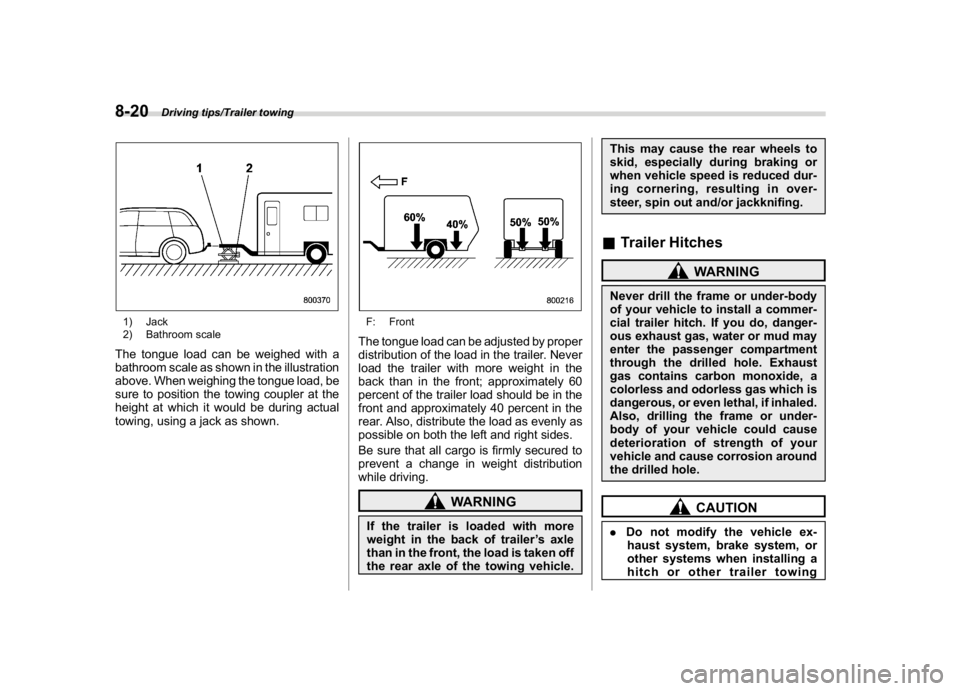
1) Jack
2) Bathroom scaleThe tongue load can be weighed with a
bathroom scale as shown in the illustration
above. When weighing the tongue load, be
sure to position the towing coupler at the
height at which it would be during actual
towing, using a jack as shown.
F: FrontThe tongue load can be adjusted by proper
distribution of the load in the trailer. Never
load the trailer with more weight in the
back than in the front; approximately 60
percent of the trailer load should be in the
front and approximately 40 percent in the
rear. Also, distribute the load as evenly as
possible on both the left and right sides.
Be sure that all cargo is firmly secured to
prevent a change in weight distribution
while driving.
WARNING
If the trailer is loaded with more
weight in the back of trailer’s axle
than in the front, the load is taken off
the rear axle of the towing vehicle.This may cause the rear wheels to
skid, especially during braking or
when vehicle speed is reduced dur-
ing cornering, resulting in over-
steer, spin out and/or jackknifing.
&Trailer Hitches
WARNING
Never drill the frame or under-body
of your vehicle to install a commer-
cial trailer hitch. If you do, danger-
ous exhaust gas, water or mud may
enter the passenger compartment
through the drilled hole. Exhaust
gas contains carbon monoxide, a
colorless and odorless gas which is
dangerous, or even lethal, if inhaled.
Also, drilling the frame or under-
body of your vehicle could cause
deterioration of strength of your
vehicle and cause corrosion around
the drilled hole.
CAUTION
.Do not modify the vehicle ex-
haust system, brake system, or
other systems when installing a
hitch or other trailer towing
Driving tips/Trailer towing
8-20
Page 348 of 474
(359,1)
北米Model "A1320BE-C" EDITED: 2017/ 10/ 10
equipment.
.Do not use axle-mounted hitches
as they can cause damage to the
axle housing, wheel bearings,
wheels or tires.
Do not use a trailer hitch other than
genuine SUBARU trailer hitch. A genuine
SUBARU hitch is available from your
SUBARU dealer.
&When you do not tow a trailer
CAUTION
.The housing should be kept dirt
and corrosion-free at the points
of contact. The surfaces only
require cleaning with a cloth.
Grease or other lubricants
should never be used.
.If the ball is not installed, the
plastic insert should then be
inserted for protection and to
prevent dirt.
When the ball is not used, place the ball
cap and store securely.
&Connecting a trailer!Trailer brakes
WARNING
.Adequate size trailer brakes are
required when the trailer and its
cargo exceed 1,000 lbs (453 kg)
total weight.
.Do not directly connect your
trailer’s hydraulic brake system
to the hydraulic brake system in
your vehicle. Direct connection
would cause the vehicle’s brake
performance to deteriorate and
could lead to an accident.
If your trailer’s total weight (trailer weight
plus its cargo weight) exceeds 1,000 lbs
(453 kg), the trailer is required to be
equipped with its own brake system.
Electric brakes or surge brakes are re-
commended, and must be installed prop-
erly. Check that your trailer’s brakes con-
form with Federal, state/province and/or
other applicable regulations. Your
SUBARU’s brake system is not designed
to be tapped into the trailer’s hydraulic
brake system. Please ask your SUBARU
dealer and professional trailer supplier for
more information about the trailer’s brake
system.!Trailer safety chains
WARNING
Always use safety chains between
your vehicle and the trailer. Towing
trailer without safety chains could
create a traffic safety hazard if the
trailer separates from the hitch due
to coupling damage or hitch ball
damage.
In case the trailer hitch connector or hitch
ball should break or become discon-
nected, the trailer could get loose and
create a traffic safety hazard.
For safety, always connect the towing
vehicle and trailer with trailer safety
chains. Two chains should be used in
total, one to the right side and the other to
the left side trailer tongue. Pass the chains
crossing each other under the trailer
tongue to prevent the trailer from dropping
onto the ground in case the trailer tongue
should disconnect from the hitch ball.
Allow sufficient slack in the chains taking
tight turn situations into account; however,
be careful not to let them drag on the
ground.
–CONTINUED–
Driving tips/Trailer towing
8-21
8
Page 350 of 474

(361,1)
北米Model "A1320BE-C" EDITED: 2017/ 10/ 10
when towing a trailer in hilly
country on hot days.
.When towing a trailer, steering,
stability, stopping distance and
braking performance will be dif-
ferent when compared to normal
operation. For safety’s sake, you
should employ extra caution
when towing a trailer and you
should never drive at excessive
speeds. You should also keep the
following tips in mind:
.The braking power of the parking
brake may not be sufficient when
stronger braking power is
needed (e.g., when parking on a
steep slope while towing a trai-
ler).
!Before starting out on a trip
.Check the towing regulations for trailer
or caravan vehicles that vary by state/
region. Failure to comply with the proce-
dures set forth will not only compromise
your safety, but will also negate your
insurance coverage and/or may violate
the state road and traffic acts and regula-
tions.
.Check that the vehicle and vehicle-to-
hitch mounting are in good condition. If any
problems are apparent, do not tow thetrailer.
.Check that the vehicle rests horizon-
tally with the trailer attached. If the vehicle
is tipped sharply up at the front and down
at the rear, check the total trailer weight,
GVW, GAWs and tongue load again, then
confirm that the load and its distribution are
acceptable.
.Check that the tire rating and pressures
are correct.
.Check that the vehicle and trailer are
connected properly. Confirm that:
–the trailer tongue is connected
properly to the hitch ball.
–the trailer lights connector is con-
nected properly and trailer’sbrake
lights illuminate when the vehicle’s
brake pedal is pressed, and that the
trailer’s turn signal lights flash when
the vehicle’s turn signal lever is oper-
ated.
–the safety chains are connected
properly.
–all cargo in the trailer is secured
safely in position.
–the side mirrors provide a good
rearward field of view without a sig-
nificant blind spot.
.Sufficient time should be taken to learn
the“feel”of the vehicle/trailer combination
before starting out on a trip. In an area free
of traffic, practice turning, stopping andbacking up.
!Driving with a trailer
.You should allow for considerably more
stopping distance when towing a trailer.
Avoid sudden braking because it may
result in skidding or jackknifing and loss
of control.
.Avoid abrupt starts and sudden accel-
erations. If your vehicle has a manual
transmission, always start out in first gear
and release the clutch at moderate engine
revolution.
.Avoid uneven steering, sharp turns and
rapid lane changes.
.Slow down before turning. Make a
longer than normal turning radius because
the trailer wheels will be closer than the
vehicle wheels to the inside of the turn. In a
tight turn, the trailer could hit your vehicle.
.Crosswinds will adversely affect the
handling of your vehicle and trailer, caus-
ingsway.Crosswindscanbedueto
weather conditions or the passing of large
trucks or buses. If swaying occurs, firmly
grip the steering wheel and promptly begin
decelerating your vehicle at a gradual
pace.
.When passing other vehicles, consider-
able distance is required because of the
added weight and length caused by
attaching the trailer to your vehicle.
–CONTINUED–
Driving tips/Trailer towing
8-23
8
Page 352 of 474

(363,1)
北米Model "A1320BE-C" EDITED: 2017/ 10/ 10
!Parking on a grade
Always block the wheels under both
vehicle and trailer when parking. Apply
the parking brake firmly. You should not
park on a hill or slope. If parking on a hill or
slope cannot be avoided, you should take
the following steps:
1. Apply the brakes and hold the pedal
down.
2. Have someone place wheel blocks
under both the vehicle and trailer wheels.
3. When the wheel blocks are in place,
release the regular brakes slowly until the
blocks absorb the load.
4. Apply the regular brakes and then
apply the parking brake; slowly release
the regular brakes.
5. Shift into 1st or reverse gear (MT
models) or“P”position (CVT models)
and shut off the engine.
Driving tips/Trailer towing
8-25
8
Page 354 of 474

(365,1)
北米Model "A1320BE-C" EDITED: 2017/ 10/ 10
If you park your vehicle in case of an
emergency............................................................9-2
Temporary sparetire..............................................9-2
Maintenance tools...................................................9-3
Tool locations........................................................ 9-4
Using the jack........................................................ 9-4
Flat tires...................................................................9-5
Changing a flat tire................................................ 9-5
Tire pressure monitoring system (TPMS)
(U.S.-spec. models).............................................. 9-8
Jump starting..........................................................9-9
How to jump start.................................................9-10
Engine overheating...............................................9-12
If steam is coming from the engine
compartment......................................................9-12If no steam is coming from the engine
compartment.....................................................9-12
Towing...................................................................9-13
Towing hooks and tie-down hooks/holes...............9-13
Using a flat-bed truck...........................................9-15
Towing with all wheels on the ground...................9-16
Access key fob–if access key fob does not
operate properly................................................9-17
Locking and unlocking.........................................9-17
Switching power status........................................9-17
Starting engine.....................................................9-18
Rear gate–if the rear gate cannot be opened .. 9-19
Moonroof (if equipped)–if the moonroof
does not close...................................................9-19
If your vehicle is involvedin an accident...........9-20
In case of emergency
9
Page 355 of 474

(366,1)
北米Model "A1320BE-C" EDITED: 2017/ 10/ 10
If you park your vehicle in
case of an emergencyThe hazard warning flasher should be
used in day or night to warn other drivers
when you have to park your vehicle under
emergency conditions.
Avoid stopping on the road. It is best to
safely pull off the road if a problem occurs.
The hazard warning flasher can be acti-
vated regardless of the ignition switch
position.
Turn on the hazard warning by pushing the
hazard warning flasher switch. Turn it off
by pushing the switch again.
NOTEWhen the hazard warning flasher is on,
the turn signals do not work.
Temporary spare tire
WARNING
.Never tow a trailer when the
temporary spare tire is used.
The temporary spare tire is not
designed to sustain the towing
load. Use of the temporary spare
tire when towing can result in
failure of the spare tire and/or
less stability of the vehicle and
may lead to an accident.
.When a spare tire is mounted or a
wheel rim is replaced without the
original pressure sensor/trans-
mitter being transferred, the low
tire pressure warning light will
illuminate steadily after blinking
for approximately one minute.
This indicates the tire pressure
monitoring system (TPMS) is un-
able to monitor all four road
wheels. Contact your SUBARU
dealer as soon as possible for
tire and sensor replacement and/
or system resetting.
In case of emergency/If you park your vehicle in case of an emergency
9-2
Page 361 of 474

(372,1)
北米Model "A1320BE-C" EDITED: 2017/ 10/ 10
on the wrench because you may exceed
the specified torque. Have the wheel nut
torque checked at the nearest automotive
service facility.1) Support holder15. Store the flat tire in the spare tire
compartment. Install with the support
holder facing upward and secure the flat
tire by firmly tightening the attaching bolt.NOTEIf you cannot fix the flat tire firmly, try
turning the support holder upside
down.
16. Store the jack, jack handle and wheel
nut wrench in their storage locations.
WARNING
Never place a tire or tire changing
tools in the passenger compartment
after changing wheels. In a sudden
stop or collision, loose equipment
could strike occupants and cause
injury. Store the tire and all tools in
the proper place.&Tire pressure monitoring
system (TPMS) (U.S.-spec.
models)The tire pressure monitoring system pro-
vides the driver with the warning message
indicated by sending a signal from a
sensor that is installed in each wheel when
tire pressure is severely low.The tire pressure monitoring system will
activate only when the vehicle is driven.
Also, this system may not react immedi-
ately to a sudden drop in tire pressure (for
example, a blow-out caused running over
a sharp object).
WARNING
.If the low tire pressure warning
light illuminates while driving,
never brake suddenly. Instead,
perform the following procedure.
(1) Keep driving straight ahead
while gradually reducing
speed.
(2) Slowly pull off the road to a
safe place. Otherwise an acci-
dent involving serious vehicle
damage and serious personal
injury could occur.
(3) Check the pressure for all four
tires and adjust the pressure
to the COLD tire pressure
shown on the vehicle placard
on the door pillar on the
driver’s side.
If this light still illuminates while
driving after adjusting the tire
pressure, a tire may have signifi-
cant damage and a fast leak that
causes the tire to lose air rapidly.
In case of emergency/Flat tires
9-8
Page 362 of 474

(373,1)
北米Model "A1320BE-C" EDITED: 2017/ 10/ 10
If you have a flat tire, replace it
with a spare tire as soon as
possible.
.When a spare tire is mounted or a
wheel rim is replaced without the
original pressure sensor/trans-
mitter being transferred, the low
tire pressure warning light will
illuminate steadily after blinking
for approximately one minute.
This indicates the TPMS is unable
to monitor all four road wheels.
Contact your SUBARU dealer as
soon as possible for tire and
sensor replacement and/or sys-
tem resetting.
.When a tire is repaired with liquid
sealant, the tire pressure warning
valve and transmitter may not
operate properly. If a liquid sea-
lant is used, contact your nearest
SUBARU dealer or other qualified
service shop as soon as possi-
ble. Make sure to replace the tire
pressure warning valve and
transmitter when replacing the
tire. You may reuse the wheel if
there is no damage to it and if the
sealant residue is properly
cleaned off.
If the light illuminates steadily
after blinking for approximatelyone minute, promptly contact a
SUBARU dealer to have the sys-
tem inspected.
Jump starting
WARNING
.Battery fluid is SULFURIC ACID.
Do not let it come in contact with
the eyes, skin, clothing or the
vehicle.
If battery fluid gets on you, thor-
oughly flush the exposed area
with water immediately. Get med-
ical help if the fluid has entered
your eyes.
If battery fluid is accidentally
swallowed, immediately drink a
large amount of milk or water,
and obtain immediate medical
help.
Keep everyone including chil-
dren away from the battery.
.The gas generated by a battery
explodes if a flame or spark is
brought near it. Do not smoke or
light a match while jump starting.
.Never attempt jump starting if the
discharged battery is frozen. It
could cause the battery to burst
or explode.
.Whenever working on or around a
battery, always wear suitable eye
–CONTINUED–
In case of emergency/Jump starting
9-9
9