2018 SUBARU CROSSTREK power steering
[x] Cancel search: power steeringPage 301 of 474
(310,1)
北米Model "A1320BE-C" EDITED: 2017/ 10/ 10
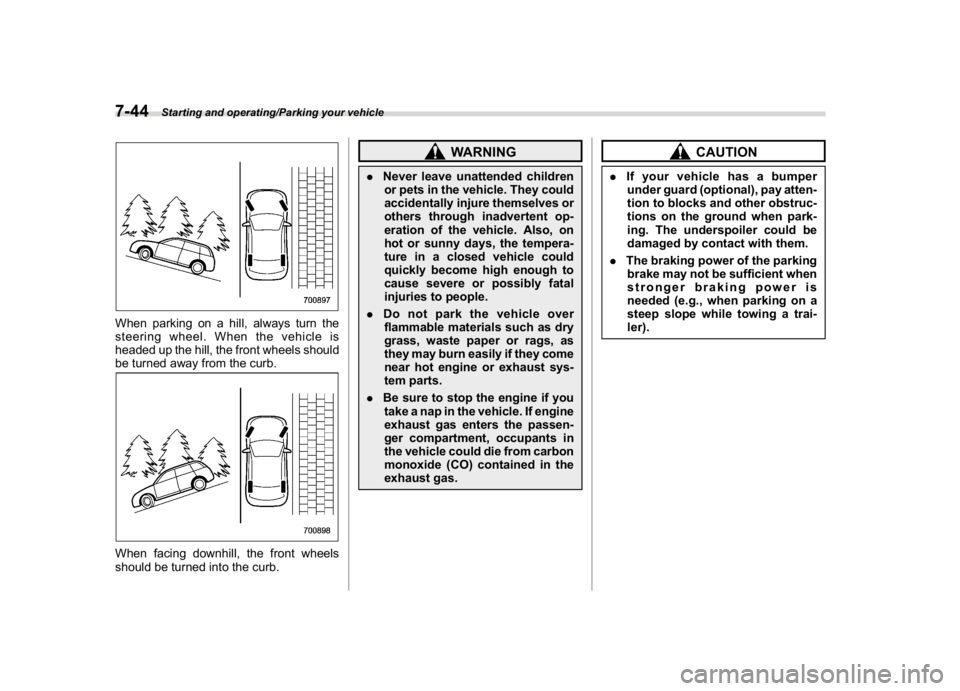
When parking on a hill, always turn the
steering wheel. When the vehicle is
headed up the hill, the front wheels should
be turned away from the curb.When facing downhill, the front wheels
should be turned into the curb.
WARNING
.Never leave unattended children
or pets in the vehicle. They could
accidentally injure themselves or
others through inadvertent op-
eration of the vehicle. Also, on
hot or sunny days, the tempera-
ture in a closed vehicle could
quickly become high enough to
cause severe or possibly fatal
injuries to people.
.Do not park the vehicle over
flammable materials such as dry
grass, waste paper or rags, as
they may burn easily if they come
near hot engine or exhaust sys-
tem parts.
.Be sure to stop the engine if you
take a nap in the vehicle. If engine
exhaust gas enters the passen-
ger compartment, occupants in
the vehicle could die from carbon
monoxide (CO) contained in the
exhaust gas.
CAUTION
.If your vehicle has a bumper
under guard (optional), pay atten-
tion to blocks and other obstruc-
tions on the ground when park-
ing. The underspoiler could be
damaged by contact with them.
.The braking power of the parking
brake may not be sufficient when
stronger braking power is
needed (e.g., when parking on a
steep slope while towing a trai-
ler).
Starting and operating/Parking your vehicle
7-44
Page 350 of 474

(361,1)
北米Model "A1320BE-C" EDITED: 2017/ 10/ 10
when towing a trailer in hilly
country on hot days.
.When towing a trailer, steering,
stability, stopping distance and
braking performance will be dif-
ferent when compared to normal
operation. For safety’s sake, you
should employ extra caution
when towing a trailer and you
should never drive at excessive
speeds. You should also keep the
following tips in mind:
.The braking power of the parking
brake may not be sufficient when
stronger braking power is
needed (e.g., when parking on a
steep slope while towing a trai-
ler).
!Before starting out on a trip
.Check the towing regulations for trailer
or caravan vehicles that vary by state/
region. Failure to comply with the proce-
dures set forth will not only compromise
your safety, but will also negate your
insurance coverage and/or may violate
the state road and traffic acts and regula-
tions.
.Check that the vehicle and vehicle-to-
hitch mounting are in good condition. If any
problems are apparent, do not tow thetrailer.
.Check that the vehicle rests horizon-
tally with the trailer attached. If the vehicle
is tipped sharply up at the front and down
at the rear, check the total trailer weight,
GVW, GAWs and tongue load again, then
confirm that the load and its distribution are
acceptable.
.Check that the tire rating and pressures
are correct.
.Check that the vehicle and trailer are
connected properly. Confirm that:
–the trailer tongue is connected
properly to the hitch ball.
–the trailer lights connector is con-
nected properly and trailer’sbrake
lights illuminate when the vehicle’s
brake pedal is pressed, and that the
trailer’s turn signal lights flash when
the vehicle’s turn signal lever is oper-
ated.
–the safety chains are connected
properly.
–all cargo in the trailer is secured
safely in position.
–the side mirrors provide a good
rearward field of view without a sig-
nificant blind spot.
.Sufficient time should be taken to learn
the“feel”of the vehicle/trailer combination
before starting out on a trip. In an area free
of traffic, practice turning, stopping andbacking up.
!Driving with a trailer
.You should allow for considerably more
stopping distance when towing a trailer.
Avoid sudden braking because it may
result in skidding or jackknifing and loss
of control.
.Avoid abrupt starts and sudden accel-
erations. If your vehicle has a manual
transmission, always start out in first gear
and release the clutch at moderate engine
revolution.
.Avoid uneven steering, sharp turns and
rapid lane changes.
.Slow down before turning. Make a
longer than normal turning radius because
the trailer wheels will be closer than the
vehicle wheels to the inside of the turn. In a
tight turn, the trailer could hit your vehicle.
.Crosswinds will adversely affect the
handling of your vehicle and trailer, caus-
ingsway.Crosswindscanbedueto
weather conditions or the passing of large
trucks or buses. If swaying occurs, firmly
grip the steering wheel and promptly begin
decelerating your vehicle at a gradual
pace.
.When passing other vehicles, consider-
able distance is required because of the
added weight and length caused by
attaching the trailer to your vehicle.
–CONTINUED–
Driving tips/Trailer towing
8-23
8
Page 369 of 474

(380,1)
北米Model "A1320BE-C" EDITED: 2017/ 10/ 10
2. Pull up the parking brake lever firmly.
3. Secure the vehicle onto the carrier
properly with safety chains. Each safety
chain should be equally tightened and care
must be taken not to pull the chains so
tightly that the suspension bottoms out.
CAUTION
If your vehicle has a bumper under
guard (optional), be careful not to
scrape it when placing the vehicle
on the carrier and when removing
the vehicle from the carrier.
&Towing with all wheels on the
ground1. Release the parking brake and put the
transmission in the neutral position (CVT
and MT).
2. The ignition switch should be in the
“ON”position while the vehicle is being
towed.
3. Take up slack in the towline slowly to
prevent damage to the vehicle.
WARNING
.Never turn the ignition switch to
the“LOCK”/“OFF”position while
the vehicle is being towed be-
cause the steering wheel and the
direction of the wheels will belocked.
.Remember that the brake booster
and power steering do not func-
tion when the engine is not run-
ning. Because the engine is
turned off, it will take greater
effort to operate the brake pedal
and steering wheel.
CAUTION
.If transmission failure occurs,
transport your vehicle on a flat-
bed truck.
.For CVT models, the traveling
speed must be limited to less
than 20 mph (30 km/h) and the
traveling distance to less than 31
miles (50 km). For greater speeds
and distances, transport your
vehicle on a flat-bed truck.
In case of emergency/Towing
9-16
Page 448 of 474

(465,1)
北米Model "A1320BE-C" EDITED: 2017/ 10/ 10
crease in temperature could cause
tread separation, and failure of the
tire(s). Possible resulting loss of
vehicle control could lead to an
accident.!Measuring and adjusting air
pressure to achieve proper in-
flationCheck and, if necessary, adjust the
pressure of each tire (including the
spare) at least once a month and
before any long journey. Check the
tire pressures when the tires are
cold. Use a pressure gauge to
adjust the tire pressures to the
specific values. Driving even a short
distance warms up the tires and
increases the tire pressures. Also,
the tire pressures are affected by
the outside temperature. It is best to
check tire pressure outdoors before
driving the vehicle. When a tire
becomes warm, the air inside it
expands, causing the tire pressure
to increase. Be careful not to mis-
takenly release air from a warm tire
to reduce its pressure.
&Glossary of tire terminology.
Accessory weight
The combined weight (in excess of
those standard items which may be
replaced) of automatic transmis-
sion, power steering, power brakes,
power windows, power seats, radio,
and heater, to the extent that these
items are available as factory-in-
stalled equipment (whether in-
stalled or not)..
Bead
The part of the tire that is made of
steel wires, wrapped or reinforced
by ply cords and that is shaped to fit
the rim..
Bead separation
A breakdown of the bond between
components in the bead..
Bias ply tire
A pneumatic tire in which the ply
cords that extend to the beads are
laid at alternate angles substantially
less than 90 degrees to the center-
line of the tread..
Carcass
The tire structure, except tread andsidewall rubber which, when in-
flated, bears the load.
.
Chunking
The breaking away of pieces of the
tread or sidewall..
Cold tire pressure
The pressure in a tire that has been
driven less than 1 mile or has been
standing for three hours or more..
Cord
The strands forming the plies in the
tire..
Cord separation
The parting of cords from adjacent
rubber compounds..
Cracking
Any parting within the tread, side-
wall, or inner liner of the tire
extending to cord material..
Curb weight
The weight of a motor vehicle with
standard equipment including the
maximum capacity of fuel, oil and
coolant, and if so equipped, air
conditioning and additional weight
optional engine.
–CONTINUED–
Consumer information and Reporting safety defects/Tire information
13-5
13