2018 SUBARU CROSSTREK automatic transmission
[x] Cancel search: automatic transmissionPage 6 of 474
(5,1)
北米Model "A1320BE-C" EDITED: 2017/ 10/ 10
&Safety symbolYou will find a circle with a slash through it
in this manual. This symbol means“Do
not”,“Do not do this”,or“Do not let this
happen”, depending upon the context.
&Abbreviation listYou may find several abbreviations in this
manual. The meanings of the abbrevia-
tions are shown in the following list.Abbreviation Meaning
A/C Air conditioner
ALR/ELRAutomatic locking retractor/
Emergency locking retractor
ABS Anti-lock brake system
AKI Anti knock index
ALR Automatic locking retractor
AWD All-wheel drive
BSD/RCTABlind Spot Detection/Rear
Cross Traffic Alert
CVTContinuously variable trans-
mission
DRL Daytime running light
EBDElectronic brake force distri-
bution
ELR Emergency locking retractor
GAW Gross axle weight
GAWR Gross axle weight rating
GPS Global positioning system
GVW Gross vehicle weight
GVWR Gross vehicle weight rating
INT IntermittentAbbreviation Meaning
LATCHLower anchors and tethers for
children
LED Light emitting diode
MIL Malfunction indicator light
MMTMethylcyclopentadienyl man-
ganese tricarbonyl
MT Manual transmission
OBD On-board diagnostics
RAB Reverse Automatic Braking
RON Research octane number
SRFSteering responsive fog lights
system
SRHSteering Responsive Head-
light
SRSSupplemental restraint sys-
tem
TIN Tire identification number
TPMSTire pressure monitoring sys-
tem
3
0
Page 281 of 474

(290,1)
北米Model "A1320BE-C" EDITED: 2017/ 10/ 10
Continuously variable trans-
mission
WARNING
Do not shift from the“P”or“N”
position into the“D”or“R”position
while depressing the accelerator
pedal. This may cause the vehicle
to jump forward or backward.
CAUTION
.Shift into the“P”or“R”position
only after the vehicle is comple-
tely stopped. Shifting while the
vehicle is moving may cause
damage to the transmission.
.Do not race the engine for more
than 5 seconds in any position
except the“N”or“P”position
when the brake is applied or
when chocks are used in the
wheels. This may cause the
transmission fluid to overheat.
.Never move the vehicle rearward
by inertia with the select lever set
in a forward driving position or
move the vehicle forward by
inertia with the select lever setin the“R”position. Doing so may
result in an unexpected accident
or malfunction.
.Do not shift from the“D”position
into the“R”position or vice versa
until the vehicle has completely
stopped. Such shifting may
cause damage to the transmis-
sion.
.When parking the vehicle, first
securely apply the parking brake
and then place the select lever in
the“P”position. Do not park for a
long time with the select lever in
any other position as doing so
could result in a dead battery.
&Continuously variable trans-
mission featuresThe continuously variable transmission is
electronically controlled and provides an
infinite number of forward speeds and 1
reverse speed. For some models, it also
has a manual mode or an“L”position.NOTE.When the engine coolant tempera-
ture is still low, the transmission will
upshift or downshift at higher engine
speeds than when the coolant tempera-
ture is sufficiently high in order toshorten the warm-up time and improve
driveability. The gearshift timing will
automatically shift to the normal timing
after the engine has warmed up.
.Immediately after transmission fluid
is replaced, you may feel that the
transmission operation is somewhat
unusual. This results from invalidation
of data which the on-board computer
has collected and stored in memory to
allow the transmission to shift at the
most appropriate times for the current
condition of your vehicle. Optimized
shifting will be restored as the vehicle
continues to be driven for a while.
.When driving a CVT model under
continuous heavy load conditions such
as when towing a camper or climbing a
long, steep hill, the engine speed or the
vehicle speed may automatically be
reduced. This is not a malfunction. This
phenomenon results from the engine
control function maintaining the cool-
ing performance of the vehicle. The
engine and vehicle speed will return to
a normal speed when the engine is able
to maintain the optimum cooling per-
formance after the heavy load de-
creases. Driving under a heavy load
must be performed with extreme care.
Do not try to pass a vehicle in front
when driving on an uphill slope while
towing.
Starting and operating/Continuously variable transmission
7-24
Page 283 of 474
(292,1)
北米Model "A1320BE-C" EDITED: 2017/ 10/ 10
!N (Neutral)
This position is for restarting a stalled
engine. In this position, the transmission is
neutral, meaning that the wheels and
transmission are not locked. Therefore,
the vehicle will roll freely, even on the
slightest incline unless the parking brake
or foot brake is applied.
Avoid coasting with the transmission in
neutral. Engine braking has no effect in
this condition.
WARNING
Do not drive the vehicle with the
select lever in the“N”(neutral)
position. Engine braking has no
effect in this condition and the risk
of an accident is consequently in-
creased.
NOTEIf the select lever is in the“N”position
when you stop the engine for parking,
you may not subsequently be able to
move it to the“R”and“P”positions. If
this happens, turn the ignition switch to
the“ON”position. You will then be able
to move the select lever to the“P”
position.
!D (Drive)
This position is for normal driving. The
transmission shifts automatically and con-
tinuously into a suitable gear according to
the vehicle speed and the acceleration you
require. Also, while driving up and down a
hill, the transmission assists and controls
the driving performance and engine brak-
ing while corresponding to the road grade.
When more acceleration is required in“D”
position, depress the accelerator pedal
fully to the floor and hold that position. The
transmission will automatically downshift.
In this case, the transmission will operate
like a conventional automatic transmis-
sion. When you release the pedal, the
transmission will return to the original gear
position.
For models with manual mode, if one of the
shift paddles behind the steering wheel is
operated while driving in the“D”position,the transmission will temporarily switch to
the manual mode. In this mode, you can
shift into any gear position using the shift
paddles. For details about the manual
mode, refer to“Selection of manual mode”
F7-26. Once the vehicle speed stabilizes,
the transmission will switch from the
manual mode back to the“D”position for
normal driving.
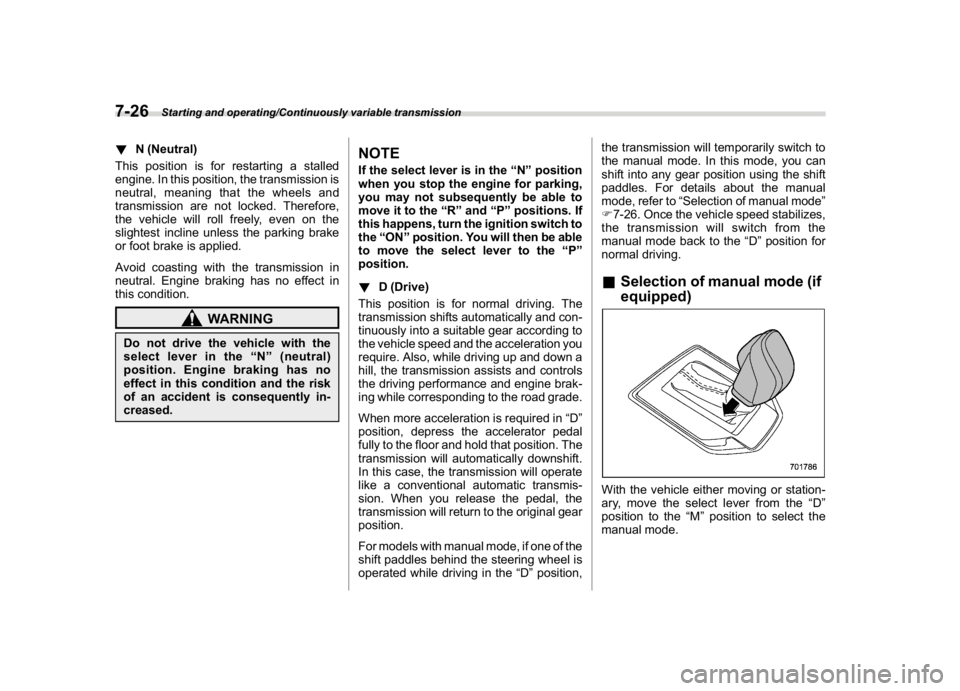
&Selection of manual mode (if
equipped)With the vehicle either moving or station-
ary, move the select lever from the“D”
position to the“M”position to select the
manual mode.
Starting and operating/Continuously variable transmission
7-26
Page 284 of 474
(293,1)
北米Model "A1320BE-C" EDITED: 2017/ 10/ 10
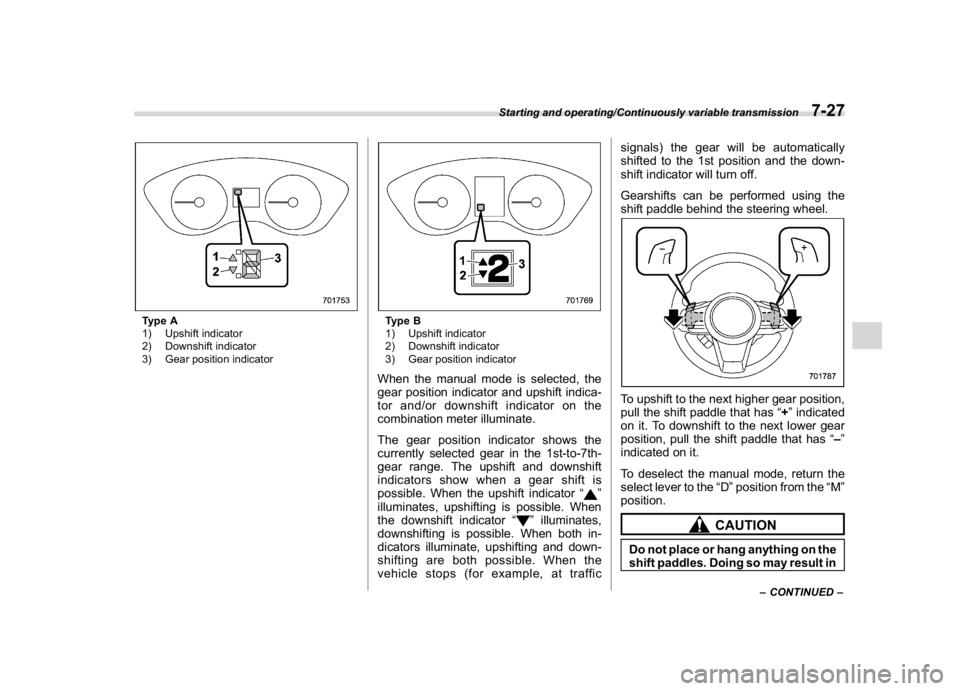
Type A
1) Upshift indicator
2) Downshift indicator
3) Gear position indicator
Type B
1) Upshift indicator
2) Downshift indicator
3) Gear position indicatorWhen the manual mode is selected, the
gear position indicator and upshift indica-
tor and/or downshift indicator on the
combination meter illuminate.
The gear position indicator shows the
currently selected gear in the 1st-to-7th-
gear range. The upshift and downshift
indicators show when a gear shift is
possible. When the upshift indicator“
”
illuminates, upshifting is possible. When
the downshift indicator“
”illuminates,
downshifting is possible. When both in-
dicators illuminate, upshifting and down-
shifting are both possible. When the
vehicle stops (for example, at trafficsignals) the gear will be automatically
shifted to the 1st position and the down-
shift indicator will turn off.
Gearshifts can be performed using the
shift paddle behind the steering wheel.
To upshift to the next higher gear position,
pull the shift paddle that has“+”indicated
on it. To downshift to the next lower gear
position, pull the shift paddle that has“–”
indicated on it.
To deselect the manual mode, return the
select lever to the“D”position from the“M”
position.
CAUTION
Do not place or hang anything on the
shift paddles. Doing so may result in
–CONTINUED–
Starting and operating/Continuously variable transmission
7-27
7
Page 285 of 474
(294,1)
北米Model "A1320BE-C" EDITED: 2017/ 10/ 10
accidental gear shifting.NOTEPlease read the following points care-
fully and bear them in mind when using
the manual mode.
.If you attempt to shift down when the
engine speed is too high, i.e., when a
downshift would push the tachometer
needle beyond the red zone, beeps will
be emitted to warn you that the down-
shift is not possible.
.If you attempt to shift up when the
vehicle speed is too low, the transmis-
sion will not respond.
.You can perform a skip-shift (for
example, from 4th to 2nd) by operating
the shift paddle twice in rapid succes-
sion.
.The transmission automatically se-
lects 1st gear when the vehicle stops
moving.
.If the temperature of the transmis-
sion fluid becomes too high, the“AT
OIL TEMP”warning light on the combi-
nation meter will illuminate. Immedi-
ately stop the vehicle in a safe location
and let the engine idle until the warning
light turns off.
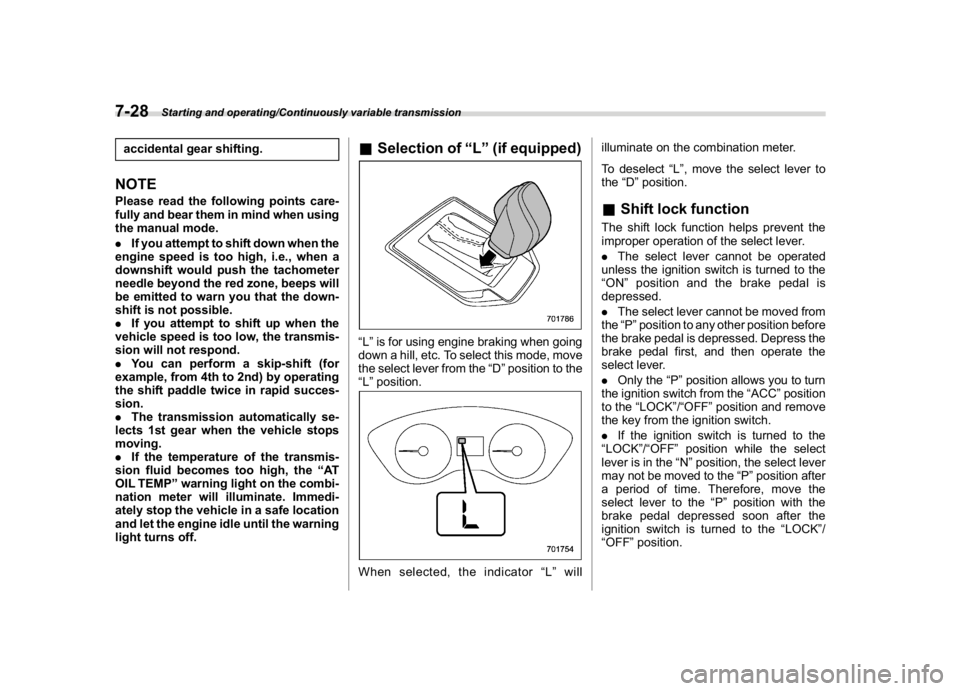
&Selection of“L”(if equipped)“L”is for using engine braking when going
down a hill, etc. To select this mode, move
the select lever from the“D”position to the
“L”position.When selected, the indicator“L”willilluminate on the combination meter.
To deselect“L”, move the select lever to
the“D”position.
&Shift lock functionThe shift lock function helps prevent the
improper operation of the select lever.
.The select lever cannot be operated
unless the ignition switch is turned to the
“ON”position and the brake pedal is
depressed.
.The select lever cannot be moved from
the“P”position to any other position before
the brake pedal is depressed. Depress the
brake pedal first, and then operate the
select lever.
.Only the“P”position allows you to turn
the ignition switch from the“ACC”position
to the“LOCK”/“OFF”position and remove
the key from the ignition switch.
.If the ignition switch is turned to the
“LOCK”/“OFF”position while the select
lever is in the“N”position, the select lever
may not be moved to the“P”position after
a period of time. Therefore, move the
select lever to the“P”position with the
brake pedal depressed soon after the
ignition switch is turned to the“LOCK”/
“OFF”position.
Starting and operating/Continuously variable transmission
7-28
Page 351 of 474
(362,1)
北米Model "A1320BE-C" EDITED: 2017/ 10/ 10
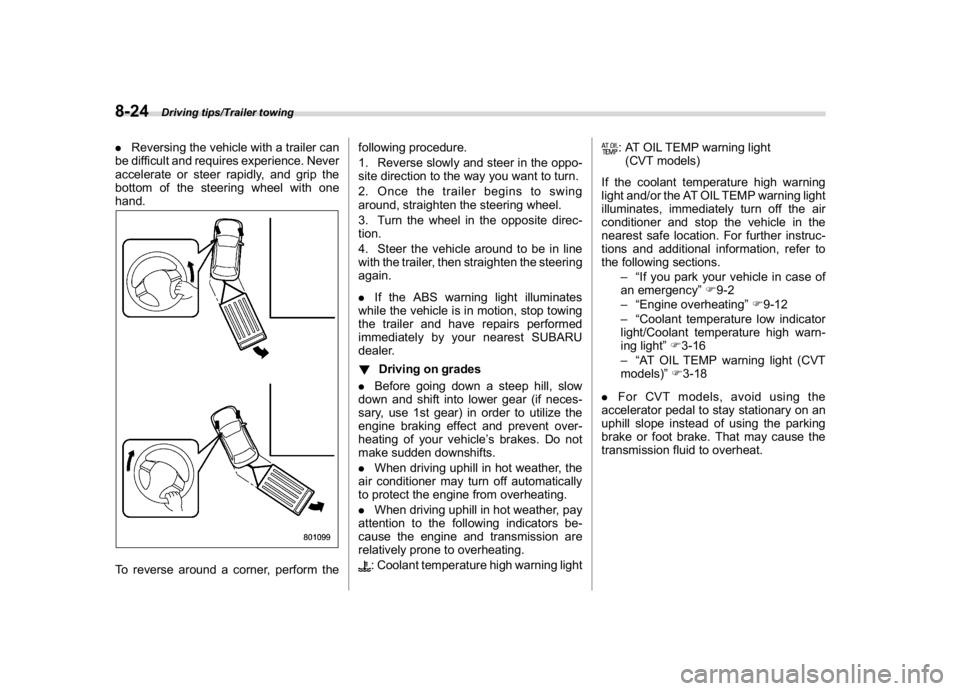
.Reversing the vehicle with a trailer can
be difficult and requires experience. Never
accelerate or steer rapidly, and grip the
bottom of the steering wheel with one
hand.To reverse around a corner, perform thefollowing procedure.
1. Reverse slowly and steer in the oppo-
site direction to the way you want to turn.
2. Once the trailer begins to swing
around, straighten the steering wheel.
3. Turn the wheel in the opposite direc-
tion.
4. Steer the vehicle around to be in line
with the trailer, then straighten the steering
again.
.If the ABS warning light illuminates
while the vehicle is in motion, stop towing
the trailer and have repairs performed
immediately by your nearest SUBARU
dealer.
!Driving on grades
.Before going down a steep hill, slow
down and shift into lower gear (if neces-
sary, use 1st gear) in order to utilize the
engine braking effect and prevent over-
heating of your vehicle’s brakes. Do not
make sudden downshifts.
.When driving uphill in hot weather, the
air conditioner may turn off automatically
to protect the engine from overheating.
.When driving uphill in hot weather, pay
attention to the following indicators be-
cause the engine and transmission are
relatively prone to overheating.
: Coolant temperature high warning light
: AT OIL TEMP warning light
(CVT models)
If the coolant temperature high warning
light and/or the AT OIL TEMP warning light
illuminates, immediately turn off the air
conditioner and stop the vehicle in the
nearest safe location. For further instruc-
tions and additional information, refer to
the following sections.
–“If you park your vehicle in case of
an emergency”F9-2
–“Engine overheating”F9-12
–“Coolant temperature low indicator
light/Coolant temperature high warn-
ing light”F3-16
–“AT OIL TEMP warning light (CVT
models)”F3-18
.For CVT models, avoid using the
accelerator pedal to stay stationary on an
uphill slope instead of using the parking
brake or foot brake. That may cause the
transmission fluid to overheat.
Driving tips/Trailer towing
8-24
Page 395 of 474

(408,1)
北米Model "A1320BE-C" EDITED: 2017/ 10/ 10
Spark plugsIt may be difficult to replace the spark
plugs. It is recommended that you have the
spark plugs replaced by your SUBARU
dealer.
The spark plugs should be replaced
according to the maintenance schedule
in the“Warranty and Maintenance Book-
let”.
CAUTION
Make sure the cables are replaced in
the correct order.&Recommended spark plugsFor the recommended spark plugs, refer to
“Electrical system”F12-8.
Drive beltsIt is unnecessary to check the deflection of
the drive belt periodically because your
engine is equipped with an automatic belt
tension adjuster. However, replacement of
the belt should be done according to the
maintenance schedule in the“Warranty
and Maintenance Booklet”. Consult your
SUBARU dealer for replacement.
If the drive belt is loose, cracked or worn,
contact your SUBARU dealer.
Manual transmission oilIt is not necessary to check the transmis-
sion oil level. Check that there are no
cracks, damage or leakage. However, the
oil inspection should be performed accord-
ing to the maintenance schedule in the
“Warranty and Maintenance Booklet”.
Consult your SUBARU dealer for details.&Recommended grade and
viscosityEach oil manufacturer has its own base
oils and additives. Never use different
brands together. For details, refer to
“Manual transmission, front differential
and rear differential gear oil”F12-6.
Maintenance and service/Spark plugs
11-14